Listen to this Post
Introduction:
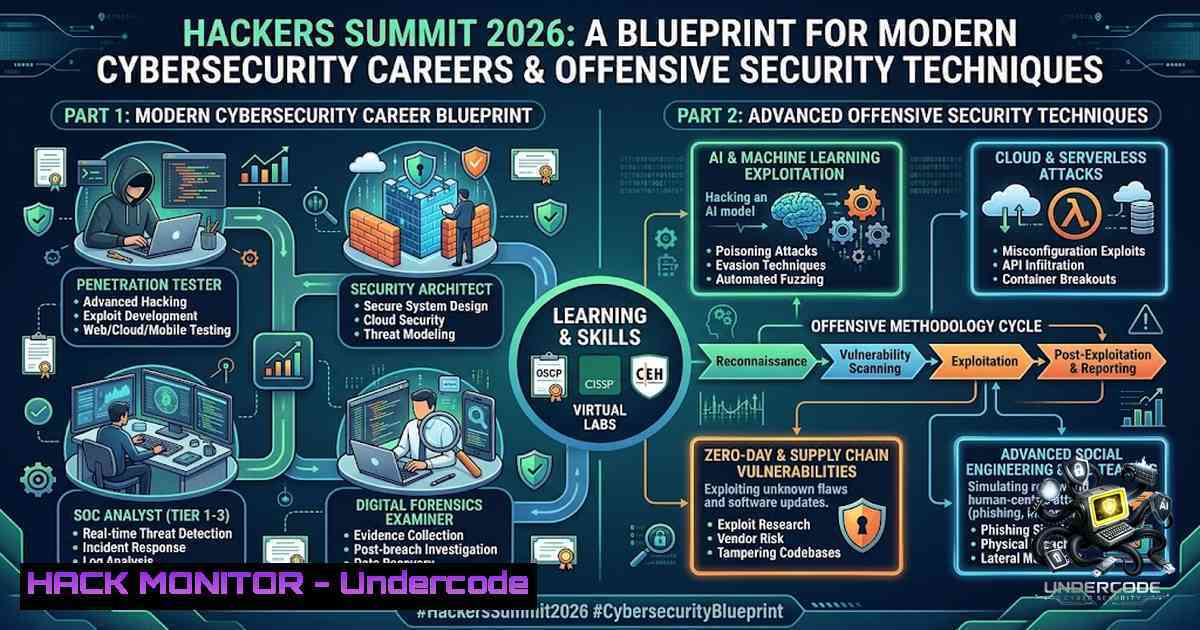
The cybersecurity landscape in 2026 is defined by the convergence of artificial intelligence, cloud-1ative architectures, and increasingly sophisticated attack surfaces. The Hackers Summit 2026 – Independence Day Special, hosted on 14 August 2026 by Cyber Community Pakistan, served as a critical knowledge-sharing platform for both aspiring and seasoned security professionals. As highlighted by attendee Ali Shaikh, the summit provided a comprehensive roadmap for entering the field, emphasizing that a strong grasp of Cybersecurity Fundamentals is the prerequisite before specializing in areas like Penetration Testing. This article distills the core technical themes from the summit—ranging from Web and Network Penetration Testing to AI-driven Bug Bounty and API Security—into actionable learning objectives, practical commands, and step-by-step guides for security practitioners.
Learning Objectives & Secrets:
- Objective 1: Master the Fundamentals of Web & Network Penetration Testing. Begin by understanding the OWASP Top 10 and core network scanning techniques. Secret Tip: On Hack The Box (HTB), leverage the new “Guided Mode” for structured learning—it provides specific tasks that walk you through exploitation steps, ensuring you grasp each technique before moving on.
- Objective 2: Integrate AI into Bug Bounty and Penetration Testing Workflows. AI is no longer optional. Secret Tip: Use LLM-powered tools like `Claude Code` with the `Caido AI Skill` to automate reconnaissance and request analysis, allowing you to focus on complex vulnerability chaining. For automated scanning, frameworks like `BugTraceAI-CLI` offer multi-agent vulnerability detection and validation.
- Objective 3: Secure Modern APIs with a “Shift-Left” Approach. Secret Tip: Most API vulnerabilities (like BOLA) are introduced during development, not deployment. Integrate security tools (SAST, DAST) directly into your CI/CD pipeline to catch issues before they reach production.
You Should Know:
- Web Penetration Testing & Red Teaming with Modern Tools
Web application and network penetration testing remains the cornerstone of offensive security. The 2026 toolkit has evolved, with AI-enhanced Command & Control (C2) platforms like Oktos leading the charge. Oktos is a modular, AI-augmented post-exploitation C2 platform that supports BOF (Beacon Object File) dynamic loading, multi-channel asynchronous communication, and memory-level evasion techniques. Its built-in AI assistant can autonomously plan attack paths and execute post-exploitation tasks.
For hands-on practice, Hack The Box remains indispensable. As of 2026, HTB has introduced exclusive machines that simulate real-world vulnerabilities, such as the “Trustful” machine, which features a vLLM Remote Code Execution (CVE-2026-22807) and a telnetd authentication bypass (CVE-2026-24061). Attackers exploit a public MinIO bucket in a CI/CD pipeline to upload a malicious model config, granting RCE within a Docker container, followed by a container breakout via a vulnerable Telnet server.
Step‑by‑Step Guide: Setting Up a Red Team Lab with Oktos (Linux)
1. Install Dependencies:
sudo apt update && sudo apt install -y git golang-go
2. Clone and Build Oktos:
git clone https://github.com/XRED-TEAM/oktos.git
cd oktos
make build
3. Start the Server:
./oktos-server
4. Generate a Beacon (Payload):
- Access the web interface at `https://localhost:8443`.
- Navigate to the “Beacon Builder” module.
- Select your target platform (e.g., Windows x64) and format (e.g., Shellcode).
- Generate the payload and deploy it on the target machine.
5. Establish Communication:
- The beacon will callback to the Oktos C2 server using HTTP(S) or an asynchronous cloud channel for stealth.
- Use the AI assistant to automate post-exploitation tasks like privilege escalation or lateral movement.
- API Security: Understanding and Mitigating the OWASP Top 10
APIs are the backbone of modern applications, making them a prime target for attackers. The OWASP API Security Top 10 (2023) remains the definitive framework in 2026. The most critical risk is API1:2023 – Broken Object Level Authorization (BOLA) , where an attacker manipulates an object ID to access unauthorized data. For example, changing `/api/v1/orders/1001` to `/1002` could expose another user’s order details.
Other critical risks include Broken Authentication (API2) and Broken Object Property Level Authorization (API3), which covers mass assignment and excessive data exposure. In 2026, the challenge is amplified by AI-generated code; research shows that 62% of code generated by the latest LLMs contains at least one exploitable vulnerability.
Step‑by‑Step Guide: Testing for BOLA using Burp Suite
- Intercept Requests: Configure Burp Suite as a proxy and capture an API request that fetches a resource using an ID (e.g.,
GET /api/v1/users/123). - Modify the ID: Send the request to Repeater and change the ID to another number (e.g.,
124). - Analyze Response: If the response returns data for user 124 without re-authenticating, the API is vulnerable to BOLA.
- Automate Testing: Use Burp Intruder to fuzz a range of IDs to identify all accessible resources.
- Mitigation (Code-First): Implement ownership checks on every backend request. Use UUIDs instead of sequential integers and enforce strict Role-Based Access Control (RBAC) on all endpoints.
-
AI & Bug Bounty: Automating Reconnaissance and Vulnerability Discovery
Artificial Intelligence is revolutionizing the bug bounty landscape. In 2026, LLMs are integral to the hunter’s workflow, assisting with reconnaissance, code review, and even report writing. Tools like the Pentest Agent Suite offer a fully automated bug bounty framework with 50 specialized security agents, 26 slash commands, and 19 CLI tools. It integrates with platforms like HackerOne, Bugcrowd, and Intigriti.
The suite features a “Seven-Question Validation Gate” where an AI validator rigorously checks each finding before submission, ensuring quality and reducing duplicates. As Aituglo, a full-time bug bounty hunter, notes, AI makes it easier to find bugs, but it also increases competition, making it crucial to maintain creative thinking and not rely solely on automation.
Step‑by‑Step Guide: Using AI for Automated Bug Bounty Recon
1. Install Pentest Agent Suite:
git clone https://github.com/H-mmer/pentest-agent-suite.git
cd pentest-agent-suite
python3 -m tools.installer
2. Configure API Keys: Add your API keys for HackerOne, Bugcrowd, etc., to the `.env` file.
3. Run Autopilot Mode:
/autopilot --target example.com --paranoid
– The `–paranoid` flag enables deep scanning with multi-layered payload encoding.
4. Review Findings: The AI will generate a report with validated vulnerabilities and proofs-of-concept.
5. Manual Verification: Always manually verify AI-discovered vulnerabilities to ensure accuracy and understand the exploit chain.
- Wi-Fi Penetration Testing: Capturing and Cracking WPA2 Handshakes
Wireless network security remains a critical domain. Tools like the `aircrack-1g` suite are essential for auditing Wi-Fi networks. The process involves capturing a WPA2 handshake and then cracking the password using a dictionary or brute-force attack.
Step‑by‑Step Guide: WPA2 Handshake Capture and Cracking (Kali Linux)
1. Enable Monitor Mode:
sudo airmon-1g start wlan0
– This creates a new interface, typically wlan0mon.
2. Scan for Access Points:
sudo airodump-1g wlan0mon
– Note the BSSID (MAC address) and channel of the target AP.
3. Capture Handshake:
sudo airodump-1g -c [bash] --bssid [bash] -w capture wlan0mon
4. Deauthenticate a Client (Optional):
- To force a handshake, send deauth packets to a connected client.
sudo aireplay-1g -0 2 -a [bash] -c [Client MAC] wlan0mon
5. Crack the Handshake:
aircrack-1g -w /usr/share/wordlists/rockyou.txt capture-01.cap
- Cybersecurity Career Roadmap: From SOC Analyst to Penetration Tester
The 2026 cybersecurity career landscape offers diverse pathways. The most common entry point is the Security Operations Center (SOC) Analyst role, which focuses on threat detection, log analysis, and incident response. From there, professionals can specialize in Penetration Testing/Red Teaming, where the average salary ranges from $115,000 to $203,000 per year.
A structured roadmap involves:
- Foundation: Networking, Operating Systems (Linux/Windows), and Programming (Python/Bash).
- Fundamentals: CompTIA Security+ certification and hands-on labs (TryHackMe, HTB).
- Specialization: Choose a path—SOC Analyst (focus on SIEM tools like Splunk) or Penetration Tester (focus on tools like Metasploit, Burp Suite, and custom scripting).
- Emerging Areas: Cloud Security, AI Security, and API Security are high-growth areas in 2026.
What Undercode Say:
- Key Takeaway 1: The foundation of a cybersecurity career lies in mastering core fundamentals before specializing. The Hackers Summit 2026 reinforced that a clear roadmap—starting with Cybersecurity Fundamentals and progressing to Penetration Testing—is essential for long-term success.
- Key Takeaway 2: AI is not a replacement for human expertise but a powerful force multiplier. Whether in bug bounty, red teaming, or API security, leveraging AI for automation and reconnaissance allows professionals to focus on complex, creative problem-solving.
- Analysis: The 2026 cybersecurity landscape is characterized by rapid technological advancement and an expanding attack surface. Aspiring professionals must adopt a continuous learning mindset, embracing both offensive and defensive techniques. The integration of AI into security tools demands a new skill set—knowing how to effectively use and validate AI-generated findings. Events like Hackers Summit 2026 are invaluable for networking, staying updated on industry trends, and gaining mentorship from experienced practitioners. The key to success lies in balancing technical proficiency with critical thinking and ethical judgment.
Prediction:
- +1 The democratization of AI-powered security tools will lower the barrier to entry for aspiring cybersecurity professionals, leading to a larger, more diverse talent pool.
- +1 The emphasis on “shift-left” security and API security will drive the adoption of DevSecOps practices, resulting in more resilient and secure software development lifecycles.
- -1 The increasing use of AI by both attackers and defenders will lead to an “AI arms race,” where the speed of attack and defense outpaces traditional security controls, necessitating continuous innovation.
- -1 The automation of bug bounty hunting may lead to market saturation, making it harder for individual hunters to stand out and potentially reducing the effectiveness of crowdsourced security programs if human intuition is deprioritized.
▶️ Related Video (82% Match):
🎯Let’s Practice For Free:
🎓 Live Courses & Certifications:
Join Undercode Academy for Verified Certifications
🚀 Request a Custom Project:
Secure, high-velocity infrastructure and disruptive technological engineering. Contact our engineering team for high-tier development and proprietary systems:
[email protected]
💎 Smart Architecture | 🛡️ Secure by Design | ⭐ Trusted by Thousands
IT/Security Reporter URL:
Reported By: https://lnkd.in/p/eTtKwUHg – Hackers Feeds
Extra Hub: Undercode MoN
Basic Verification: Pass ✅


