Listen to this Post
Introduction:
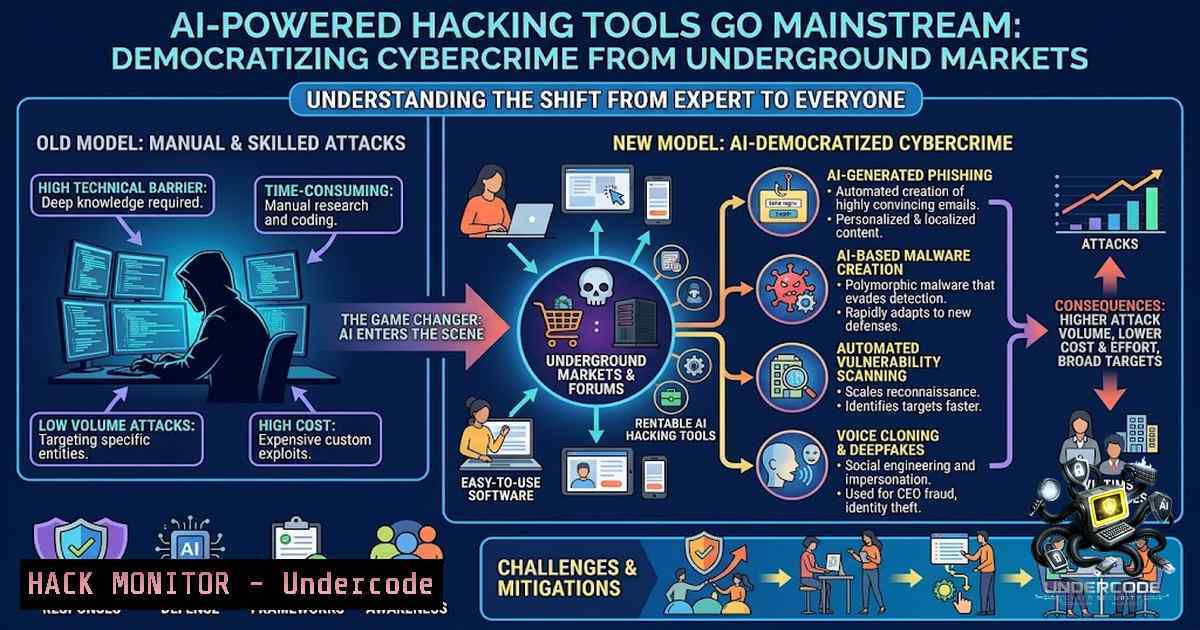
The commoditization of artificial intelligence has reached a dangerous new frontier: underground cybercrime forums. Researchers from Akamai Technologies and Trellix have documented a profound shift in 2026—AI-powered hacking tools are now systematically advertised and sold on dark web marketplaces, transforming complex attack capabilities into low-cost, subscription-based commodities accessible even to novice threat actors. This commercialization of offensive AI, coupled with emerging AI-specific attack vectors that bypass traditional perimeter defenses, marks a critical tipping point that demands an urgent reassessment of enterprise security architectures. What was once the domain of nation-state actors and elite hackers has become a pay-per-use service available to anyone with cryptocurrency and a Telegram account.
Learning Objectives & Secrets:
- Objective 1: Understand the three emerging AI attack vectors. Master the mechanisms of Vibe Hacking (manipulating local Markdown instruction files to deceive AI coding assistants), CursorJacking (malicious browser extensions harvesting API keys and code repositories), and CometJacking (indirect prompt injection on public webpages to hijack agentic browsers).
-
Objective 2 Secret Tip: Identify “shadow AI” power users. Security teams often overlook that just 5% of high-risk employees generate the vast majority of interactive AI prompts within an organization. Focusing telemetry and governance on this cohort can eliminate up to 80% of shadow AI risk.
-
Objective 3 Secret Tip: Treat browser extensions as privileged software. Nearly 75% of AI browser extensions require high or critical permissions, with 16.3% containing known vulnerabilities. Subjecting these extensions to the same rigorous scrutiny as endpoint security tools is no longer optional—it is foundational.
You Should Know:
- The Underground AI Marketplace: From WormGPT to MessiahGPT
The commoditization of offensive AI has accelerated dramatically since 2023. Early malicious LLMs like WormGPT and FraudGPT—priced at up to $1,700 annually for malware and phishing generation—have evolved into sophisticated, specialized criminal platforms. In August 2026, Trellix researchers identified MessiahGPT, an unrestricted AI service openly advertised on BreachForums capable of generating ransomware, rootkits, crypters, credential stealers, and phishing templates on demand.
What distinguishes MessiahGPT is its commercial SaaS model: subscriptions starting at approximately $8 per month via cryptocurrency, 50 free queries without registration, and a dedicated Telegram community. The platform’s operators claim the model was trained from scratch exclusively on dark web archives, leaked documents, and raw internet data—deliberately omitting RLHF or constitutional AI safeguards.
The scale of this market is staggering. Trellix observed a 3,810% surge in underground forum posts mentioning AI tools—from 38 in December 2025 to 1,486 in February 2026. These offerings fall into four distinct categories: weaponized LLMs (dark LLMs without safety guardrails), AI-enabled identity fraud (deepfakes for KYC bypass), AI-augmented malware infrastructure, and jailbroken/stolen AI services—with hacked AI accounts being the largest and cheapest category.
Step-by-Step Guide: Monitoring Underground AI Threat Intelligence
To detect and track emerging AI-powered threats targeting your organization:
Linux – Monitor for suspicious outbound connections to known malicious IPs:
 Monitor established outbound connections to suspicious IP ranges
sudo ss -tunp | grep ESTAB | awk '{print $5}' | cut -d: -f1 | sort | uniq -c | sort -1r

Check for unusual outbound traffic patterns
sudo tcpdump -i eth0 -1 'tcp[bash] & (tcp-syn) != 0' | awk '{print $3}' | sort | uniq -c | sort -1r

Monitor auth logs for brute force attempts (potential AI-assisted reconnaissance)
sudo grep "Failed password" /var/log/auth.log | awk '{print $9}' | sort | uniq -c | sort -1r
Windows PowerShell – Detect suspicious network activity:
 Identify established outbound connections to suspicious IP addresses
Get-1etTCPConnection | Where-Object {$_.State -eq "Established"} | Select-Object LocalAddress, LocalPort, RemoteAddress, RemotePort, OwningProcess

Check for unusual processes making outbound connections
Get-1etTCPConnection | Where-Object {$_.State -eq "Established"} | Group-Object OwningProcess | Select-Object Count, Name | Sort-Object Count -Descending

Monitor for suspicious scheduled tasks (common AI malware persistence)
Get-ScheduledTask | Where-Object {$_.State -1e "Disabled"} | Select-Object TaskName, State, Actions
2. Vibe Hacking: Manipulating the Developer’s Trusted Assistant
Akamai’s 2026 Enterprise AI Usage Risk Report identified Vibe Hacking as a particularly insidious attack vector. Attackers secretly tamper with local Markdown instruction files (.md, .mdc) within a developer’s environment—files that AI coding assistants like Cursor use to understand project context. These subtle modifications cause the AI to generate vulnerable code or execute attacker-directed tasks, all while appearing as normal workflow behavior to the developer.
The attack succeeds because developers implicitly trust their AI coding tools. A malicious instruction file might insert a backdoor into authentication logic, inject SQL injection vulnerabilities, or exfiltrate API keys through seemingly legitimate code patterns. The compromised code then passes peer review and enters production, creating a supply-chain compromise that is extremely difficult to detect through traditional code review processes.
Step-by-Step Guide: Detecting and Mitigating Vibe Hacking
Step 1: Audit local instruction files. Identify all .md, .mdc, and configuration files that AI coding tools reference in your development environment.
Step 2: Implement file integrity monitoring. Use `fschange` (Linux) or PowerShell’s `FileSystemWatcher` (Windows) to alert on unauthorized modifications to these files.
Linux – File integrity monitoring with AIDE:
 Install AIDE (Advanced Intrusion Detection Environment)
sudo apt-get install aide  Debian/Ubuntu
sudo yum install aide  RHEL/CentOS

Initialize AIDE database
sudo aideinit

Check for unauthorized file modifications (run daily)
sudo aide --check

Monitor specific AI instruction file directories
sudo aide --config=/etc/aide/aide.conf --check | grep -E ".md|.mdc|.json"
Windows – File integrity monitoring with PowerShell:
 Create a file watcher for AI instruction file directories
$watcher = New-Object System.IO.FileSystemWatcher
$watcher.Path = "C:\Users\Documents\AI-Configs"
$watcher.Filter = ".md"
$watcher.EnableRaisingEvents = $true

Register event for file changes
Register-ObjectEvent $watcher "Changed" -Action {
$path = $Event.SourceEventArgs.FullPath
$changeType = $Event.SourceEventArgs.ChangeType
Write-Host "ALERT: File $path was $changeType at $(Get-Date)"
 Log to security event log
Write-EventLog -LogName Security -Source "FileIntegrity" -EntryType Warning -EventId 4625 -Message "File modification detected: $path"
}
Step 3: Implement code review gates. Require manual review of all AI-generated code before commit. Use pre-commit hooks to scan for suspicious patterns:
 Git pre-commit hook to scan for suspicious code patterns
!/bin/bash
 .git/hooks/pre-commit

Scan for common backdoor patterns
if grep -r "eval(" --include=".py" --include=".js" | grep -v "test"; then
echo "WARNING: Potential code injection pattern detected in AI-generated code"
exit 1
fi

Scan for hardcoded credentials
if grep -r "API_KEY|SECRET|PASSWORD" --include=".py" --include=".js" --include=".env"; then
echo "WARNING: Potential hardcoded credentials detected"
exit 1
fi
- CursorJacking and CometJacking: The Browser as an Attack Surface
Akamai identified two additional AI-driven attack techniques: CursorJacking and CometJacking. CursorJacking uses malicious browser extensions to stealthily collect sensitive data—including API keys, source code, and conversation logs—accessed by popular AI coding tools like Cursor. With nearly 75% of AI browser extensions requiring high or critical permissions and 16.3% containing known vulnerabilities, this attack vector represents a massive and largely unaddressed risk surface.
CometJacking takes this further by hiding malicious commands on public webpages to manipulate AI agents, leaking users’ files, emails, and login credentials. It specifically targets agent-based browsers like Perplexity’s Comet AI, where autonomous agents interact with web content and execute actions based on what they “read”.
Step-by-Step Guide: Securing AI Browser Extensions and Agentic Workflows
Step 1: Audit all browser extensions. Inventory every extension installed across your organization, with special focus on AI-powered tools.
Step 2: Enforce least-privilege permissions. Block extensions that request excessive permissions (e.g., “read and change all data on websites,” “access browsing history”).
Step 3: Monitor extension behavior. Use browser management policies to control which extensions can be installed.
Chrome Enterprise – Extension management policy (Windows Registry):
 Block unauthorized extensions
[HKEY_LOCAL_MACHINE\SOFTWARE\Policies\Google\Chrome\ExtensionInstallBlocklist]
"1"=""

Allow only approved extensions
[HKEY_LOCAL_MACHINE\SOFTWARE\Policies\Google\Chrome\ExtensionInstallAllowlist]
"1"="{extension-id-1}"
"2"="{extension-id-2}"
Step 4: Detect CursorJacking through network monitoring. Monitor for unusual API key exfiltration patterns:
 Linux - Monitor for suspicious outbound traffic to unknown domains
sudo tcpdump -i eth0 -1 'tcp port 443' | grep -E "api.|key|token|secret" | awk '{print $3}' | sort | uniq -c | sort -1r

Monitor DNS queries for suspicious domains (potential C2)
sudo tcpdump -i eth0 -1 'udp port 53' | grep -E ".top|.xyz|.click|.loan" | awk '{print $NF}' | sort | uniq -c | sort -1r
Windows – Monitor for API key exfiltration via PowerShell:
 Monitor for processes accessing sensitive files (API keys, .env files)
Get-Process | ForEach-Object {
$proc = $_
$files = Get-Process -Id $proc.Id -Module 2>$null | Where-Object {$_.FileName -match ".env|api_key|secret"}
if ($files) {
Write-Host "WARNING: Process $($proc.ProcessName) accessed sensitive file: $($files.FileName)"
}
}

Monitor network connections from browser processes
Get-1etTCPConnection | Where-Object {
$_.OwningProcess -in (Get-Process -1ame chrome, edge, firefox | Select-Object -ExpandProperty Id)
} | Select-Object LocalAddress, LocalPort, RemoteAddress, RemotePort, State
4. APEX AI: Nation-State Grade Attacks for Beginners
A particularly concerning development is APEX AI, offered by an underground forum user named Shadowx007. Users simply input a target domain, and the service provides a complete attack plan with step-by-step instructions for ransomware deployment. This means individuals with limited technical knowledge can execute complex attacks that previously required APT-level expertise.
The rise of such tools directly correlates with ransomware attacks growing by 20% since 2023, with an increased focus on targeting smaller enterprises, which now comprise 80% of attacks. Modern ransomware operators no longer need to build operations from scratch—they purchase turnkey solutions through multiple channels with tiered pricing and freemium models, all automated through Telegram bot-driven sales and marketing.
Step-by-Step Guide: Defending Against AI-Assisted Reconnaissance and Attack Planning
Step 1: Implement domain monitoring and threat intelligence feeds to detect reconnaissance attempts before they escalate.
Step 2: Deploy deception technologies like honeypots and decoy assets to identify and track automated reconnaissance patterns typical of AI scanning tools.
Step 3: Configure network segmentation to limit lateral movement even if attackers gain initial access through AI-generated attack vectors.
Linux – Detect port scanning and reconnaissance:
 Monitor for unusual port scanning patterns (AI-assisted reconnaissance)
sudo tcpdump -i eth0 'tcp[bash] & (tcp-syn) != 0' | awk '{print $3}' | sort | uniq -c | sort -1r | head -20

Detect SYN flood attempts (potential DoS preparation)
sudo tcpdump -i eth0 'tcp[bash] & (tcp-syn) != 0 and tcp[bash] & (tcp-ack) == 0' | awk '{print $3}' | sort | uniq -c | sort -1r

Monitor for unusual ICMP traffic (network mapping)
sudo tcpdump -i eth0 'icmp[bash] == icmp-echo' | awk '{print $3}' | sort | uniq -c | sort -1r
Windows – Detect reconnaissance via PowerShell:
 Monitor for port scanning attempts (Event ID 5156 - Windows Filtering Platform connection)
Get-EventLog -LogName Security -InstanceId 5156 -After (Get-Date).AddHours(-24) |
Where-Object {$<em>.Message -match "Direction: Inbound"} |
Group-Object {$</em>.ReplacementStrings[bash]} |
Sort-Object Count -Descending |
Select-Object Count, Name

Monitor for failed login attempts (potential AI-assisted brute force)
Get-EventLog -LogName Security -InstanceId 4625 -After (Get-Date).AddHours(-24) |
Group-Object {$_.ReplacementStrings[bash]} |
Sort-Object Count -Descending |
Select-Object Count, Name
Network segmentation configuration (Cisco ACL example):
! Limit lateral movement by segmenting critical assets
access-list 100 deny ip any 10.0.0.0 0.255.255.255
access-list 100 deny ip any 172.16.0.0 0.15.255.255
access-list 100 deny ip any 192.168.0.0 0.0.255.255
access-list 100 permit ip any any

! Apply to critical server VLAN interface
interface GigabitEthernet0/0.10
description CRITICAL-SERVERS-VLAN
ip access-group 100 in
- The API Security Crisis: AI’s New Attack Surface
Akamai’s 2025 Year in Review report revealed that attackers have transformed AI from an experimental tool into a mature offensive weapon, targeting the digital backbone of enterprises—APIs—with unprecedented audacity. In 2024, Akamai observed over 311 billion attacks against web applications and APIs, a 33% year-over-year increase. API security vulnerabilities cost global enterprises an estimated $87 billion annually, with projections exceeding $100 billion in 2026.
The convergence of AI-powered attacks and API vulnerabilities creates a perfect storm. AI-driven malicious bot traffic surged 300% in the past year, with bots mimicking real user behavior to evade detection. Attackers now automate the entire kill chain—from intelligence gathering and targeted phishing content generation to malware that adapts in real-time to defensive responses.
Step-by-Step Guide: Hardening API Security Against AI-Powered Attacks
Step 1: Conduct comprehensive API inventory. Identify all APIs, including “zombie APIs” (forgotten, unpatched) and “shadow APIs” (unmonitored) that represent critical backdoors.
Step 2: Implement API rate limiting and anomaly detection to identify AI-driven automated attacks.
Step 3: Deploy LLM-specific firewalls to defend against prompt injection and data poisoning attacks.
Nginx rate limiting configuration (protect APIs from AI-driven brute force):
 /etc/nginx/nginx.conf
limit_req_zone $binary_remote_addr zone=api_limit:10m rate=10r/s;
limit_conn_zone $binary_remote_addr zone=addr:10m;

server {
location /api/ {
 Rate limit requests
limit_req zone=api_limit burst=20 nodelay;
limit_conn addr 10;

Block suspicious user agents (AI scrapers)
if ($http_user_agent ~ (python|curl|wget|scrapy|bot|spider|crawler)) {
return 403;
}

Log API requests for analysis
access_log /var/log/nginx/api_access.log;
}
}
API Gateway configuration (Kong/KrakenD example):
 API rate limiting with anomaly detection
plugins:
- name: rate-limiting
config:
minute: 100
hour: 1000
policy: local
- name: bot-detection
config:
allow:
- "Googlebot"
- "Bingbot"
deny:
- ".python."
- ".curl."
- name: request-transformer
config:
add:
headers:
- "X-API-Security: enabled"
Linux – Monitor API abuse patterns:
 Monitor API endpoint access patterns for anomalies
sudo tail -f /var/log/nginx/api_access.log | awk '{print $1, $7}' | sort | uniq -c | sort -1r | head -20

Detect API scraping patterns (high request volume from single IP)
sudo grep "POST /api/" /var/log/nginx/access.log | awk '{print $1}' | sort | uniq -c | sort -1r | head -10

Monitor for SQL injection attempts (common AI-generated payloads)
sudo grep -E "(\%27)|(\')|(--)|(\%23)|()" /var/log/nginx/access.log | grep "api"
Windows – Monitor API abuse via IIS logs:
 Analyze IIS logs for API abuse patterns
$logs = Get-ChildItem "C:\inetpub\logs\LogFiles\W3SVC1" -Filter ".log"
foreach ($log in $logs) {
Get-Content $log.FullName |
Where-Object {$_ -match "/api/"} |
ForEach-Object {
$fields = $_ -split " "
[bash]@{
IP = $fields[bash]
Method = $fields[bash]
URI = $fields[bash]
Status = $fields[bash]
}
} |
Group-Object IP |
Sort-Object Count -Descending |
Select-Object Count, Name
}
6. The AI Token Jacking Threat: Stolen AI-as-a-Service
A rapidly growing financial cybercrime model called “AI token jacking” has emerged, where attackers steal API keys from popular AI platforms and resell the computing power. This represents a new twist on the AI commoditization trend: not only are attackers using AI to hack, but they are also hacking AI itself as a business model.
The stolen credentials are sold through Telegram channels and underground forums, often at fractions of the original service cost. This allows even low-skill attackers to access premium AI capabilities for reconnaissance, code generation, and attack automation—creating a self-reinforcing cycle where stolen AI power fuels more sophisticated attacks that steal more AI credentials.
Step-by-Step Guide: Securing AI API Keys and Preventing Token Jacking
Step 1: Implement API key rotation. Rotate all AI platform API keys regularly (minimum every 90 days).
Step 2: Enforce IP whitelisting. Restrict AI API access to known corporate IP ranges.
Step 3: Monitor for anomalous API usage patterns. Unusual query volumes, geographic anomalies, or suspicious prompt patterns may indicate token theft.
AWS Secrets Manager – Secure API key rotation:
 Rotate secret using AWS CLI
aws secretsmanager rotate-secret --secret-id ai-api-key --rotation-rules AutomaticallyAfterDays=90

Monitor secret access attempts
aws cloudtrail lookup-events --lookup-attributes AttributeKey=EventName,AttributeValue=GetSecretValue --start-time $(date -d '7 days ago' +%s)
Azure Key Vault – Monitor API key access:
 Monitor Key Vault access logs
$date = (Get-Date).AddDays(-7)
Get-AzActivityLog -StartTime $date |
Where-Object {$_.OperationName -eq "Microsoft.KeyVault/vaults/secrets/read"} |
Select-Object EventName, Caller, TimeStamp, ResourceId

Implement key rotation policy
$secret = Get-AzKeyVaultSecret -VaultName "ai-key-vault" -1ame "api-key"
$newSecret = Set-AzKeyVaultSecret -VaultName "ai-key-vault" -1ame "api-key" -SecretValue (ConvertTo-SecureString -String (New-Guid).Guid -AsPlainText -Force)
GCP Secret Manager – Prevent token jacking:
 Enable audit logging for secret access
gcloud services enable cloudaudit.googleapis.com

Monitor secret access patterns
gcloud logging read "resource.type=secretmanager.googleapis.com/Secret AND protoPayload.methodName=google.cloud.secretmanager.v1.SecretManagerService.AccessSecretVersion" --freshness=7d

Implement automatic rotation
gcloud secrets versions add ai-api-key --data-file=new-key.txt
gcloud secrets versions destroy previous-version --secret=ai-api-key
Linux – Monitor for API key exfiltration attempts:
 Monitor outbound traffic for patterns matching API keys (regex pattern matching)
sudo tcpdump -i eth0 -1 -A 'tcp port 443' | grep -E "api_key=|token=|secret=|Authorization: Bearer" | tee -a /var/log/api_key_exfil.log

Monitor process memory for API key strings (potential credential dumping)
sudo grep -r "sk-" /proc//maps 2>/dev/null | head -20

Monitor for unexpected curl/wget requests to AI APIs
sudo auditctl -a always,exit -F arch=b64 -S execve -F a0=curl -k process_watch
What Undercode Say:
- Key Takeaway 1: The democratization of offensive AI through underground marketplaces has fundamentally lowered the barrier to entry for cybercrime. Tools like APEX AI, MessiahGPT, and WormGPT 4 now enable novice attackers to execute sophisticated attacks that previously required APT-level expertise. The 3,810% surge in AI tool mentions on underground forums is not hype—it represents a market forming in real time.
-
Key Takeaway 2: Organizations must shift from simply blocking AI to continuously controlling and managing its operations at the interaction layer. Legacy DLP tools designed for file transfers and emails are inadequate for an era where sensitive data is systematically fragmented across millions of dynamic prompts, unmanaged personal accounts, and autonomous AI agents. The focus must be on identifying high-risk “shadow AI” power users (the 5% generating most prompts), hardening browser extensions with the same rigor as endpoint security, and implementing file integrity monitoring for AI instruction files.
Analysis:
The findings from Akamai, Trellix, and Halcyon paint a clear picture: offensive AI has moved from experimental concept to commercial reality. The ransomware ecosystem has grown by 20% since 2023, with 80% of attacks now targeting smaller enterprises. Criminal operators have adopted vendor-like business models with tiered pricing, freemium offerings, and Telegram-based customer support. Even more concerning, criminal OpSec remains weak—black hats are attacking each other, with credentials from one WormGPT instance stolen by another criminal operator. This chaotic environment creates both risk and opportunity: defenders can exploit the fragmentation of the criminal marketplace while simultaneously preparing for AI-1ative attacks that compress response timelines from days to hours. The 300% surge in AI-driven malicious bot traffic and 33% increase in API attacks demonstrate that adversaries are weaponizing AI at scale.
Prediction:
- +1 AI-powered autonomous attack agents will compress exploitation timelines from weeks to hours by 2027. HexStrike AI already demonstrates how LLMs can weaponize zero-day vulnerabilities within hours of public disclosure. Organizations must prepare for attacks that evolve faster than human response cycles.
-
-1 The 80% ransomware attack rate on smaller enterprises will increase as AI tools continue lowering the barrier to entry. Small and medium businesses lack the security resources to defend against AI-generated attacks, making them prime targets for automated ransomware campaigns.
-
+1 AI token jacking will emerge as a major financial cybercrime vector, with stolen API credentials becoming a primary currency on underground markets. This will drive innovation in API security and credential management, potentially creating new defensive technologies.
-
-1 Vibe Hacking and CursorJacking will cause significant supply-chain compromises in 2026-2027. As AI coding tools become ubiquitous, malicious instruction file tampering will introduce vulnerabilities that pass peer review and enter production codebases undetected.
-
+1 The criminal AI marketplace’s inherent fragmentation and OpSec weaknesses (black hats attacking each other) will create intelligence opportunities for defenders. Organizations that invest in dark web monitoring and threat intelligence will gain early warning of emerging attack techniques.
▶️ Related Video (86% Match):
https://www.youtube.com/watch?v=-um9zKf1V30
🎯Let’s Practice For Free:
🎓 Live Courses & Certifications:
Join Undercode Academy for Verified Certifications
🚀 Request a Custom Project:
Secure, high-velocity infrastructure and disruptive technological engineering. Contact our engineering team for high-tier development and proprietary systems:
[email protected]
💎 Smart Architecture | 🛡️ Secure by Design | ⭐ Trusted by Thousands
IT/Security Reporter URL:
Reported By: https://lnkd.in/p/eTWZSMSb – Hackers Feeds
Extra Hub: Undercode MoN
Basic Verification: Pass ✅


