
Listen to this Post
Introduction:
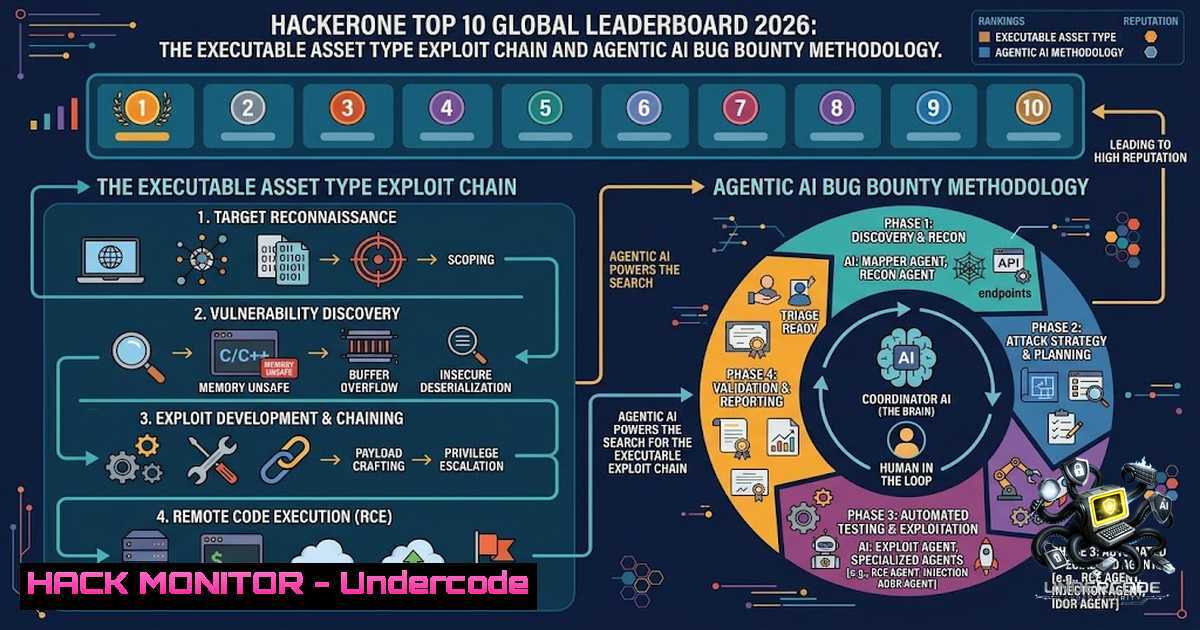
The modern bug bounty landscape is defined not just by individual critical vulnerabilities, but by the ability to chain low-severity weaknesses into high-impact exploit paths. Seth Kraft’s recent ascension to the Top 10 Global Leaderboard for the Executable Asset Type on HackerOne highlights a paradigm shift where success is driven by creativity, strict documentation, and the strategic integration of agentic AI workflows. His methodology underscores a move away from basic automation to a more structured, intelligence-driven hunting process, focusing on the often-overlooked execution vectors within binary and application environments.
Learning Objectives & Secrets:
- Objective 1: Master the art of executable asset hunting by focusing on runtime behavior and memory corruption primitives rather than just static analysis.
- Objective 2 (Secret Tip): Exhaust the CWE (Common Weakness Enumeration) catalog by mapping specific CWEs to distinct runtime signals, ensuring no attack vector (from buffer overflows to race conditions) is left unchecked.
- Objective 3 (Secret Tip): Implement Agentic AI workflows with strict validation layers to automate payload generation while maintaining human oversight to prevent false positives and irrelevant noise.
You Should Know:
- The Executable Asset Type: Understanding the Attack Surface
The “Executable Asset Type” refers to targets involving compiled binaries, services, and firmware where the attack surface exists at the machine-code level. Unlike web applications, these assets require deep understanding of memory management, system calls, and CPU architecture. Seth Kraft’s success emphasizes a multi-faceted approach: Static analysis to find logic flaws, Dynamic analysis to trigger heap overflows, and Fuzzing to discover edge-case crashes.
Step‑by‑step guide:
- Step 1: Reconnaissance. Use `file` and `strings` to identify binary type and embedded artifacts. On Linux: `file /usr/local/bin/target_service` and
strings target_binary | grep -i "version\|key". - Step 2: Static Analysis. Disassemble using Ghidra or radare2. Look for dangerous functions like
gets,strcpy, orsystem(). Set breakpoints. - Step 3: Fuzzing Setup. Use AFL++ to target a network service. Command:
afl-fuzz -i input_seeds/ -o findings/ -m none -- ./target_binary @@. - Step 4: Crash Triage. Use `gdb` to parse core dumps. Command: `gdb ./target_binary core` followed by `bt` to analyze the stack trace.
- Exhausting the CWE Catalog: A Structured Hunting Methodology
The “Exhaust the entire CWE catalog” tip is a strategic approach to ensure comprehensive coverage. Rather than relying on low-hanging fruit, hunters map their testing to specific weakness categories. This forces the tester to simulate injection attacks (CWE-89), memory leaks (CWE-404), and logic flaws (CWE-20) systematically. It requires a dynamic checklist that evolves with the application’s architecture.
Step‑by‑step guide:
- Step 1: Map the Target. Identify the primary function of the binary. Is it a web server, a library, or a system driver?
- Step 2: Prioritize CWEs. Filter vulnerabilities relevant to “Executable Assets” (e.g., CWE-119, CWE-122, CWE-190).
- Step 3: Develop Test Harnesses. Write small test scripts to validate each category.
- Step 4: Document the Methodology. Use a structured format to record the state of each vulnerability type. This will prevent duplicate effort and ensure comprehensive coverage.
3. Chaining Signals for Maximum Impact
Chaining signals involves combining a low-severity information disclosure with a medium-severity local privilege escalation to generate a critical exploit. This is the secret to high-impact reports. For example, a memory leak revealing a stack cookie (CWE-665) can be combined with a buffer overflow (CWE-120) to bypass ASLR and achieve RCE (Remote Code Execution).
Step‑by‑step guide:
- Step 1: Identify Low-Level Primitives. Look for read-what-where conditions.
- Step 2: Build a Chain Roadmap. Map out how primitive A (e.g., infoleak) enables primitive B (e.g., arbitrary write).
- Step 3: Practice in Lab. Set up a test environment with similar hardening features (ASLR, DEP, NX).
- Step 4: Validate the Chain. Ensure the exploit is reliable and does not crash the target prematurely.
4. Agentic AI Workflows in Cybersecurity
Incorporating “agentic AI” means using autonomous agents to perform tasks like payload generation or log analysis, but with strict standards. Seth Kraft emphasizes validation—AI should generate the code, but a human must review it to prevent the propagation of errors or overlooked evasion techniques. This reduces the cognitive load on the hunter, allowing them to focus on strategy.
Step‑by‑step guide (Linux/Windows):
- Step 1: Set up the Environment. Install Llama or GPT4All locally for security.
- Step 2: API Integration. Use a custom Python script to send vulnerability context to an AI agent and receive potential exploit code.
- Step 3: Validation. Run the generated code in a sandboxed environment to test its reliability.
- Step 4: Implement Guardrails. Use regex and static analysis to sanitize AI output, preventing the AI from injecting malicious code into the testing system.
5. Structured Documentation and Payload Management
Documentation is often underrated in bug bounty. Maintaining a repository of “payloads, guidelines, leads, and dupes” allows for rapid response during a hunt. A well-organized system prevents wastage of time and boosts efficiency. By tracking “dupes,” hunters can avoid redundant testing and focus on novel attack vectors.
Step‑by‑step guide:
- Step 1: Use Git to version control your payloads and scripts.
- Step 2: Categorize payloads by CWE classification.
- Step 3: Use Markdown to document the success/failure of each payload.
- Step 4: Integrate documentation tools like Notion or Obsidian.
6. Emulating the “Try Harder” Mindset
The “Try Harder” mantra is psychological resilience. Cybersecurity vulnerabilities often require thousands of failed attempts before a single exploit works. The key is to persist, break the application in ways it wasn’t designed to be broken, and adopt a “there is always a bug” mentality.
Step‑by‑step guide:
- Step 1: Set daily or weekly goals for hours spent fuzzing, reading logs, or reversing.
- Step 2: Use mental frameworks like OODA (Observe, Orient, Decide, Act) to strategize attack patterns.
- Step 3: Learn from failures by analyzing why a particular attack vector failed (e.g., stack cookies, ASLR, permissions).
- Step 4: Work with peers in collaboration rooms to share insights.
What Undercode Say:
- Key Takeaway 1: Success in modern bug bounty requires a fusion of automated tooling and human-centric creativity, specifically targeting the “Executable Asset” space.
- Key Takeaway 2: The “chaining signals” strategy transforms minor bugs into critical exploits, elevating your standing on leaderboards and solidifying your reputation.
Analysis: Kraft’s achievement represents a generation of hunters who understand that security isn’t just about finding a bug, but proving a business impact. The emphasis on agentic AI is a game-changer, allowing hunters to sift through massive data sets quickly. However, the insistence on “strict standards” mitigates the risk of AI-induced hallucinations, ensuring reliability. The shift away from web-only testing to executable assets indicates a saturation in the web space and a lucrative opportunity in IoT and firmware. Furthermore, meticulous documentation not only helps in individual success but also contributes to the overall maturity of the vulnerability management lifecycle. This approach reinforces the idea that vulnerability research is a science, requiring rigor, repeatability, and systems thinking.
Prediction:
- +1 (Positive): Agentic AI will level the playing field, allowing smaller teams to compete with larger corporations in vulnerability discovery, leading to more secure software globally.
- -1 (Negative): The reliance on AI workflows will create a new class of vulnerabilities—attackers will begin poisoning AI datasets to manipulate automated hunting algorithms.
- +1 (Positive): The “Chaining Signals” technique will become the industry standard for vulnerability scoring, prompting secure development teams to invest in holistic security patches rather than patchwork fixes.
- -1 (Negative): As more hunters shift to executable assets, the supply of skilled reverse engineers will face a bottleneck, widening the cybersecurity skills gap further.
- +1 (Positive): Increased documentation and sharing will accelerate the patching lifecycle, reducing the average window of exposure for critical systems.
▶️ Related Video (72% Match):
🎯Let’s Practice For Free:
🎓 Live Courses & Certifications:
Join Undercode Academy for Verified Certifications
🚀 Request a Custom Project:
Secure, high-velocity infrastructure and disruptive technological engineering. Contact our engineering team for high-tier development and proprietary systems:
[email protected]
💎 Smart Architecture | 🛡️ Secure by Design | ⭐ Trusted by Thousands
IT/Security Reporter URL:
Reported By: https://lnkd.in/p/e-T3yqis – Hackers Feeds
Extra Hub: Undercode MoN
Basic Verification: Pass ✅


