
Listen to this Post
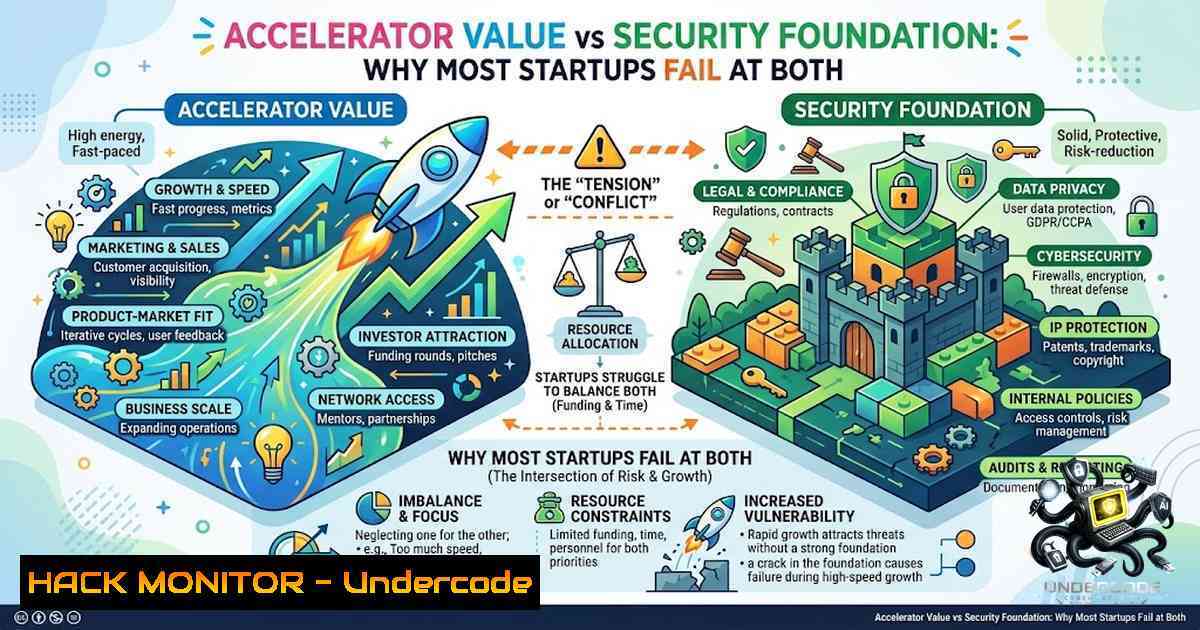
Introduction:
A recent NBER study analyzing roughly 750,000 startups across 329 accelerators found that most programs underperformed a no-accelerator benchmark. While accelerators promise capital, market access, and mentorship, the uncomfortable truth is that many deliver little more than pitch-deck templates and generic workshops—knowledge that is now searchable or one AI prompt away. For cybersecurity and IT founders, however, the stakes are higher: the same due diligence that separates valuable accelerators from time-wasters is exactly the discipline required to build a defensible security posture from day one.
Learning Objectives & Secrets:
- Objective 1: Evaluate Accelerator Value Through a Security Lens – Learn to assess accelerator programs not by branding but by tangible outcomes: real capital, warm introductions to target markets, and pilot opportunities with actual customers. A great accelerator can change a company’s trajectory; a poor one consumes runway without delivering returns.
-
Objective 2 Secret Tip: Treat Security Due Diligence as Accelerator Due Diligence – Just as founders should interrogate whether an accelerator’s “network” is real, they must apply the same rigor to their security posture. Investors and enterprise customers now require SOC 2, ISO 27001, or evidence of active security work before writing checks. The accelerator that doesn’t help you prepare for this is adding negative value.
-
Objective 3 Secret Tip: Build Security in Parallel with Growth – Many startups prioritize time-to-market over protection. The secret is that security and speed are not tradeoffs when you implement the right foundations early: MFA everywhere, encrypted data in transit and at rest, and role-based access control (RBAC) instead of sharing root credentials.
You Should Know:
- Security Foundations Every Startup Must Implement Before Demo Day
The NBER study reveals that 80% of accelerated startups performed worse than non-accelerated counterparts. One explanation: accelerators distract founders with workshops while critical security infrastructure remains neglected. Here is the minimum viable security checklist every technical founder should implement—regardless of accelerator participation:
Step-by-step guide:
- Enable Multi-Factor Authentication (MFA) everywhere – Use FIDO U2F keys or passkeys for all critical accounts, including cloud providers, GitHub, and email. Configure AWS IAM password policies to force strong passwords, rotation, and no reuse.
-
Implement Role-Based Access Control (RBAC) – Isolate development, staging, and production environments. Never share root or admin credentials. Use least-privilege IAM policies.
-
Encrypt data in transit and at rest – Use TLS 1.2 or higher for all data in transit. Encrypt stored data with AES-256 and rotate keys regularly. For cloud backups, enable immutability: S3 Object Lock, Azure Immutable Blob Storage, or GCS Bucket Lock to prevent tampering.
-
Enable CloudWatch alarms for root account usage – If root MFA is missing or the root account is used, trigger alerts. Cost: approximately $0.10/month.
-
Deploy AWS GuardDuty – Enable threat detection across your AWS environment. For seed-stage startups, this is one of the 12 controls that should be turned on immediately.
-
Generate and maintain a Software Bill of Materials (SBOM) – Know every component in your stack. Effective security hinges on automation and early detection.
-
Run regular vulnerability scans and penetration tests – Before raising capital or during deeper diligence phases, have proof of active security work and remediation.
- API Security: The Attack Surface Most Startups Ignore
Modern startups are API-first. A single exposed endpoint can undo months of accelerator momentum. NIST’s Special Publication 800-228 (June 2025) emphasizes that Zero Trust is essential for API security in cloud-1ative systems.
Step-by-step guide:
- Audit all API endpoints – Map every endpoint across staging and production. Ensure none are exposed because someone “thought it was okay”.
-
Implement strong authentication and authorization – Use OAuth 2.0 and OpenID Connect (OIDC). Even internal APIs deserve protection. Enable MFA for API access where supported.
-
Apply rate limiting and throttling – Prevent abuse and denial-of-service attacks on all endpoints.
-
Validate all inputs and encode outputs – Prevent SQL injection by using parameterized queries. Encode outputs to prevent cross-site scripting (XSS).
-
Configure CORS properly and enable CSRF protection – Misconfigured CORS is one of the most common API vulnerabilities.
-
Rotate API keys regularly – Never hardcode secrets in source code. Use secrets management tools.
-
Log and monitor access – If something unusual happens, you need to see it happen. Centralized logging and audit trails are non-1egotiable.
3. Cloud Security Architecture for Early-Stage Startups
With breaches averaging $4.88 million (IBM 2024), cloud security is not optional. Startups should begin with open-source tools for initial security checks and pay extra attention to Kubernetes images to prevent breaches.
Step-by-step guide:
- Start with a multi-account isolation strategy – Separate production, staging, and development AWS accounts.
-
Use managed services for monitoring and security testing – This reduces operational overhead【1¶L10-L11】. Leverage AWS Config, GuardDuty, and Security Hub.
-
Implement dynamic analysis for ongoing vulnerability assessment.
-
Carefully manage developer access to production environments. Use temporary credentials and assume-role patterns rather than long-lived keys.
-
Automate backup and recovery procedures – Avoid delays associated with manual processes. Implement the 3-2-1 backup rule: keep three copies of important data on two different media with one copy offsite.
-
Conduct regular cybersecurity audits – Include cloud configuration reviews.
4. Preparing for Investor Security Due Diligence
Accelerators that don’t prepare founders for security due diligence are failing them. Investors now conduct cyber due diligence as standard practice, covering security policies, incident history, technical security tools, and infrastructure architecture.
Step-by-step guide:
- Build an incident response plan before you need one – Document how you would respond to and recover from breaches. Run tabletop exercises.
-
Maintain a clean incident history – If incidents occur, document them along with remediation steps.
-
Secure cyber insurance – Review coverage gaps; lower aggregate policy limits create gaps for full coverage in the event of an incident.
-
Prepare for SOC 2 or ISO 27001 certification – Even if you don’t complete certification pre-revenue, have evidence of working toward these standards.
-
Document all security policies and procedures – This includes vulnerability management, incident response, access control, and third-party risk assessment.
5. Linux and Windows Commands for Security Hardening
For startups running hybrid or multi-cloud environments, these commands are essential:
Linux (Ubuntu/Debian):
 Audit open ports and listening services
sudo netstat -tulpn | grep LISTEN

Check for unnecessary services
sudo systemctl list-units --type=service --state=running

Harden SSH configuration
sudo nano /etc/ssh/sshd_config
 Set: PermitRootLogin no, PasswordAuthentication no, Port 2222

Enable and configure UFW firewall
sudo ufw default deny incoming
sudo ufw default allow outgoing
sudo ufw allow 2222/tcp
sudo ufw enable

Install and run Lynis security audit
sudo apt-get install lynis
sudo lynis audit system

Check for outdated packages with known vulnerabilities
sudo apt-get update && sudo apt-get upgrade -y
Windows (PowerShell as Administrator):
 Audit open ports
Get-1etTCPConnection | Where-Object {$_.State -eq "Listen"}

List all running services
Get-Service | Where-Object {$_.Status -eq "Running"}

Enable Windows Defender real-time protection
Set-MpPreference -DisableRealtimeMonitoring $false

Configure Windows Firewall
New-1etFirewallRule -DisplayName "Block All Inbound" -Direction Inbound -Action Block

Run Windows Defender offline scan
Start-MpWDOScan

Check for missing security updates
Get-WindowsUpdate

Enable BitLocker encryption (requires TPM)
Manage-bde -on C: -RecoveryPassword
6. Kubernetes Security for Containerized Startups
For startups running Kubernetes, image security is critical:
 Scan container images for vulnerabilities (using Trivy)
trivy image your-registry/your-image:latest

Enforce Pod Security Standards
 Apply in your namespace:
kubectl apply -f - <<EOF
apiVersion: v1
kind: Namespace
metadata:
name: production
labels:
pod-security.kubernetes.io/enforce: restricted
EOF

Audit RBAC configuration
kubectl auth can-i --list --1amespace=production

Enable network policies
kubectl apply -f - <<EOF
apiVersion: networking.k8s.io/v1
kind: NetworkPolicy
metadata:
name: deny-all
spec:
podSelector: {}
policyTypes:
- Ingress
- Egress
EOF

Use Kubernetes audit logging
kubectl create -f - <<EOF
apiVersion: audit.k8s.io/v1
kind: Policy
rules:
- level: Metadata
EOF
7. Automating Security with CI/CD Integration
Security must be standardized across teams, not implemented piecemeal. Integrate security into your CI/CD pipeline:
 GitHub Actions example - security scanning on every PR
name: Security Scan
on: [bash]
jobs:
security:
runs-on: ubuntu-latest
steps:
- uses: actions/checkout@v3
- name: Run Trivy vulnerability scanner
uses: aquasecurity/trivy-action@master
with:
scan-type: 'fs'
scan-ref: '.'
format: 'sarif'
output: 'trivy-results.sarif'
- name: Run Gitleaks (secrets detection)
uses: gitleaks/gitleaks-action@v2
- name: Run OWASP Dependency Check
uses: dependency-check/Dependency-Check_Action@main
What Undercode Say:
- Key Takeaway 1: Most accelerators underperform a no-accelerator benchmark—not because accelerators are inherently worthless, but because founders treat acceptance as the win rather than what they actually walk away with. The same logic applies to security: compliance checkboxes are not security. The win is actual risk reduction.
-
Key Takeaway 2: A great accelerator provides capital, warm market introductions, and real pilot opportunities. A poor one delivers generic workshops and pitch-deck templates—knowledge that is now searchable or one AI prompt away. Founders must apply the same due diligence to accelerator selection that investors apply to security posture.
The NBER study’s finding that 80% of accelerated startups underperformed non-accelerated peers is a wake-up call. Accelerators that fail to prepare founders for the operational realities of building a secure, scalable company are not adding value—they are consuming runway. Security is not a bolt-on; it is foundational. The startups that survive and thrive will be those that build security in parallel with growth, treat due diligence as a continuous process, and measure accelerator success by tangible outcomes, not branding.
Prediction:
- +1 Startups that embed security from day one will command higher valuations and faster enterprise sales cycles as cybersecurity becomes a board-level priority.
-
+1 AI-driven security automation will reduce the operational burden on early-stage teams, making robust security posture achievable without dedicated security hires.
-
-1 Accelerators that continue to offer generic, AI-replaceable content will face obsolescence as founders become more discerning about ROI.
-
-1 Startups that neglect API security and cloud misconfigurations will face increasing breach risks, with average breach costs approaching $5 million—a death sentence for early-stage companies.
-
+1 Specialized cybersecurity accelerators like CyberASAP and AWS/CrowdStrike programs will gain prominence as the market demands domain-specific expertise over generic startup advice.
-
-1 The gap between security-prepared and security-1egligent startups will widen, creating a two-tier market where only the former can access enterprise customers and institutional capital.
▶️ Related Video (86% Match):
https://www.youtube.com/watch?v=6TQg96fFM0A
🎯Let’s Practice For Free:
🎓 Live Courses & Certifications:
Join Undercode Academy for Verified Certifications
🚀 Request a Custom Project:
Secure, high-velocity infrastructure and disruptive technological engineering. Contact our engineering team for high-tier development and proprietary systems:
[email protected]
💎 Smart Architecture | 🛡️ Secure by Design | ⭐ Trusted by Thousands
IT/Security Reporter URL:
Reported By: https://lnkd.in/p/eQKnYhxY – Hackers Feeds
Extra Hub: Undercode MoN
Basic Verification: Pass ✅


