
Listen to this Post
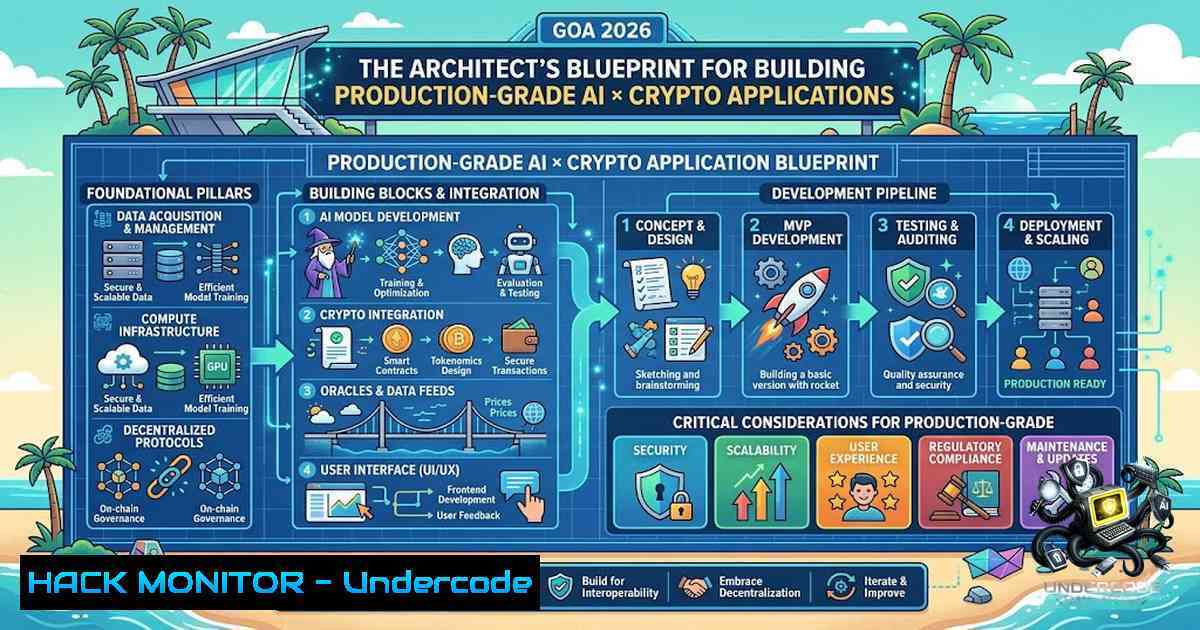
Introduction:
The convergence of artificial intelligence and blockchain technology has evolved from theoretical discourse to practical engineering reality. HackerHouseGoa 2026, India’s premier 4-day builder residency, represents a critical inflection point where 247 selected developers, designers, and AI-1ative creators will converge at a private beach resort in Goa from October 28–31, 2026. With over $50,000 in bounties, 50+ mentors and VCs on-site, and a focused mandate to build, launch, and scale real products, this event demands more than just enthusiasm—it requires technical preparedness across AI agent architectures, multichain infrastructure, and smart contract security.
Learning Objectives:
- Architect and deploy autonomous onchain AI agents that own wallets and execute transactions without human intervention
- Build multichain decentralized applications leveraging chain abstraction patterns
- Implement secure Web3 wallet integrations with robust permission controls
- Deploy and verify smart contracts across EVM-compatible networks
- Apply MCP (Model Context Protocol) to connect large language models with blockchain RPC endpoints
You Should Know:
- Onchain AI Agent Architecture: From LLM to Transaction
Onchain AI agents represent a fundamental shift in how autonomous software interacts with blockchain networks. Unlike traditional bots that follow rigid if-then rules, these agents combine large language models with the ability to own wallets, sign transactions, manage treasuries, and execute complex multi-step strategies. The architecture follows a four-layer pattern: perception (ingesting blockchain state, price feeds, mempool data), reasoning (LLM evaluation against objectives), planning (translating intent into transaction sequences), and execution (wallet management, signing, gas estimation).
To build a functional AI agent that turns natural language into on-chain transactions, follow this step-by-step implementation:
Step 1: Project Setup
 Create project directory and initialize
mkdir ai-wallet-agent && cd ai-wallet-agent
npm init -y
npm install express ethers dotenv cors @metamask/connect-multichain
Step 2: Environment Configuration
Create a `.env` file with your RPC endpoint and private key (testnet only):
RPC_URL=https://sepolia.base.org
PRIVATE_KEY=your_testnet_private_key_here
GROQ_API_KEY=your_groq_api_key_here
CONTRACT_ADDRESS=your_deployed_contract_address
Step 3: Smart Contract Deployment (Solidity)
// contracts/TipJar.sol
// SPDX-License-Identifier: MIT
pragma solidity ^0.8.19;

contract TipJar {
event TipSent(address indexed from, address indexed to, uint256 amount);

function sendTip(address payable recipient) external payable {
require(msg.value > 0, "Tip must be greater than 0");
(bool success, ) = recipient.call{value: msg.value}("");
require(success, "Transfer failed");
emit TipSent(msg.sender, recipient, msg.value);
}

function getBalance() external view returns (uint256) {
return address(this).balance;
}
}
Deploy using Hardhat or Remix to Base Sepolia testnet.
Step 4: AI Agent Core Logic (Node.js)
// server.js
const { ethers } = require('ethers');
const express = require('express');
const Groq = require('groq-sdk');

const app = express();
const provider = new ethers.JsonRpcProvider(process.env.RPC_URL);
const wallet = new ethers.Wallet(process.env.PRIVATE_KEY, provider);

// Define tools for AI to call
const tools = [{
type: 'function',
function: {
name: 'send_eth',
description: 'Send ETH to a specified address',
parameters: {
type: 'object',
properties: {
to: { type: 'string', description: 'Recipient address' },
amount: { type: 'string', description: 'Amount in ETH' }
},
required: ['to', 'amount']
}
}
}];

async function executeToolCall(toolCall) {
if (toolCall.function.name === 'send_eth') {
const { to, amount } = JSON.parse(toolCall.function.arguments);
const tx = await wallet.sendTransaction({
to: to,
value: ethers.parseEther(amount)
});
await tx.wait();
return <code>Successfully sent ${amount} ETH. Transaction: ${tx.hash}</code>;
}
}
This architecture enables the AI to autonomously decide which blockchain function to call based on natural language input.
2. Multichain Development: Building Chain-Abstracted Applications
In 2026, chain abstraction has become the default expectation for serious decentralized applications. The multi-chain reality includes Ethereum Layer 2s (Arbitrum, Optimism, Base, zkSync, Linea), Solana, Avalanche, and emerging networks. Chain abstraction treats multiple blockchains as a single unified backend, eliminating the need for users to manually bridge assets or manage gas on different networks.
Step-by-Step Multichain DApp Setup:
Step 1: Scaffold React + TypeScript Project
npm create vite@latest multichain-dapp -- --template react-ts
cd multichain-dapp
npm install @metamask/connect-multichain @solana/kit
Step 2: Initialize Multichain Client
// src/multichain.ts
import { createMultichainClient } from '@metamask/connect-multichain';

export const SCOPES = {
ETHEREUM: 'eip155:1',
LINEA: 'eip155:59144',
BASE: 'eip155:8453',
SOLANA: 'solana:5eykt4UsFv8P8NJdTREpY1vzqKqZKvdp',
} as const;

export async function getClient() {
if (!client) {
client = await createMultichainClient({
scopes: Object.values(SCOPES)
});
}
return client;
}
Step 3: Read Balances Across Chains
// src/App.tsx
async function getBalances(address: string) {
const client = await getClient();
const balances = {};

for (const [name, scope] of Object.entries(SCOPES)) {
if (scope.startsWith('eip155')) {
// EVM chain balance
const result = await client.invokeMethod({
scope,
method: 'eth_getBalance',
params: [address, 'latest']
});
balances[bash] = ethers.formatEther(result);
}
}
return balances;
}
Step 4: Send Cross-Chain Transactions
async function sendCrossChainTx(scope: string, to: string, amount: string) {
const client = await getClient();
const tx = await client.request({
scope,
method: 'eth_sendTransaction',
params: [{
from: client.account.address,
to,
value: ethers.parseEther(amount).toString(16)
}]
});
return tx;
}
This approach enables a single wallet to manage assets and execute transactions across multiple chains without network switching.
3. MCP Integration: Connecting LLMs to Blockchain Data
The Model Context Protocol (MCP) provides the most straightforward method to connect LLMs with blockchain data. An MCP server exposes tools that translate natural-language intent into RPC calls.
Step 1: Install MCP Dependencies
pip install mcp web3
Step 2: Build MCP Server for Blockchain Context
 mcp_blockchain_server.py
from mcp import Server, Tool
from web3 import Web3

w3 = Web3(Web3.HTTPProvider("https://go.getblock.io/YOUR_TOKEN/"))
server = Server("blockchain-context")

@server.tool("get_eth_balance")
async def get_balance(address: str) -> str:
"""Get ETH balance for an Ethereum address."""
balance = w3.eth.get_balance(address)
return f"Balance: {w3.from_wei(balance, 'ether')} ETH"

@server.tool("get_latest_block")
async def get_latest_block() -> str:
"""Get the latest Ethereum block number and timestamp."""
block = w3.eth.get_block("latest")
return f"Block {block.number}, timestamp: {block.timestamp}"

@server.tool("get_transaction")
async def get_transaction(tx_hash: str) -> str:
"""Get details of an Ethereum transaction."""
tx = w3.eth.get_transaction(tx_hash)
receipt = w3.eth.get_transaction_receipt(tx_hash)
return (f"From: {tx['from']}, To: {tx['to']}, "
f"Value: {w3.from_wei(tx['value'], 'ether')} ETH, "
f"Status: {'Success' if receipt['status'] else 'Failed'}")
With these tools, an LLM can answer queries like “What’s the ETH balance of vitalik.eth?” or “How many transactions were in the last block?” by calling the appropriate tool and interpreting results.
4. Web3 Wallet Security: Protecting Assets in Production
Security remains paramount when deploying production AI agents and dApps. In 2026, most losses still stem from infinite token approvals granted months earlier.
Critical Security Practices:
Hardware Wallet Integration: Any asset exceeding $1,000 should be stored in a hardware wallet. Use Ledger or similar devices for cold storage.
Permission Management: Review and revoke smart contract approvals regularly—every 30 days is recommended. Use tools like Revoke.cash to manage permissions.
Seed Phrase Protection: Never type your seed phrase into any website, app, or chatbot. Never photograph or store it digitally. Write it physically and keep copies in secure locations.
Transaction Simulation: Use wallets with transaction simulation features to preview outcomes before signing.
Multi-Wallet Strategy: Use separate wallets for long-term holdings versus daily transactions to limit exposure.
2FA Implementation: Enable two-factor authentication using authenticator apps or hardware security keys over SMS-based verification.
Linux Command for Wallet Security Audit:
 Check for suspicious wallet activity using a local node
curl -X POST http://localhost:8545 \
-H "Content-Type: application/json" \
--data '{"jsonrpc":"2.0","method":"eth_getTransactionCount","params":["0xYourWalletAddress","latest"],"id":1}'

Monitor mempool for pending transactions
curl -X POST http://localhost:8545 \
-H "Content-Type: application/json" \
--data '{"jsonrpc":"2.0","method":"txpool_content","params":[],"id":1}'
- Deployment and Scaling: From Hackathon MVP to Production
The transition from hackathon prototype to production-ready application requires careful consideration of infrastructure, monitoring, and scaling patterns.
Step 1: Smart Contract Verification
 Verify contract on Etherscan/BaseScan
npx hardhat verify --1etwork baseSepolia DEPLOYED_CONTRACT_ADDRESS
Step 2: Frontend Deployment
 Build and deploy to Vercel
npm run build
vercel --prod
Step 3: Monitoring Setup
 Install monitoring dependencies
npm install @opentelemetry/api @opentelemetry/auto-instrumentations-1ode

Set up structured logging
npm install pino pino-pretty
Step 4: Environment Hardening
 Linux: Secure environment variables
chmod 600 .env
 Set restrictive permissions
umask 077

Windows PowerShell: Secure environment
$env:NODE_ENV="production"
Step 5: CI/CD Pipeline (GitHub Actions)
 .github/workflows/deploy.yml
name: Deploy to Production
on:
push:
branches: [bash]
jobs:
deploy:
runs-on: ubuntu-latest
steps:
- uses: actions/checkout@v3
- uses: actions/setup-1ode@v3
with:
node-version: '18'
- run: npm ci
- run: npm run test
- run: npm run build
- run: npx hardhat deploy --1etwork production
What Undercode Say:
- Key Takeaway 1: The convergence of AI agents and blockchain infrastructure is no longer experimental—it’s production-ready. Onchain AI agents that own wallets and execute autonomous transactions represent the next evolution of decentralized applications. The combination of EIP-7702 and account abstraction (ERC-4337) has matured enough to enable granular permission controls, making 2026 the inflection point for autonomous onchain systems.
-
Key Takeaway 2: Chain abstraction is the defining architectural pattern for 2026. Users no longer care which chain their assets reside on. Applications that only work on a single chain will be left behind. Cross-chain messaging protocols (LayerZero, Chainlink CCIP, Hyperlane), intent-based execution (Across, UniswapX), and unified account layers are the building blocks of the next generation of dApps.
-
Analysis: HackerHouseGoa 2026 provides the ideal environment for builders to experiment with these emerging technologies. With 50+ mentors and VCs on-site, structured building sessions, and daily product reviews, the event bridges the gap between hackathon experimentation and real-world product development. The $50,000+ bounty pool and on-chain voting public demo day create genuine incentives for shipping quality products. However, builders must prioritize security from day one—most 2026 losses still stem from infinite token approvals and compromised private keys. The builders who succeed will be those who combine technical innovation with rigorous security practices.
Prediction:
-
+1 The AI × Crypto builder movement will accelerate institutional adoption of autonomous onchain agents, with enterprise-grade frameworks emerging within 12-18 months of events like HackerHouseGoa.
-
+1 Chain abstraction will become the default standard for dApp development by 2027, eliminating the concept of “chain-specific” applications entirely.
-
-1 The rise of autonomous AI agents introduces new attack vectors—compromised agent wallets could execute malicious transactions at scale, requiring new security paradigms and insurance mechanisms.
-
+1 Hackathon-driven innovation will produce the next generation of DeFi protocols, with AI agents managing treasuries, executing arbitrage, and optimizing yields across hundreds of chains autonomously.
-
-1 Regulatory frameworks (MiCA and equivalents) will struggle to keep pace with autonomous onchain agents, creating compliance uncertainty that may slow mainstream adoption.
-
+1 The 247 builders selected for HackerHouseGoa 2026 will form the core of India’s Web3 talent pipeline, positioning the region as a global hub for AI × Crypto innovation.
▶️ Related Video (84% Match):
https://www.youtube.com/watch?v=1-9yDyMGrPE
🎯Let’s Practice For Free:
🎓 Live Courses & Certifications:
Join Undercode Academy for Verified Certifications
🚀 Request a Custom Project:
Secure, high-velocity infrastructure and disruptive technological engineering. Contact our engineering team for high-tier development and proprietary systems:
[email protected]
💎 Smart Architecture | 🛡️ Secure by Design | ⭐ Trusted by Thousands
IT/Security Reporter URL:
Reported By: Roshan Sahani – Hackers Feeds
Extra Hub: Undercode MoN
Basic Verification: Pass ✅


