Listen to this Post
Introduction:
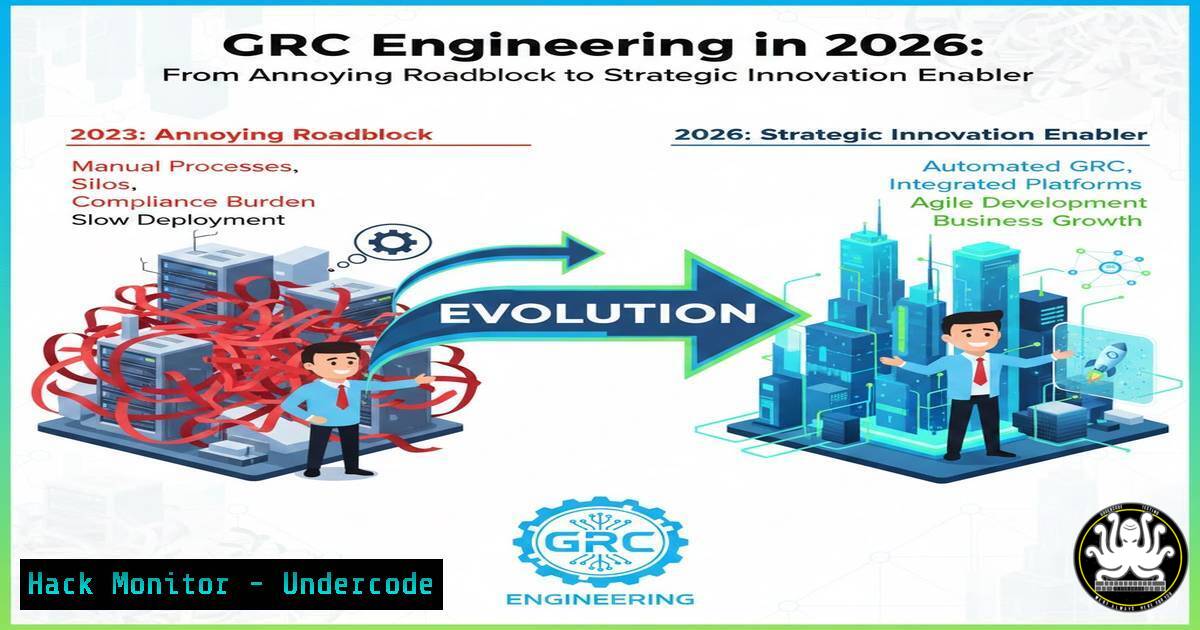
The traditional view of Governance, Risk, and Compliance (GRC) as a bureaucratic hurdle is rapidly becoming obsolete. In 2026, forward-thinking organizations are leveraging GRC Engineering to transform these functions into automated, data-driven systems that enable secure innovation rather than stifle it. This paradigm shift integrates AppSec, Cloud Security, and proactive risk management into the DevOps lifecycle, turning compliance into a competitive advantage.
Learning Objectives:
- Understand the core principles of GRC Engineering and how it differs from traditional GRC.
- Learn practical steps to automate compliance checks and security controls in cloud environments.
- Explore how to integrate Security Chaos Engineering and Detection Engineering into a GRC program for proactive risk management.
You Should Know:
- The Pillars of GRC Engineering: Automation, Integration, and Measurement
GRC Engineering is the application of software engineering principles to governance, risk, and compliance. It focuses on codifying policies, automating controls, and integrating security into CI/CD pipelines. The goal is to make security and compliance continuous, auditable, and invisible to developers.
Step‑by‑step guide:
- Codify Policies: Translate regulatory requirements (e.g., ISO 27001, SOC 2, GDPR) and internal security policies into machine-readable code (e.g., YAML, JSON, Rego).
Example (Open Policy Agent – Rego):
 rego_policy.rego
package envoy.security.gcp

default allow = false

allow {
input.resource_type == "compute.v1.instance"
input.properties.labels["env"] == "production"
input.properties.scheduling.preemptible == false  Prod must not be preemptible
}
2. Integrate into Pipeline: Use policy-as-code tools like Open Policy Agent (OPA), HashiCorp Sentinel, or cloud-native tools (AWS Config, Azure Policy) to evaluate infrastructure-as-code (Terraform, CloudFormation) before deployment.
Example CI/CD Step (GitHub Actions):
- name: Evaluate Terraform with OPA
uses: open-policy-agent/conftest-action@v1
with:
files: terraform/main.tf
policy: policies/terraform/
3. Remediate Automatically: Configure automated remediation workflows for common, low-risk violations (e.g., auto-tagging resources, disabling public storage access) using serverless functions or orchestration tools.
2. Cloud Hardening Through Automated Compliance Baselines
A core tenet of GRC Engineering is enforcing secure baselines across cloud estates. This involves continuous scanning for misconfigurations and drift from defined security standards.
Step‑by‑step guide:
- Establish a Baseline: Define a hardening standard using frameworks like CIS Benchmarks for AWS, Azure, or GCP.
- Deploy a Scanner: Implement a tool like Prowler, Scout Suite, or cloud-native security hub to assess your environment.
Example Command (Prowler for AWS):
 Run a specific CIS benchmark check
./prowler -g cislevel1 -M json -F envoy-security-audit
3. Centralize Findings: Aggregate findings into a SIEM or a dedicated dashboard (e.g., Elastic SIEM, Splunk, Grafana) for correlation and prioritization.
4. Automate Responses: Use cloud provider event-driven services (e.g., AWS EventBridge -> Lambda) to automatically respond to critical findings, such as revoking overly permissive IAM policies.
3. Integrating AppSec into the GRC Engineering Lifecycle
Application Security is not a separate silo. GRC Engineering embeds security scanning and vulnerability management directly into the software development lifecycle (SDLC).
Step‑by‑step guide:
- Shift Left with SAST/SCA: Integrate Static Application Security Testing (SAST) and Software Composition Analysis (SCA) tools (e.g., Semgrep, Snyk, Mend) into pull request workflows.
Example (GitHub Actions with Semgrep):
- name: Semgrep SAST Scan
uses: returntocorp/semgrep-action@v1
with:
config: p/security-audit
2. Dynamic Checks in Pre-Production: Run Dynamic Application Security Testing (DAST) or Interactive Application Security Testing (IAST) tools against staging environments.
3. Policy Gates: Define quality gates. For example, block the merge of a PR if a critical vulnerability (CVSS >= 9.0) is introduced or if a dependency with a known exploit is used.
4. Proactive Risk Management with Security Chaos Engineering
Security Chaos Engineering (SCE) proactively tests your security controls and incident response by safely injecting failures or attack simulations. This moves GRC from a state of assumed compliance to verified resilience.
Step‑by‑step guide:
- Define a Hypothesis: Start with a testable statement. E.g., “Our intrusion detection system (IDS) will generate an alert within 5 minutes of a simulated brute-force attack on our admin portal.”
- Choose a Tool: Use tools like Chaos Monkey for Kubernetes, AWS Fault Injection Simulator (FIS), or specialized security tools like Mitigant’s emulation platform.
- Design a Safe Experiment: Scope the blast radius to a non-production environment. Define abort conditions and rollback procedures.
- Execute and Learn: Run the experiment, monitor your detection and response capabilities, and document gaps. Use findings to improve controls and playbooks.
5. Quantifying Risk with Data-Driven Detection Engineering
Detection Engineering is the disciplined process of creating, testing, and maintaining high-fidelity threat detection logic. It provides the measurable evidence of control effectiveness that modern GRC requires.
Step‑by‑step guide:
- Threat Modeling: Identify high-value assets and likely attack paths (e.g., initial access via phishing, lateral movement via RDP).
- Write a Detection Rule: Codify detection logic in a standard format like Sigma, which is vendor-agnostic.
Example (Sigma Rule for suspicious RDP activity):
title: Suspicious RDP Network Connection
logsource:
product: windows
service: security
detection:
selection:
EventID: 4624
LogonType: 10  RDP
SourceNetworkAddress:  External IP not in whitelist
- '10.0.0.0/8'
- '192.168.0.0/16'
- '172.16.0.0/12'
condition: selection
3. Test and Validate: Use a detection testing framework (e.g., Atomic Red Team, Caldera) to simulate the adversary technique and ensure your rule triggers accurately with minimal false positives.
4. Deploy and Measure: Deploy the rule to your SIEM (converted to the native query language, e.g., Splunk SPL, Elastic QL). Track key metrics: alert volume, true positive rate, and mean time to respond (MTTR).
What Undercode Say:
- The “Compliance Tax” is Now Optional: Organizations that cling to manual, document-centric GRC will incur massive opportunity costs, slowing innovation. Those who engineer their GRC will see it accelerate secure delivery.
- Verification Over Assumption: The future belongs to programs that can prove their controls work through continuous automated testing (via SCE) and validated detection, not just assert compliance based on point-in-time audits.
- Analysis: Anton Horn’s post highlights a critical inflection point. The convergence of GRC Engineering, Cloud Security, and AppSec, fueled by the methodologies of Detection and Security Chaos Engineering, is creating a new operational model for cybersecurity. This model is inherently measurable and agile. In 2026, the CISO’s value will be quantified not by the thickness of a policy binder, but by the resilience metrics and risk velocity data their engineered systems produce. Platforms and consultancies that can operationalize this shift, as indicated by Envoy Security’s projects and tools like Mitigant’s, are positioned at the forefront of this transformation.
Prediction:
By the end of 2026, GRC Engineering will become the default approach for tech-forward enterprises and scale-ups. We will see the rise of “Compliance-as-Code” platforms that offer pre-built, regulatory-framework-specific policy modules (for FINRA, HIPAA, DORA, etc.) that integrate directly into developer platforms. This will further democratize security, embedding it into the fabric of engineering. Concurrently, security audits will evolve to include mandatory demonstrations of control efficacy via automated security chaos experiments, moving the industry from check-box compliance to evidenced-based assurance.
▶️ Related Video (86% Match):
🎯Let’s Practice For Free:
IT/Security Reporter URL:
Reported By: Anton Horn – Hackers Feeds
Extra Hub: Undercode MoN
Basic Verification: Pass ✅


