Listen to this Post
Introduction:
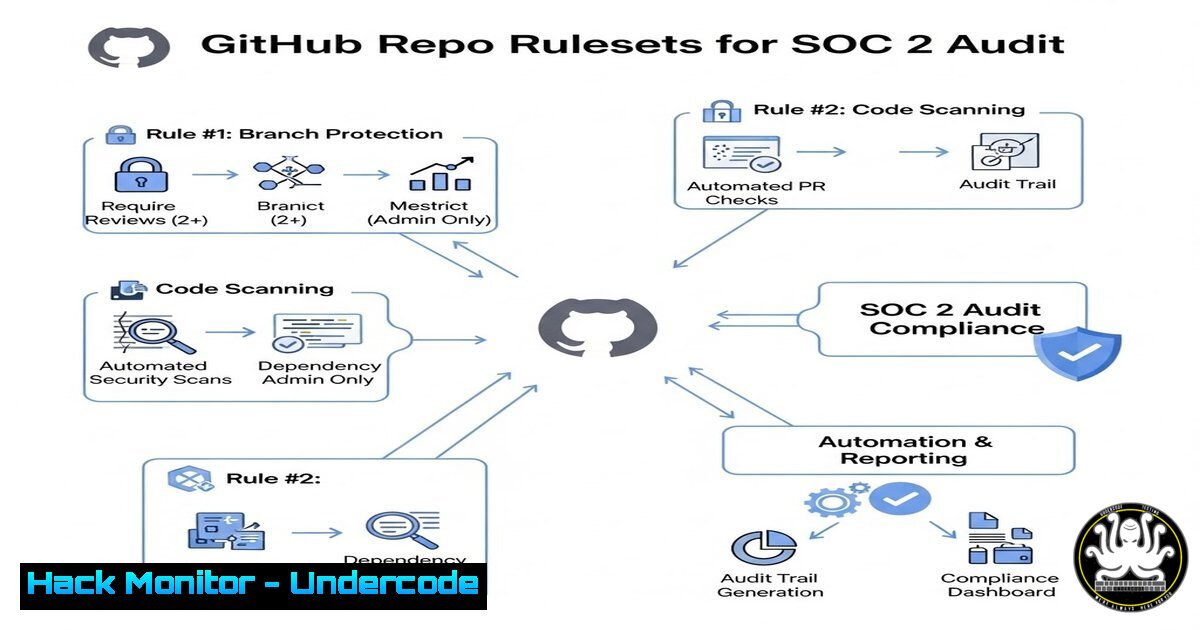
In the modern DevSecOps pipeline, a misconfigured branch protection rule is equivalent to leaving the vault door open. While many organizations believe they have secured their source code by enabling settings like required pull requests or signed commits, the reality is that “enabled” does not equal “enforced.” A new Python-based auditing tool bridges the gap between security policy and technical reality by leveraging GitHub’s Repository Rulesets API. This tool transforms abstract SOC 2 controls (CC6.1, CC7.1) into measurable, auditable evidence, ensuring that your software integrity isn’t just assumed—it’s verified across your entire organization.
Learning Objectives:
- Understand the critical difference between enabling a security setting and enforcing it at scale.
- Learn how to audit GitHub branch protections using Python and the Repository Rulesets API.
- Map technical Git controls (like signed commits) to specific SOC 2 compliance criteria (CC6.8).
- Automate the remediation of non-compliant repositories through issue generation.
You Should Know:
1. Auditing Branch Protection with the GitHub API
The core of this tool relies on interacting with GitHub’s API to fetch current ruleset configurations. Unlike manually checking each repository, this script aggregates data at the organization level. It parses both legacy branch protections and the new rulesets, converting them into a unified data structure for analysis. This allows security teams to see, at a glance, which repos require a linear history or which require two approving reviews before merge.
To test connectivity and fetch rules for a specific repository manually (Linux/macOS terminal), you can use cURL:
 Replace OWNER, REPO, and TOKEN
curl -H "Authorization: token YOUR_GITHUB_TOKEN" \
-H "Accept: application/vnd.github+json" \
https://api.github.com/repos/OWNER/REPO/rules/branches/main
This command returns the JSON structure of the rules applied to the main branch, forming the raw data the Python script processes.
2. Mapping Technical Controls to SOC 2 Frameworks
The script doesn’t just list settings; it interprets them. It maps specific rules to SOC 2 Common Criteria. For example, the requirement for a “pull request” before merging is mapped to CC6.1 (Logical Access Security) and CC8.1 (Change Management) . The requirement for “linear history” maps to audit trail integrity. This mapping is crucial because it translates developer workflows into language auditors understand. If the API reports that `required_status_checks` is null or empty, the script flags the repo as failing CC7.1 (System Operations) , which demands that system changes are authorized and tested prior to implementation.
3. Converting Classic Protections to Rulesets (The Shift)
GitHub is deprecating classic branch protections in favor of Rulesets. This tool helps future-proof governance. It handles the conversion logic, ensuring that a rule like “Dismiss stale reviews” in the classic model is accurately represented in the new unified format. Security engineers can use this script to identify which repositories are still relying on legacy protections and prioritize their migration. A step-by-step remediation might involve using the GitHub CLI to create a new ruleset:
gh api repos/OWNER/REPO/rulesets -f name="soc2_compliance" \
-f target="branch" \
-f enforcement="active" \
-f 'conditions[bash][include]=~ALL' \
-F 'rules[bash][type]=pull_request' \
-F 'rules[bash][parameters][bash]=1' \
-F 'rules[bash][type]=required_status_checks'
This command pushes the compliance standard directly to the repo, enforcing the settings rather than just suggesting them.
4. Generating Auditor-Ready Compliance Reports
Once the data is aggregated and mapped, the tool generates a report. This moves compliance from a collection of screenshots to a structured dataset (JSON/CSV). The report lists every repository, its current enforcement state for each control, and a pass/fail status. For Windows-based security teams, a PowerShell script could complement this by ingesting the JSON output and automatically updating a GRC tool (like ServiceNow) via API, proving continuous compliance rather than point-in-time audits.
5. Auto-Creating Remediation Issues
The final and most powerful feature is automated remediation. For every repository that fails a check (e.g., missing required code owners), the script can open a GitHub Issue with a pre-defined template. This issue explains why the repo is non-compliant (citing the specific SOC 2 control) and provides the exact commands or settings required to fix it. This closes the loop between detection and correction, embodying the “enforcement” mindset.
What Undercode Say:
- Key Takeaway 1: Configuration drift is the enemy of compliance. An enabled setting today can be disabled tomorrow without anyone noticing. Continuous auditing via API is the only way to ensure persistent enforcement.
- Key Takeaway 2: The integration of development workflows with audit frameworks (like SOC 2) is no longer optional. By mapping `signed commits` to CC6.8 (Software Integrity) , we embed security into the engineering lifecycle, making compliance a byproduct of good coding practice, not a separate overhead task.
In essence, this tool transforms GitHub from a code host into a source of truth for security governance. It highlights that in the age of supply chain attacks, protecting the branch is protecting the build. Security engineers must shift from asking “Do we have this setting?” to “Can we prove this setting is actively enforced across 100% of our repos?”
Prediction:
Within the next 12 months, API-driven compliance auditing will become a standard requirement for major cloud service providers and insurance underwriters. Tools like this will evolve from “nice-to-have” scripts into mandatory components of the CI/CD pipeline, where a failed branch protection rule will break the build just as surely as a failing unit test. The era of manual evidence collection for source code management is ending; real-time, automated governance is the new baseline for cyber insurance and regulatory compliance.
▶️ Related Video (74% Match):
🎯Let’s Practice For Free:
IT/Security Reporter URL:
Reported By: Priyesh Em – Hackers Feeds
Extra Hub: Undercode MoN
Basic Verification: Pass ✅


