Listen to this Post
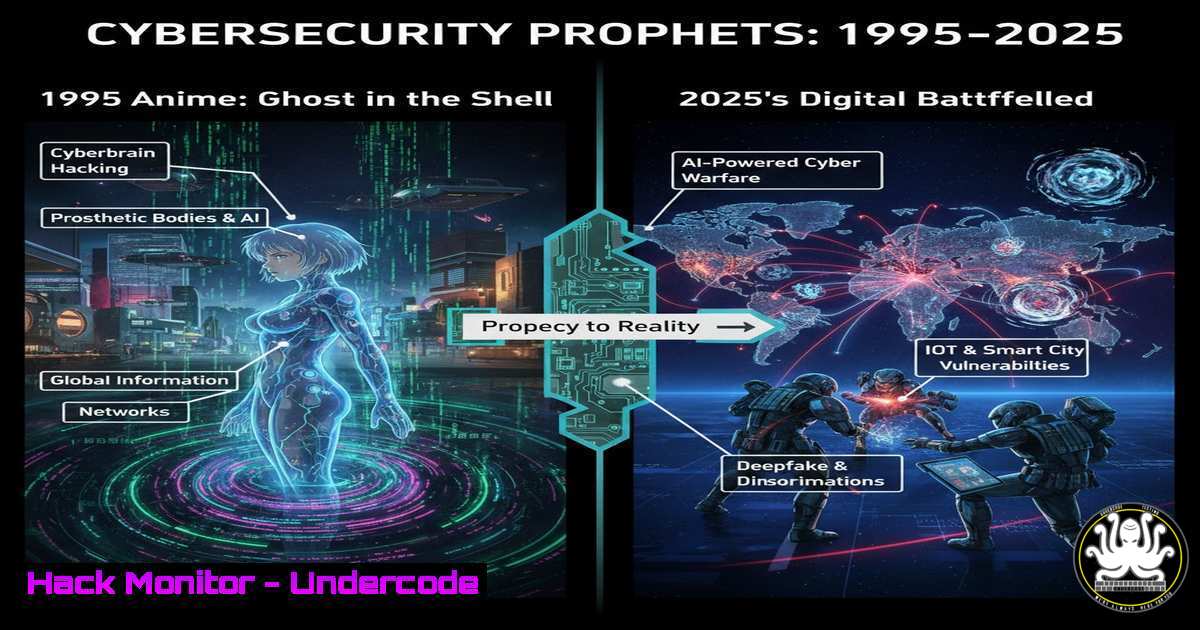
Introduction:
Three decades before advanced persistent threats (APTs) and state-sponsored hacking became daily headlines, the anime masterpiece ‘Ghost in the Shell’ presented a startlingly accurate vision of our cybersecurity reality. The film’s depiction of the Puppet Master—a government entity hacking human cyber-brains and network terminals—mirrors contemporary concerns about AI-powered cyber warfare, neural interfaces, and mass-scale digital espionage. This prescient fiction now serves as both warning and roadmap for security professionals facing an increasingly interconnected threat landscape.
Learning Objectives:
- Decode the cybersecurity concepts predicted by Ghost in the Shell and their modern equivalents
- Implement defensive measures against advanced persistence threats and AI-powered attacks
- Understand the emerging security implications of human-machine interfaces and neural networks
You Should Know:
- The Puppet Master: Blueprint for Modern State-Sponsored APTs
The Puppet Master character represents what we now classify as an Advanced Persistent Threat (APT) actor, typically state-sponsored with nearly unlimited resources. Like modern APT groups, the Puppet Master demonstrates sophisticated target selection, political motivations, and the ability to maintain long-term access across multiple networks.
Step-by-step guide explaining what this does and how to use it:
Modern APT detection requires layered security monitoring. Begin with establishing baseline network behavior:
 Linux: Monitor network connections for suspicious outbound traffic
netstat -tunap | grep ESTABLISHED
ss -tunap state established
 Windows equivalent:
netstat -ano | findstr ESTABLISHED

Set up continuous monitoring with auditd rules
sudo auditctl -a always,exit -F arch=b64 -S connect -F a0=2 -k NETWORK_CONNECTIONS
Configure Security Onion or Elastic Stack for enterprise-level APT detection:
– Deploy YARA rules for memory scanning: `yara -r rules.yar /proc//mem`
– Implement Sigma rules for detecting lateral movement: `git clone https://github.com/SigmaHQ/sigma`
– Set up threat intelligence feeds from AlienVault OTX or MISP
2. Cyber-Brain Hacking: Securing Human-Machine Interfaces
Ghost in the Shell’s “cyber-brain” concept predates current brain-computer interface (BCI) security concerns. As neural interfaces like Neuralink emerge, similar vulnerabilities could allow malicious actors to manipulate memory, perception, or even motor functions.
Step-by-step guide explaining what this does and how to use it:
While direct BCI security measures are emerging, the principles translate to IoT and embedded systems security:
 Secure communication protocols for embedded devices
 Implement certificate-based authentication
openssl genrsa -aes256 -out ca-key.pem 4096
openssl req -new -x509 -days 365 -key ca-key.pem -sha256 -out ca.pem

 Memory protection for embedded Linux systems
echo 2 > /proc/sys/kernel/randomize_va_space
echo 1 > /proc/sys/kernel/dmesg_restrict
Hardening guide for embedded Linux devices:
– Disable unnecessary services: `systemctl list-unit-files | grep enabled`
– Implement secure boot with UEFI: `mokutil –sb-state`
– Configure memory protection: `echo kernel.dmesg_restrict=1 >> /etc/sysctl.conf`
3. Network-Wide Compromise: Containing Mass-Scale Breaches
The Puppet Master’s ability to compromise “every terminal on the network” mirrors modern ransomware and worm outbreaks that propagate across enterprise environments. This requires zero-trust architectures and rapid containment protocols.
Step-by-step guide explaining what this does and how to use it:
Implement network segmentation and zero-trust principles:
 Linux iptables rules for network segmentation
iptables -A FORWARD -s 192.168.1.0/24 -d 10.0.0.0/8 -j DROP
iptables -A FORWARD -m state --state RELATED,ESTABLISHED -j ACCEPT

PowerShell for Windows network isolation
Get-NetFirewallRule | Where-Object {$_.Enabled -eq "True"}
New-NetFirewallRule -DisplayName "Block Lateral Movement" -Direction Inbound -Protocol TCP -LocalPort 445 -Action Block
Containment procedures for detected breaches:
- Immediately isolate compromised segments: `iptables -I FORWARD -s
 -j DROP`
- Revoke authentication tokens: `kubectl delete secrets --all` (Kubernetes)</li>
<li>Initiate incident response protocol with automated scripts</li>
</ul>

<h2 style="color: yellow;">4. AI-Powered Social Engineering: The Modern Puppet Master</h2>

The film's depiction of manipulated memories and identities foreshadows AI-driven social engineering attacks using deepfakes and generated content that can compromise organizational security.

Step-by-step guide explaining what this does and how to use it:

<h2 style="color: yellow;">Defend against AI-powered social engineering with technical controls:</h2>

[bash]
 Python script to detect deepfake images using metadata analysis
from PIL import Image
from PIL.ExifTags import TAGS
import hashlib

def analyze_image_authenticity(image_path):
with Image.open(image_path) as img:
exifdata = img.getexif()
for tag_id, value in exifdata.items():
tag = TAGS.get(tag_id, tag_id)
print(f"{tag}: {value}")

Check for GAN-generated artifacts
img_data = img.tobytes()
hash_digest = hashlib.sha256(img_data).hexdigest()
return hash_digest
Implement multi-factor authentication and behavioral analysis:
- Deploy FIDO2 security keys: `sudo apt install libfido2-1`
– Configure anomalous behavior detection in SIEM systems - Train employees using simulated AI-powered phishing campaigns
5. Government Hacking Operations: Ethical and Technical Boundaries
The revelation that the Puppet Master is a government project mirrors modern debates around state-sponsored hacking tools and their potential leakage into criminal ecosystems.
Step-by-step guide explaining what this does and how to use it:
Protect against nation-state level threats:
 Advanced logging for detection of sophisticated attacks
 Configure auditd for comprehensive system monitoring
cat > /etc/audit/rules.d/security.rules << EOF
-w /etc/passwd -p wa -k identity
-w /etc/shadow -p wa -k identity
-w /etc/gshadow -p wa -k identity
-a always,exit -F arch=b64 -S execve -k process_execution
EOF

Windows advanced audit policies
auditpol /set /category:"Detailed Tracking" /success:enable
Implement cryptographic protection for sensitive data:
- Use LUKS for full disk encryption: `cryptsetup luksFormat /dev/sdX`
– Deploy certificate pinning for applications: `openssl s_client -connect example.com:443 < /dev/null | openssl x509 -pubkey -noout`
- Cyber-Physical Convergence: When Digital Attacks Have Physical Consequences
The film’s integration of cybernetics and physical reality anticipates modern IoT, industrial control system (ICS), and automotive security challenges where digital breaches create physical damage.
Step-by-step guide explaining what this does and how to use it:
Secure cyber-physical systems with specialized protocols:
 SCADA/ICS security monitoring
 Network segmentation for operational technology
iptables -A FORWARD -p tcp --dport 502 -m state --state NEW -j LOG --log-prefix "MODBUS_ACCESS: "

Monitor industrial protocol traffic
tcpdump -i any -A 'port 102 or port 502 or port 20000'
Implement safety-critical system protections:
- Deploy unidirectional security gateways for air-gapped networks
- Configure PLC program change detection: `systemctl enable tripwire`
– Establish physical emergency shutdown procedures alongside digital controls
7. Identity and Authentication in a Cyberized World
The film explores identity manipulation through cyber-brain hacking, directly relating to modern identity and access management challenges, including biometric spoofing and multi-factor authentication bypass.
Step-by-step guide explaining what this does and how to use it:
Implement robust identity verification systems:
 Linux PAM configuration for enhanced authentication
cat > /etc/pam.d/sshd << EOF
auth required pam_google_authenticator.so
auth required pam_unix.so
auth required pam_faillock.so preauth silent audit deny=3 unlock_time=900
EOF

Windows Credential Guard deployment
Confirm-SecureBootUEFI
Enable-WindowsOptionalFeature -Online -FeatureName Microsoft-Hyper-V -All
Biometric security enhancement:
- Implement liveness detection for facial recognition systems
- Combine multiple biometric factors: `echo “Requiring fingerprint + facial recognition” >> /etc/security/policy.conf`
– Deploy hardware security modules for credential protection: `sudo apt install opensc-pkcs11`
What Undercode Say:
- The convergence of human and machine interfaces represents the next frontier in cybersecurity, requiring fundamentally new security paradigms that prioritize continuity of consciousness and identity verification
- Fiction often precedes technological reality by decades, making speculative media like Ghost in the Shell essential viewing for forward-looking security professionals
Analysis: Ghost in the Shell’s enduring relevance stems from its foundational understanding that technological advancement doesn’t eliminate human vulnerability—it merely transforms it. The film correctly anticipated that as humans integrate more deeply with technology, the attack surface expands beyond networks and devices to include human cognition, memory, and identity. Modern security professionals must recognize that we’re building toward the world depicted in the film, where the distinction between personal identity and digital presence becomes increasingly blurred. This requires developing security frameworks that protect not just data, but the integrity of human experience in cyber-enhanced environments.
Prediction:
The next decade will see the emergence of cybersecurity challenges directly mirroring Ghost in the Shell’s predictions, particularly around neural interface security, AI-generated identity manipulation, and state-level cognitive warfare. We’ll witness the first major incidents involving compromised brain-computer interfaces, forcing the industry to develop entirely new security categories focused on neurological integrity and consciousness verification. The legal and ethical frameworks governing these technologies will become as critical as the technical controls, creating a new specialization at the intersection of cybersecurity, neuroscience, and ethics.
🎯Let’s Practice For Free:
IT/Security Reporter URL:
Reported By: Michael Tchuindjang – Hackers Feeds
Extra Hub: Undercode MoN
Basic Verification: Pass ✅🔐JOIN OUR CYBER WORLD [ CVE News • HackMonitor • UndercodeNews ]
📢 Follow UndercodeTesting & Stay Tuned:
- Deploy FIDO2 security keys: `sudo apt install libfido2-1`


