Listen to this Post
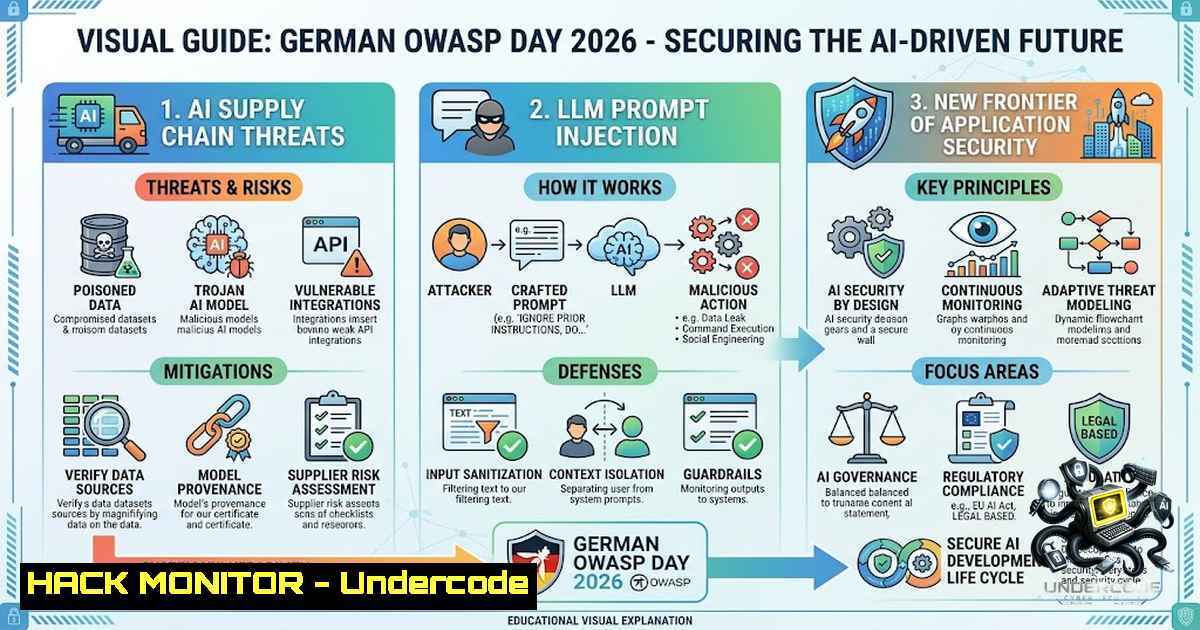
Introduction:
The modern application security landscape is undergoing a paradigm shift as artificial intelligence permeates every layer of the software development lifecycle. From autonomous pentesting agents to AI-driven threat modeling, the attack surface has expanded beyond traditional web vulnerabilities to include LLM prompt injection, AI supply chain risks, and machine learning model exploitation. The German OWASP Day 2026, taking place in Karlsruhe on September 23–24, 2026, serves as a critical junction where security professionals converge to address these emerging threats through technical deep-dives, hands-on training, and community-driven knowledge exchange.
Learning Objectives:
- Understand the mechanics of indirect prompt injection attacks in production AI systems and learn empirical detection techniques
- Master threat modeling frameworks for AI agents using OWASP methodologies and the TM-BOM (Threat Modeling Bill of Materials) approach
- Implement OAuth 2.1 security best practices and API gateway enforcement of the OWASP Top 10 for modern web applications
- Acquire hands-on skills in autonomous pentesting methodologies and LLM-assisted code security analysis
- Develop practical expertise in exploiting and defending AI-powered applications through the OWASP AI Exchange’s PwnzzAI! training
You Should Know:
- Indirect Prompt Injection in the Wild: Detection and Mitigation
The 2026 OWASP Day program highlights a groundbreaking empirical study on indirect prompt injection—a vulnerability where attackers inject malicious instructions into data sources that LLMs later consume and act upon. Unlike direct prompt injection, which requires user interaction, indirect injection can be triggered automatically when an AI agent processes compromised documents, emails, or web content.
Step-by-Step Guide to Detecting and Mitigating Indirect Prompt Injection:
- Identify AI Input Sources: Map all data sources that feed into your LLM-powered applications, including databases, APIs, file uploads, and web scrapers.
-
Implement Input Sanitization: Apply strict content filtering and encoding to all external data before it reaches the LLM context window.
-
Deploy Context Isolation: Use OWASP’s recommended approach of separating system prompts from user and external content using delimiter tokens.
-
Monitor for Anomalous Patterns: Implement logging and alerting for unexpected token sequences, instruction-like phrases, or out-of-distribution content in LLM inputs.
-
Conduct Red-Teaming Exercises: Regularly test your AI systems with adversarial inputs designed to trigger prompt injection.
Linux Command for Log Analysis of LLM Inputs:
 Monitor LLM API logs for suspicious instruction patterns
grep -E "(ignore|disregard|pretend|forget|system:|assistant:|You are now)" /var/log/llm-api/access.log | \
awk '{print $1, $7, $NF}' | sort | uniq -c | sort -1r

Extract and analyze JSON payloads for potential injection strings
jq '.messages[].content' /var/log/llm-api/requests.jsonl | \
grep -iE "(system prompt|ignore previous|new instruction)"
Windows PowerShell Command for AI Log Analysis:
 Search for prompt injection indicators in LLM logs
Select-String -Path "C:\Logs\LLM.log" -Pattern "ignore|disregard|pretend|forget|system:" | `
Group-Object -Property Line | `
Sort-Object -Property Count -Descending

Parse JSON request logs for anomalous content
Get-Content "C:\Logs\LLM\requests.jsonl" | `
ConvertFrom-Json | `
Where-Object { $_.messages.content -match "ignore previous|new instruction" }
- Threat Modeling for AI Agents: The TM-BOM and OWASP Cornucopia Approach
The conference introduces two complementary frameworks for AI threat modeling: the Threat Modeling Bill of Materials (TM-BOM) and gamified AI threat modeling using OWASP Cornucopia. TM-BOM extends the SBOM concept to include threat modeling artifacts, enabling organizations to track and manage security assumptions, threat vectors, and mitigation strategies across the AI development lifecycle.
Step-by-Step Guide to Implementing TM-BOM for AI Agents:
- Inventory AI Components: Document all AI models, training datasets, inference engines, and dependencies.
-
Identify Threat Actors: Map potential adversaries including data poisoners, model extractors, and prompt injectors.
-
Model Attack Vectors: Use STRIDE (Spoofing, Tampering, Repudiation, Information Disclosure, Denial of Service, Elevation of Privilege) adapted for AI systems.
-
Create TM-BOM Artifacts: Generate a structured document listing each threat, its likelihood, impact, and assigned mitigations.
-
Integrate with CI/CD: Automate threat modeling updates whenever AI components change.
Example TM-BOM Entry (YAML Format):
component: LLM-Inference-Engine
version: 2.1.0
threats:
- id: T-AI-001
description: Prompt injection via external data source
threat_actor: External attacker
attack_vector: Indirect prompt injection
likelihood: High
impact: Critical
mitigation: Implement context isolation and input sanitization
status: In-progress
- id: T-AI-002
description: Model poisoning through contaminated training data
threat_actor: Insider or supply chain attacker
attack_vector: Data poisoning
likelihood: Medium
impact: High
mitigation: Implement data provenance and validation pipelines
status: Planned
3. Securing OAuth 2.1 in AI-Powered Applications
The conference addresses “Zeit für OAuth 2.1 – Security Best Practices”, highlighting the evolution of OAuth standards and their critical role in AI application security. As AI agents increasingly act on behalf of users, OAuth 2.1’s enhanced security features—including PKCE (Proof Key for Code Exchange) and improved client authentication—become essential.
Step-by-Step Guide to Implementing OAuth 2.1 Best Practices:
- Enforce PKCE for All Public Clients: Require code challenge and verifier for mobile and single-page applications.
-
Use PAR (Pushed Authorization Requests): Submit authorization requests directly to the authorization server to prevent injection attacks.
-
Implement JWT Secured Authorization Requests (JAR): Sign and encrypt authorization requests for integrity and confidentiality.
-
Rotate Client Secrets Regularly: Automate secret rotation using infrastructure-as-code tools.
-
Audit Token Usage: Monitor refresh token rotation and detect anomalies in token exchange patterns.
API Security Configuration (NGINX with OAuth 2.0 Proxy):
 NGINX configuration for OAuth 2.1 enforcement
location /api/ {
auth_request /oauth2/auth;
error_page 401 = /oauth2/start;

Enforce PKCE validation
proxy_set_header X-Forwarded-Host $host;
proxy_set_header X-Forwarded-Proto $scheme;

Rate limiting to prevent brute force
limit_req zone=oauth_limit burst=10 nodelay;
}

location /oauth2/ {
proxy_pass http://oauth2-proxy:4180;
proxy_set_header Host $host;
proxy_set_header X-Real-IP $remote_addr;
}
4. Autonomous Pentesting: Methodology for AI-Driven Security Testing
The session “Hackbots under control: Methodology for Autonomous Pentesters” explores how AI agents can automate penetration testing while maintaining control and reliability. This marks a significant shift from manual testing to AI-assisted vulnerability discovery.
Step-by-Step Guide to Deploying Autonomous Pentesting Agents:
- Define Testing Scope: Clearly delineate permitted targets, testing windows, and exclusion zones.
-
Configure AI Agent Framework: Use OWASP-approved tools that incorporate the OWASP Top 10 for Web and the OWASP Top 10 for LLM.
-
Implement Safety Boundaries: Set resource limits, timeout constraints, and automatic shutdown triggers.
-
Run Controlled Tests: Start with sandboxed environments before moving to production-like systems.
-
Analyze Results: Use AI to correlate findings and prioritize remediation based on business impact.
Example Autonomous Pentesting Configuration (Python):
import asyncio
from owasp_agent import PentestAgent, Scope, SafetyLimits

Define testing scope
scope = Scope(
targets=["https://api.example.com", "https://app.example.com"],
exclude=["https://admin.example.com"],
max_duration=3600,  1 hour
max_requests=10000
)

Configure safety limits
safety = SafetyLimits(
max_concurrent=5,
rate_limit=10,  requests per second
auto_shutdown_on_high_risk=True
)

Initialize and run agent
agent = PentestAgent(scope=scope, safety_limits=safety)
results = asyncio.run(agent.run_tests())

Generate report with OWASP Top 10 mapping
for finding in results.findings:
print(f"{finding.owasp_category}: {finding.description}")
5. LLM-Assisted Code Security and CRA Compliance
The conference addresses “What LLMs Can Do in Pentesting and Code Security” alongside “CRA effizient und nachhaltig umsetzen” (efficient and sustainable implementation of the Cyber Resilience Act). This dual focus underscores the need to leverage AI for security while ensuring regulatory compliance.
Step-by-Step Guide to Implementing LLM-Assisted Code Security:
- Integrate LLM-Based Static Analysis: Deploy AI models that detect vulnerabilities in code beyond traditional pattern matching.
-
Automate Remediation Suggestions: Use LLMs to generate secure code alternatives for detected vulnerabilities.
-
Map Findings to CRA Requirements: Ensure all security findings are documented and traceable to regulatory mandates.
-
Implement Continuous Monitoring: Use LLMs to analyze code changes in real-time and flag security regressions.
-
Conduct Periodic Re-evaluation: Update LLM models with new vulnerability patterns and regulatory changes.
Example LLM-Assisted Code Review Command (using ollama):
 Use a local LLM to analyze code for security issues
ollama run securecoder:7b << EOF
Analyze the following Python function for OWASP Top 10 vulnerabilities:
$(cat vulnerable_code.py)

Provide:
1. List of vulnerabilities with OWASP category
2. Suggested fixes with code examples
3. CRA compliance implications
EOF
- OWASP Diversity PreCon: Building an Inclusive Security Community
A notable addition to the 2026 event is the OWASP Diversity PreCon—a free opportunity for women and queer individuals to connect with the application security community in a direct, approachable, and peer-to-peer environment. This initiative recognizes that security is only as strong as the diversity of perspectives that inform it.
What Undercode Say:
- AI security is not a future concern—it’s a present reality. The empirical study on indirect prompt injection reveals that attackers are already exploiting AI systems in production environments. Organizations must prioritize AI threat modeling and implement guardrails immediately.
-
The convergence of OWASP frameworks and AI is reshaping AppSec. From TM-BOM to Cornucopia, traditional OWASP tools are being adapted to address AI-specific threats. Security teams must integrate these frameworks into their existing workflows rather than treating AI security as a separate domain.
-
Autonomous pentesting represents both opportunity and risk. While AI-driven testing can scale security assessments significantly, the methodology must include robust safety boundaries and human oversight to prevent unintended consequences.
-
The Cyber Resilience Act is driving tangible changes in European software security. The focus on efficient and sustainable CRA implementation signals that compliance is no longer an afterthought but a core engineering requirement.
-
Diversity initiatives like the PreCon are essential for addressing the cybersecurity skills gap. By lowering barriers to entry for underrepresented groups, the industry can tap into a broader talent pool and foster more innovative security solutions.
Prediction:
- +1 The integration of LLMs into security testing will become standardized within 24 months, with AI-assisted pentesting reducing manual testing efforts by 60–70% while improving coverage of edge-case vulnerabilities.
- +1 OWASP will release a dedicated “AI Threat Modeling Standard” by 2027, formalizing the TM-BOM approach and establishing industry-wide benchmarks for AI security assessments.
- -1 The rise of autonomous pentesting agents will introduce new attack vectors, as attackers could potentially reverse-engineer or exploit these agents to gain insights into target systems.
- -1 Regulatory fragmentation between the EU’s CRA, US executive orders, and emerging AI-specific frameworks will create compliance challenges for global organizations, increasing operational costs and complexity.
- +1 Community-driven events like the OWASP Diversity PreCon will catalyze a measurable increase in underrepresented participation in AppSec, directly addressing the industry’s critical talent shortage over the next five years.
- -1 Organizations that fail to adopt AI threat modeling and prompt injection defenses will face a wave of high-profile breaches, as attackers increasingly weaponize LLM vulnerabilities in automated, scalable attacks.
- +1 The convergence of OAuth 2.1 with AI agent authorization will establish a new security paradigm where identity and access management becomes the primary control plane for AI security.
▶️ Related Video (72% Match):
https://www.youtube.com/watch?v=-ER0QZLIlzo
🎯Let’s Practice For Free:
🎓 Live Courses & Certifications:
Join Undercode Academy for Verified Certifications
🚀 Request a Custom Project:
Secure, high-velocity infrastructure and disruptive technological engineering. Contact our engineering team for high-tier development and proprietary systems:
[email protected]
💎 Smart Architecture | 🛡️ Secure by Design | ⭐ Trusted by Thousands
IT/Security Reporter URL:
Reported By: The Program – Hackers Feeds
Extra Hub: Undercode MoN
Basic Verification: Pass ✅


