
Listen to this Post
Introduction
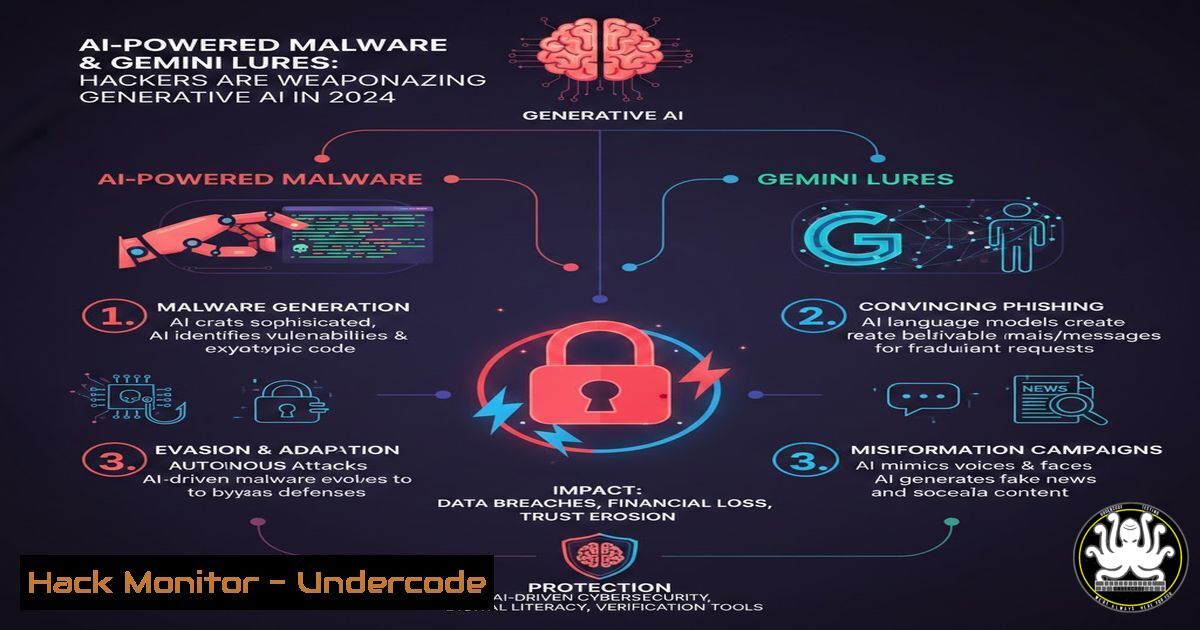
The dual-use nature of artificial intelligence has reached a critical inflection point. While enterprises leverage large language models (LLMs) to automate workflows and boost productivity, threat actors are now systematically integrating AI into their attack chains to bypass traditional security controls. Google’s latest Threat Intelligence Group (GTIG) AI Threat Tracker reveals that attackers are not merely using AI to write phishing emails—they are reverse-engineering models, deploying AI-powered malware, and creating sophisticated Gemini-themed lures to compromise endpoints and cloud environments. This article dissects the technical methodologies observed by Google, provides actionable defense commands, and outlines how blue teams can adapt to this evolving threat landscape.
Learning Objectives
- Understand how threat actors exploit generative AI for reconnaissance, payload generation, and evasion.
- Analyze real-world AI-assisted attack chains and the tools used to clone or jailbreak LLMs.
- Implement detection and mitigation strategies using Linux, Windows, and cloud-native security controls.
You Should Know
1. LLM Jailbreaking and Model Cloning Techniques
Google’s report highlights a surge in attempts to “jailbreak” commercial AI models to bypass content restrictions and extract proprietary reasoning logic. Attackers use prompt injection to coerce models into generating exploit code or revealing how they were trained. In some cases, adversaries have successfully cloned smaller models by querying APIs and using the outputs to train local replicas.
Step‑by‑step guide to understanding and detecting LLM exfiltration:
- Monitor API usage anomalies: Use cloud logging tools to detect unusual query patterns.
– AWS CloudTrail: `aws cloudtrail lookup-events –lookup-attributes AttributeKey=EventName,AttributeValue=InvokeModel`
– Azure Monitor: `az monitor activity-log list –resource-id /subscriptions/{sub-id}/resourceGroups/{rg}/providers/Microsoft.MachineLearningServices/workspaces/{workspace}`
2. Analyze prompt payloads: Deploy a proxy like OWASP Coraza to inspect incoming prompts for known jailbreak strings.
 Example ModSecurity rule for detecting common jailbreak attempts
SecRule REQUEST_BODY "@rx ignore\s+all\s+previous\s+instructions" \
"id:1001,phase:2,deny,status:403,msg:'AI Jailbreak Attempt Detected'"
- Check for model extraction traffic: Use Zeek (formerly Bro) to identify large volumes of identical queries from a single source IP.
zeek -C -r traffic.pcap
cat notice.log | grep "High_Query_Volume"
-
AI-Powered Social Engineering: Gemini Lures in the Wild
Threat actors are leveraging the brand recognition of AI assistants like Google Gemini to distribute malware. These campaigns use spear-phishing emails that appear to be from Gemini support, urging recipients to install a “security update” or “enhanced plugin.” The payloads are often signed with stolen certificates to evade initial detection.
Step‑by‑step guide to analyzing and blocking Gemini-themed lures:
1. Extract indicators from email headers:
 Use eml parser to analyze phishing email
eml_parser --input malicious.eml --output json | jq '.header.from, .header.subject'
2. Sandbox execution analysis:
- Run the attached executable in Cuckoo Sandbox or any dynamic analysis tool.
cuckoo submit --timeout 120 suspicious_installer.exe
cuckoo report --json 1 > report.json
3. Block malicious domains via DNS sinkhole:
- Add detected domains to a blocklist in Pi-hole or Bind.
echo "address=/fake-gemini-update.com/0.0.0.0" >> /etc/pihole/custom.list
pihole restartdns
- Create Windows Firewall rule to block outbound C2:
New-NetFirewallRule -DisplayName "Block Gemini Malware C2" -Direction Outbound -Protocol TCP -RemotePort 443 -RemoteAddress 192.168.1.100 -Action Block
3. AI-Generated Malware: Polymorphic Payloads on the Fly
Attackers are now using LLMs to generate polymorphic code that changes with each infection. This technique evades signature-based antivirus and makes reverse engineering more difficult. Google observed malware that queries a private AI model to generate new decryption routines or obfuscation layers every 24 hours.
Step‑by‑step guide to analyzing AI-generated malware:
- Static analysis with YARA rules targeting AI artifacts:
rule AI_Generated_JavaScript {
strings:
$a = "eval(atob" nocase
$b = "function decrypt" nocase
$c = "Math.random" nocase
condition:
all of them
}
2. Dynamic analysis using ProcMon and API monitoring:
- On Windows, use Sysinternals ProcMon to log process activity.
- On Linux, use `strace` to trace system calls.
strace -o malware_trace.log -f -e trace=network,file ./malicious_binary
3. Deobfuscate using CyberChef or custom Python scripts:
import base64
with open("obfuscated.txt", "r") as f:
encoded = f.read()
decoded = base64.b64decode(encoded).decode('utf-8')
print(decoded)
4. Attack Chain Integration: AI as the Orchestrator
In advanced persistent threats (APTs), AI is being used to automate decision-making during an intrusion. The AI monitors the infected environment, decides which credential harvesting tool to deploy based on the operating system, and adjusts its C2 communication patterns to mimic legitimate traffic.
Step‑by‑step guide to detecting AI-driven attack chains:
1. Baseline network behavior with Zeek and RITA:
 Install RITA (Real Intelligence Threat Analytics)
rita import pcap/ zeek-logs/
rita show-beacons --html
2. Detect unusual process parent-child relationships using Sysmon:
<!-- Sysmon config to log process creation with command line -->
<EventFiltering>
<ProcessCreate onmatch="exclude"/>
</EventFiltering>
3. Hunt for AI-generated scripts in PowerShell logs:
Get-WinEvent -LogName "Microsoft-Windows-PowerShell/Operational" | Where-Object { $<em>.Message -like "Invoke-Expression" -or $</em>.Message -like "FromBase64String" } | Select-Object TimeCreated, Message
5. Cloud Hardening Against AI-Assisted Attacks
Attackers are exploiting misconfigured cloud AI services to mine cryptocurrency or steal proprietary models. Google’s report notes a rise in compromised cloud credentials used to spin up GPU instances for model theft.
Step‑by‑step guide to securing AI workloads in the cloud:
1. Enforce least privilege for AI service accounts:
- Use AWS IAM conditions to restrict model invocation.
{
"Effect": "Deny",
"Action": "sagemaker:InvokeEndpoint",
"Resource": "",
"Condition": {
"IpAddress": {
"aws:SourceIp": "10.0.0.0/8"
}
}
}
2. Enable VPC endpoints for AI services:
- Prevent public internet access to model endpoints.
aws ec2 create-vpc-endpoint --vpc-id vpc-12345 --service-name com.amazonaws.sagemaker.runtime
3. Monitor for anomalous GPU usage with CloudWatch:
aws cloudwatch get-metric-statistics --namespace AWS/SageMaker --metric-name GPUUtilization --start-time 2024-01-01T00:00:00Z --end-time 2024-01-02T00:00:00Z --period 3600 --statistics Average
6. Exploitation and Mitigation of AI Model Vulnerabilities
Adversaries are now targeting the model supply chain. By poisoning training data or exploiting insecure model serialization formats (like Pickle), they can embed backdoors that activate under specific conditions.
Step‑by‑step guide to securing the ML pipeline:
1. Scan models for malicious payloads using Fickling:
fickling model.pkl --check-safety
2. Validate training data integrity with cryptographic hashes:
sha256sum dataset.csv > dataset.checksum
 Compare checksums before each training run
3. Implement model signing and verification:
import hashlib
import hmac
key = b'secret-key'
with open('model.h5', 'rb') as f:
digest = hmac.new(key, f.read(), hashlib.sha256).hexdigest()
 Store digest securely; verify before loading
What Undercode Say
- The AI attack surface is expanding beyond chatbots. As Google’s report confirms, threat actors are treating LLMs as just another component to exploit—whether through prompt injection, model theft, or AI-generated malware. Defenders must extend their monitoring to include API calls to AI services, not just traditional endpoints.
- Traditional signatures are obsolete against polymorphic AI payloads. Security teams must shift toward behavioral analysis and anomaly detection. Tools like Zeek, RITA, and custom YARA rules targeting AI artifacts are now essential for hunting campaigns that use Gemini lures or LLM-generated code.
The integration of AI into offensive security toolkits represents a paradigm shift. Attackers are no longer limited by manual coding skills—they can generate, test, and deploy variants at machine speed. Defenders must respond in kind, using AI for threat hunting, log analysis, and automated containment. The key is to secure the AI supply chain, monitor for unusual model access patterns, and assume that any public-facing AI service is a potential vector for compromise.
Prediction
Within the next 12 months, we will see the first fully autonomous AI-to-AI cyberattacks, where one LLM compromises another without human intervention. This will likely involve adversarial prompts that trigger model hallucinations leading to privilege escalation in connected systems. Additionally, the rise of AI-generated deepfake voice calls combined with Gemini-themed lures will lead to a spike in business email compromise (BEC) incidents targeting C-level executives. Organizations that fail to implement AI-aware security controls today will find themselves unable to defend against these machine-speed threats tomorrow.
▶️ Related Video (82% Match):
🎯Let’s Practice For Free:
IT/Security Reporter URL:
Reported By: Richardstaynings Ai – Hackers Feeds
Extra Hub: Undercode MoN
Basic Verification: Pass ✅


