
Listen to this Post
Introduction:
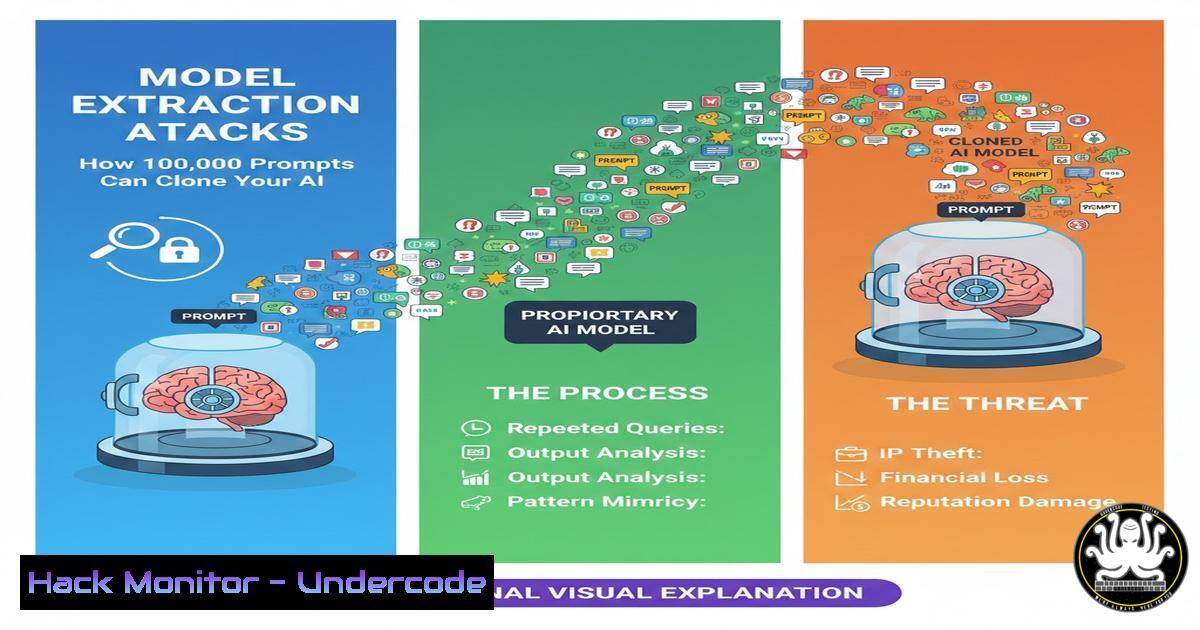
A recent incident involving Google’s Gemini AI has sent shockwaves through the enterprise world: attackers successfully probed the model over 100,000 times in an attempt to clone its core capabilities. This event highlights a critical vulnerability known as a “model extraction attack” or “distillation attack,” where adversaries use numerous queries to reverse-engineer a proprietary AI through its public API. For organizations racing to adopt AI, this reveals a fundamental security flaw—if a model can be replicated simply by talking to it, what happens to the sensitive data and competitive intelligence it holds?
Learning Objectives:
- Understand the mechanics of model extraction attacks and how they differ from traditional data breaches.
- Learn to identify the indicators of an ongoing distillation attack through API monitoring.
- Implement practical defense strategies, including rate limiting, output randomization, and query pattern analysis.
You Should Know:
1. Anatomy of a Distillation Attack
The technique used against Gemini is not a hack in the traditional sense. It leverages the model’s own functionality to create a “shadow” model. The attacker sends thousands of varied prompts, collects the output pairs, and uses this dataset to train a smaller, cheaper model that mimics the behavior of the original. Stanford researchers famously demonstrated this for just $600. The attack exploits the fact that AI models, by design, reveal their learned patterns through their responses.
Step‑by‑step guide to simulating (ethically) and understanding the attack vector:
1. Probe for Coverage: An attacker first maps the model’s knowledge by asking diverse questions across different domains (e.g., “Explain quantum computing,” “Write a Python script for a reverse shell,” “Summarize the plot of ‘Inception'”).
2. Synthesize Data: The prompts and responses are stored as a new dataset. The goal is not to steal the data the model was trained on, but to steal the model’s behavior.
3. Train the Clone: This synthetic dataset is used to train a new, often smaller, model (a student model). The student learns to produce outputs similar to the target (teacher) model.
4. Validate and Iterate: The attacker tests the clone’s responses against the original and refines the prompt set to fill knowledge gaps.
2. Detecting Extraction Through API Monitoring
Google caught this attack because of the sheer volume (100,000+ prompts). However, sophisticated attackers will spread queries over time. Defenders must look beyond simple volume.
Step‑by‑step guide to setting up basic detection logic:
- Analyze Query Diversity: A normal user has a focused query pattern (e.g., all on marketing copy). An extractor shows high entropy—queries spanning coding, history, creative writing, and security topics.
- Monitor for Repetitive Structures: Extraction often uses similar prompt templates with slight variations (e.g., “Explain X in 50 words,” “Explain X in 100 words”). Use a SIEM tool to log and analyze prompt structures.
- Check for API Cost Anomalies: A sudden spike in compute or token usage from a single source is a red flag. Set up alerts in your cloud provider (AWS CloudWatch, Azure Monitor) for anomalous API consumption patterns.
Linux Command Suggestion: Use `tcpdump` or `ngrep` on a test API endpoint to capture and analyze prompt patterns for research purposes.Example: Capture HTTP POST requests to your AI endpoint for pattern analysis (test environment only!) sudo tcpdump -i eth0 -A -s 0 'tcp port 80 and (((ip[2:2] - ((ip[bash]&0xf0)>>2)) != 0))' | grep -i "prompt"
3. Defending Your AI: Rate Limiting and Beyond
The first line of defense against extraction is aggressive rate limiting, but it must be intelligent.
Step‑by‑step guide to implementing layered API defenses:
- Per-User/Per-IP Rate Limiting: Implement strict limits on the number of requests per API key or IP address over a short period. This is basic but essential.
- Semantic Rate Limiting: This is more advanced. Limit requests based on the diversity of topics from a single source. If a user asks about physics, then poetry, then malware coding within a minute, throttle them.
- Add Noise to Outputs: Introduce minor, non-deterministic variations in responses (e.g., slight paraphrasing, different code comment styles) for non-critical queries. This makes it harder for an attacker to create a consistent training set without degrading user experience.
Windows PowerShell Suggestion: For testing a local model, you can create a script to simulate varied requests.Example: Simulate a multi-topic prompt sequence for testing defenses $prompts = @("Write a haiku about servers", "Explain SQL injection", "Give me a recipe for pasta") foreach ($p in $prompts) { Use Invoke-RestMethod to call your local API Invoke-RestMethod -Uri "http://your-model/api" -Method POST -Body (@{prompt=$p} | ConvertTo-Json) -ContentType "application/json" Write-Host "Simulating prompt: $p" Start-Sleep -Seconds 1 }
4. Securing the Training Data Pipeline
The hypocrisy in Google’s reaction points to a deeper issue: the data used to train these models is often scraped indiscriminately. For enterprises, this means the model you build might inadvertently contain and reveal your own proprietary information if not properly sanitized.
Step‑by‑step guide to hardening your data pipeline:
- Data Sanitization: Before any company data touches a model, scrub it of PII, trade secrets, and internal project names. Use tools like Presidio or Apache Beam for large-scale data de-identification.
- Differential Privacy: Implement differential privacy during training. This adds statistical noise to the training process, making it exponentially harder for an attacker to determine if a specific piece of data was used in training, thus protecting individual records.
- Adversarial Retraining: Train your model to recognize and reject extraction attempts. This involves creating a dataset of known “extraction-style” prompts and fine-tuning the model to respond with a generic error or refuse to answer.
-
The Future of AI Security: Watermarking and Forensics
To prove a cloned model originated from yours, you need a way to fingerprint your AI’s outputs.
Step‑by‑step concept for implementing AI watermarks:
- Choose a Watermarking Technique: Methods include subtly biasing the model’s word choices (e.g., preferring certain synonyms) or embedding a specific statistical signature in the output tokens.
- Integrate at Inference: The watermark is applied not during training, but during the response generation phase. It’s invisible to the user but detectable by the model owner.
- Build a Detection Tool: Create a secondary tool that analyzes text and determines the likelihood it came from your watermarked model. This can be used to scan the web for unauthorized clones.
Linux Command Suggestion: You can use `grep` and `awk` to search for unique watermark phrases in a suspect model’s output if you used a simple textual watermark.Search for a specific watermark phrase (e.g., "additionally," used at a specific rate) echo "$suspect_output" | grep -o "additionally" | wc -l
What Undercode Say:
- The irony is the architecture: The very feature that makes LLMs powerful—their ability to generalize from training data—is what makes them vulnerable to extraction. We are building our castles on sand.
- Defense is a cat-and-mouse game: Rate limits can be circumvented with distributed attacks, and watermarking can be diluted. The security community must shift focus from “preventing access” to “making extraction economically non-viable.”
Key Takeaways:
- Assume your model’s behavior can be copied. If it’s accessible via an API, treat it as a public blueprint. Focus your protection on the data that fine-tuned it, which is your true competitive advantage.
- The hypocrisy is a red herring. While Google’s outrage over scraping is ironic, it distracts from the real engineering problem: we lack robust, native security controls for AI models. The industry must prioritize building these controls into the model architecture itself, not just the API gateway.
Prediction:
Within the next 18 months, we will see the first major corporate data leak traced not to a database hack, but to a systematic model extraction attack. An attacker will clone a company’s internal support or coding assistant and, through analysis of the clone’s behavior, infer confidential business logic, unreleased product details, or security vulnerabilities present in the original’s training data. This will force a complete re-evaluation of AI risk management and spur the development of “AI Firewalls” as a standard enterprise security product.
▶️ Related Video (86% Match):
🎯Let’s Practice For Free:
IT/Security Reporter URL:
Reported By: Jeffrey Fleischer – Hackers Feeds
Extra Hub: Undercode MoN
Basic Verification: Pass ✅


