Listen to this Post
Introduction
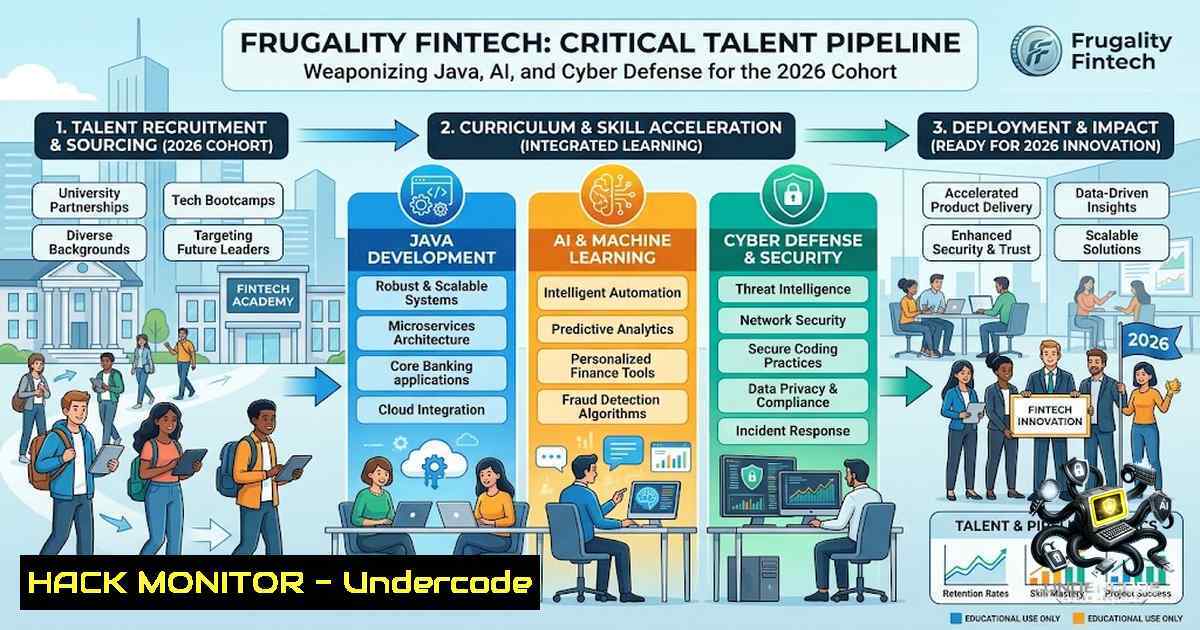
The financial technology sector faces an unprecedented convergence of software engineering velocity and cybersecurity threat surfaces, demanding professionals who can architect resilient systems while simultaneously defending them. Furgality Fintech’s recent announcement of stipend-based internships for the 2026 and 2027 graduating batches signals a strategic investment in cultivating a dual-skilled workforce capable of navigating the complexities of modern fintech infrastructure—where a single misconfigured API endpoint can expose millions of transactions, and an unhardened cloud deployment can become an attacker’s entry point.
Learning Objectives
- Master the intersection of Java full-stack development with secure coding practices, including OWASP Top 10 mitigation strategies
- Develop proficiency in AI-driven threat detection and data analytics for financial fraud pattern recognition
- Implement enterprise-grade cybersecurity frameworks, including zero-trust architecture principles and incident response protocols
- Understand the compliance landscape (PCI-DSS, GDPR, SOC2) and its implementation in fintech environments
You Should Know
1. Java Full-Stack Secure Development Lifecycle
The Java Full Stack Developer role at Furgality Fintech demands more than CRUD operations—it requires embedding security at every layer of the application stack. Modern fintech applications typically employ Spring Boot microservices with React or Angular frontends, all orchestrated through Kubernetes clusters. However, the 2025 CVE database reveals that 43% of fintech breaches originated from improper input validation in Java-based REST APIs.
Step-by-Step Secure Development Guide:
- Dependency Vulnerability Scanning: Before writing a single line of code, scan your project dependencies using OWASP Dependency-Check:
Linux/macOS
./dependency-check.sh --project "FintechApp" --scan ./src --format HTML --out ./reports

Windows PowerShell
dependency-check.bat --project "FintechApp" --scan ./src --format HTML --out ./reports
-
Implement Parameterized Queries: Prevent SQL injection in your data access layer:
// Secure implementation using JPA with parameter binding @Query("SELECT t FROM Transaction t WHERE t.userId = :userId AND t.date BETWEEN :startDate AND :endDate") List<Transaction> findUserTransactions(@Param("userId") Long userId, @Param("startDate") LocalDateTime startDate, @Param("endDate") LocalDateTime endDate); -
JWT Token Hardening: Implement token-based authentication with short-lived access tokens and refresh token rotation:
// Configure JWT with appropriate expiration and signing key public String generateAccessToken(UserDetails userDetails) { return Jwts.builder() .setSubject(userDetails.getUsername()) .setIssuedAt(new Date()) .setExpiration(new Date(System.currentTimeMillis() + 900000)) // 15 minutes .signWith(SignatureAlgorithm.HS512, secretKey) .compact(); } -
Rate Limiting Implementation: Protect your APIs from brute force and DoS attacks:
Spring Boot application.yml rate limiting configuration
resilience4j.ratelimiter:
instances:
authEndpoint:
limitForPeriod: 5
limitRefreshPeriod: 60s
timeoutDuration: 5s
-
Logging and Monitoring: Implement structured logging with sensitive data redaction:
// Logback configuration with masking
public class SensitiveDataMaskingConverter extends MessageConverter {
@Override
public String convert(ILoggingEvent event) {
String message = event.getFormattedMessage();
return message.replaceAll("\b\d{16}\b", ""); // Mask credit cards
}
}
2. Cybersecurity Operations and Incident Response
The Cybersecurity Internship at Furgality Fintech requires hands-on experience with threat hunting, SIEM configuration, and vulnerability assessment. In 2026, fintech organizations face an average of 1,200 attack attempts per day, making automated security monitoring and rapid incident response critical competencies.
Step-by-Step Cybersecurity Lab Setup:
- Set Up a Home SOC Lab: Deploy the Elastic Stack (ELK) for centralized logging and threat detection:
Deploy Elasticsearch, Logstash, Kibana using Docker
docker-compose up -d elasticsearch logstash kibana

Configure Filebeat to ship application logs
filebeat modules enable system
filebeat setup --dashboards
-
Network Traffic Analysis with Wireshark: Capture and analyze suspicious network patterns:
Linux - Capture HTTP traffic on port 80
sudo tshark -i eth0 -f "tcp port 80" -Y "http.request" -T fields -e ip.src -e http.user_agent

Windows PowerShell - Similar capture using netsh
netsh trace start capture=yes provider=Microsoft-Windows-Kernel-1etwork tracefile=C:\capture.etl
netsh trace stop
3. Vulnerability Scanning with Nmap and OpenVAS:
 Comprehensive Nmap scan with service detection
nmap -sV -sC -O -p- --script=vuln 192.168.1.0/24 -oA fintech_network_scan

OpenVAS/GVM vulnerability assessment
gvm-cli --gmp-username admin --gmp-password password socket --socket-path /var/run/gvmd.sock
4. SIEM Rule Creation for Fraud Detection:
-- Example Splunk/Elastic query for detecting multiple failed logins followed by success
index=fintech_app_logs
| eval status = if(status_code=401, "failed", "success")
| stats count(eval(status="failed")) as failed_count,
count(eval(status="success")) as success_count by user_id, src_ip
| where failed_count > 5 AND success_count > 0
| table user_id, src_ip, failed_count, success_count
5. Implementing Zero-Trust Network Access:
 Configure iptables to implement micro-segmentation
iptables -A INPUT -p tcp --dport 3306 -s 10.0.1.0/24 -j ACCEPT  Allow only internal subnet
iptables -A INPUT -p tcp --dport 3306 -j DROP  Deny all other access

Set up WireGuard VPN for secure access
wg genkey | tee privatekey | wg pubkey > publickey
wg setconf wg0 /etc/wireguard/wg0.conf
3. AI & Data Analytics for Financial Security
The AI & Data Analyst role focuses on building predictive models for fraud detection, credit risk assessment, and algorithmic trading pattern analysis. Machine learning models in fintech must balance accuracy with explainability, particularly when regulatory compliance requires auditable decision-making processes.
Step-by-Step AI Model Development and Security:
- Set Up a Secure ML Pipeline with Python:
Environment setup with security-focused libraries
pip install tensorflow-privacy  Differential privacy for training data
pip install adversarial-robustness-toolbox  Defend against adversarial attacks
pip install lime shap  Model explainability
2. Implement Anomaly Detection for Financial Transactions:
from sklearn.ensemble import IsolationForest
import pandas as pd
import numpy as np

Load transaction data with feature engineering
df = pd.read_csv('transactions_2026.csv')
features = ['amount', 'transaction_time', 'location_distance', 'device_id_count']
X = df[bash]

Train isolation forest for anomaly detection
iso_forest = IsolationForest(contamination=0.01, random_state=42)
predictions = iso_forest.fit_predict(X)
anomalies = df[predictions == -1]  Flagged transactions
3. Secure Model Deployment with Model Monitoring:
 Kubernetes deployment with model serving and monitoring
apiVersion: apps/v1
kind: Deployment
metadata:
name: fraud-detection-model
labels:
app: fraud-detector
annotations:
security: "enable-model-signature-verification"
spec:
replicas: 3
selector:
matchLabels:
app: fraud-detector
template:
metadata:
labels:
app: fraud-detector
spec:
containers:
- name: triton-server
image: nvcr.io/nvidia/tritonserver:23.10-py3
args: ["--model-repository", "/models", "--enable-metrics"]
- name: model-monitor
image: openzipkin/zipkin:latest
env:
- name: STORAGE_TYPE
value: "elasticsearch"
4. Data Encryption at Rest and in Transit:
 Enable Transparent Data Encryption (TDE) for PostgreSQL
sudo -u postgres psql -c "CREATE EXTENSION pgcrypto;"

AWS CLI command to enable S3 server-side encryption
aws s3 put-bucket-encryption --bucket fintech-data-bucket --server-side-encryption-configuration '{
"Rules": [
{
"ApplyServerSideEncryptionByDefault": {
"SSEAlgorithm": "AES256"
}
}
]
}'
5. Implement Data Drift Detection:
from alibi_detect.cd import KSDrift
import numpy as np

Monitor feature distributions for model degradation
drift_detector = KSDrift(X_ref, p_val=0.05)
preds = drift_detector.predict(X_new)
if preds['data']['is_drift']:
alert_team("Model drift detected - retraining required")
4. Cloud Hardening for Fintech Workloads
Furgality Fintech’s infrastructure likely operates on major cloud providers (AWS, Azure, or GCP). Understanding cloud security best practices is essential, particularly around IAM policies, network security groups, and data protection.
Step-by-Step Cloud Security Implementation:
- AWS Security Groups with Principle of Least Privilege:
{
"Version": "2012-10-17",
"Statement": [
{
"Effect": "Allow",
"Action": "s3:GetObject",
"Resource": "arn:aws:s3:::fintech-data/",
"Condition": {
"IpAddress": {
"aws:SourceIp": "10.0.0.0/8"
},
"StringEquals": {
"s3:prefix": "transactions/encrypted/"
}
}
}
]
}
2. Azure Key Vault Configuration for Secrets Management:
 Azure PowerShell - Configure Key Vault access policies
$keyVault = Get-AzKeyVault -VaultName "FintechKV"
Set-AzKeyVaultAccessPolicy -VaultName "FintechKV" `
-UserPrincipalName "[email protected]" `
-PermissionsToSecrets get,list `
-PermissionsToKeys decrypt,encrypt
3. GCP Cloud Armor for DDoS Protection:
 Google Cloud Armor security policy
securityPolicy:
name: fintech-waf
defaultRule: rate-based-ban
rules:
- action: allow
match:
config:
srcIpRanges:
- "10.0.0.0/8"
priority: 1000
- action: deny(429)
match:
config:
srcIpRanges:
- ""
rateLimitOptions:
rateLimitThreshold: 100
perInterval: minute
5. Vulnerability Exploitation and Mitigation
Understanding how attackers operate is crucial for effective defense. The cybersecurity internship should include hands-on experience with common attack vectors and their remediation.
Practical Attack Simulation and Defense:
1. Cross-Site Scripting (XSS) Prevention:
// React component with XSS protection
import DOMPurify from 'dompurify';

function SecureTransactionDisplay({ transactionData }) {
const sanitizedData = DOMPurify.sanitize(transactionData, {
ALLOWED_TAGS: ['b', 'i', 'em', 'strong'],
ALLOWED_ATTR: []
});
return

<div dangerouslySetInnerHTML={{ __html: sanitizedData }} />

;
}
2. API Security Testing with Burp Suite:
 Burp Suite CLI automation for OWASP API Top 10
burp-rest-api -c "https://api.furgality.com/v1" --scope "https://api.furgality.com/v1/" \
--run-scan --output-format html --output-file api_security_report.html
3. Database Hardening Commands:
-- MySQL security hardening
CREATE USER 'fintech_app'@'10.0.0.%' IDENTIFIED BY 'strong_password_2026';
GRANT SELECT, INSERT, UPDATE ON fintech_db. TO 'fintech_app'@'10.0.0.%';
REVOKE ALL PRIVILEGES ON . FROM 'fintech_app'@'10.0.0.%';
FLUSH PRIVILEGES;

-- Enable query logging for audit
SET GLOBAL general_log = 'ON';
SET GLOBAL log_output = 'TABLE';
What Undercode Say
- Key Takeaway 1: The convergence of Java development skills with cybersecurity knowledge is no longer optional but mandatory for fintech roles. Candidates who demonstrate both secure coding practices and an understanding of defensive architecture will have a significant competitive advantage.
-
Key Takeaway 2: The internship structure at Furgality Fintech reflects a broader industry trend toward building security into the development lifecycle from day one, rather than treating it as an afterthought. This shift creates opportunities for cross-functional learning and career acceleration.
Analysis: The stipend of ₹12,000 per month, while modest, positions this as a accessible entry point for students from any degree background, democratizing opportunities in fintech. The dual focus on AI/Data Analytics alongside traditional cybersecurity signals recognition that modern threat detection increasingly relies on machine learning capabilities. The inclusion of Java Full Stack development ensures that interns understand the full application architecture, making them more effective security practitioners. The application deadlines (August 14, 2026) provide a structured timeline for students to prepare their technical portfolios, potentially including GitHub projects demonstrating secure API development, SIEM configurations, or ML-based anomaly detection. Furgality’s recruitment strategy appears designed to build a talent pipeline that can immediately contribute to both feature development and security operations, reducing the onboarding friction common in fintech hiring.
Prediction
- +1: The internship program will produce a cohort of professionals with rare cross-domain expertise, making them highly sought after in the fintech job market of 2027-2028, potentially commanding starting salaries 30% above market average for their experience level.
-
+1: Furgality Fintech’s investment in talent development positions them competitively against legacy financial institutions, potentially resulting in faster product innovation cycles and improved security posture within 12-18 months of the program’s completion.
-
-1: The rapid pace of technological change in fintech security may render some skills learned during the internship partially obsolete within 3 years, necessitating continuous learning and adaptation from all participants.
-
-1: The concentration of technical training without equal emphasis on soft skills and business context could create a cohort of specialists who struggle to communicate security risks to non-technical stakeholders, a critical gap in enterprise security programs.
-
+1: The internship’s timing aligns with the increasing regulatory scrutiny on fintech security (RBI guidelines, GDPR enforcement), creating immediate value for Furgality’s compliance efforts and potentially opening doors for permanent roles focused on regulatory technology (RegTech) development.
▶️ Related Video (78% Match):
https://www.youtube.com/watch?v=2Lm5m7GoaZs
🎯Let’s Practice For Free:
🎓 Live Courses & Certifications:
Join Undercode Academy for Verified Certifications
🚀 Request a Custom Project:
Secure, high-velocity infrastructure and disruptive technological engineering. Contact our engineering team for high-tier development and proprietary systems:
[email protected]
💎 Smart Architecture | 🛡️ Secure by Design | ⭐ Trusted by Thousands
IT/Security Reporter URL:
Reported By: Yashashree Khandate – Hackers Feeds
Extra Hub: Undercode MoN
Basic Verification: Pass ✅


