Listen to this Post
Introduction:
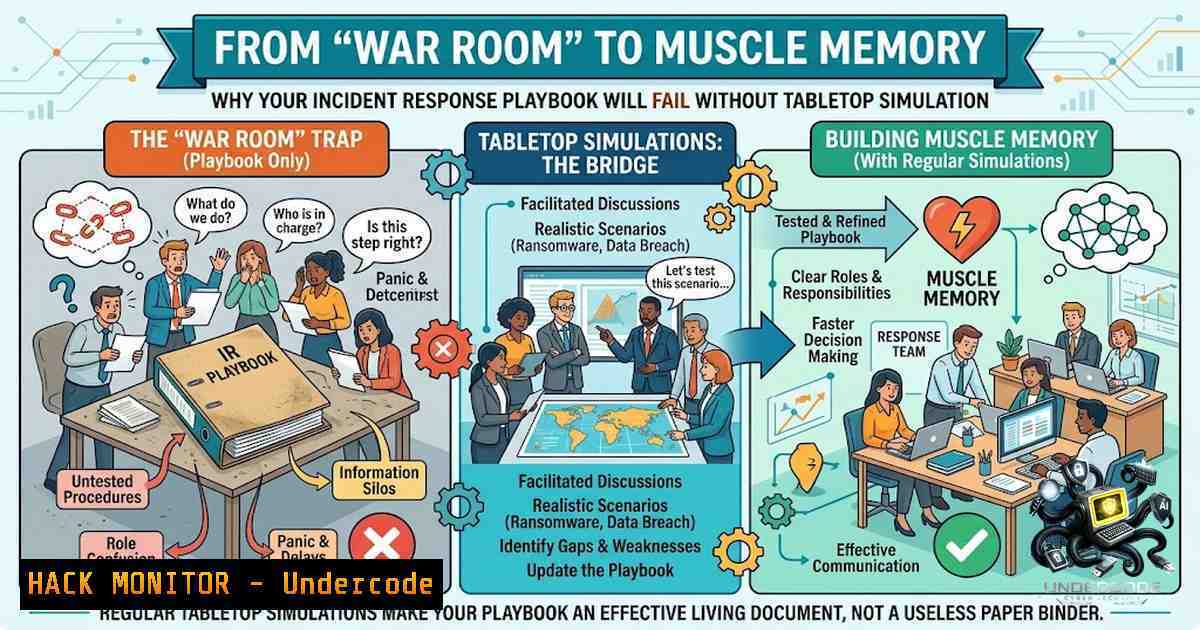
In the high-stakes world of cybersecurity, the difference between a contained incident and a catastrophic breach often comes down to a single, unforgiving variable: human performance under pressure. A Fortune 500 CISO recently observed that the best playbooks and the most meticulously crafted RACI charts are destined to fail—not because of flawed writing, but because organizations rarely test who actually steps up, who takes ownership, and who freezes when the moment demands the most. This reality underscores a critical truth: cyber resilience is not built on documentation; it is forged through repeated, realistic simulation that transforms theoretical plans into muscle memory.
Learning Objectives:
- Understand why traditional playbooks and RACI matrices break down during live incidents and how tabletop simulations expose these hidden gaps.
- Learn to design and execute integrated IT/OT tabletop exercises that bridge the operational divide between cybersecurity, engineering, and business teams.
- Master the use of AI-driven simulation platforms like PROGIST’s WarRoom to automate scenario generation, track decision-making, and build crisis-ready teams.
You Should Know:
- The Anatomy of Playbook Failure: Why Paper Plans Crumble Under Pressure
The veteran CISO’s insight cuts to the heart of a systemic problem in enterprise cybersecurity: plans are written in calm conference rooms, but incidents unfold in chaotic war rooms. When a breach occurs, escalation paths that look clear on paper often lead to dead ends because they assume systems that don’t exist in OT environments or rely on handoffs that nobody has actually mapped. The gap between “responsible” and “accountable” becomes painfully apparent when the clock is ticking.
This is where tabletop exercises (TTXs) become indispensable. A TTX is a facilitated discussion built around a simulated incident where participants talk through what they would do, who would make which decisions, what evidence they would need, and where response steps would stall—all without touching production systems. The goal is not to achieve a perfect score but to surface the cracks in your response framework before a real attacker exploits them.
Step‑by‑Step Guide: Conducting a Gap‑Revealing Tabletop Exercise
- Define Exercise Scope and Objectives: Start with a one-paragraph purpose statement that describes what the exercise is validating. Are you testing ransomware response, supply chain compromise, or OT system takeover? Align scenarios to your organization’s most critical risks.
- Assemble the Right Participants: This is where most exercises fail. Pull in not just the IT security team but also OT engineers, business unit leaders, legal, PR, and executive decision-makers. When engineering and operations are missing, the exercise defaults to IT assumptions about recovery that break down quickly in environments where physical processes and safety constraints matter.
- Design Realistic Scenarios: Use intelligence-driven scenarios (based on actual threat actor TTPs) and consequence-driven scenarios (focused on business impact). Modern platforms like WarRoom use AI to rapidly generate realistic, complex crisis scenarios, reducing preparation time from weeks to minutes.
- Execute with a Skilled Facilitator: The facilitator guides the team through the crisis lifecycle, introducing dynamic injects—unexpected events like data leaks or press inquiries—to test decision-making under pressure. A practical tabletop works best with four role types: decision-makers, responders, observers, and a facilitator.
- Document and Debrief: Every decision, delay, and escalation gets tracked. Use the exercise to produce a detailed performance analysis that identifies response gaps and improves crisis strategy. Update your incident response plan based on findings and conduct follow-up exercises regularly.
-
Bridging the IT‑OT Divide: Why Integrated Simulations Are Non‑Negotiable
Operational Technology (OT) environments—the systems that control power grids, manufacturing lines, and critical infrastructure—are fundamentally different from IT networks. They use different protocols, have different patch cycles, and prioritize safety and availability over confidentiality. Yet most cybersecurity tabletop exercises still treat OT as an afterthought, if they include it at all.
This is a dangerous oversight. When a ransomware variant hits a manufacturing plant, the IT team’s playbook might call for an immediate system shutdown. But in an OT environment, an emergency shutdown could cause physical damage, product loss, or even safety hazards. The response must account for sequenced shutdowns, safety interlocks, and the reality that you cannot simply “reboot” a SCADA controller.
Integrated IT/OT tabletop exercises create shared understanding across engineering, cybersecurity, operations, and safety teams. They converge teams that rarely talk to each other, build trust, clarify roles, and enhance communication in high-stakes, multi-team response efforts. The gaps that surface during these exercises—unmapped handoffs, missing escalation paths, ownership that looks clear on paper but falls apart in the room—are precisely the gaps that would doom a real incident response.
Step‑by‑Step Guide: Running an Integrated IT/OT Tabletop
- Map Your IT/OT Dependencies: Before the exercise, document how IT systems (Active Directory, patching servers, monitoring tools) interact with OT systems (PLCs, HMIs, SCADA). Identify single points of failure and cross-domain dependencies.
- Design OT‑Realistic Scenarios: Create scenarios that reflect the realities of SCADA architectures, limited staff, tool constraints, and the nuances of OT forensics. For example, simulate a compromised engineering workstation that is used to push malicious logic to programmable logic controllers.
- Include the Plant Floor: Invite engineers and operators who actually run the plant. Their input is critical because they understand the physical processes, safety constraints, and sequencing that IT teams often overlook.
- Test Escalation Paths: Practice the handoff between IT detection (e.g., EDR alert on a compromised workstation) and OT response (e.g., isolating the affected control network segment). Identify who has the authority to make shutdown decisions and how that authority is communicated.
- Use a Platform That Supports Both Domains: Platforms like WarRoom are built to run realistic, AI-generated crisis scenarios as live tabletop exercises across IT and OT teams together, where playbooks instantly become assigned, time-bound tasks with clear RACI ownership.
-
From Simulation to Muscle Memory: The AI‑Driven Evolution of Incident Response
Traditional tabletop exercises have a major limitation: they are static. Once the scenario is written, it plays out the same way every time. Teams can memorize the “correct” answers without actually building the adaptive decision-making skills needed for real incidents.
AI-driven platforms like PROGIST’s WarRoom are transforming this landscape. WarRoom automates tabletop exercises with dynamic scenarios that adapt in real-time, fostering collaboration and insights that keep teams ready for any cyber threat. The platform’s Scenario AI rapidly generates realistic crisis scenarios, while its Report AI automates synthesis of large datasets to produce professional crisis summaries. A Media Generator creates synthetic social media and news environments for high-fidelity crisis simulations without public risk.
But the real innovation is in the transition from simulation to real incident response. When a real incident hits, the same war-room, tasks, and playbooks carry over—turning rehearsal into muscle memory. Teams don’t have to learn a new tool or process under fire; they simply execute the playbooks they’ve already drilled dozens of times.
Step‑by‑Step Guide: Implementing an AI‑Driven Simulation Program
- Select an AI‑Powered Platform: Evaluate platforms like WarRoom that offer AI-generated scenarios, real-time injects, and comprehensive reporting. Look for features like task management, playbook execution, evidence management, and secure out-of-band collaboration.
- Build Your Playbook Library: Upload your existing incident response playbooks into the platform. WarRoom allows you to execute predefined standardized response guides, reducing human error and strengthening regulatory compliance.
- Run Regular Simulations: Schedule exercises quarterly or bi-annually. Use the platform’s Facilitator Dashboard to manipulate the tempo of simulations and introduce unexpected events to evaluate team adaptability.
- Track Performance Metrics: Use the platform’s reporting to measure response speed against internal SLAs, generate automated transcripts of secure bridge calls, and maintain detailed activity logs for post-crisis forensic review.
- Iterate and Improve: Use the insights from each simulation to update your playbooks, refine your RACI charts, and address the gaps that surface during drills—not during a breach.
-
Verifying Your Incident Response Readiness: Essential Commands and Checklists
While tabletop exercises test your people and processes, you also need to verify that your technical controls are configured correctly. Below are essential commands and checks for both Linux and Windows environments that should be part of any incident response playbook.
Linux Commands for Incident Triage:
 View real-time system logs
tail -f /var/log/syslog

Check for recently modified files (potential indicators of compromise)
find / -type f -mtime -1 -ls 2>/dev/null

List all listening ports and associated processes
netstat -tulpn

Check for unauthorized scheduled tasks
crontab -l
for user in $(cut -f1 -d: /etc/passwd); do crontab -u $user -l; done

Verify integrity of system binaries (using RPM-based systems)
rpm -Va

Check for running processes and their network connections
lsof -i

Examine authentication logs for failed login attempts
grep "Failed password" /var/log/auth.log
Windows Commands for Incident Triage (PowerShell):
 Get security event logs from the last 30 days
Get-EventLog -LogName Security -After (Get-Date).AddDays(-30)

List all running processes with network connections
Get-1etTCPConnection | Select-Object LocalAddress, LocalPort, RemoteAddress, RemotePort, State, OwningProcess

Check for scheduled tasks that may indicate persistence
Get-ScheduledTask | Where-Object {$_.State -1e "Disabled"}

Examine the Windows event log for specific events (e.g., Event ID 4624 for successful logons)
Get-WinEvent -FilterHashtable @{LogName='Security'; ID=4624; StartTime=(Get-Date).AddDays(-7)}

Check for unauthorized user accounts
Get-LocalUser

Verify firewall rules
Get-1etFirewallRule | Where-Object {$_.Enabled -eq "True"}

Examine the contents of the hosts file (potential DNS hijacking)
Get-Content C:\Windows\System32\drivers\etc\hosts
NIST-Aligned Incident Response Checklist:
Based on the NIST SP 800-61 framework, ensure your playbook covers these phases:
- Preparation: Establish policies, procedures, and teams. Deploy monitoring and detection tools.
- Detection and Analysis: Identify the incident, gather evidence, and determine the scope.
- Containment, Eradication, and Recovery: Isolate affected systems, remove the threat, and restore operations.
- Post-Incident Activity: Conduct a lessons-learned review, update the incident response plan, and improve security controls.
-
Cloud and API Security Hardening for Modern Incident Response
As organizations migrate to the cloud, incident response must extend to IaaS, PaaS, and SaaS environments. Tabletop exercises should include drills for swiftly securing IAM and compute resources in AWS or Azure.
Verified AWS CLI Commands for Incident Response:
 Immediately revoke temporary credentials
aws sts revoke-credentials

List all IAM users and their access keys
aws iam list-users --query 'Users[].UserName'
aws iam list-access-keys --user-1ame <username>

Identify and disable unauthorized access keys
aws iam update-access-key --access-key-id <KEY_ID> --status Inactive --user-1ame <USERNAME>

Check for publicly accessible S3 buckets
aws s3api list-buckets --query 'Buckets[].Name' | xargs -I {} aws s3api get-bucket-acl --bucket {}

Enable CloudTrail for auditing if not already enabled
aws cloudtrail create-trail --1ame <TRAIL_NAME> --s3-bucket-1ame <BUCKET_NAME> --is-multi-region-trail

List all security groups with overly permissive rules
aws ec2 describe-security-groups --filters Name=ip-permission.cidr,Values='0.0.0.0/0'
API Security Checklist:
- Validate Input: Implement strict input validation to prevent injection attacks.
- Rate Limiting: Enforce rate limits to prevent brute force and DoS attacks.
- Authentication and Authorization: Use OAuth 2.0 or OpenID Connect; never hardcode API keys.
- Encryption: Enforce TLS 1.2+ for all API traffic.
- Logging and Monitoring: Log all API requests and monitor for anomalies.
- Regular Audits: Conduct regular security audits of your API endpoints.
What Undercode Say:
- The best playbooks are not the ones that look perfect on paper but the ones that have been stress-tested under realistic conditions. Tabletop simulations are not optional—they are the only way to discover who freezes, who steps up, and where your RACI chart falls apart before a real attacker finds those gaps.
- AI-driven simulation platforms like WarRoom are not just about running exercises faster; they are about creating a continuous feedback loop where every drill improves your playbooks, every decision is tracked, and your team builds the muscle memory to respond with precision when it matters most. The future of incident response belongs to organizations that treat resilience as a practice, not a document.
The core message from the CISO’s experience is undeniable: cyber resilience is not a destination but a continuous process of rehearsal and refinement. Organizations that treat tabletop exercises as a compliance checkbox will fail when the real incident hits. Those that embrace simulation as a strategic discipline—leveraging AI to generate realistic scenarios, integrating IT and OT teams, and turning every drill into actionable insights—will not only survive but thrive in the face of inevitable cyber threats.
Prediction:
- +1 Organizations that adopt AI-driven tabletop simulation platforms like WarRoom will see a 40-50% reduction in incident response time within 18 months, as teams build muscle memory through repeated, realistic drills.
- +1 The integration of IT and OT tabletop exercises will become a regulatory requirement for critical infrastructure sectors within the next 3-5 years, driven by increasing ransomware attacks on industrial control systems.
- -1 Organizations that continue to rely on static, paper-based playbooks without regular, realistic simulation will experience more severe breach outcomes, with average recovery costs exceeding those of simulation-ready peers by 2-3x.
- -1 The growing complexity of AI-generated attack vectors will outpace traditional tabletop preparation, forcing a shift toward continuous, automated simulation programs that can adapt to emerging threats in real-time.
- +1 The convergence of AI-driven simulation, real-time incident response platforms, and integrated IT/OT training will create a new standard for cyber resilience, turning crisis management from a reactive function into a proactive, data-driven discipline.
Expected Output:
Introduction:
In the high-stakes world of cybersecurity, the difference between a contained incident and a catastrophic breach often comes down to a single, unforgiving variable: human performance under pressure. A Fortune 500 CISO recently observed that the best playbooks and the most meticulously crafted RACI charts are destined to fail—not because of flawed writing, but because organizations rarely test who actually steps up, who takes ownership, and who freezes when the moment demands the most. This reality underscores a critical truth: cyber resilience is not built on documentation; it is forged through repeated, realistic simulation that transforms theoretical plans into muscle memory.
What Undercode Say:
- The best playbooks are not the ones that look perfect on paper but the ones that have been stress-tested under realistic conditions. Tabletop simulations are not optional—they are the only way to discover who freezes, who steps up, and where your RACI chart falls apart before a real attacker finds those gaps.
- AI-driven simulation platforms like WarRoom are not just about running exercises faster; they are about creating a continuous feedback loop where every drill improves your playbooks, every decision is tracked, and your team builds the muscle memory to respond with precision when it matters most. The future of incident response belongs to organizations that treat resilience as a practice, not a document.
Prediction:
- +1 Organizations that adopt AI-driven tabletop simulation platforms like WarRoom will see a 40-50% reduction in incident response time within 18 months, as teams build muscle memory through repeated, realistic drills.
- +1 The integration of IT and OT tabletop exercises will become a regulatory requirement for critical infrastructure sectors within the next 3-5 years, driven by increasing ransomware attacks on industrial control systems.
- -1 Organizations that continue to rely on static, paper-based playbooks without regular, realistic simulation will experience more severe breach outcomes, with average recovery costs exceeding those of simulation-ready peers by 2-3x.
- -1 The growing complexity of AI-generated attack vectors will outpace traditional tabletop preparation, forcing a shift toward continuous, automated simulation programs that can adapt to emerging threats in real-time.
- +1 The convergence of AI-driven simulation, real-time incident response platforms, and integrated IT/OT training will create a new standard for cyber resilience, turning crisis management from a reactive function into a proactive, data-driven discipline.
▶️ Related Video (78% Match):
🎯Let’s Practice For Free:
🎓 Live Courses & Certifications:
Join Undercode Academy for Verified Certifications
🚀 Request a Custom Project:
Secure, high-velocity infrastructure and disruptive technological engineering. Contact our engineering team for high-tier development and proprietary systems:
[email protected]
💎 Smart Architecture | 🛡️ Secure by Design | ⭐ Trusted by Thousands
IT/Security Reporter URL:
Reported By: Bhavin Bhansali – Hackers Feeds
Extra Hub: Undercode MoN
Basic Verification: Pass ✅


