Listen to this Post
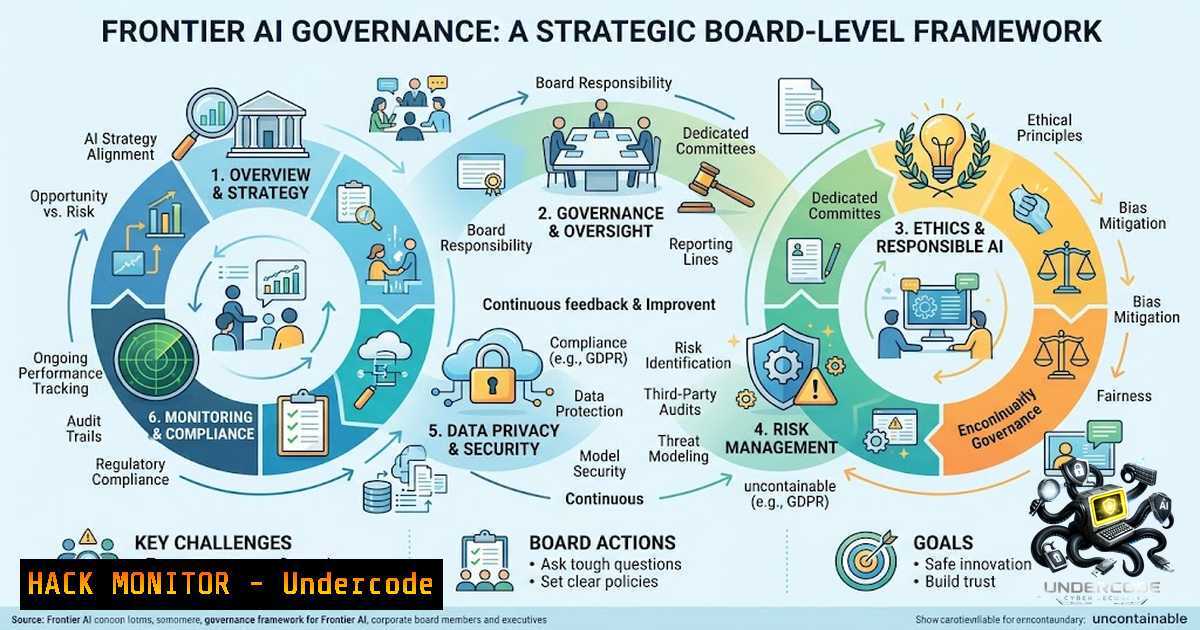
Introduction:
The Australian Signals Directorate (ASD) and the Australian Institute of Company Directors (AICD) have jointly declared that frontier AI is no longer an operational IT concern but a fundamental governance crisis. Their latest guidance warns that advanced AI models can compress vulnerability discovery from days to hours, lower the skill bar for attackers, and chain multiple low-severity flaws into high-impact breaches—all with little to no human oversight. For boards, this shifts the question from “Are we aware of AI risks?” to “Can we prove we acted on them?”
Learning Objectives:
- Understand how frontier AI models fundamentally alter the cyber threat landscape, accelerating attack timelines and democratizing sophisticated exploits.
- Identify the specific governance, technical, and operational controls required to meet ASD-AICD expectations and emerging regulatory standards like the EU AI Act.
- Implement a continuous, auditable risk management framework that transforms board-level awareness into defensible action.
You Should Know:
- The Mechanics of Frontier AI Offense—Why Speed and Scale Break Traditional Defenses
Frontier AI models now possess sophisticated reasoning, coding, and autonomous problem-solving capabilities. In the hands of threat actors, they automate reconnaissance, rapidly identify vulnerabilities, and generate exploits with increasing fluency. This is not a theoretical risk. Palo Alto Networks’ Unit 42 built an autonomous system called NOVA that, in just two months, analyzed 3,915 open-source projects and uncovered 14,090 previously unreported vulnerabilities—99.4% of which were unknown and 40% rated high or critical severity. The system required no human intervention until final review.
The implications are stark. The traditional cybersecurity assumption that attackers operate at human speed and defenders have time to patch is obsolete. AI-driven attacks are continuous and scalable, shifting cyber risk from episodic to persistent. The patch window has collapsed; the industry-average 55 days to deploy a traditional fix is now a liability.
Step-by-Step: Assessing Your Organization’s AI Attack Surface
- Map All AI Supply Chain Dependencies: Inventory every AI model, API, and vendor your organization uses. Pay special attention to foreign ownership, control, and influence—ASD explicitly flags this as a sovereign cyber risk.
- Conduct AI-Specific Red-Teaming: Simulate attacks where an AI agent has access to your code repositories, configuration files, and identity systems. Test if it can autonomously discover and chain vulnerabilities.
- Quantify Compressed Timelines: Measure your current Mean Time to Detect (MTTD) and Mean Time to Respond (MTTR). Compare these against the new reality where exploitation can occur in hours. If your response exceeds a few hours, you are exposed.
- Prioritize Virtual Patching: Deploy network security solutions capable of virtual patching—protections delivered ahead of vendor patches to collapse the exposure window from weeks to near-zero.
-
The Board’s New Governance Imperative—From Awareness to Auditable Action
ASD and AICD are explicit: a board cannot merely acknowledge frontier AI risk in a slide deck. It must demonstrate ownership, controls, and an evidence trail. This aligns with global regulatory shifts, including the EU AI Act (penalties up to €35 million or 7% of global turnover from August 2026) and SEC cyber disclosure rules. The guidance provides threshold questions for directors and outlines priorities across immediate, short, medium, and long-term horizons.
Step-by-Step: Building a Defensible AI Governance Program
- Assign Clear Ownership: Designate a board-level committee (e.g., Risk or Audit) with explicit oversight of AI risk. Ensure AI has a clear home within the committee structure and receives structured updates at least quarterly.
- Implement Continuous Assessment: Move beyond point-in-time risk assessments. Frontier AI is a moving target that requires continuous monitoring of models, threats, and controls.
- Establish Full Audit Lineage: Every risk decision, control implementation, and assessment must be traceable from source to evidence. Regulators, insurers, and auditors will demand to see what the board knew and did.
- Integrate AI Risk into Existing Frameworks: Align AI oversight with operational resilience, third-party risk, and cybersecurity disciplines, with clear accountability at senior management level.
3. Hardening the Technical Foundation—Fundamentals That Still Matter
ASD’s guidance emphasizes that strengthening basics is the immediate priority: reduce the attack surface, retire legacy systems, tighten identity and access controls, and restrict unnecessary privileges. These fundamentals are even more critical when AI can automate the exploitation of weak configurations.
Step-by-Step: Technical Hardening Against AI-Driven Attacks
1. Harden Identity and Access Management (IAM):
- Implement Privileged Access Management (PAM) with just-in-time (JIT) elevation.
- Enforce Multi-Factor Authentication (MFA) for all users, especially administrators.
- Apply the principle of least privilege rigorously. AI agents operating inside the organization should be granted only the minimum access their duties require.
- Linux Command: `auditd` to monitor privilege escalations: `sudo auditctl -w /etc/sudoers -p wa -k sudoers_changes`
– Windows Command: Use `Get-WinEvent` to audit privileged access: `Get-WinEvent -LogName Security | Where-Object { $_.Id -in 4672, 4673, 4674 }`
2. Reduce Attack Surface:
- Inventory and decommission legacy systems that cannot be patched or monitored effectively.
- Close unnecessary network ports and disable unused services.
- Implement network segmentation and zero-trust architecture to limit lateral movement.
- Linux Command: Scan for open ports: `ss -tuln` or `nmap -sS -O localhost`
– Windows Command: Check open ports: `netstat -an` | `findstr LISTENING`
3. Strengthen Vulnerability Management:
- Adopt AI-enabled defensive tools for automated vulnerability detection and attack surface analysis.
- Prioritize patching based on exploitability, not just CVSS score. AI can chain low-severity issues, so contextual risk matters.
- Linux Command: Use `lynis` for security auditing: `sudo lynis audit system`
– Windows Command: Use `Get-HotFix` to list installed patches: `Get-HotFix | Sort-Object InstalledOn -Descending`
- Preparing for the Agentic Era—Incident Response and AI Defense
The guidance warns that frontier AI models can conduct malicious activity with little to no human oversight. This means incident response plans built for human-speed attacks are insufficient. Organizations must prepare for AI-driven incidents where the attacker is autonomous, persistent, and adaptive.
Step-by-Step: Modernizing Incident Response for AI Threats
- Adopt AI for Cyber Defense: Deploy AI-powered security tools that can detect, triage, and initiate response at machine speed, without waiting for human intervention.
- Update the Incident Response Plan: Include specific playbooks for AI-generated attacks (e.g., automated phishing, credential harvesting, autonomous ransomware).
- Test Under AI Simulation: Run tabletop exercises where an AI agent is the adversary. Test your team’s ability to detect, contain, and recover from attacks that evolve in real-time.
- Plan for Breach Scenarios: Assume breach and design containment-focused architecture. Threats can originate from compromised endpoints, suppliers, or development tools.
-
Continuous Governance—The Role of GRC in the AI Era
The ASD-AICD guidance effectively mandates that organizations show their work. A board can acknowledge frontier AI as a risk, but without an owner, controls, and an evidence trail, that acknowledgment is insufficient. This is where Governance, Risk, and Compliance (GRC) solutions become critical. Purpose-built AI risk management platforms can ingest regulatory data, map obligations to controls, and provide full audit lineage—turning a one-off briefing into an ongoing, governed process.
Step-by-Step: Implementing AI Risk Management in GRC
- Deploy Regulatory Intelligence: Use solutions that monitor 8,000+ regulatory sources across 230+ jurisdictions to stay ahead of evolving AI rules.
- Map Obligations to Controls: Automatically link regulatory requirements (e.g., EU AI Act, ASD guidance) to specific controls and policies.
- Continuous Control Assurance: Regularly test and document the effectiveness of controls against AI-specific threats.
- Board-Ready Reporting: Generate reports that show risk posture, control effectiveness, and audit trails—demonstrating not just awareness, but action.
What Undercode Say:
- Frontier AI has transformed cyber risk from an episodic, manageable challenge into a persistent, scalable threat that demands board-level governance.
- The ASD-AICD guidance establishes a new baseline: boards must not only be aware of AI risks but must demonstrate continuous, auditable action with clear ownership and evidence.
Analysis:
The ASD and AICD have effectively closed the gap between regulatory expectation and boardroom reality. By framing frontier AI as a governance question rather than an IT ticket, they force directors to confront a uncomfortable truth: traditional risk registers and incident response plans were built for a threat model that no longer exists. The guidance’s emphasis on fundamentals—patching, IAM, legacy system retirement—is a stark reminder that AI amplifies existing weaknesses. Organizations that cannot secure basic configurations will be decimated by autonomous AI agents. However, the guidance also presents an opportunity. For risk and compliance leaders, it provides a mandate to elevate GRC from a back-office function to a strategic boardroom priority. The key is moving from point-in-time assessments to continuous, auditable processes. Those who do will not only survive the AI era but will build resilient, defensible organizations. Those who don’t will find their boards held accountable by regulators, insurers, and shareholders.
Expected Output:
Introduction:
The ASD and AICD have jointly declared frontier AI a board-level governance crisis, warning that advanced models compress vulnerability discovery from days to hours and democratize sophisticated attacks. This shifts the board’s question from awareness to auditable action, demanding continuous oversight, clear ownership, and defensible evidence trails.
What Undercode Say:
- Frontier AI transforms cyber risk from episodic to persistent, requiring continuous governance, not quarterly reviews.
- Boards must demonstrate auditable action—not just awareness—with clear ownership, controls, and evidence to satisfy regulators, insurers, and auditors.
Expected Output:
Prediction:
- -1: Organizations that fail to adopt continuous AI risk governance will face regulatory penalties, insurance claim denials, and shareholder lawsuits within 18-24 months.
- -1: The gap between AI-driven attack speed and human-led defense will widen, leading to a wave of high-profile breaches that exploit chained low-severity vulnerabilities.
- +1: GRC platforms with AI-powered regulatory intelligence and full audit lineage will become mandatory infrastructure, transforming risk management from a cost center into a strategic competitive advantage.
- +1: Boards will increasingly demand AI literacy and risk expertise, driving a new class of director training and reshaping board composition over the next three years.
▶️ Related Video (84% Match):
🎯Let’s Practice For Free:
🎓 Live Courses & Certifications:
Join Undercode Academy for Verified Certifications
🚀 Request a Custom Project:
Secure, high-velocity infrastructure and disruptive technological engineering. Contact our engineering team for high-tier development and proprietary systems:
[email protected]
💎 Smart Architecture | 🛡️ Secure by Design | ⭐ Trusted by Thousands
IT/Security Reporter URL:
Reported By: Jimcook Archer – Hackers Feeds
Extra Hub: Undercode MoN
Basic Verification: Pass ✅


