Listen to this Post
Introduction:
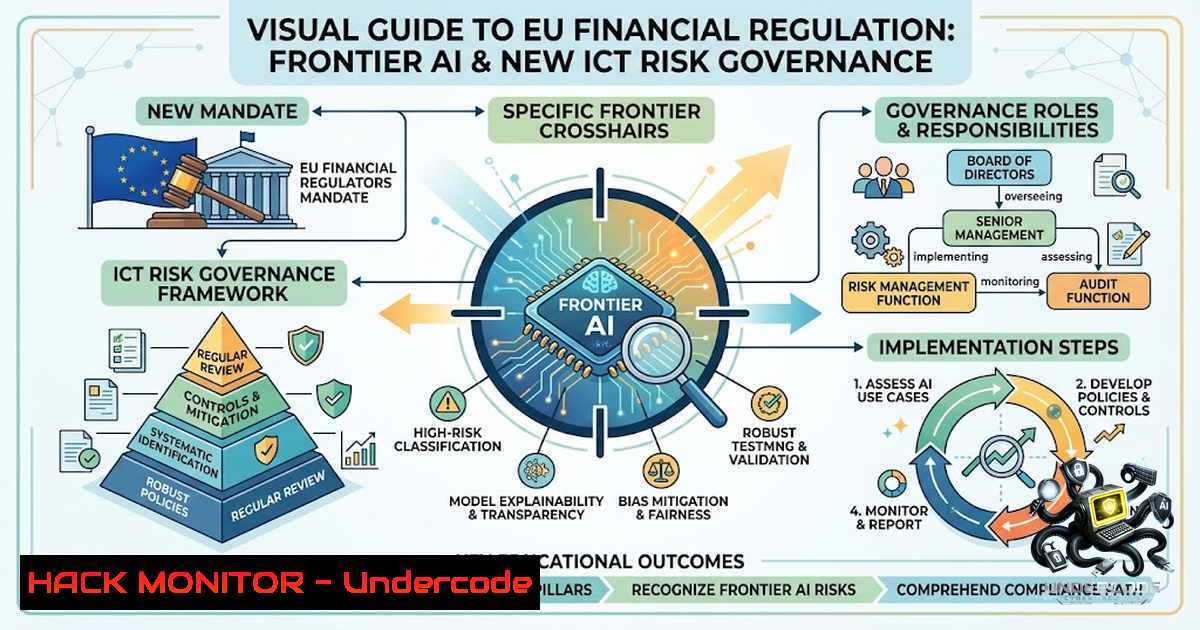
The European Supervisory Authorities (EBA, EIOPA, and ESMA) have fundamentally redefined the cybersecurity landscape for financial institutions. In a landmark joint statement issued on 31 July 2026, the ESAs called for a cross-sectoral, risk-based supervisory approach to mitigate ICT risks stemming from frontier AI models. This regulatory shift moves AI risk beyond the internal systems an organization deploys, expanding the threat surface to encompass external AI capabilities that attackers can weaponize. Financial entities must now treat frontier AI as a distinct risk dimension, integrating it into enterprise risk appetites and shifting from periodic reviews to continuous, dynamic risk assessment.
Learning Objectives:
- Understand the expanded scope of ICT risk management under the ESAs’ new frontier AI framework, including the requirement for combined AI + ICT dependency inventories.
- Master the technical implementation of secure-by-design principles, zero trust architecture, and continuous monitoring to counter AI-assisted cyber threats.
- Develop actionable strategies for enhancing supply-chain risk management, AI literacy, and incident response scenarios tailored to AI-driven attack vectors.
You Should Know:
- Building the Combined AI + ICT Dependency Inventory
The ESAs mandate that financial firms move beyond traditional IT asset management toward a comprehensive, continuously updated inventory that captures both ICT assets and AI dependencies. This inventory must classify assets based on criticality and exposure, extending to open-source components, third-party libraries, and externally hosted AI models.
Step‑by‑Step Guide: Creating an AI+ICT Dependency Inventory
Step 1: Discover and map all ICT assets. Use network scanning and configuration management tools to identify hardware, software, and cloud resources.
Linux command – network discovery:
nmap -sP 192.168.1.0/24
Windows command – list installed software:
Get-WmiObject -Class Win32_Product | Select-Object Name, Version, Vendor
Step 2: Identify AI and machine learning dependencies. Catalog all AI models in use, including internally developed, open-source, and vendor-provided models. Track model versions, training data sources, and deployment endpoints.
Step 3: Map dependencies between AI systems and ICT infrastructure. Document which servers, databases, APIs, and third-party services each AI model interacts with.
Step 4: Classify by criticality and exposure. Assign risk scores based on the sensitivity of data processed, the potential impact of compromise, and the attack surface exposed.
Step 5: Establish a continuous update cadence. Integrate inventory updates into change management processes and deploy automated discovery tools to detect shadow AI.
Linux command – monitor for new services:
watch -1 60 'ss -tulpn | grep LISTEN'
- Adopting Continuous / Dynamic Risk Assessment for AI-Assisted Attackers
Traditional periodic risk reviews are obsolete. The ESAs warn that AI-assisted attackers can discover and exploit vulnerabilities much faster than conventional cycles permit. Financial entities must transition to continuous or near-real-time monitoring to reduce detection and response times.
Step‑by‑Step Guide: Implementing Continuous Risk Assessment
Step 1: Deploy continuous vulnerability scanning. Automate scanning across all ICT assets and AI components.
Linux command – schedule automated vulnerability scans with OpenVAS:
sudo openvas-cli --target 192.168.1.0/24 --scan
Step 2: Implement Security Information and Event Management (SIEM) with AI-enhanced analytics. Configure log aggregation and real-time correlation.
Step 3: Establish baseline behavioral profiles. Use machine learning to model normal system and user behavior, enabling anomaly detection.
Python snippet – simple anomaly detection using isolation forest:
from sklearn.ensemble import IsolationForest
model = IsolationForest(contamination=0.01)
model.fit(normal_behavior_data)
anomalies = model.predict(new_data)
Step 4: Integrate threat intelligence feeds. Automate the ingestion of IOCs (Indicators of Compromise) and adjust monitoring rules dynamically.
Step 5: Implement automated alerting and escalation workflows. Define thresholds and response playbooks for AI-specific threats.
3. Secure‑by‑Design, Attack‑Surface Reduction, and Zero Trust
The ESAs explicitly call for embedding secure-by-design principles, attack-surface reduction, automated patching, zero trust, behavioral monitoring, and AI-enhanced detection into AI controls and human oversight. For AI-1ative financial institutions, trust depends less on legacy perimeter controls and more on embedding security into every stage of the technology lifecycle.
Step‑by‑Step Guide: Implementing Zero Trust for AI Systems
Step 1: Adopt least-privilege access controls. Ensure that every AI component, API, and data store has the minimum permissions required.
Step 2: Implement micro-segmentation. Isolate AI workloads from other systems.
Step 3: Enforce continuous authentication and authorization. Require re-authentication for sensitive AI operations.
Step 4: Encrypt data at rest and in transit. Protect training data, model weights, and inference outputs.
Step 5: Deploy behavioral monitoring for AI systems. Track model inputs, outputs, and performance metrics to detect poisoning or evasion attacks.
Linux command – monitor AI model API traffic:
tcpdump -i eth0 port 5000 -w ai_traffic.pcap
Step 6: Implement automated patching. Deploy virtual patches at the network edge without waiting for software release cycles.
4. Enhancing Supply‑Chain Risk Management for AI
The ESAs emphasize strengthening supply-chain risk management, a critical area given that 29% of major ICT incidents in the EU financial sector in 2025 originated from third-party failures. Financial institutions rely on a concentrated set of third-party providers for specialized hardware, cloud infrastructure, and pre-trained models, exposing them to significant operational vulnerabilities.
Step‑by‑Step Guide: AI Supply-Chain Risk Management
Step 1: Identify all third-party AI providers. Include cloud providers, model vendors, data suppliers, and open-source libraries.
Step 2: Conduct vendor security assessments. Evaluate providers against DORA and NIST frameworks.
Step 3: Implement contractual security requirements. Mandate incident reporting, security audits, and compliance with regulatory standards.
Step 4: Diversify AI supply chains. Avoid excessive reliance on single critical providers.
Step 5: Develop exit strategies and contingency plans. Ensure business continuity if a critical provider fails.
5. Updating Incident Scenarios for AI‑Assisted, Cascading Attacks
The ESAs require financial entities to update incident scenarios for AI-assisted attacks, cascading attacks, and simultaneous multi-system failures. Linear incident assumptions are no longer adequate.
Step‑by‑Step Guide: Developing AI-Ready Incident Response Plans
Step 1: Conduct threat modeling for AI-specific attack vectors. Include model poisoning, evasion, extraction, and inference attacks.
Step 2: Develop playbooks for AI-assisted social engineering. Train employees to recognize deepfakes, AI-generated phishing, and business email compromise.
Step 3: Simulate cascading failures. Test scenarios where a breach in one AI system propagates to interconnected systems.
Step 4: Implement AI-enhanced detection tools. Deploy AI-powered detectors that analyze communication patterns and identify anomalies.
Step 5: Establish rapid escalation and decision-making protocols. Ensure management can authorize containment actions within minutes.
6. Deepening AI Literacy Across the Organization
The ESAs call for extending AI awareness beyond responsible AI use into recognizing AI-enhanced cyberattacks and social engineering. Since 1 February 2025, the EU AI Act requires financial institutions to ensure their employees are AI literate. However, 60% of breaches still involve human error, yet AI literacy remains absent from most financial institutions’ leadership capability frameworks.
Step‑by‑Step Guide: Building AI Literacy Programs
Step 1: Define role-based learning paths. Tailor AI literacy training for technical staff, management, and non-technical employees.
Step 2: Incorporate practical threat simulations. Use real-world examples of AI-enhanced attacks.
Step 3: Establish continuous learning. Implement monthly discussion series and share real use cases.
Step 4: Certify AI literacy. Offer certifications to ensure baseline competency.
Step 5: Integrate AI literacy into performance reviews. Make it a measurable competency for all roles.
- Moving from Periodic to Continuous Informed Management Engagement
The ESAs emphasize shifting from periodic AI oversight toward continuous informed management engagement, including resource allocation and faster escalation. Management bodies must ensure that accountability keeps pace with emerging risks.
Step‑by‑Step Guide: Embedding Continuous AI Governance
Step 1: Establish a dedicated AI risk committee. Include executive sponsorship and cross-functional representation.
Step 2: Implement AI-specific risk dashboards. Provide real-time visibility into AI system performance, security incidents, and compliance status.
Step 3: Define AI risk appetite statements. Explicitly incorporate frontier-AI risks into the enterprise risk appetite framework.
Step 4: Conduct regular AI risk reviews. Schedule monthly or quarterly reviews with management.
Step 5: Allocate resources dynamically. Ensure budget and personnel can scale with emerging AI threats.
What Undercode Say:
- Key Takeaway 1: AI risk is no longer confined to the systems we deploy; the ESAs have made it clear that external frontier AI capabilities—whether weaponized by attackers or embedded in third-party supply chains—represent a distinct and urgent risk dimension that must be integrated into every facet of ICT governance.
-
Key Takeaway 2: The shift from periodic to continuous risk assessment is not merely regulatory box-ticking; it is a technical imperative. AI-assisted attackers operate at machine speed, and only continuous monitoring, automated patching, and zero trust architectures can hope to keep pace with the evolving threat landscape.
The ESAs’ July 2026 statement, built on the foundation of DORA and reinforced by the ESRB’s warning on systemic cyber risks from frontier AI models, represents a paradigm shift in financial cybersecurity. Financial institutions that treat this as a compliance exercise will fail; those that embrace it as a strategic transformation will build resilience against the next generation of cyber threats. The report covering 3,383 major ICT incidents in 2025 under DORA serves as a stark reminder that the baseline is already concerning—and frontier AI will only accelerate the frequency and severity of incidents. Organizations must act now to inventory their AI dependencies, implement continuous monitoring, embed zero trust, and cultivate AI literacy at every level. The regulators are watching, but more importantly, the attackers are already leveraging AI. The time for preparation is over; the time for action is now.
Prediction:
- -1 Financial institutions that delay implementing the ESAs’ frontier AI risk framework will face escalating regulatory fines, reputational damage, and operational disruptions as AI-assisted attacks become more sophisticated and frequent over the next 12–24 months.
-
+1 Organizations that proactively adopt continuous risk assessment, zero trust architectures, and AI-enhanced detection will not only achieve regulatory compliance but will also gain a competitive advantage through superior operational resilience and client trust.
-
-1 The concentration of AI supply chains among a few critical providers will create systemic vulnerabilities, potentially triggering cascading failures across the EU financial sector if a major AI cloud provider or model vendor is compromised.
-
+1 The ESAs’ emphasis on AI literacy will drive a new wave of cybersecurity training and talent development, creating a more resilient workforce capable of recognizing and responding to AI-enhanced social engineering and phishing attacks.
-
-1 The rapid evolution of frontier AI capabilities will outpace regulatory updates, creating a persistent gap between supervisory expectations and technical reality, particularly in areas like model extraction, prompt injection, and adversarial attacks.
-
+1 The integration of AI into incident response and threat hunting will enable financial institutions to detect and contain breaches faster than ever before, potentially reducing the average time to identify and contain a breach from days to hours.
-
-1 Smaller financial institutions with limited resources will struggle to meet the ESAs’ continuous monitoring and governance expectations, potentially leading to consolidation or increased outsourcing—which in turn introduces new third-party risks.
-
+1 The ESAs’ framework will serve as a global benchmark, influencing regulatory approaches in other jurisdictions and driving harmonization of AI risk management standards across the financial sector worldwide.
-
-1 The reliance on AI for security monitoring creates a paradox: as defenses become more AI-driven, attackers will increasingly target the AI systems themselves, leading to an AI-vs-AI arms race that escalates costs and complexity.
-
+1 Forward-thinking financial institutions that treat frontier AI risk as a strategic imperative will emerge as leaders in the AI-driven financial era, setting new standards for security, governance, and operational resilience that will define the industry for the next decade.
▶️ Related Video (80% Match):
https://www.youtube.com/watch?v=7biiOl_tuyw
🎯Let’s Practice For Free:
🎓 Live Courses & Certifications:
Join Undercode Academy for Verified Certifications
🚀 Request a Custom Project:
Secure, high-velocity infrastructure and disruptive technological engineering. Contact our engineering team for high-tier development and proprietary systems:
[email protected]
💎 Smart Architecture | 🛡️ Secure by Design | ⭐ Trusted by Thousands
IT/Security Reporter URL:
Reported By: Sacha Schwab – Hackers Feeds
Extra Hub: Undercode MoN
Basic Verification: Pass ✅


