Listen to this Post
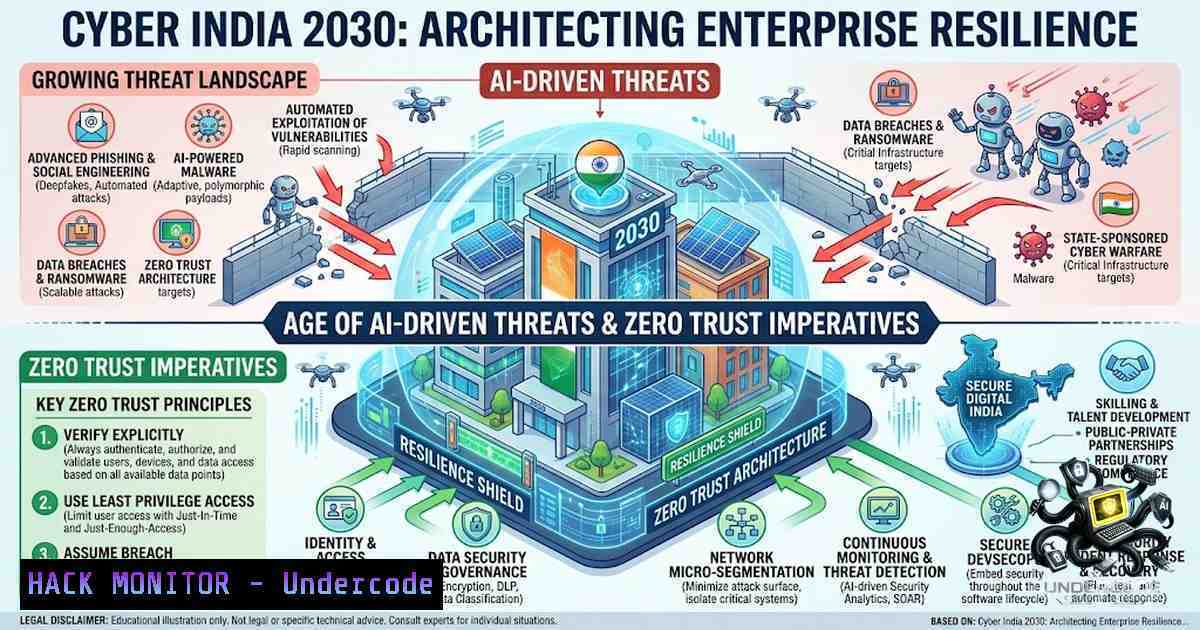
Introduction:
The enterprise technology landscape is undergoing a paradigm shift where digital transformation and cybersecurity are no longer parallel tracks but a single, integrated strategy. As highlighted at the National Cyber Security Conference 2026 – Hyderabad Edition, themed “Cyber India 2030: Innovation, Defence and Trust at Scale,” the conversation has moved beyond mere system connectivity to the fundamental challenge of securing interconnected ecosystems. For organizations modernizing their SAP landscapes and embracing cloud-1ative architectures, the convergence of AI, Zero Trust principles, and supply chain security is not just a regulatory requirement but a business imperative. This article distills the conference’s core technical takeaways into a practical, command-level guide for hardening enterprise environments against the evolving threat landscape of 2026 and beyond.
Learning Objectives:
- Master Linux and Windows server hardening techniques, including SSH lockdown, firewall configuration, and identity management to establish a secure foundational layer.
- Implement Zero Trust architecture principles through identity-aware proxies, micro-segmentation, and continuous verification of every access request.
- Deploy AI-powered security tools and API security controls to detect, analyze, and mitigate modern threats, including Broken Object Level Authorization (BOLA) and supply chain vulnerabilities.
You Should Know:
- Fortifying the Foundation: Linux and Windows Server Hardening
Securing enterprise applications like SAP S/4HANA begins at the operating system layer. A compromised OS undermines every security control above it. The 2026 SAP Security Assessment Checklist emphasizes the necessity of rigorously validating configurations and eliminating external exposure across the entire enterprise architecture. This involves a multi-step process of visibility, control, and enforcement.
Step-by-Step Guide:
- Secure Password Hashing: Ensure passwords use SHA512 or stronger hashing to protect against offline cracking. Verify the setting in
/etc/login.defs:grep -E '^ENCRYPT_METHOD (SHA512|YESCRYPT)' /etc/login.defs
If the output is “0”, edit the file and set
ENCRYPT_METHOD SHA512. -
Harden SSH Access: Disable root login and enforce key-based authentication to prevent brute-force attacks:
sudo sed -i 's/^PermitRootLogin./PermitRootLogin no/' /etc/ssh/sshd_config
sudo sed -i 's/^PasswordAuthentication./PasswordAuthentication no/' /etc/ssh/sshd_config
sudo systemctl restart sshd
This eliminates two of the most common attack vectors.
-
Configure UFW Firewall: Enable the Uncomplicated Firewall and allow only necessary ports:
sudo ufw default deny incoming
sudo ufw default allow outgoing
sudo ufw allow ssh
sudo ufw enable
sudo ufw status verbose
This establishes a default-deny posture, a cornerstone of Zero Trust.
-
Windows Server Hardening (PowerShell): On Windows Server, enforce least privilege by removing unnecessary admin rights and setting granular NTFS permissions:
Remove user from Administrators group
Remove-LocalGroupMember -Group "Administrators" -Member "jdoe"
Set granular NTFS permissions
icacls C:\SAP\data /grant "jdoe:(R,W)"
Audit effective permissions
accesschk.exe -u "jdoe" C:\SAP\data
These commands align with CIS benchmarks for Windows security.
-
File Integrity Monitoring: Implement auditd on Linux to monitor critical files:
sudo auditctl -w /etc/passwd -p wa -k identity_changes
sudo auditctl -w /etc/sudoers -p wa -k sudoers_changes
This enables detection of unauthorized modifications, a key component of incident response.
- Implementing Zero Trust Architecture: Identity, Microsegmentation, and Continuous Verification
Zero Trust has become the default security architecture for modern systems. The core principle—”never trust, always verify”—requires that every request, regardless of network location, is authenticated and authorized. For SAP and cloud environments, this means moving beyond perimeter-based defenses to a model where identity is the new perimeter. Gartner predicts that by the end of 2026, 60% of organizations will embrace Zero Trust as a starting point for security.
Step-by-Step Guide:
- Establish a Security Model and Inventory: Before implementing controls, inventory all assets. Use Nmap to discover services:
nmap -sV -oX inventory.xml 10.0.0.0/16
Classify each asset by sensitivity tier (public, internal, restricted, crown-jewel).
-
Implement Workload Identity: Move to short-lived, cryptographically verifiable identities using frameworks like SPIFFE/SPIRE:
spire-server entry create \
-spiffeID spiffe://safeguard.internal/payments/api \
-parentID spiffe://safeguard.internal/node \
-selector k8s:ns:payments \
-selector k8s:sa:api-service
This replaces static credentials with dynamic, scoped identities.
-
Deploy a Policy Enforcement Point (PEP): Place a PEP in front of every resource. An identity-aware proxy configuration ensures device posture is checked before access:
location /internal-app/ {
auth_request /verify;
auth_request_set $device_trust $upstream_http_x_device_trust;
if ($device_trust != "compliant") {
return 403;
}
proxy_pass http://internal-app-backend;
}
This enforces that every request is authenticated and authorized.
-
Enforce Multi-Factor Authentication (MFA): Enforce phishing-resistant MFA (FIDO2/WebAuthn) for all admin and remote access. Eliminate standing admin credentials in favor of just-in-time (JIT) elevation.
-
Continuous Monitoring: Log every authentication and authorization decision. Use OpenTelemetry for consistent instrumentation across services to enable anomaly detection and post-incident analysis.
3. AI-Powered Defense: Integrating Autonomous Security Tools
AI is transforming both cyber defense and the threat landscape. The conference highlighted that AI creates new opportunities while introducing new risks. To stay ahead, security teams must leverage AI-driven tools that can reason, adapt, and automate responses. The emergence of AI-1ative tools for Kali Linux, such as the SPECTER suite and BrainSAIT, represents a significant leap forward.
Step-by-Step Guide:
- Install and Use BrainSAIT: BrainSAIT combines local LLMs with Kali Linux security tools for intelligent, offline security analysis.
npm install -g brainsait
Ask a security question
brainsait "scan localhost for open ports"
Start interactive mode
brainsait interactive
List available tools
brainsait tools
This allows natural language queries to drive security tooling.
-
Deploy AI-Powered Malware Scanning: Use Semantics-AV-CLI, a free AI-powered malware scanner for Linux that detects evasive threats without signatures.
curl -sSL https://raw.githubusercontent.com/metaforensics-ai/semantics-av-cli/main/scripts/install.sh | bash -s -- --user
semantics-av analyze suspicious.exe --format html -o report.html
This provides offline, signature-less threat detection.
- Autonomous Penetration Testing: For advanced testing, consider tools like Specter-Vicious-CE, an AI-driven autonomous web application penetration testing tool that uses DeepSeek R1 for attack reasoning.
pip install specter-vicious-ce
specter-vicious-ce --target https://example.com --gate INJECT --roe roe.json
This represents a shift from manual to AI-1ative autonomous exploitation.
- Securing the API Attack Surface: From Discovery to Hardening
With over 90% of web applications exposing attack surfaces through APIs, securing these interfaces is critical. The OWASP API Security Top 10 highlights risks such as Broken Object Level Authorization (BOLA) and Broken Authentication. For SAP environments, APIs are the glue connecting S/4HANA, BTP, and third-party systems.
Step-by-Step Guide:
- API Discovery and Inventory: Use DAST tools like OWASP ZAP or Burp Suite to discover and map all API endpoints. For API-first architectures, tools like Escape or StackHawk provide deep GraphQL and REST coverage.
-
Implement Rate Limiting and Authentication: Enforce strict authentication (OAuth2, JWT) and rate limiting to prevent unrestricted resource consumption.
Nginx rate limiting example limit_req_zone $binary_remote_addr zone=api:10m rate=10r/s; location /api/ { limit_req zone=api burst=20 nodelay; auth_request /auth; proxy_pass http://api-backend; } -
Validate Input and Output: Implement strict schema validation using OpenAPI/Swagger to prevent injection attacks. Use API security tools that understand the business logic to detect and block complex attacks.
-
Continuous API Security Testing: Integrate API security scanners into the CI/CD pipeline. Tools like StackHawk are designed to run on every pull request, providing developer-first security testing.
5. SAP Security Hardening: Protecting the Digital Core
SAP S/4HANA systems are the digital core of many enterprises, making them prime targets. The 2026 SAP Security Assessment Checklist provides a structured approach to securing these environments.
Step-by-Step Guide:
- Apply Security Notes and Patches: Apply the latest SAP Security Notes and HotNews regularly. Validate S/4HANA and RISE baselines.
-
Enforce SAProuter Security and TLS: Review the external exposure of SAP services and enforce TLS for all communications. Validate critical configurations for RFC, ICM, LDAP, SNC, and Web Dispatcher.
-
Audit Segregation of Duties (SoD): Audit SoD conflicts and enforce MFA for admin and remote access. Standardize role design during the transition from ECC to S/4HANA.
-
Secure the Operating System: For SAP on SUSE Linux Enterprise Server, enforce least privilege, restrict network access with allowlist-based firewall rules, disable obsolete services, and strengthen SSH and password controls. Enable AppArmor and file-integrity monitoring.
-
Monitor and Detect: Deploy SAP threat detection software to enable Security Operations Centers (SOC) to identify and neutralize active exploitation attempts in real time.
6. Supply Chain Security: Vetting the Ecosystem
With 54% of large organizations identifying supply chain challenges as the greatest obstacle to achieving cyber resilience, securing the broader ecosystem is critical. The conference emphasized that as enterprises become dependent on interconnected systems, third-party platforms must be vetted rigorously.
Step-by-Step Guide:
- Establish a Central Supplier Repository: Maintain visibility into who your suppliers are, what they do, and how they support business operations.
-
Require Certifications: Onboard vendors with certifications like Cyber Essentials, SOC2, or ISO/IEC 27001:2022 to remove the burden of completing and reviewing questionnaires.
-
Implement Strong Contractual Obligations: Ensure contracts include clear, extensively documented security requirements and incident response plans.
-
Continuous Monitoring: Monitor external signals for supplier security posture changes and require Software Bill of Materials (SBOM) from vendors.
What Undercode Say:
-
Key Takeaway 1: The future of enterprise security is not about connecting systems but securing them. The convergence of AI, Zero Trust, and supply chain security represents a fundamental shift in how we approach enterprise architecture. The conference reinforced that security must be embedded into every layer of the technology stack, from the operating system to the application logic.
-
Key Takeaway 2: The move to S/4HANA and cloud environments is not just a technical upgrade but a security transformation. Access control, authorization, sensitive business data, integrations, APIs, cloud environments, and digital trust are becoming increasingly relevant as organizations modernize their SAP landscapes. This requires a holistic approach that combines technical controls, policy, and continuous monitoring.
-
Analysis: The insights from the National Cyber Security Conference 2026 underscore that cybersecurity is no longer a siloed function but a business enabler. The discussions around “Cyber India 2030” highlight a national strategy focused on digital sovereignty, data protection, and self-reliant technologies. For SAP professionals and enterprise architects, this means expanding their skill sets to include cybersecurity fundamentals, API security, and cloud hardening. The practical, command-level guidance provided in this article serves as a starting point for implementing these principles in real-world environments. The emphasis on AI-powered defense tools and Zero Trust architectures reflects a broader industry trend toward proactive, intelligence-driven security postures.
Prediction:
-
+1 The integration of AI into security operations will lead to a significant reduction in mean time to detect (MTTD) and mean time to respond (MTTR) by 2028, as autonomous agents will handle initial triage and response. This will allow human analysts to focus on complex, strategic threats.
-
+1 The adoption of Zero Trust architectures will become a regulatory requirement for critical infrastructure sectors in India by 2030, driving widespread investment in identity management, microsegmentation, and continuous monitoring solutions.
-
-1 The increasing complexity of supply chains and the proliferation of interconnected APIs will lead to a rise in supply chain attacks, as attackers target less-secure third-party vendors to gain access to larger enterprises.
-
-1 The rapid adoption of AI in both defense and offense will create an “AI arms race,” where attackers use AI to automate vulnerability discovery and exploit development, outpacing traditional signature-based defenses. This will necessitate a shift toward AI-1ative security tools and proactive threat hunting.
-
+1 The “Cyber India 2030” initiative will foster a robust domestic cybersecurity industry, creating new opportunities for innovation, research, and talent development, positioning India as a global leader in cybersecurity by the end of the decade.
▶️ Related Video (76% Match):
https://www.youtube.com/watch?v=5-EzZHRxWa4
🎯Let’s Practice For Free:
🎓 Live Courses & Certifications:
Join Undercode Academy for Verified Certifications
🚀 Request a Custom Project:
Secure, high-velocity infrastructure and disruptive technological engineering. Contact our engineering team for high-tier development and proprietary systems:
[email protected]
💎 Smart Architecture | 🛡️ Secure by Design | ⭐ Trusted by Thousands
IT/Security Reporter URL:
Reported By: Dhanishabdul03 Sap – Hackers Feeds
Extra Hub: Undercode MoN
Basic Verification: Pass ✅


