Listen to this Post
Introduction:
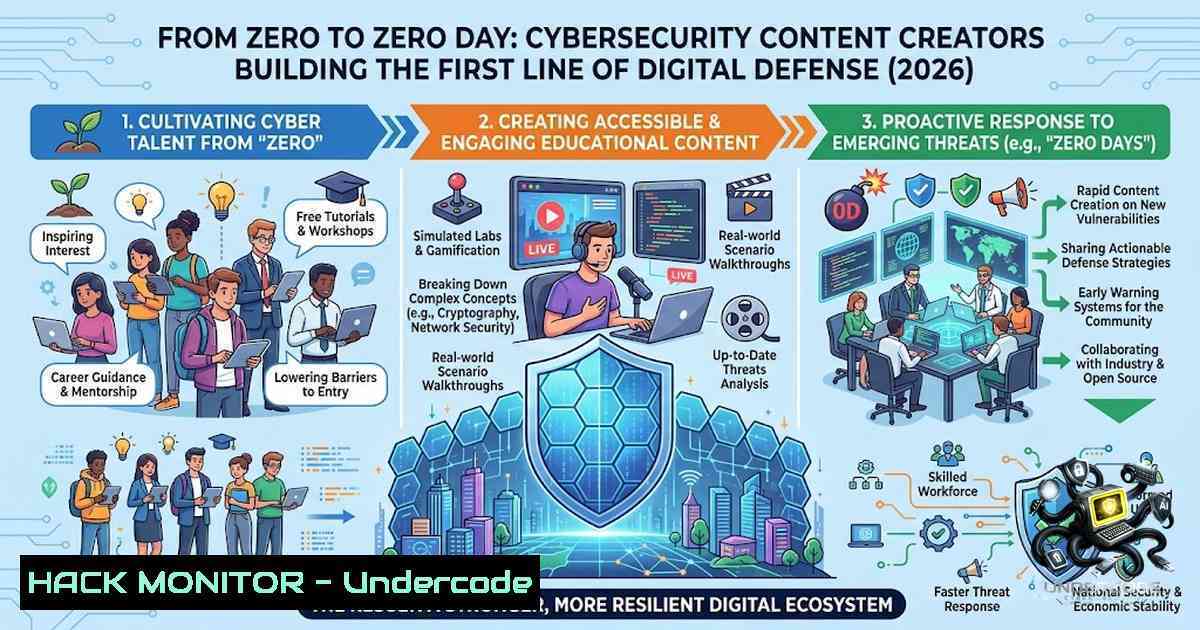
The cybersecurity industry faces a paradox: threats are evolving at machine speed, yet the gap between technical expertise and public awareness continues to widen. In 2026, AI tools can generate convincing content in any language, allowing threat actors to target a broader range of victims with greater accuracy than ever before. Simultaneously, content generation tools have become so accessible that even non-experts can create mid-quality deepfakes in just a few clicks. This is where the cybersecurity content creator emerges not as a marketer, but as a critical defender—translating complex vulnerabilities, attack vectors, and defensive strategies into stories that educate, engage, and ultimately protect. Zero Hacks Given Cyber Security Pvt. Ltd. is now hiring for exactly this role, signaling a growing recognition that content is not ancillary to security—it is foundational.
Learning Objectives:
- Understand the dual role of AI in cybersecurity: as both a weapon for threat actors and a force multiplier for defenders
- Master the technical and creative workflows for producing high-impact cybersecurity content across digital platforms
- Develop practical skills in threat research, content automation, and audience engagement strategies tailored to 2026’s threat landscape
You Should Know:
- Understanding the 2026 Threat Landscape: The Content Creator’s Technical Briefing
Before you can create content about cybersecurity, you must understand what you are defending against. In the first half of 2026, Kaspersky’s Global Research & Analysis Team identified that large language models are already being used to generate phishing emails, malicious code, and supporting operational content. This is not theoretical—Flashpoint analysts identified more than 2.9 million posts discussing artificial intelligence in the context of illicit activity in May 2026 alone.
The threat actor’s toolkit now includes:
- AI-Generated Phishing Campaigns: Attackers can produce professional-quality written content in seconds, generating convincing emails and social media posts at scale. A single adversarial campaign can generate thousands of unique content variants per day, outpacing human moderation teams.
-
Deepfakes as Mainstream Weapons: Deepfakes are becoming a mainstream technology, with visual quality already high and realistic audio rapidly improving. This enables impersonation attacks that bypass traditional identity verification.
-
Agentic AI in Cybercrime: Beyond content generation, the emergence of agentic AI is expected to further transform cybercrime operations, automating entire attack chains from reconnaissance to exfiltration.
For the content creator, this means your audience is not just curious—they are under active attack. Your content must bridge the gap between abstract threat reports and actionable defensive behaviors.
- Building Your Cybersecurity Content Creation Workflow: From Research to Publication
Creating effective cybersecurity content requires a systematic approach that balances technical accuracy with accessibility. Here is a step-by-step workflow for producing content that educates and engages:
Step 1: Threat Intelligence Gathering
Begin each content cycle with primary research. Monitor trusted sources including:
- CISA alerts and advisories
- Vendor threat reports (Kaspersky, Trend Micro, Palo Alto Networks)
- Open-source intelligence feeds
- Dark web monitoring platforms (where legally accessible)
Step 2: Technical Translation
Translate technical findings into audience-appropriate language. For a technical audience, include specific indicators of compromise (IoCs), CVSS scores, and mitigation steps. For general audiences, focus on behavioral impacts and actionable precautions.
Step 3: Visual Asset Development
Use tools like Canva for static graphics and CapCut for short-form video. Canva is stronger for on-brand text and templates, while CapCut has become the default video editor with AI features that automate captions and transitions. Build reusable templates per content pillar to maintain consistency.
Step 4: Multi-Platform Distribution
Adapt content for each platform’s format and audience:
- LinkedIn: Long-form technical posts and thought leadership
- Instagram/TikTok: Short-form reels (15-60 seconds) with strong visual hooks
- YouTube: Deep-dive tutorials and walkthroughs
- Twitter/X: Real-time threat updates and thread-based explainers
Step 5: Engagement and Iteration
Track engagement metrics (reach, shares, saves, comments) and adjust content strategy accordingly. High-performing cybersecurity content in 2026 focuses on practical, outcome-driven value.
3. Technical Setup for the Cybersecurity Content Creator
To produce credible content, you need hands-on familiarity with the tools and techniques you are discussing. Here are essential technical setups:
Linux Command Line (For Demonstrating Security Concepts)
 Check for open ports and running services
sudo netstat -tulpn

Analyze network traffic (requires tcpdump)
sudo tcpdump -i eth0 -1

Check system logs for suspicious activity
sudo journalctl -xe | grep -i "fail|error|attack"

Scan for open ports with nmap
nmap -sV -p- 192.168.1.0/24

Monitor real-time system processes
htop
Windows Command Line (For Endpoint Security Demonstrations)
 Check for open ports and connections
netstat -an

View running processes
tasklist

Check Windows Event Logs for security events
Get-WinEvent -LogName Security -MaxEvents 50

Test network connectivity and trace route
ping -t 8.8.8.8
tracert google.com

Check firewall rules
netsh advfirewall show allprofiles
API Security Testing (For Demonstrating Common Vulnerabilities)
 Test for API key exposure in HTTP headers
curl -I https://api.example.com/v1/data

Check for CORS misconfigurations
curl -H "Origin: https://malicious-site.com" https://api.example.com/v1/data

Test for rate limiting
for i in {1..100}; do curl https://api.example.com/v1/data; done
4. Translating Technical Concepts for General Audiences
The core skill of a cybersecurity content creator is simplification without distortion. Here is a framework for translating common technical concepts:
| Technical Concept | Simplified Analogy |
|-|-|
| Phishing | A digital con artist pretending to be someone you trust |
| Ransomware | A digital hostage situation for your files |
| Zero-day vulnerability | A lock that the manufacturer doesn’t know is broken |
| Multi-factor authentication | A second lock on your digital door |
| Encryption | A secret code that only you and the intended recipient can read |
Example Script for a 60-Second Reel on Phishing:
Visual: Split screen showing a legitimate email and a phishing email
“Did you know that in 2026, AI can generate 1,000 unique phishing emails in under a minute? Here’s how to spot them. Check the sender’s domain—one character off means it’s fake. Hover over links without clicking—does the URL match the text? And always verify urgent requests through a separate channel. Security isn’t just about firewalls—it’s about what you click. Follow for more.”
5. Campaign Development and Measurement
Creating content is only half the battle—you must also measure its effectiveness. Here is a framework for developing and tracking cybersecurity awareness campaigns:
Campaign Structure:
- Awareness Phase: Attention-grabbing content that highlights a threat (e.g., “Your Password Is Probably Already Leaked”)
- Education Phase: Detailed explainers on how the threat works and why it matters
- Action Phase: Specific, step-by-step guidance on protective measures
- Reinforcement Phase: Follow-up content that reinforces behaviors and addresses common objections
Key Performance Indicators (KPIs) for Cybersecurity Content:
- Reach: How many unique users saw your content
- Engagement Rate: Shares, saves, and comments (indicating perceived value)
- Click-Through Rate: How many users accessed linked resources
- Behavior Change: Trackable actions like enabling 2FA or updating passwords
- Trust Metrics: Sentiment analysis of comments and direct messages
- The Ethical Dimension: Responsible AI Use in Content Creation
As a cybersecurity content creator, you occupy a unique ethical position. You are discussing threats while using tools that could potentially be misused. AI-generated content without meaningful human oversight increases the risk of misunderstanding, factual errors, and hallucinations. We have already seen AI hallucinations cause real damage in legal and scientific settings, and cybersecurity is not immune.
Ethical Guidelines for Cybersecurity Content Creators:
- Never share active exploits or step-by-step attack instructions that could be used by threat actors
- Clearly label AI-generated content to maintain transparency and trust
- Verify all technical claims against primary sources before publication
- Avoid fear-based messaging—focus on empowerment and actionable steps
- Respect privacy—never share real victim data or personally identifiable information
What Undercode Say:
- Cybersecurity content creation is not marketing—it is public defense. In an era where AI-generated threats can scale infinitely, the content creator becomes a force multiplier for security teams, extending their reach to audiences that technical reports will never touch.
-
The best cybersecurity content is technically accurate, emotionally resonant, and immediately actionable. Users don’t need more fear—they need clear, simple steps they can take to protect themselves. Every piece of content should answer the question: “What should I do differently after watching this?”
The role Zero Hacks Given Cyber Security is hiring for represents a paradigm shift. The company, founded by Rivka Tadjer, specializes in financial protection and secure communication for individuals and organizations. By investing in content creation, they are recognizing that education is prevention—and that the most effective security controls are the ones that users actually understand and adopt.
Prediction:
- +1 The demand for cybersecurity content creators will grow exponentially through 2027 as organizations realize that technical controls alone cannot prevent social engineering attacks. Content creators who can translate complex threats into engaging, accessible content will become as valuable as security engineers.
-
+1 AI-powered content creation tools will increasingly be integrated into security awareness platforms, enabling personalized, adaptive training at scale. This will democratize access to security education, particularly for small and medium businesses that cannot afford dedicated security teams.
-
-1 The same AI tools that enable defenders will continue to empower attackers, creating an arms race in content generation. As deepfakes become indistinguishable from reality, the public’s ability to discern legitimate security guidance from malicious content will be severely tested. This will require content creators to adopt cryptographic verification methods for their content.
-
-1 Without rigorous editorial standards, AI-generated cybersecurity content risks creating a “hallucination cascade”—where inaccurate or oversimplified security advice spreads faster than corrections can follow. The cybersecurity content creator’s role as a trusted human validator will become more critical, not less, as AI automation increases.
-
+1 The integration of cybersecurity content creation with incident response and threat intelligence teams will create a new career path: the Security Storyteller. These professionals will sit at the intersection of SOC operations, public relations, and education, translating real-time threat data into protective guidance for diverse audiences.
▶️ Related Video (70% Match):
https://www.youtube.com/watch?v=-eWu9JjCf64
🎯Let’s Practice For Free:
🎓 Live Courses & Certifications:
Join Undercode Academy for Verified Certifications
🚀 Request a Custom Project:
Secure, high-velocity infrastructure and disruptive technological engineering. Contact our engineering team for high-tier development and proprietary systems:
[email protected]
💎 Smart Architecture | 🛡️ Secure by Design | ⭐ Trusted by Thousands
IT/Security Reporter URL:
Reported By: Wing Commander – Hackers Feeds
Extra Hub: Undercode MoN
Basic Verification: Pass ✅


