
Listen to this Post
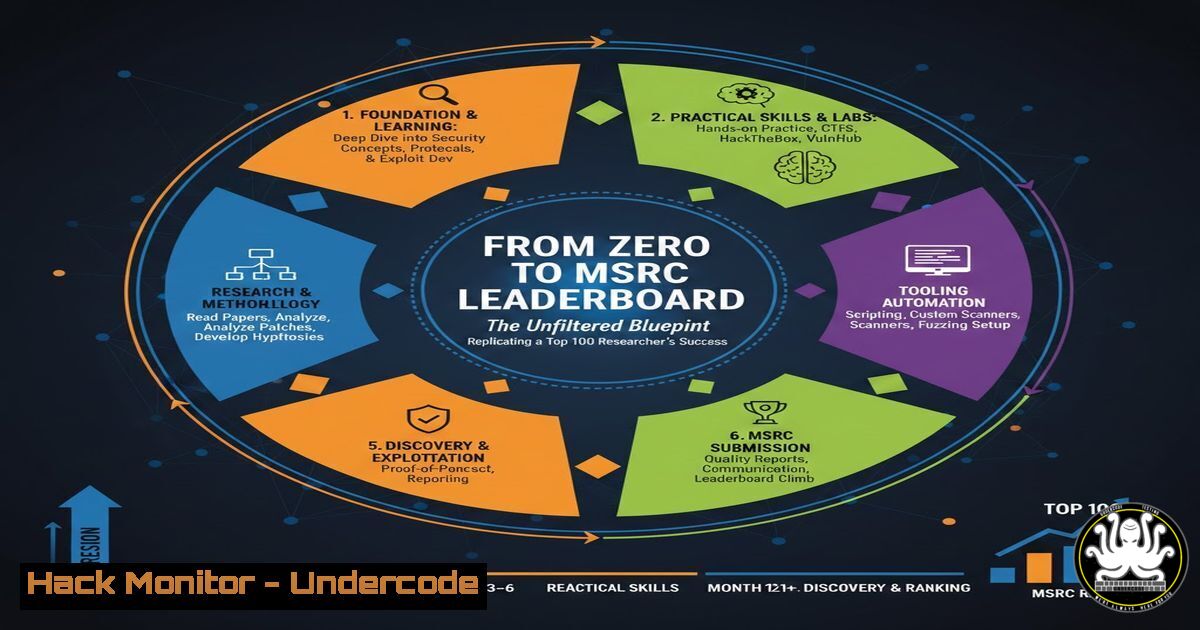
Introduction:
Achieving a ranking on the Microsoft Security Response Center (MSRC) Quarterly Leaderboard is a pinnacle of recognition in the vulnerability research community. This feat, as demonstrated by researcher Sreejith A R, is not accidental but the result of a disciplined methodology encompassing application security, cloud security, and responsible disclosure. This article deconstructs the pathway to such success, providing actionable steps to transition from enthusiast to recognized security researcher.
Learning Objectives:
- Understand the end-to-end workflow of a professional bug bounty hunter, from reconnaissance to report submission.
- Learn practical commands and techniques for identifying vulnerabilities in modern web applications and cloud services.
- Develop the skills to write high-quality, actionable vulnerability reports that meet the standards of major programs like MSRC.
You Should Know:
1. Building Your Foundational Lab & Reconnaissance Engine
The first step is constructing a controlled environment to safely practice and automate the initial discovery phase. This involves setting up virtual machines, proxy tools, and automated scanners.
Step-by-step guide:
Operating System & Tools: Use a Linux distribution like Kali Linux or Parrot OS as your primary machine. Install essential packages:
sudo apt update && sudo apt install git python3-pip docker.io gobuster seclists -y
Proxy Configuration: Set up Burp Suite or OWASP ZAP as a man-in-the-middle proxy. Configure your browser to route traffic through it (e.g., 127.0.0.1:8080). This allows you to intercept, inspect, and modify all HTTP/S requests.
Automated Recon: Use tools like `amass` and `subfinder` to enumerate subdomains of your target scope.
subfinder -d target.com -o subdomains.txt
amass enum -d target.com >> subdomains.txt
sort -u subdomains.txt -o final_subs.txt
Live Host & Port Discovery: Feed the subdomains into `httpx` and `nmap` to find live web servers and open ports.
cat final_subs.txt | httpx -silent -o live_hosts.txt
nmap -iL live_hosts.txt -sV --top-ports 100 -oA initial_scan
2. Manual Vulnerability Discovery & Testing Methodology
Automation finds low-hanging fruit; critical findings like CVE-2025-23269 require manual, intelligent testing. This phase focuses on logic flaws, misconfigurations, and API security.
Step-by-step guide:
Map the Application: Manually browse every functionality of the web app through your proxy. Use Burp Suite’s “Target” tab to build a site map.
Test for Common Vulnerabilities:
IDOR (Insecure Direct Object Reference): Change parameter values (e.g., `user_id=1001` to user_id=1000) in requests to see if you can access another user’s data.
Broken Access Control: Log in as a low-privilege user, capture a privileged request (e.g., to /admin/addUser), and try replaying it without the admin role.
API Testing: For REST APIs, fuzz endpoints with malformed JSON, excessive data, or SQL injection payloads in parameters.
 Using curl to fuzz an API parameter
curl -X GET "https://api.target.com/v1/user?id=PAYLOAD" -H "Authorization: Bearer <token>"
 Replace PAYLOAD with test cases like: 1' OR '1'='1'--, ../../../etc/passwd, {"malformed": json]
Cloud-Specific Tests: For Azure or AWS services, check for storage blob misconfigurations (publicly readable/writable), insecure Serverless Function permissions, and metadata service (IMDS) vulnerabilities.
- The Art of Crafting a MSRC-Worthy Proof of Concept (PoC)
A valid report requires a clear, reproducible PoC. This demonstrates impact and speeds up triage.
Step-by-step guide:
- Document the Flow: Write a concise description of the vulnerability’s location and pre-conditions.
- Capture the Evidence: Use Burp Suite’s “Logger” or “Repeater” to show the raw, malicious HTTP request and the vulnerable response. Always redact sensitive tokens or personal data.
- Show Impact: Craft a final payload that proves real-world impact, such as exfiltrating a non-sensitive config file or demonstrating a privilege escalation. Example for a path traversal:
GET /api/v1/download?file=../../../../etc/passwd HTTP/1.1
Host: vulnerable.target.com
...
Show the server’s response containing the `/etc/passwd` file contents.
- Create a Video: For complex logic flaws, a short, silent screen recording (using `ffmpeg` or OBS) is invaluable.
4. Writing the Report: From Finding to Fix
The quality of your report directly influences recognition and reward. MSRC expects professional, concise, and actionable reports.
Step-by-step guide:
- Clear and specific (e.g., “Server-Side Request Forgery in [bash] leading to internal metadata access”).
- Summary: One paragraph describing the vulnerability, component, and impact.
- Technical Details: Include the vulnerable URL, parameters, and steps. Provide the raw HTTP request/response blocks.
- Proof of Concept: As prepared in the previous section.
- Impact Assessment: Detail the worst-case scenario (e.g., “This SSRF could allow an attacker to retrieve credentials from the cloud instance metadata service”).
- Remediation: Suggest a fix (e.g., “Validate and sanitize user input against an allowlist of permitted domains or internal IP ranges”).
5. Responsible Disclosure & Post-Submission Protocol
Adhering to responsible disclosure ethics is mandatory for programs like MSRC.
Step-by-step guide:
- Submit via Portal: Only use the official vendor portal (e.g., MSRC Portal). Do not contact engineers directly.
- Be Patient: Triage can take days to weeks. Only send polite follow-up inquiries if the report is acknowledged but goes silent for an unusually long time.
- Maintain Confidentiality: Do not disclose the vulnerability publicly until the vendor has fully patched it and granted permission. This is often stipulated in the program’s terms.
- Collaborate: If the vendor asks for clarification, respond promptly and helpfully. Your goal is to ensure the bug gets fixed.
What Undercode Say:
- Methodology Over Tools: Success is 20% tools and 80% methodology. A researcher with a sharp analytical mindset and a structured approach will outperform someone relying solely on automated scanners. The discovery of a CVE like CVE-2025-23269 likely stemmed from understanding underlying systems and abusing logic flows, not just running a vuln scanner.
- Persistence Fuels Recognition: The MSRC Leaderboard ranking is a cumulative result of consistent, quality submissions. It reflects a commitment to ongoing learning and contribution to the ecosystem. This journey involves studying patches, understanding new technologies, and continuously refining one’s testing approach.
Prediction:
The public recognition of individual researchers through leaderboards like MSRC’s will become a primary driver for talent entering the cybersecurity field, acting as a credible alternative to traditional certifications. We will see a rise in highly specialized, automated reconnaissance platforms powered by AI that handle the initial drudgery of target mapping, freeing researchers to focus on deep, complex vulnerability discovery. However, this will also lead to an arms race where defensive AI will start to proactively patch common bug classes, pushing ethical hackers towards discovering more novel, chained attack vectors that mimic advanced persistent threat (APT) strategies. The researcher of the future will be a hybrid of creative hacker and data scientist, leveraging machine learning models to predict where the next critical flaw will emerge.
▶️ Related Video (78% Match):
🎯Let’s Practice For Free:
IT/Security Reporter URL:
Reported By: Sreejith A – Hackers Feeds
Extra Hub: Undercode MoN
Basic Verification: Pass ✅


