Listen to this Post
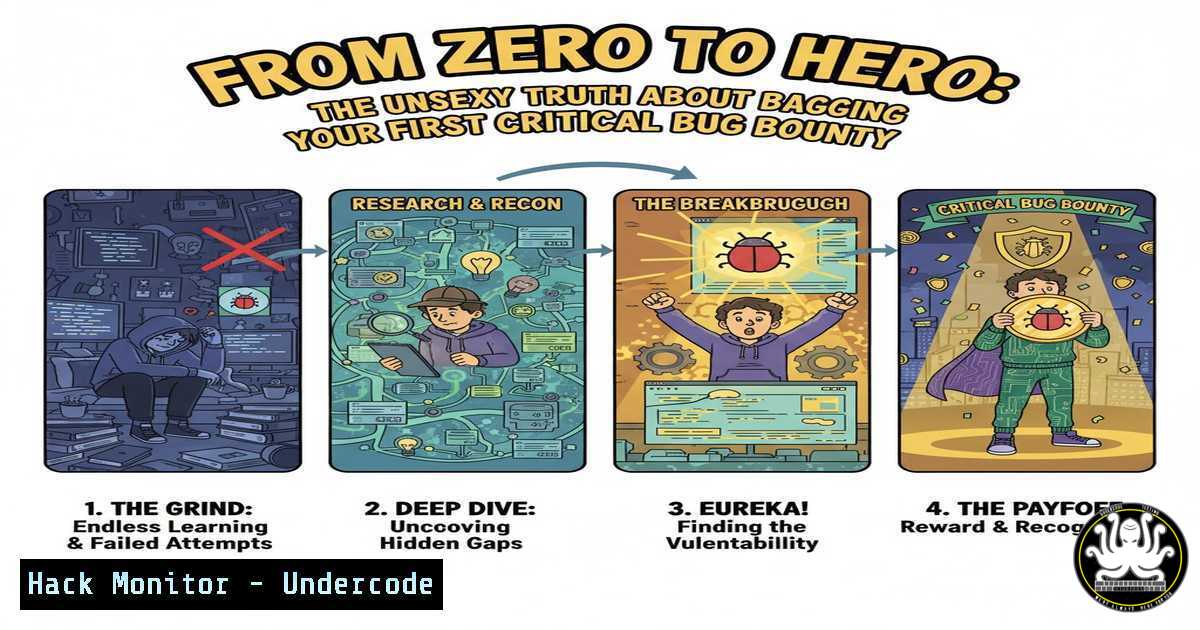
Introduction:
The allure of bug bounty programs is undeniable, promising financial rewards for uncovering critical vulnerabilities. However, the path to success is often obscured by a focus on results over process. This article deconstructs a real-world authentication bypass discovery to provide a foundational, methodology-first approach for aspiring bug hunters, shifting the focus from automated tools to deep, manual reconnaissance and a mastery of core web concepts.
Learning Objectives:
- Understand why a deep understanding of HTTP, authentication flows, and business logic is more critical than tool mastery for beginner bug hunters.
- Learn a systematic process for manual application reconnaissance and mapping to identify high-value attack surfaces.
- Develop the patient, documentation-driven mindset required for consistent success in bug bounty programs.
You Should Know:
1. Mastering the Fundamentals: HTTP and Authentication
Before touching a scanning tool, you must achieve fluency in the language of the web. This involves manually inspecting and understanding every aspect of HTTP communication.
Verified Command/Tutorial List:
`curl -v -X GET https://target.com/api/v1/user/profile` (Verbose HTTP request)
`curl -v -X POST -H “Content-Type: application/json” -d ‘{“email”:”[email protected]”}’ https://target.com/auth/magic-link` (Custom POST request)
Burp Suite Proxy: Intercept and analyze browser traffic.
Browser Developer Tools (F12): Network tab to monitor all client-server communications.
PortSwigger Web Security Academy: Labs for OAuth, JWT, and SQL Injection.
Step-by-step guide:
Step 1: Use your browser’s developer tools. Navigate to a target website, open the “Network” tab, and perform a login action. Observe every request and response, paying close attention to status codes, headers, and parameters.
Step 2: Configure Burp Suite as your proxy. Repeat the actions and use Burp to intercept the requests. Manually re-send them with modified parameters (e.g., change a user ID in a `userId` parameter) to test for Insecure Direct Object References (IDOR).
Step 3: For authentication flaws, meticulously trace the entire flow. For a magic link system, note the endpoint that generates the link, the token parameter, its expiration, and how it’s validated. The vulnerability often lies in the logic between steps, such as how OAuth account linking is handled when a magic link session is pending.
2. Deep Manual Reconnaissance and Functionality Mapping
Automated subdomain enumeration is a secondary step. The primary focus should be a thorough, manual exploration of the target application’s core functionality.
Verified Command/Tutorial List:
`gobuster dir -u https://target.com/ -w /usr/share/wordlists/dirb/common.txt` (For directory brute-forcing after manual mapping)
Browser Bookmarking: Create a structured folder of bookmarks for every discovered endpoint (/api/v1/, /admin/, /auth/, /uploads/).
Burp Suite Target Scope and Site Map: Define your scope and let Burp automatically build a site map as you browse.
OWASP Testing Guide: Methodology for information gathering and configuration testing.
Step-by-step guide:
Step 1: Add the main target domain to your Burp Scope. Browse the application normally for several hours, ensuring Burp is intercepting. Click every link, submit every form, and use every feature.
Step 2: Document everything in a notepad. Create a list of all identified functionalities: “User Registration,” “Password Reset,” “Profile Update,” “Checkout Process,” “API Key Generation.”
Step 3: Map each functionality to potential vulnerability classes. For example: “Profile Update” -> IDOR, XSS, CSRF; “Password Reset” -> Logic Flaws, Token Leakage; “Checkout” -> Business Logic Flaws, Race Conditions.
3. Intelligent Subdomain and Directory Enumeration
Once the main application is fully understood, use tools to expand your attack surface intelligently, based on the context you’ve gathered.
Verified Command List:
`subfinder -d target.com -silent | httpx -silent` (Passive subdomain discovery and HTTP probing)
`ffuf -u https://target.com/FUZZ -w /usr/share/wordlists/SecLists/Discovery/Web-Content/common.txt -mc all -fc 403` (Directory/File fuzzing)
`ffuf -u https://FUZZ.target.com -w /usr/share/wordlists/SecLists/Discovery/DNS/subdomains-top1million-5000.txt -mc all -fc 403` (VHost fuzzing)
`amass enum -passive -d target.com` (In-depth passive enumeration)
Step-by-step guide:
Step 1: Run a passive subdomain enumeration tool like `subfinder` or amass. Feed the live results to `httpx` to find web servers.
Step 2: For each new subdomain, add it to your Burp Scope and repeat the manual mapping process. A `dev.target.com` or `api.target.com` subdomain often has a different attack surface than the main application.
Step 3: Use `ffuf` for directory brute-forcing on high-value targets. Use the `-fc` flag to filter out common false positives like 403 Forbidden pages. Pay special attention to endpoints like /backup/, /admin/, /api/, and /logs/.
4. Testing Authentication Flows (OAuth/JWT/Magic Links)
Authentication is a prime target for critical vulnerabilities. Test every possible edge case in the login, registration, and session management processes.
Verified Command/Code Snippet List:
`jwt_tool ` (JWT vulnerability scanner)
Burp Suite Extender: Autorize (for testing access control)
Manual OAuth Flow Interception: Manipulate `state` and `redirect_uri` parameters.
Testing for Magic Link Reuse: Attempt to use a generated token multiple times.
Step-by-step guide:
Step 1 (OAuth): Initiate an OAuth login with a provider like Google. Intercept the request to the `redirect_uri` and tamper with the `state` parameter. If the application does not validate it, this can lead to CSRF. Also, try registering a new account with the same OAuth email to see how the application handles account linking/pre-existing accounts.
Step 2 (JWT): When you encounter a JWT, use `jwt_tool` to analyze it. Check if it uses a weak secret (none algorithm), if you can change the `alg` to none, or if the token signature is not verified on the server.
Step 3 (Magic Links): Request a magic link. Note the token length and format. Try to brute-force shorter tokens, check for token expiration, and critically, see if using the token logs you into a different, pre-existing account if an OAuth flow was initiated but not completed—this was the core of the authentication bypass described in the source.
5. Business Logic and API Testing
The most severe flaws are often not technical bugs but flaws in the application’s business logic that can be exploited.
Verified Command/Code Snippet List:
`curl -X PUT https://target.com/api/v1/cart/update -H “Authorization: Bearer
Burp Suite Repeater: For manual, repeated testing of API endpoints.
Turbo Intruder: For testing race conditions (e.g., redeeming a coupon multiple times).
`for i in {1..10}; do curl -X POST https://target.com/api/claim_reward & done` (Simple race condition test)
Step-by-step guide:
Step 1 (Parameter Tampering): In an e-commerce flow, intercept the request when adding an item to the cart or during checkout. Look for parameters like price, quantity, product_id, or coupon_code. Try modifying these on the client-side before the request is sent to the server.
Step 2 (API Sequencing): Map out all API endpoints for a single function, like changing an email. The correct flow might be `POST /api/verify-new-email` -> GET /api/confirm-email?token=abc123. Try skipping the first step and directly calling the confirmation endpoint with a guessed token.
Step 3 (Race Conditions): Find a endpoint that performs an action with a limit, like “claim one free reward.” In Burp, send the request to Turbo Intruder and fire off 10-20 concurrent requests. If the logic is flawed, you may be able to claim the reward multiple times.
What Undercode Say:
- Process Over Payload: The biggest differentiator between a novice and a successful bug hunter is not the toolset but the rigorous, patient process of manual reconnaissance and documentation.
- Context is King: Automated tools are blind to business logic. Understanding the why behind an application’s functionality reveals vulnerabilities that scanners will never find.
The analysis from the source post underscores a critical industry shift: the low-hanging fruit found by mass scanners is rapidly depleting. The future of bug bounties belongs to those who can think like an application architect and an adversary simultaneously. The detailed account of spending three days solely on mapping the application’s authentication, API flows, and functionality—before writing a single line of exploit code—is a testament to this reality. This methodical approach uncovers complex vulnerability chains and logic flaws that represent the most severe threats to modern web applications, moving beyond simple XSS or SQLi. It transforms bug hunting from a lottery into a reproducible engineering discipline.
Prediction:
The increasing complexity of web architectures, particularly with the intertwining of microservices, serverless functions, and complex authentication schemes like OAuth 2.0 and Passkeys, will make manual, logic-based vulnerability discovery the primary source of critical-impact bugs. Automation will continue to evolve, but it will serve to augment the hunter’s process, not replace it. Bug bounty programs will increasingly reward the depth of analysis over the quantity of findings, solidifying the value of the meticulous, patient researcher who masters the underlying protocols and business contexts.
🎯Let’s Practice For Free:
IT/Security Reporter URL:
Reported By: Augusto Gaieta – Hackers Feeds
Extra Hub: Undercode MoN
Basic Verification: Pass ✅


