Listen to this Post
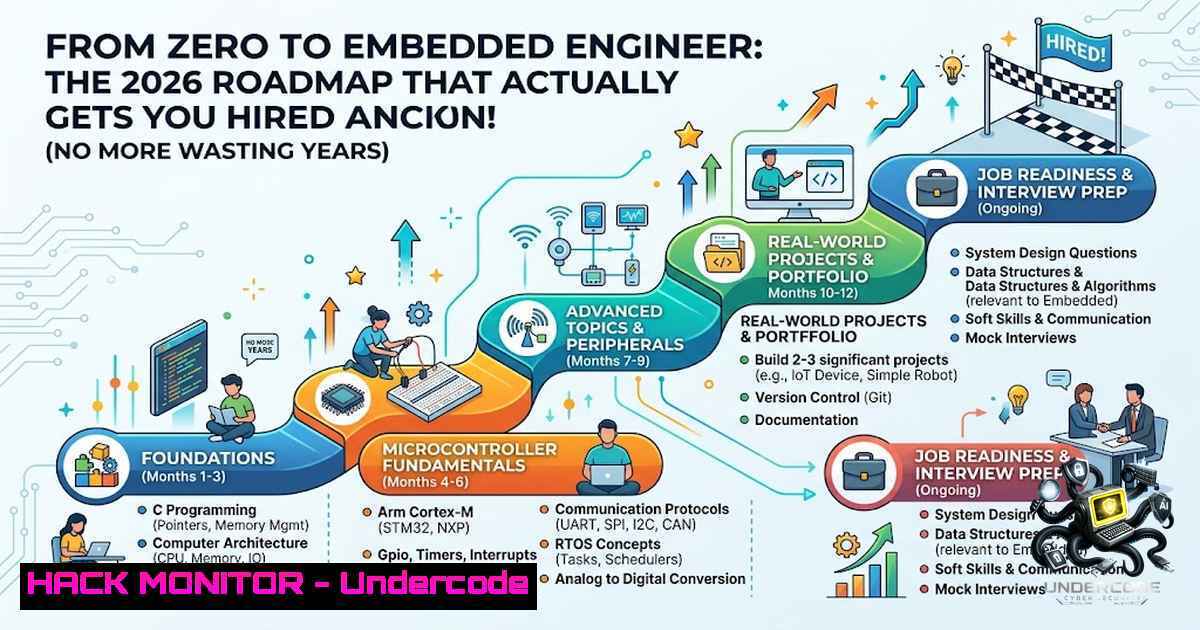
Introduction:
Thousands of engineering students graduate every year with degrees in ECE, EEE, or CSE, yet struggle to land their first embedded systems role. The gap isn’t talent—it’s direction. Most aspiring embedded engineers waste months watching random tutorials and buying expensive development boards without a structured learning path. This article provides a battle-tested, year-by-year roadmap that bridges the chasm between academic theory and industry-ready skills, complete with practical commands, debugging workflows, and the exact tools that hiring managers actually look for.
Learning Objectives:
- Master the foundational programming (C) and electronics principles required for embedded development
- Gain hands-on proficiency with microcontrollers, firmware writing, and industry-standard communication protocols
- Develop debugging, Embedded Linux, and portfolio-building skills to pass technical interviews
- Year 1 – Building Your Core: C Programming and Electronics Fundamentals
The first year isn’t about impressing anyone—it’s about building an unshakable foundation. Most students fail here because they jump straight into microcontrollers without understanding memory management, pointers, or basic circuit theory.
What to Learn:
- C Programming (The Embedded Dialect): Focus on pointers, memory allocation, bitwise operations, structs, and volatile keyword usage. Embedded C is not general-purpose C—you’re writing code that talks directly to hardware registers.
- Electronics Fundamentals: Ohm’s Law, Kirchhoff’s Laws, pull-up/pull-down resistors, transistors, op-amps, and basic filter design. You can’t debug a circuit if you don’t understand what’s happening at the voltage level.
- Digital Logic: Binary, hexadecimal, logic gates, flip-flops, counters, and state machines.
Step‑by‑Step Guide:
- Set up a Linux environment (dual-boot or WSL on Windows)—most embedded toolchains are Linux-1ative.
- Practice C daily on platforms like LeetCode or HackerRank, but with a twist: always use `-Wall -Wextra -Werror` flags to enforce strict coding standards.
- Build a simple CLI calculator in C that uses bitwise operations for arithmetic—this forces you to think at the register level.
- Simulate circuits using LTspice or Falstad’s circuit simulator before touching physical hardware.
- Read datasheets—start with a simple component like a 555 timer or an LED driver. Learn to extract absolute maximum ratings, timing diagrams, and application notes.
Key Linux Commands for Embedded Beginners:
 Check system information
uname -a

View memory mapping
cat /proc/meminfo

Compile C code with embedded-friendly flags
gcc -Wall -Wextra -Werror -std=c99 -o program main.c

Check binary size (critical for memory-constrained devices)
size program
2. Year 2 – Microcontrollers and Firmware Development
Now you’re ready to get your hands dirty. This is where theory meets practice. Start with a beginner-friendly platform like Arduino to understand the basics, but don’t stay there—industry uses ARM Cortex-M series microcontrollers (STM32, NXP, TI).
What to Learn:
- Microcontroller Architecture: ARM Cortex-M0/M3/M4, memory maps, clock trees, interrupt vectors, and peripheral registers.
- Communication Protocols: UART, I2C, SPI, CAN—these are non-1egotiable. Know how to configure them, read timing diagrams, and debug using logic analyzers.
- Firmware Structure: Main loop vs. interrupt-driven vs. RTOS-based architectures.
Step‑by‑Step Guide:
- Buy an STM32 Nucleo or Discovery board (under $30)—these are industry-relevant and have excellent toolchain support.
- Install the ARM GCC toolchain and OpenOCD for debugging:
sudo apt-get install gcc-arm-1one-eabi openocd
- Write a bare-metal LED blink program—not using Arduino libraries, but by directly manipulating memory-mapped registers. This teaches you how the hardware actually works.
- Configure a UART to send “Hello, World” to your PC over a serial terminal (PuTTY on Windows, `screen` or `minicom` on Linux).
- Implement an I2C driver to read data from a temperature sensor (e.g., LM75). This forces you to understand clock stretching, start/stop conditions, and acknowledge bits.
Sample Embedded C Code (STM32 Register-Level LED Blink):
include "stm32f4xx.h"

int main(void) {
// Enable GPIOA clock
RCC->AHB1ENR |= (1 << 0);

// Set PA5 as output (GPIO mode 01)
GPIOA->MODER |= (1 << 10);
GPIOA->MODER &= ~(1 << 11);

while(1) {
// Toggle PA5
GPIOA->ODR ^= (1 << 5);
for(int i = 0; i < 1000000; i++); // crude delay
}
}
- Year 3 – Real Projects, Industry Protocols, and RTOS
This is the year that separates hobbyists from professionals. You stop following tutorials and start solving real problems. Companies don’t care how many tutorials you’ve watched—they care whether you can read datasheets, debug hardware, and write reliable Embedded C code.
What to Learn:
- Real-Time Operating Systems (RTOS): FreeRTOS or Zephyr. Understand tasks, semaphores, mutexes, queues, and interrupt service routines.
- Industry Protocols: CAN bus (automotive), Modbus (industrial), MQTT (IoT), and USB device classes.
- Version Control: Git is non-1egotiable. Learn branching, merging, and pull requests.
Step‑by‑Step Guide:
- Choose a project that solves a real problem—e.g., a data logger for environmental sensors, a motor controller for a robot, or a CAN bus monitor for a vehicle.
- Implement the project using an RTOS—create separate tasks for sensor reading, data processing, and communication.
- Add a communication interface—send data over UART to a PC, or over MQTT to a cloud dashboard.
- Document everything—write a README, create schematics, and record a demo video. This becomes your portfolio.
- Learn to use a logic analyzer (e.g., Saleae) to debug protocol timing issues.
Essential Git Commands for Embedded Projects:
 Initialize a repository
git init

Add all files
git add .

Commit with a meaningful message
git commit -m "Add I2C driver for temperature sensor"

Create a branch for a new feature
git checkout -b feature/can-bus-implementation

Push to remote
git push origin main
- Debugging Like a Pro – GDB, OpenOCD, and JTAG
Debugging embedded systems is fundamentally different from debugging desktop applications. You’re dealing with real-time constraints, memory-mapped I/O, and hardware that may behave unpredictably. Mastery of debugging tools is what makes you valuable.
What to Learn:
- GDB (GNU Debugger): Set breakpoints, inspect memory, step through code, and examine register values.
- OpenOCD (Open On-Chip Debugger): Bridges your host PC to the target hardware via JTAG or SWD.
- Logic Analyzers and Oscilloscopes: Visualize signal integrity, timing violations, and protocol errors.
Step‑by‑Step Guide:
- Connect your STM32 board to your PC via a debugger (ST-Link, J-Link, or built-in).
2. Launch OpenOCD with the appropriate configuration file:
openocd -f board/stm32f4discovery.cfg
3. In another terminal, connect GDB to the OpenOCD server:
arm-1one-eabi-gdb your_firmware.elf
(gdb) target remote localhost:3333
(gdb) load
(gdb) break main
(gdb) continue
4. Inspect memory while the program is paused:
(gdb) x/32xw 0x20000000  Examine 32 words at SRAM start
(gdb) info registers  View all CPU registers
5. Use `monitor` commands in GDB to interact with OpenOCD:
(gdb) monitor reset halt  Reset and halt the target
(gdb) monitor flash write_image erase your_firmware.hex
5. Embedded Linux – The Next Frontier
By Year 4, you should be comfortable with Embedded Linux. This is where the industry is heading—Yocto, Buildroot, device tree files, and kernel module development. Even if you don’t become a Linux kernel expert, understanding the ecosystem is critical.
What to Learn:
- Linux Boot Process: U-Boot, kernel loading, device tree, and root filesystem.
- Cross-Compilation: Building software for ARM targets from an x86 host.
- Systemd and Init Systems: Managing services on embedded Linux devices.
- Networking: TCP/IP, socket programming, and network debugging.
Step‑by‑Step Guide:
- Get a Raspberry Pi (any model) and install Raspberry Pi OS Lite (headless).
- Set up SSH and connect to the Pi from your PC:
ssh pi@<raspberry-pi-ip>
- Write a simple C program that reads a GPIO pin and prints its state, then cross-compile it for ARM:
arm-linux-gnueabihf-gcc -o gpio_read gpio_read.c
- Transfer and run the binary on the Pi using
scp. - Learn device tree—overlay a custom device tree to enable a new peripheral.
Essential Embedded Linux Commands:
 Check kernel version
uname -r

View mounted filesystems
df -h

List all USB devices
lsusb

Check network interfaces
ip addr show

Monitor kernel messages (debugging)
dmesg -w

Check CPU frequency and temperature
cat /sys/devices/system/cpu/cpu0/cpufreq/scaling_cur_freq
vcgencmd measure_temp
6. Interview Preparation – What Companies Actually Ask
The final piece of the puzzle is interview preparation. Embedded systems interviews are notoriously technical—you’ll be tested on everything from bitwise operations to RTOS scheduling to hardware debugging scenarios.
What to Learn:
- Common Interview Questions: Endianness, volatile vs. const, interrupt latency, stack vs. heap, memory-mapped I/O, and linker scripts.
- Coding Challenges: Implement a circular buffer, write a state machine, or design a driver for a virtual peripheral.
- System Design: How would you design a system that reads 10 sensors and sends data over Wi-Fi every second?
Step‑by‑Step Guide:
- Review the “Embedded C Coding Standard” (BARR-C) —this is widely used in industry and frequently appears in interview discussions.
- Practice explaining your projects—use the STAR method (Situation, Task, Action, Result).
- Simulate an interview with a friend or use online platforms like Pramp.
- Study real interview experiences from companies like Qualcomm, Nvidia, and Broadcom.
- Build a public portfolio on GitHub with your best projects and clean, well-documented code.
Sample Interview Question – Circular Buffer Implementation:
typedef struct {
uint8_t buffer;
size_t head;
size_t tail;
size_t max_len;
bool full;
} circular_buffer_t;

bool cb_push(circular_buffer_t cb, uint8_t data) {
if (cb->full) return false;
cb->buffer[cb->head] = data;
cb->head = (cb->head + 1) % cb->max_len;
cb->full = (cb->head == cb->tail);
return true;
}
What Undercode Say:
- Execution > Roadmap. A beautiful roadmap is useless without daily, consistent effort. Companies don’t hire based on how many tutorials you’ve watched—they hire based on what you can actually build and debug.
-
Master the Fundamentals. You can’t skip C, electronics, and datasheet reading. These are the non-1egotiable building blocks of embedded engineering. Every advanced skill—RTOS, Embedded Linux, security—rests on this foundation.
The embedded systems field is projected to grow at 26% through 2031, but the competition is fierce. The engineers who succeed are those who treat learning as a disciplined, structured process rather than a random collection of YouTube videos. Start with the basics, build real projects, document everything, and never stop debugging. The difference between “learning” and “becoming employable” is the ability to solve problems, read datasheets, debug hardware, and write code that actually works in production.
Prediction:
- +1 The demand for embedded engineers will continue to outpace supply, especially as AI moves to the edge (TinyML, edge AI) and automotive electrification accelerates. Engineers who combine embedded skills with machine learning will command premium salaries.
- +1 Open-source toolchains (GCC, OpenOCD, Zephyr, FreeRTOS) will become even more dominant, reducing the barrier to entry and making embedded development more accessible than ever.
- -1 The complexity of embedded systems is increasing exponentially—security vulnerabilities, certification requirements (ISO 26262, DO-178C), and multi-core architectures will make the field harder to enter without a structured, disciplined approach.
- -1 Students who rely solely on academic coursework without hands-on projects will find themselves unemployable. The gap between university curricula and industry expectations is widening, not narrowing.
▶️ Related Video (74% Match):
🎯Let’s Practice For Free:
🎓 Live Courses & Certifications:
Join Undercode Academy for Verified Certifications
🚀 Request a Custom Project:
Secure, high-velocity infrastructure and disruptive technological engineering. Contact our engineering team for high-tier development and proprietary systems:
[email protected]
💎 Smart Architecture | 🛡️ Secure by Design | ⭐ Trusted by Thousands
IT/Security Reporter URL:
Reported By: Shubham Sharma – Hackers Feeds
Extra Hub: Undercode MoN
Basic Verification: Pass ✅


