Listen to this Post
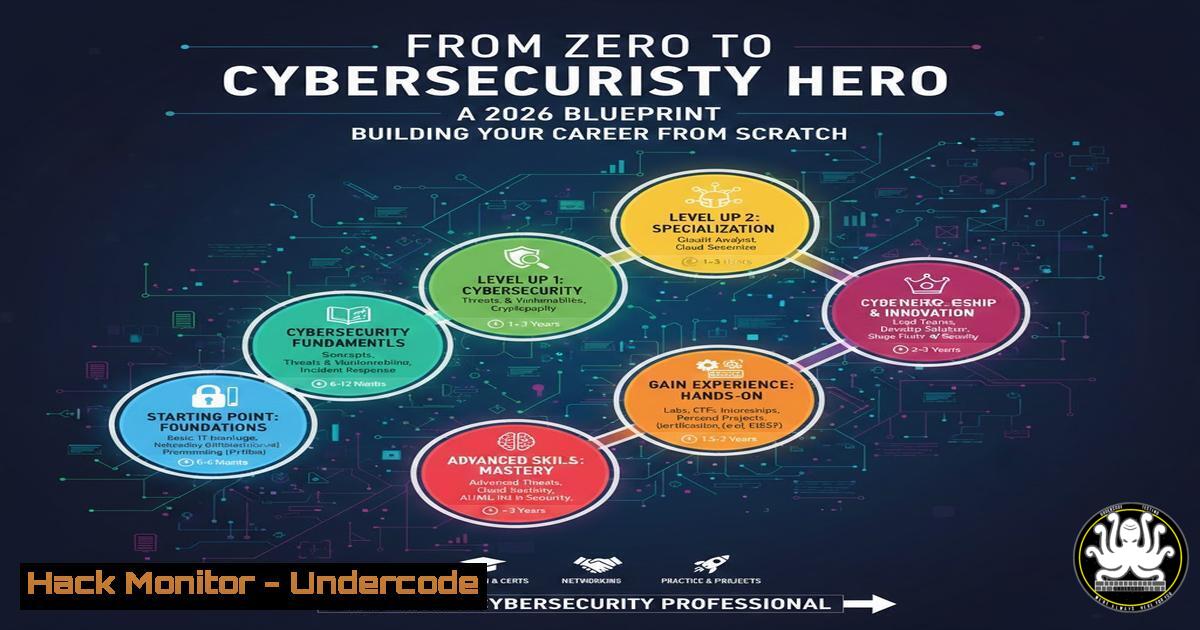
Introduction:
The cybersecurity skills gap remains one of the most critical challenges facing the global digital economy, with millions of unfilled positions offering lucrative and stable career paths. For aspiring professionals, the overwhelming volume of resources, certifications, and specializations can create a paralyzing “analysis paralysis.” This guide synthesizes a proven pathway, combining strategic career channel insights with hands-on technical practice, to build a formidable cybersecurity skill set from the ground up in 2026.
Learning Objectives:
- Understand the dual-channel strategy for career navigation and technical skill acquisition.
- Build a practical, project-based lab environment for penetration testing and defensive skills.
- Master the initial reconnaissance and enumeration phases of a security assessment.
- Develop a structured learning plan integrating certifications, platforms, and documentation.
You Should Know:
1. The Dual-Pillar Strategy for Cybersecurity Learning
To avoid confusion, successful learners separate career-focused information from deep technical knowledge. This mirrors the strategy of dedicated learning channels, where one resource focuses on events, jobs, and opportunities, and another concentrates purely on technical roadmaps, course summaries, and fundamentals.
Step-by-step guide:
Step 1: Organize Your Inputs. Create two bookmarked folders in your browser: “Career Navigator” and “Technical Deep Dive.” Populate the Career folder with links to job boards (LinkedIn, Indeed), professional organizations, and channels sharing internships and events. Populate the Technical folder with documentation (OWASP, MITRE ATT&CK), practice platforms (TryHackMe, Hack The Box), and tutorial channels.
Step 2: Establish a Routine. Dedicate 30 minutes each morning to scan your “Career Navigator” sources. Allocate your deeper, focused study blocks (2-3 hours) to engaging with content from your “Technical Deep Dive” folder. This prevents distraction and ensures consistent progress in both domains.
- Building Your Attack Lab: From Virtual Machines to First Boot
You cannot learn cyber security in a vacuum. A safe, isolated lab environment is non-negotiable for practicing offensive and defensive techniques without legal or network risks.
Step-by-step guide:
Step 1: Choose Your Hypervisor. Download and install a free hypervisor like Oracle VM VirtualBox or VMware Workstation Player. This software allows you to run multiple virtual machines (VMs) on your physical computer.
Step 2: Provision Your Machines.
- Download an attacker VM image like Kali Linux from the official Offensive Security website.
- Download a vulnerable practice VM like Metasploitable2 or OWASP Broken Web Applications.
- In your hypervisor, create a new VM, select “Use an existing virtual hard disk file,” and point it to the downloaded Kali Linux image file (.ova or .vmdk). Repeat for the target VM.
Step 3: Network Isolation. In the settings for both VMs, set the network adapter to “Host-Only Network” or “Internal Network.” This creates a virtual network where your Kali machine can attack the target VM, but neither can access your real home network or the internet, keeping your practice contained.
3. Mastering the First Step: Reconnaissance and Enumeration
Before any attack comes information gathering. Reconnaissance (passively collecting data) and enumeration (actively probing a target) are the bedrock of any security assessment, revealing the attack surface.
Step-by-step guide:
Step 1: Passive Recon with whois. From your Kali Linux terminal, gather domain registration data: whois example.com. Look for registrant names, email addresses, name servers, and the domain’s creation/expiry dates.
Step 2: Active Enumeration with nmap. Nmap is the quintessential network scanner. Begin with a basic scan: `nmap -sV -O 192.168.56.101` (replace IP with your target VM’s IP). The `-sV` flag probes open ports to determine service/version info, and `-O` attempts to identify the operating system. Save your results: nmap -sV -oA scan_results 192.168.56.101.
Step 3: Web Enumeration with gobuster. For web servers, discover hidden directories and files using a wordlist attack: gobuster dir -u http://192.168.56.101 -w /usr/share/wordlists/dirb/common.txt. This often reveals admin panels, backup files, or configuration directories.
4. The Certification Ladder: From Foundations to Specialization
Certifications validate your knowledge and structure your learning. Follow a progressive path from broad fundamentals to a chosen specialty.
Step-by-step guide:
Step 1: Foundation. Start with CompTIA Security+. It establishes essential vocabulary and concepts in networks, threats, and cryptography. Study using official syllabi, video courses, and practice tests.
Step 2: Entry-Level Technical. Choose a path:
Blue Team (Defense): Pursue CompTIA CySA+ (Cybersecurity Analyst) to learn threat detection and analysis.
Red Team (Offense): Pursue EC-Council’s CEH (Certified Ethical Hacker) or the more rigorous PNPT (Practical Network Penetration Tester) for hands-on attack methodology.
Step 3: Advanced Specialization. After experience, aim for high-tier certs like OSCP (Offensive Security Certified Professional) for offensive security, requiring a grueling 24-hour practical exam, or GCIH (GIAC Certified Incident Handler) for incident response.
5. Weaponizing Practice: From CTFs to Real-World Simulation
Theory and certs mean little without applied skill. Capture The Flag (CTF) platforms and guided labs provide the necessary playground.
Step-by-step guide:
Step 1: Start with Guided Learning. Create an account on TryHackMe. Complete the “Pre Security” and “Complete Beginner” learning paths. Rooms like “Nmap” or “Web Hacking Fundamentals” offer step-by-step instructions alongside a virtual machine, building muscle memory.
Step 2: Progress to Applied Challenges. Move to Hack The Box (HTB). Start in the “Starting Point” tier, which provides vital clues. Each machine is a puzzle box. Use your enumeration skills (nmap, gobuster), research known vulnerabilities for the services you find, and attempt to exploit them to find “flags” (text files proving your access).
Step 3: Document Religiously. For every machine you solve, write a detailed report in a tool like Obsidian or Notion. Include the IP, steps taken, commands used, vulnerabilities found, proof of concept, and remediation advice. This builds a personal knowledge base and is direct practice for real-world penetration test reports.
6. The Hacker’s Toolkit: Essential Open-Source Software (OSS)
Beyond the Kali Linux default tools, a professional builds a personalized toolkit for efficiency and depth.
Step-by-step guide:
Step 1: Reconnaissance & Intelligence.
theHarvester: Gather emails, subdomains: theHarvester -d example.com -l 500 -b google.
Amass: Perform in-depth DNS enumeration and mapping: amass enum -d example.com.
Step 2: Vulnerability Scanning.
Nikto: Scan web servers for misconfigurations and known flaws: `nikto -h http://192.168.56.101`.
Nuclei: Use community-powered templates to scan for thousands of vulnerabilities: `nuclei -u http://192.168.56.101 -t /path/to/templates.msfconsole
<h2 style="color: yellow;"> Step 3: Exploitation & Post-Exploitation.</h2>
Metasploit Framework: The classic exploitation tool. Launch with, search for exploits (search eternalblue), and configure payloads.john –format=nt hashfile.txt
John the Ripper: Crack passwords from obtained hashes:.crackmapexec smb 192.168.1.0/24 -u userlist.txt -p passwordlist.txt`.
CrackMapExec: A Swiss Army knife for assessing Active Directory environments:
What Undercode Say:
- Career and Craft are Separate Disciplines. Treating job hunting and skill-building as distinct, parallel tracks prevents information overload and allows for focused mastery in both areas. Success requires a dedicated strategy for each.
- The Lab is the True Classroom. Certifications open doors, but demonstrable, hands-on skill built in a personal lab is what secures jobs and wins bug bounties. The ability to document and reproduce an attack chain is the core differentiator between a theorist and a practitioner.
The current landscape shows a democratization of cybersecurity education but also a saturation of entry-level generalists. The pathway to success in 2026 is defined not by consuming more content, but by strategically curating it and, most importantly, applying it relentlessly in a controlled environment. The community-driven model of sharing technical roadmaps and resources is invaluable, but it is a map, not the journey itself. The individual’s commitment to systematic practice, documentation, and progressive skill validation through increasingly difficult challenges (CTFs, certs, simulated labs) is what forges a competent professional. The tools and techniques will evolve, but this foundational methodology of learn-practice-document will remain constant.
Prediction:
The future of cybersecurity hiring will increasingly de-prioritize traditional degrees in favor of auditable, practical skill portfolios. We will see a rise in platform-verified skill badges (from HTB, TryHackMe, etc.) being integrated directly into professional profiles like LinkedIn. Furthermore, the role of AI as both a copilot for attackers/defenders (automating reconnaissance, generating exploit code) and as a novel attack surface itself will create a new specialization niche. Professionals who combine deep, hands-on technical fundamentals with the adaptability to leverage AI tools will become the most sought-after assets in the security market by the end of the decade.
▶️ Related Video (80% Match):
🎯Let’s Practice For Free:
IT/Security Reporter URL:
Reported By: Kerolos Ayman – Hackers Feeds
Extra Hub: Undercode MoN
Basic Verification: Pass ✅


