Listen to this Post
Introduction:
In the high-stakes world of cybersecurity, local privilege escalation (LPE) vulnerabilities represent a critical chokepoint for attackers seeking to dominate a network. The recent disclosure of CVE-2025-54100, a vulnerability in the Microsoft Windows Server Message Block (SMB) protocol, exemplifies this threat, allowing a standard user to gain SYSTEM-level privileges. This technical deep-dive, based on the research of Osman Eren Güneş and Melih Kaan Yıldız, explores the mechanics of this flaw, its exploitation, and the essential steps for mitigation.
Learning Objectives:
- Understand the technical root cause and impact of the CVE-2025-54100 local privilege escalation vulnerability.
- Learn the methodology for identifying unpatched systems and conceptualizing the exploitation chain.
- Gain actionable knowledge for implementing mitigations and hardening SMB client configurations on Windows systems.
You Should Know:
1. Vulnerability Deep Dive: The SMB Client Flaw
The core of CVE-2025-54100 lies within the Windows SMB client driver (mrxsmb.sys). SMB is a fundamental protocol for file, printer, and port sharing on Windows networks. The vulnerability is a race condition that occurs during specific SMB connection negotiation and session setup processes. When a malicious SMB server responds to a client’s request in a precisely malformed and timed manner, it can corrupt kernel memory. This corruption occurs due to improper handling of objects in the SMB client’s state machine, where one thread might attempt to use a connection object that another thread has already freed or is in the process of cleaning up. This “use-after-free” or double-free condition in kernel space is the gateway to privilege escalation.
Step‑by‑step guide explaining what this does and how to use it.
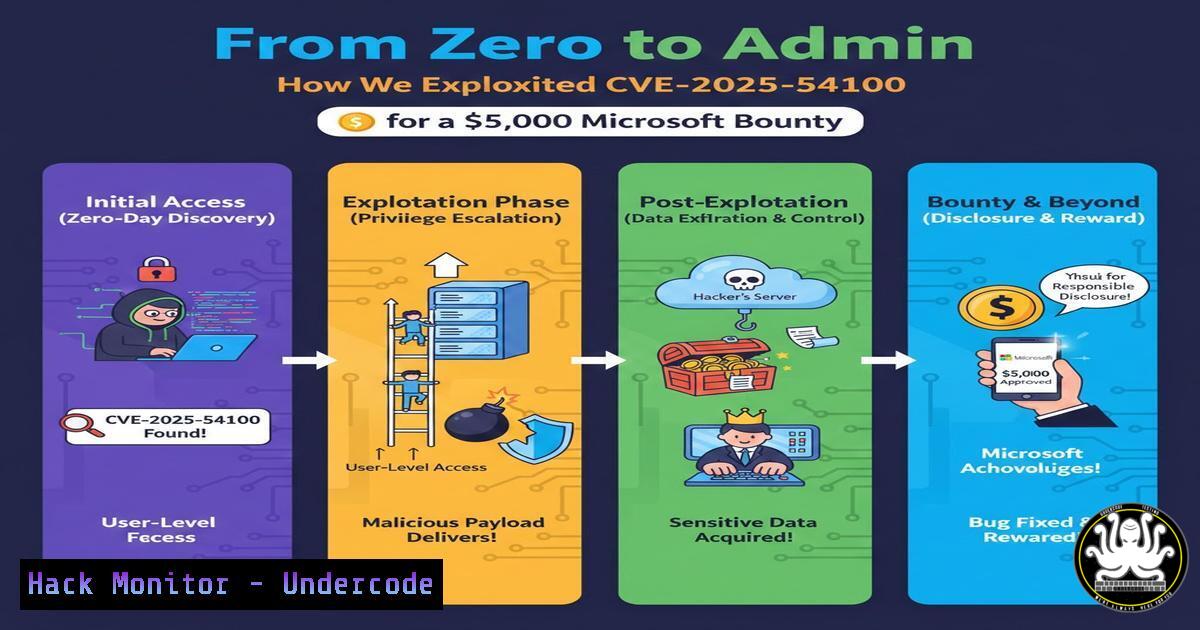
To conceptualize the attack flow:
- Attacker Setup: The attacker controls a malicious SMB server (e.g., configured on a Linux machine using tools like `impacket` or a modified `samba` server).
- Victim Trigger: The victim (a standard user on a vulnerable Windows system) is induced to connect to the attacker’s SMB share. This could be through various means: a malicious document with an embedded SMB link (
\\ATTACKER-IP\share), a phishing email, or even automated network discovery. - Exploit Execution: Upon connection attempt, the malicious server sends specially crafted SMB response packets. These packets are designed to manipulate the timing and state of the SMB client’s kernel objects.
- Race Condition Trigger: The crafted responses create a race window where the client driver’s cleanup routine for the connection object is executed concurrently with operations still trying to use that object.
- Kernel Memory Corruption: This race leads to memory corruption. A skilled attacker can then leverage this corrupted state to overwrite critical kernel data structures.
- Privilege Escalation: By carefully controlling the overwritten memory, the attacker can hijack the execution flow of the kernel, ultimately executing arbitrary code with SYSTEM privileges from the context of the logged-in standard user.
2. Identifying Vulnerable Systems
Before testing or mitigating, you must identify systems at risk. This vulnerability affects Windows client and server versions that have not applied the relevant security patch from May 2025 or later.
Step‑by‑step guide explaining what this does and how to use it.
On Windows (Using Command Prompt or PowerShell):
- Check the specific KB patch: Microsoft patches are delivered in Knowledge Base (KB) updates. You need to find the specific KB number that addresses CVE-2025-54100 from the official MSRC advisory.
wmic qfe list | findstr "KBXXXXXXX"
(Replace `KBXXXXXXX` with the actual KB number from the MSRC update guide.)
- Check system version and build number: Sometimes confirming the patch is not installed is easier by checking if the OS build is older than the patched version.
systeminfo | findstr /B /C:"OS Name" /C:"OS Version"
Compare the “OS Version” (e.g., 10.0.19045.xxxx) against the version lists in the MSRC advisory.
On Linux (For Remote Enumeration):
You can use `nmap` NSE scripts to check for SMB vulnerabilities and versions remotely, though a specific script for this CVE may not exist immediately. General SMB auditing is still valuable.
 Scan for open SMB ports and gather basic info
nmap -p 445 --script smb-protocols,smb-security-mode <target_ip>

A more aggressive script to check for known vulnerabilities (base for future CVE checks)
nmap -p 445 --script smb-vuln-ms17-010,smb-vuln-ms10-054 <target_ip>
3. Proof-of-Concept Exploit Framework
Understanding the exploit’s components is crucial for defense. The public proof-of-concept (PoC) typically involves two main parts: a malicious SMB server and a kernel payload.
Step‑by‑step guide explaining what this does and how to use it.
Disclaimer: This section is for educational understanding and security testing in controlled, authorized environments only.
1. Malicious SMB Server: This is often a custom Python script using libraries like `impacket` or a modified version of an open-source SMB server. Its job is to handle the initial connection and send the malicious response sequences.
 Pseudocode structure of a malicious SMB server component
from impacket import smbserver

class MaliciousSMBServer(smbserver.SimpleSMBServer):
def negotiateSession(self, request):
 1. Send normal negotiation response
send_normal_response(request)
 2. Introduce a precise delay
time.sleep(0.001)  Critical timing
 3. Send a malformed SMB Session Setup Response
send_corrupting_packet(request.connection)
2. Kernel Payload: Once memory is corrupted, the exploit needs a payload to gain SYSTEM privileges. This often involves token stealing—copying the access token from a SYSTEM process (like `lsass.exe` or a critical system thread) to the attacker’s process.
// Conceptual kernel payload objective
NTSTATUS EscalatePrivileges() {
PEPROCESS CurrentProcess = GetCurrentProcess();
PEPROCESS SystemProcess = FindSystemProcess();
// Steal the SYSTEM token
CurrentProcess->Token = SystemProcess->Token;
return STATUS_SUCCESS;
}
3. Weaponization: The full exploit chains these together. It may be delivered as a single executable that spawns a local SMB server on a loopback port, triggers the vulnerable client to connect to it, and then executes the kernel payload.
4. Mitigation and Patching Strategy
The primary and most effective mitigation is to apply the official security update from Microsoft.
Step‑by‑step guide explaining what this does and how to use it.
1. Apply Windows Updates:
Manual Check: Go to Settings > Windows Update > Check for updates. Install all available critical security updates.
Enterprise Management: Use Windows Server Update Services (WSUS), Microsoft Endpoint Configuration Manager, or Intune to approve and deploy the relevant security update to all endpoints.
2. Interim Mitigations (If Immediate Patching is Impossible):
Restrict SMB Traffic: Use Windows Firewall or network firewall rules to block outbound SMB (TCP 445) connections from workstations to untrusted networks. This prevents connections to external malicious servers.
 PowerShell to create a firewall rule blocking outbound SMB
New-NetFirewallRule -DisplayName "Block Outbound SMB" -Direction Outbound -Protocol TCP -RemotePort 445 -Action Block
Disable SMBv1 Client: While this vulnerability may affect newer versions, disabling the legacy and insecure SMBv1 client is a good security practice.
 Disable SMBv1 Client
Set-SmbClientConfiguration -EnableSMB1Protocol $false
Enable SMB Signing: Enforcing SMB packet signing can inhibit some types of man-in-the-middle attacks that might be used to trigger this, though it may not directly stop a user-initiated connection to a malicious server.
5. Defensive Detection Techniques
Security teams need to detect exploitation attempts. This involves monitoring for specific patterns.
Step‑by‑step guide explaining what this does and how to use it.
1. Windows Event Log Monitoring: Look for unusual SMB client activity.
Event ID 30800 in Microsoft-Windows-SmbClient/Security: Records SMB connection failures. A cluster of failures to an unusual IP could indicate attack attempts.
Use PowerShell to query recent SMB client errors:
Get-WinEvent -FilterHashtable @{LogName='Microsoft-Windows-SmbClient/Security'; ID=30800} -MaxEvents 20
2. Sysmon Monitoring (Advanced): Configure Sysmon to track network connections (Event ID 3) where the destination port is 445 and the image is a process not typically initiating SMB connections (e.g., word.exe, excel.exe, or a user’s browser).
<!-- Example Sysmon rule snippet for tracking process creation with network connection -->
<RuleGroup name="" groupRelation="or">
<NetworkConnect onmatch="include">
<DestinationPort condition="is">445</DestinationPort>
<Image condition="end with">winword.exe</Image>
</NetworkConnect>
</RuleGroup>
3. Endpoint Detection and Response (EDR): Ensure your EDR solution is configured to alert on attempts to manipulate kernel objects or suspicious driver behavior, which are hallmarks of kernel-level exploits.
6. Ethical Disclosure and Bug Bounty Lessons
The discovery of CVE-2025-54100 and its $5,000 bounty through Microsoft’s MSRC program highlights a successful ethical hacking workflow.
Step‑by‑step guide explaining what this does and how to use it.
1. Research & Fuzzing: Researchers used systematic testing (likely fuzzing) of the SMB client protocol to find unexpected crashes.
2. Root Cause Analysis: They analyzed the crash dumps in a kernel debugger (WinDbg) to trace the faulting code path and understand the race condition.
!analyze -v
kv
!poolview <corrupted_address> // Hypothetical command to inspect pool memory
3. Weaponization & Reliability: They developed a reliable exploit to prove the severity (Privilege Escalation to SYSTEM).
4. Report Drafting: They created a clear, detailed report for MSRC, including impact, steps to reproduce, and PoC code.
5. Coordination & Disclosure: They worked with MSRC during the patch development embargo period and publicly disclosed only after the patch was widely available.
What Undercode Say:
- The Perimeter is Inside the Machine: This vulnerability underscores that network perimeter defenses are insufficient. An attacker who gains a basic user foothold (via phishing, credential theft, etc.) can use flaws like CVE-2025-54100 to instantly become the most powerful entity on that host, bypassing application allowlists and user access controls.
- Kernel Race Conditions are a Persistent Threat: The subtle timing required for this exploit makes it difficult to find with static analysis alone, ensuring that similar bugs will remain in complex, performance-critical kernel code for years to come. Defenders must prioritize kernel-level monitoring and rapid patch application for OS components.
Analysis:
CVE-2025-54100 is not an isolated incident but part of a consistent trend of high-severity LPE vulnerabilities in Windows kernel drivers. These vulnerabilities are gold for attackers because they reliably turn low-value access into total control. The $5,000 bounty reflects Microsoft’s assessment of its severity and the quality of the report. For red teams, it’s a new tool; for blue teams, it’s a urgent patching priority. The technical sophistication—exploiting a race condition in a core protocol driver—demonstrates that attackers are moving beyond simple buffer overflows. Future exploits will increasingly target logical flaws and concurrency issues in core OS components, making defense more challenging. This places a premium on behavioral detection that can spot the anomalous kernel activity that follows a successful exploitation, rather than just the initial trigger.
Prediction:
The successful exploitation of CVE-2025-54100 will catalyze two immediate trends in the cybersecurity landscape. First, we will see a surge in focused fuzzing and reverse engineering campaigns targeting other SMB client state machines and similar networked kernel drivers (like RPC or HTTP.sys), leading to the discovery of analogous race condition flaws in the next 6-12 months. Second, this vulnerability will be rapidly integrated into sophisticated ransomware and advanced persistent threat (APT) group playbooks as a reliable “break-glass” escalation method, especially in environments where outbound SMB is not restricted. This will force a defensive shift beyond mere monthly patching cycles towards implementing aggressive attack surface reduction rules, such as default-deny firewall policies for workstation egress and widespread deployment of hypervisor-protected code integrity (HVCI) to make kernel exploitation significantly harder, even when a vulnerability is successfully triggered.
▶️ Related Video (82% Match):
🎯Let’s Practice For Free:
IT/Security Reporter URL:
Reported By: Osman Eren – Hackers Feeds
Extra Hub: Undercode MoN
Basic Verification: Pass ✅


