Listen to this Post
Introduction:
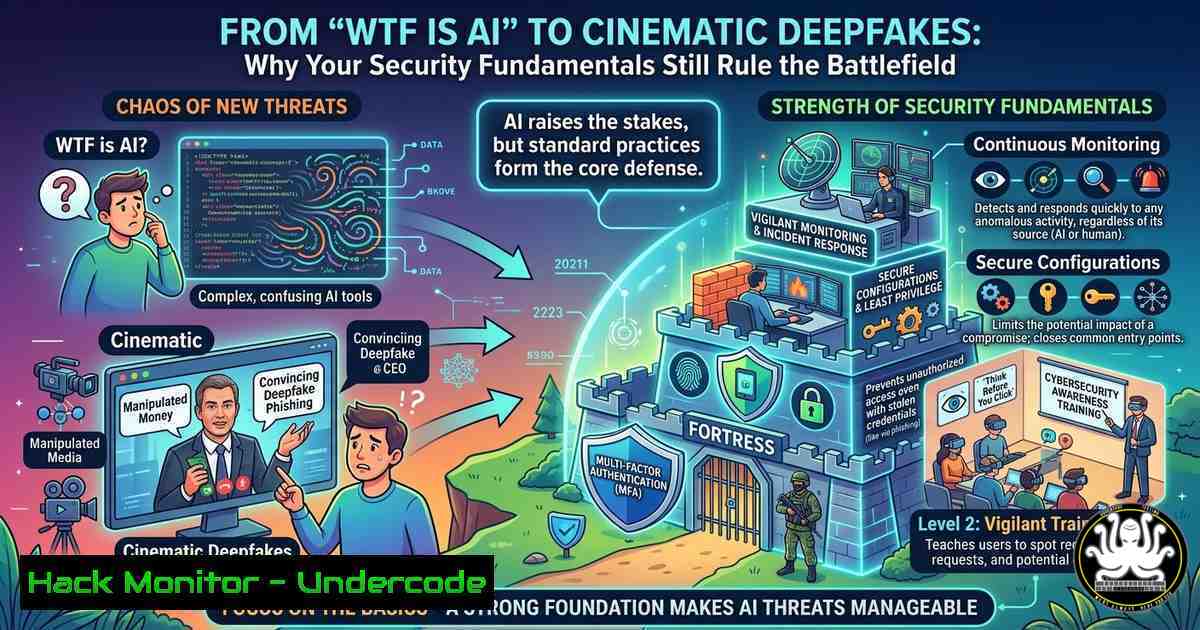
The cybersecurity landscape is experiencing a paradox: while offensive and defensive technologies have evolved at breakneck speed—particularly with the advent of generative AI—the core conversations and vulnerabilities remain remarkably stagnant. As highlighted by Ryan Williams’ retrospective on six years of security journalism, the industry is still grappling with the same fundamental challenges, albeit with exponentially more sophisticated tools. This article explores the shifting dynamics of AI-powered offense and defense, questioning whether we are approaching a stalemate where breaches are mitigated so quickly that their impact becomes negligible, or if we are simply accelerating the same arms race with new paint.
Learning Objectives:
- Understand the historical stagnation of core security principles despite technological advancements in AI.
- Analyze the dual-use nature of AI in both launching attacks and automating defense postures.
- Learn to implement AI-assisted security controls and identify gaps where “financial friction” controls become critical.
You Should Know:
- The Unchanged Core: Why Security Fundamentals Outlast Tech Hype
Despite the explosion of AI tools, the foundational elements of security—identity management, patch cycles, and network segmentation—remain the primary battleground. Six years ago, magazines discussed the basics of phishing and misconfigurations; today, those same issues cause breaches, now accelerated by AI-generated lures. The post references a sentiment that “security has always been a game of catch up,” but the reality is that defenders often neglect basic hygiene while chasing AI solutions.
Step‑by‑step guide to hardening fundamentals using modern automation:
- Linux (Audit & Harden): Use `auditctl` to monitor critical system files. Run `sudo auditctl -w /etc/passwd -p wa -k identity_changes` to track unauthorized modifications. Combine this with `fail2ban` to automate responses to brute-force attempts.
- Windows (Attack Surface Reduction): Utilize PowerShell to enforce ASR rules. Execute `Set-MpPreference -AttackSurfaceReductionRules_Ids $rule_id -AttackSurfaceReductionRules_Actions Enabled` to block common attack vectors like Office child processes.
- Tool Configuration: Deploy OpenSCAP or Microsoft Defender for Endpoint to generate compliance reports against CIS benchmarks, ensuring that the “boring” controls are validated daily.
- The AI Stalemate: Offense vs. Defense in a Generative World
The core thesis from the source material suggests a future where AI-powered offense and defense achieve parity. Attackers now use models to create cinema-quality deepfakes and polymorphic malware, while defenders leverage AI for real-time log analysis and automated incident response. The question is whether this will lead to a state where breaches are remediated so fast they have “zero impact,” or if it simply widens the gap between resource-rich and resource-poor defenders.
Step‑by‑step guide to testing AI-driven defense parity:
- Simulating AI-Enhanced Phishing: Use open-source tools like `Gophish` combined with AI-generated text (via local LLMs like Ollama) to create dynamic, context-aware phishing simulations. Set up a lab environment to measure click rates against traditional templates.
- Automated Defense (SOAR): Configure a Security Orchestration, Automation, and Response (SOAR) platform. Create a playbook that automatically isolates a host (using `ipconfig /release` via remote commands or firewall rules) when an AI-based SIEM (like Wazuh with ML) detects anomalous user behavior.
- API Security Testing: With AI automating API endpoints, security must keep pace. Use `Burp Suite` or `Postman` to perform fuzzing on AI endpoints. Run `ffuf -u https://target.com/api/v1/upload/FUZZ -w wordlist.txt` to discover hidden endpoints that could be leveraged by AI-driven enumeration bots.
- Financial Friction: The Next Frontier of Security Controls
As the post speculates, if AI makes breaches inevitable but mitigatable, attackers may shift focus to those who can’t afford the solutions. This introduces the concept of “financial friction” controls—security measures designed not just to stop an attacker, but to make the cost of the attack exceed the potential gain. This involves sophisticated rate limiting, fraud detection algorithms, and identity verification that imposes computational or monetary costs.
Step‑by‑step guide to implementing friction-based controls:
- Linux (Rate Limiting): Use `iptables` or `nftables` to create dynamic rate limits. Example: `sudo iptables -A INPUT -p tcp –dport 443 -m connlimit –connlimit-above 10 –connlimit-mask 32 -j REJECT` to prevent credential stuffing attacks.
- Windows (Identity Friction): Enable Windows Defender Credential Guard to isolate secrets from the operating system process, forcing attackers to expend significantly more effort to extract credentials.
- Cloud Hardening (AWS/GCP): Implement “WAF” with custom rules that require computational proof-of-work for high-risk actions, or use anomaly detection to trigger step-up authentication for any API call exceeding a certain financial threshold.
4. Building an AI-Integrated Red Team Lab
To understand the stalemate, one must train with the tools. The retrospective mentions early experiments with DALL-E; today, defenders must test against models that generate code, voices, and images indistinguishably. Creating a home lab that integrates these AI components is crucial for modern security training.
Step‑by‑step guide for setting up an AI security lab:
1. Deploy Local AI Models: Install `Ollama` or `GPT4All` on a Linux VM. Pull models like `llava` for vision analysis or `codellama` for code generation.
2. Create a Vulnerable Target: Deploy a deliberately vulnerable application like `DVWA` or `Juice Shop` in Docker (docker run -p 80:80 bkimminich/juice-shop).
3. Automate AI Attacks: Write a Python script using the `requests` library and the local LLM to automatically generate SQL injection payloads based on the target’s error messages. This mimics how AI agents will autonomously probe for vulnerabilities.
4. Monitor with AI SIEM: Forward logs from the vulnerable host to Wazuh. Use the `wazuh-ai` module (if configured) to analyze logs for zero-day patterns that signature-based tools might miss.
5. Attack Surface Reduction in the AI Era
The post implies that while tech changes, the conversation remains the same. In practice, this means that attack surface reduction (ASR) principles from six years ago—like limiting admin privileges and blocking macros—are still the most effective countermeasures against AI-generated malware. AI can write better code, but it cannot bypass a properly configured application whitelist if the fundamentals are solid.
Step‑by‑step guide for advanced ASR:
- Linux (AppArmor/Seccomp): Confine applications using AppArmor profiles. Create a profile for your browser to prevent it from executing scripts in the `/tmp` directory, mitigating drive-by downloads.
- Windows (PowerShell Constrained Language Mode): Run `$ExecutionContext.SessionState.LanguageMode` to check the mode. Enforce Constrained Language Mode via AppLocker to prevent PowerShell from executing arbitrary code, a common vector for AI-generated ransomware.
- Network Micro-segmentation: Use `Calico` or `Cilium` in Kubernetes environments to enforce granular network policies. This ensures that even if an AI agent compromises a container, it cannot laterally move to the database tier.
What Undercode Say:
- Fundamentals are Immutable: No matter how advanced AI becomes, misconfigured S3 buckets, weak passwords, and unpatched systems remain the primary vectors of compromise. AI just automates the exploitation of these age-old mistakes.
- The Stalemate is Economic: The predicted stalemate where “offence and defence are pretty much on par” will likely bifurcate the industry. Large enterprises with AI-driven SOAR will achieve near-instant remediation, while small to medium businesses will face an unprecedented wave of hyper-personalized attacks they cannot afford to defend against.
The analysis of the source material reveals a critical truth: we are not facing a technological revolution in security so much as an automation acceleration. The “hair brained schemes” of six years ago are now mainstream threats. Defenders must focus on integrating AI to automate the response to those threats while simultaneously refusing to abandon the manual, fundamental controls that form the bedrock of defense. The future isn’t just about having AI; it’s about using AI to enforce the basics faster than the adversary can.
Prediction:
As AI-generated media becomes indistinguishable from reality, the next major breach won’t be a malware infection but a deepfake-driven supply chain attack. We will likely see a rise in “real-time verification” services—cryptographically signed video and audio—as a mandatory control. The stalemate will force attackers to pivot from technical exploitation to psychological manipulation at scale, turning security into a discipline dominated by AI verifiers and AI forgers locked in a continuous, automated battle.
▶️ Related Video (78% Match):
🎯Let’s Practice For Free:
IT/Security Reporter URL:
Reported By: Ryan Williams – Hackers Feeds
Extra Hub: Undercode MoN
Basic Verification: Pass ✅


