Listen to this Post
Introduction:
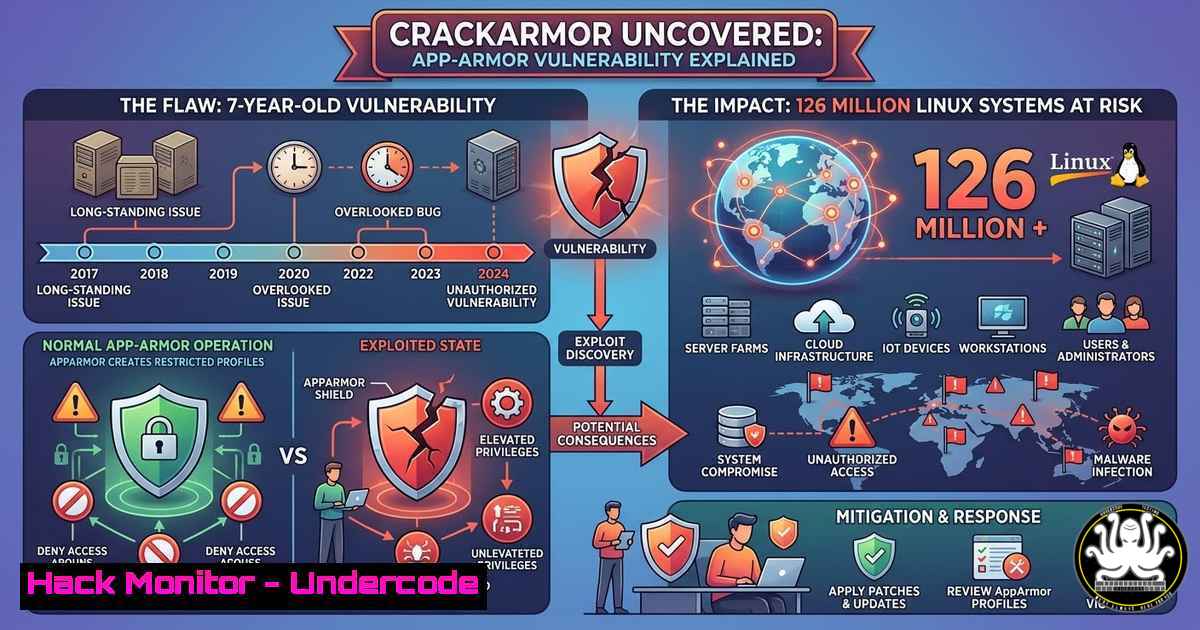
A newly disclosed set of vulnerabilities dubbed “CrackArmor” has exposed a critical weakness in the AppArmor Linux kernel security module, allowing unprivileged users to bypass kernel protections and escalate to root privileges. Discovered by Saeed Abbasi at Qualys Threat Research Unit (TRU), these “confused deputy” flaws have been present in the codebase since 2017 and are estimated to affect over 12.6 million systems globally, including major enterprise Linux distributions and containerized environments.
Learning Objectives:
- Understand the technical mechanics of the “confused deputy” vulnerability within AppArmor’s policy enforcement.
- Identify exploitation vectors that lead to local privilege escalation (LPE) and container breakout.
- Implement effective mitigation strategies, including patch management and configuration hardening.
You Should Know:
1. Mitigating CrackArmor: Immediate Patching and Verification
The primary defense against CrackArmor is to apply the latest security patches released by your Linux distribution vendor. Because the vulnerability exists in the kernel’s AppArmor implementation (specifically within the `aa_label_parse` and related policy enforcement functions), a kernel update is required to close the hole.
Step‑by‑step guide to verify and patch:
1. Identify your distribution and current kernel version:
cat /etc/os-release
uname -r
2. Check for available security updates related to AppArmor or the kernel:
– Debian/Ubuntu:
sudo apt update && sudo apt list --upgradable | grep -E "linux-image|apparmor"
– RHEL/CentOS/Fedora:
sudo dnf check-update | grep -E "kernel|apparmor"
3. Apply the updates:
 For Debian/Ubuntu
sudo apt upgrade linux-image-$(uname -r) apparmor
 For RHEL/CentOS/Fedora
sudo dnf update kernel apparmor
4. Reboot the system to load the new kernel:
sudo reboot
5. After reboot, confirm the patch is applied:
 Check for known fixed versions (e.g., Ubuntu 22.04 requires kernel 5.15.0-119 or later)
uname -r
 Verify AppArmor status and loaded profiles
sudo aa-status
- Understanding the Exploitation Chain: How the Confused Deputy Works
The “CrackArmor” vulnerabilities exploit a logic flaw where AppArmor’s policy engine incorrectly handles overlapping or conflicting profiles. In a “confused deputy” scenario, an unprivileged process (the deputy) with limited permissions is tricked into performing actions on behalf of an attacker, using the deputy’s elevated privileges. Here, an attacker can craft a malicious application that manipulates AppArmor to load a policy that grants unintended access, leading to arbitrary code execution with root privileges.
Step‑by‑step guide to the conceptual exploitation flow:
- Identify a vulnerable AppArmor version (pre‑patch). The flaw allows a process to call `aa_change_hat` or manipulate profile transitions without proper label validation.
- Create a malicious policy profile that appears to be a legitimate subprofile but contains rules allowing access to sensitive files (e.g.,
/etc/shadow). - Trigger the confusion: The attacker’s process, running as a regular user, invokes a legitimate, privileged helper that normally switches to a restricted profile. Due to the bug, the helper inherits the attacker’s crafted profile instead of the intended restrictive one.
- Escalate to root: With the malicious profile active, the process can now write to system binaries or modify `sudoers` configuration, achieving root escalation.
While full exploit code is not publicly detailed to allow patching time, Qualys has demonstrated working Proofs of Concept (PoCs) showing the complete chain.
- Breaking Container Isolation: Implications for Cloud and DevOps
Because AppArmor is commonly used to enforce mandatory access control (MAC) in containerized environments (Docker, Kubernetes, LXC), CrackArmor directly threatens container isolation. A successful exploit inside a container could allow an attacker to break out to the host node, compromising all containers running on that host and potentially the entire cluster.
Step‑by‑step guide to verify container isolation settings:
- Check if AppArmor is enabled on the host and container:
On host
sudo aa-status
Check container's AppArmor profile (Docker)
docker inspect --format='{{.AppArmorProfile}}' <container_id>
2. Enforce a default restrictive profile for containers:
- In Docker, set the default profile via
--security-opt apparmor=docker-default. - For Kubernetes, use a PodSecurityPolicy or admission controller to enforce AppArmor annotations:
metadata:
annotations:
container.apparmor.security.beta.kubernetes.io/<container_name>: runtime/default
- Monitor for suspicious profile changes or `aa_change_hat` calls using auditd or Falco to detect potential exploitation attempts.
4. Detection and Monitoring: Identifying Potential Exploitation
Before patching, defenders should look for signs of attempted or successful CrackArmor exploitation. Since the flaw involves abnormal AppArmor profile transitions, logging and monitoring these events is key.
Step‑by‑step guide to enable and analyze AppArmor audit logs:
1. Ensure AppArmor auditing is enabled:
sudo aa-status
 If not, enable auditing in /etc/apparmor/parser.conf or kernel command line
2. Monitor kernel audit logs for AppArmor denials or unusual transitions:
sudo ausearch -m APPARMOR_DENIED --start today
sudo journalctl -u auditd | grep -i "apparmor"
3. Use Linux Audit Rules to specifically capture `aa_change_hat` syscalls:
sudo auditctl -a always,exit -S change_hat -k apparmor_hat_change
4. Review logs for unexpected `change_hat` events originating from low-privileged processes:
sudo ausearch -k apparmor_hat_change | grep "uid=1000"
- Windows Context: Understanding the Analogy of Privilege Escalation
While CrackArmor is Linux-specific, the concept of a “confused deputy” is universal. In Windows environments, similar vulnerabilities occur when a service with high integrity (SYSTEM) mistakenly executes code based on untrusted input. For defenders managing hybrid environments, understanding this pattern helps in cross-platform defense.
Windows counterpart example:
- DLL Sideloading or Unquoted Service Paths: An attacker places a malicious DLL in a location where a privileged service expects a legitimate one.
- Detection using Sysmon:
Get-WinEvent -FilterHashtable @{LogName='Microsoft-Windows-Sysmon/Operational'; ID=7} | Where-Object { $<em>.Message -like "ImageLoaded" -and $</em>.Message -like "C:\Users\Public" }
What Undercode Say:
- Key Takeaway 1: CrackArmor highlights a seven-year-old vulnerability, proving that even mature kernel security modules can harbor critical design flaws. Organizations must prioritize patch management cycles to close such longstanding gaps.
- Key Takeaway 2: Container isolation is not a silver bullet. AppArmor, SELinux, and seccomp profiles must be rigorously maintained and updated; a kernel-level flaw in these MAC systems can break container boundaries entirely.
The discovery of CrackArmor underscores the necessity of proactive vulnerability research and coordinated disclosure. While the flaw was present since 2017, it took until now for the exploitation chain to be fully realized and communicated. For defenders, this is a reminder that security is not static—continuous monitoring, rapid patching, and understanding the underlying mechanics of privilege escalation are essential. The “confused deputy” pattern is a classic software vulnerability that persists across operating systems and applications. Moving forward, expect to see increased scrutiny of MAC frameworks and more automated tooling to detect similar logic flaws in policy engines.
Prediction:
In the coming months, we will likely see a surge in research targeting mandatory access control systems (AppArmor, SELinux, and their container implementations) as researchers replicate the “confused deputy” pattern. Additionally, container security platforms will incorporate specific detection rules for abnormal profile transitions, and kernel hardening guides will be updated to emphasize the importance of timely updates for MAC frameworks. For enterprises, automated patch management tools that cover the kernel layer will become non-negotiable, especially for Linux-based cloud infrastructures.
▶️ Related Video (84% Match):
🎯Let’s Practice For Free:
IT/Security Reporter URL:
Reported By: Mthomasson When – Hackers Feeds
Extra Hub: Undercode MoN
Basic Verification: Pass ✅


