Listen to this Post
Introduction:
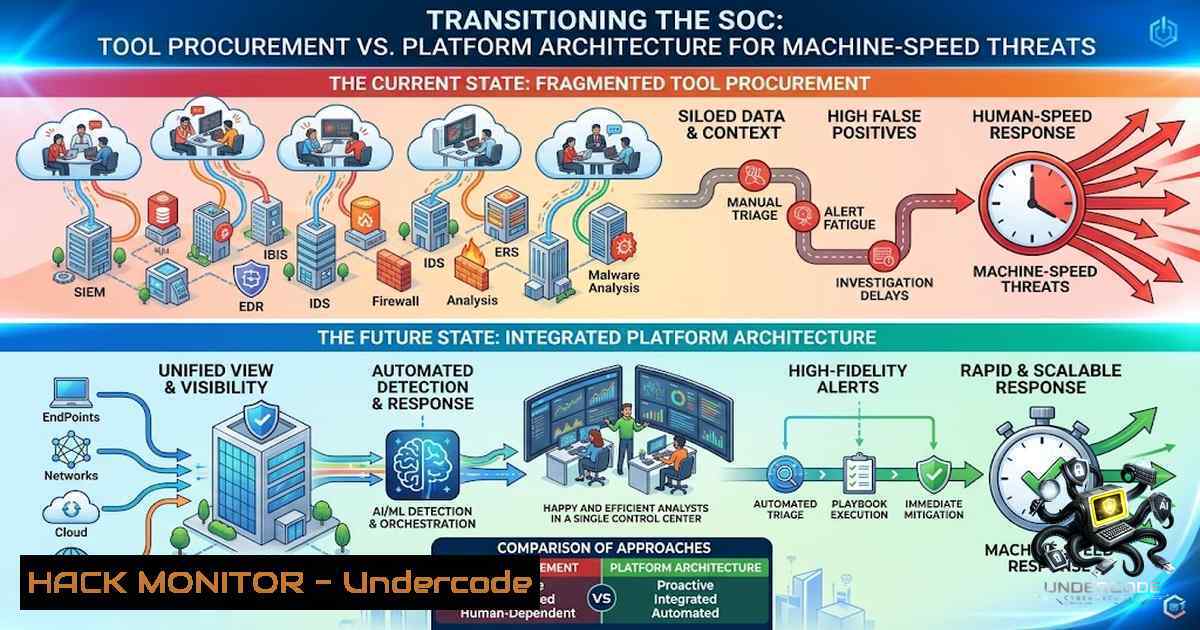
The gap between attacker speed and defender readiness is widening at an alarming rate. Attackers can now move from initial access to full domain control in less than a minute using AI, while AI-generated phishing campaigns achieve click-through rates 4.5 times higher than traditional methods. Most enterprise Security Operations Centers (SOCs) were never built for this tempo—they were assembled tool by tool over a decade of point-solution buying, creating a fragmented architecture that taxes defenders before adversaries even arrive. The question for 2026 is no longer which security product to buy next, but whether your underlying architecture can support the speed, transparency, and economics that AI-era defense now requires.
Learning Objectives:
- Understand the architectural limitations of traditional SOCs and why AI cannot repair a fragmented foundation
- Learn how agentic AI architectures enable machine-speed threat detection, investigation, and response
- Master practical implementation steps for deploying agentic workflows using modern security platforms
- Acquire hands-on Linux and Windows commands for incident response in an AI-driven SOC environment
- Develop a roadmap for transitioning from tool-centric to platform-centric security operations
You Should Know:
- The Fragmentation Tax: Why Traditional SOCs Are Failing
Security teams today navigate an average of 11 security consoles during an active investigation, and 91% of teams trace serious incidents directly back to friction between disconnected tools. This fragmentation isn’t just a productivity problem—it’s a direct risk exposure created by architectural choices. Per-endpoint pricing forces coverage decisions to become budget decisions. Rehydration fees on historical data create blind spots during active incidents when full context matters most. Separate SOAR licensing turns automation into a line item instead of a native capability.
The industry’s answer has been to layer AI on top of this fragmentation. But this approach is already showing its limits. AI models—whether classification systems, machine learning detectors, or agentic reasoning frameworks—depend on unified access to historical context. When telemetry is scattered across dozens of systems in inconsistent formats, models inherit the same blind spots as the humans they’re meant to augment. This isn’t a foundation for autonomous reasoning—it’s a foundation for expensive hallucination.
Step-by-Step Guide: Auditing Your Current SOC Architecture
- Map your data sources: Document every security tool generating telemetry (SIEM, EDR, cloud logs, network flows, identity providers).
- Identify integration gaps: For each tool, note how data is ingested, normalized, and made available for correlation.
- Calculate the “console count”: How many separate interfaces must an analyst open during a typical investigation?
- Measure MTTR friction points: Time how long it takes to pivot from an alert in one tool to relevant context in another.
- Audit data accessibility: Can your AI tools query historical data without rehydration fees or performance degradation?
- Document automation覆盖率: What percentage of alert triage and investigation steps are automated versus manual?
Linux Command: Assessing System Integrity and Suspicious Activity
 Check for unauthorized user accounts and privilege escalation
cat /etc/passwd | grep -E ":(0|1000):" && sudo grep "sudo" /var/log/auth.log

Identify running processes with suspicious network connections
ss -tulpen | grep -v "127.0.0.1" && ps auxf | grep -v "^root"

Review recent authentication failures and successes
journalctl -xe -u sshd --since "24 hours ago" | grep -E "Failed|Accepted"

Check for persistence mechanisms
crontab -l 2>/dev/null && ls -la ~/.ssh/authorized_keys && systemctl list-timers --all

Capture forensic snapshot for later analysis
tar -czf /tmp/forensic_$(date +%Y%m%d).tgz /var/log/auth.log /var/log/syslog /etc/passwd /etc/shadow 2>/dev/null
Windows PowerShell Command: Rapid Incident Response Collection
 Collect running processes and network connections
Get-Process | Export-Csv -Path C:\temp\processes.csv -1oTypeInformation
netstat -anob | Out-File C:\temp\network_connections.txt

Audit user accounts and recent logins
Get-LocalUser | Where-Object {$<em>.Enabled -eq $true} | Format-Table Name, LastLogon
Get-WinEvent -LogName Security -MaxEvents 100 | Where-Object {$</em>.Id -in @(4624,4625,4672)} | Format-Table TimeCreated, Id, Message -AutoSize

Check for scheduled tasks and startup items
Get-ScheduledTask | Where-Object {$_.State -1e "Disabled"} | Format-Table TaskName, State
Get-CimInstance -ClassName Win32_StartupCommand | Format-Table Command, Location, User

Verify Windows Defender and firewall status
Get-MpComputerStatus | Select-Object AntivirusEnabled, RealTimeProtectionEnabled
Get-1etFirewallProfile | Format-Table Name, Enabled
- The Agentic SOC Architecture: Moving Beyond “Copilot-Only” AI
An Agentic SOC is a security operations center that has deployed AI agents and corresponding agent skills to perform SOC-related workflows such as detection engineering, alert triage, incident investigation, escalation, response, and threat hunting. Unlike traditional “copilot” approaches where AI merely assists humans step-by-step, agentic AI systems can plan, reason, and act autonomously.
The architecture decomposes SOC operations into cooperative tiers: a perception layer of distributed agents performing real-time telemetry analysis across IT, OT, and network domains, an orchestration layer that coordinates how agents collaborate and escalate decisions, and an investigation and reasoning engine that enables agents to form hypotheses and validate findings.
Elastic’s approach to the agentic SOC unifies data across cloud, hybrid, and on-premises environments with a data mesh architecture that provides real-time holistic visibility without moving data to a central location. The platform incorporates retrieval augmented generation (RAG) and open agentic frameworks like LangChain, building agentic workflows for dedicated security operations tasks using an agent, tool, and graph architecture.
Step-by-Step Guide: Deploying Elastic Agent for Unified Telemetry Collection
- Download the Elastic Agent for your operating system:
Linux x86_64
curl -L -O https://artifacts.elastic.co/downloads/beats/elastic-agent/elastic-agent-9.0.0-linux-x86_64.tar.gz
tar xzvf elastic-agent-9.0.0-linux-x86_64.tar.gz
cd elastic-agent-9.0.0-linux-x86_64
-
Install and enroll the agent with your Fleet Server:
sudo ./elastic-agent install --url=<fleet_server_url> --enrollment-token=<enrollment_token>
Run this command as root because some integrations require root privileges to collect sensitive data.
3. Verify the agent is running:
sudo systemctl status elastic-agent
sudo systemctl enable elastic-agent  Ensure it starts on boot
- Configure integrations through Kibana Fleet UI to enable:
– System integration for host metrics and logs
– Endpoint security integration for XDR capabilities
– Cloud integrations for AWS, Azure, or GCP telemetry
- Test data ingestion by querying the Elasticsearch index:
curl -X GET "https://<kibana_host>:5601/api/console/proxy?path=_cat/indices&method=GET" -H "kbn-xsrf: true"
-
Alert Zero: Automating Alert Triage at Machine Speed
Elastic Security 9.5 introduces “Alert Zero”—a state where agents and analysts work together to reduce the alert queue to only the attacks that actually matter. AI-driven alert triage and attack investigation handles first-pass triage, turning a wall of raw alerts into a short list of real attacks.
In production deployments, Elastic’s InfoSec team built an agentic SOC that triages every alert before an analyst opens it. A 30-minute manual investigation now finishes in under 3 minutes. The agents investigate every alert and assemble the complete case—including attack summaries, attached alerts, observables (IP addresses, file hashes, domains), and supporting events—before an analyst ever opens it.
Key components of the Alert Zero architecture:
- Attack Discovery: Automatically correlates alerts into attack narratives, reducing 30+ alerts into a single coherent story like “Malware with DLL Side-Loading Persistence”
- Agent Builder: Creates custom agents that understand your specific environment using RAG with your own data
- Elastic Workflows: Executes sophisticated actions bidirectionally—workflows can invoke agents, and agents can invoke workflows as tools
- Security Skills: Modular AI capabilities that teach agents how to detect, investigate, and hunt like specialists across detection, triage, hunting, entity analysis, and anomaly investigation
Step-by-Step Guide: Creating an Automated Alert Triage Workflow
1. Define the trigger condition in Kibana:
- Navigate to Security → Workflows → Create workflow
- Set trigger: “On alert creation” with severity filter (e.g., High or Critical)
2. Add investigation actions:
- Query Elasticsearch for related alerts from same host or user
- Enrich with threat intelligence (VirusTotal, MISP, etc.)
- Check asset criticality from CMDB integration
3. Configure agent reasoning using Agent Builder:
- Create a custom agent with RAG access to your playbooks
- Define the agent’s goal: “Determine if this alert represents a true positive”
- Provide tool access: Elasticsearch queries, threat intel APIs, ticketing system
4. Set response actions:
- Isolate compromised host (if confirmed malicious)
- Create a case with all investigation context
- Notify the on-call analyst via Slack or email
- Escalate to human review only for high-confidence attacks
5. Test and refine:
- Run the workflow against historical alerts
- Measure false positive rates and investigation time reduction
- Iterate on agent prompts and tool configurations
API Example: Creating a Detection Rule Programmatically
 Create a new detection rule via Elastic's API
curl -X POST "https://<kibana_host>:5601/api/detection_engine/rules" \
-H "kbn-xsrf: true" \
-H "Content-Type: application/json" \
-d '{
"rule_id": "linux-persistence-detection",
"name": "Linux Persistence via Cron Job Creation",
"description": "Detects unauthorized cron job creation on Linux systems",
"type": "query",
"query": "event.dataset: system.cron AND event.action: cron_job_created AND user.name: (root OR sudo)",
"severity": "medium",
"risk_score": 50,
"interval": "5m",
"from": "now-6m",
"threat": [{"framework": "MITRE ATT&CK", "tactic": {"name": "Persistence", "id": "TA0003"}}]
}'
4. Human-Led, Agent-Powered: The Symbiotic Security Model
The future of security operations isn’t AI replacing human analysts—it’s human-led, agent-powered security. AI agents handle speed, scale, and repetitive analysis while security professionals provide judgment, oversight, and accountability. This represents a fundamental shift: moving from SOCs that constantly react to alerts toward security operations that can understand, prioritize, investigate, and respond to threats at machine speed.
Research on human-AI collaboration frameworks defines four AI agent roles—Assistant, Auto-Pilot, Companion, and Operator—aligned with operational autonomy levels to support function-specific delegation. Governance frameworks like the Model-Control-Policy (MCP) model have been shown to reduce unauthorized actions by 85% and cut mean detection time by 70% in SOC scenarios.
The Elastic platform embodies this philosophy with AI that handles machine-speed work while leaving critical judgment to analysts, and a platform that seamlessly connects the two. Detection engineers can have a conversation, define their intent, and instantly generate, test, and deploy sophisticated, context-rich detection rules. Analysts can use natural language to ask complex security questions, with answers grounded in enterprise knowledge through RAG, eliminating the need to craft complex queries.
Step-by-Step Guide: Implementing Governance for Agentic AI
1. Define agent roles and permissions:
- Tier 1 (Auto-Pilot): Fully automated alert triage with predefined actions
- Tier 2 (Assistant): Recommends actions but requires human approval
- Tier 3 (Operator): Human-driven with AI-assisted research
2. Implement guardrails using regex and semantic classifiers:
 Example guardrail for restricting agent actions
ALLOWED_ACTIONS = ["query", "enrich", "create_case", "notify"]
DENIED_ACTIONS = ["isolate_host", "delete_data", "modify_firewall"]

def validate_agent_action(action, context):
if action["type"] in DENIED_ACTIONS:
return {"allowed": False, "reason": "Action requires human approval"}
if action["type"] in ALLOWED_ACTIONS and action["target"] in context["allowed_targets"]:
return {"allowed": True}
return {"allowed": False, "reason": "Action not in allowed scope"}
- Enable audit trails: Every agent decision should be logged with:
– Reasoning trace (why the agent took each action)
– Tool calls and their results
– Confidence scores for each conclusion
4. Establish escalation thresholds:
- Auto-respond for low/medium severity with high confidence
- Human review for high severity or low confidence
- Two-person approval for critical infrastructure changes
5. Monitor and measure:
- Track agent accuracy vs. human analyst decisions
- Measure time saved per investigation
- Continuously refine agent prompts based on false positive/negative analysis
- From Point Solutions to Unified Platform: The Economics of Agentic Security
The financial case for agentic SOC architecture is compelling. Elastic tested two agentic SOC architectures in parallel across 36,822 real Agent Builder conversations—one architecture won by 5.7x in cost efficiency. Investigating a Windows endpoint alert in production costs just $0.69.
Traditional SOC economics are broken. Per-endpoint pricing forces organizations to make coverage decisions based on budget rather than risk. Separate SOAR licensing turns automation into an additional cost center rather than a native capability. An open, unified security architecture eliminates these vendor-imposed taxes by:
– Decoupling compute from storage, allowing AI to operate on open data lakes
– Providing native workflows instead of requiring separate SOAR licensing
– Enabling query-in-place data access without rehydration fees
– Supporting serverless scaling that aligns costs with actual usage
The architectural inflection point is already here: nearly two-thirds of organizations are experimenting with AI agents in security operations, but fewer than one in four have deployed them into production. That gap reflects the difficulty of running agentic systems on infrastructure not designed for them. Governance models, transparency requirements, and cost controls are maturing rapidly, but they require an architecture that supports them natively.
What Undercode Say:
- Architecture precedes automation: AI cannot fix a fragmented security architecture. Organizations must first unify their data foundation before agentic AI can deliver meaningful results. The most sophisticated AI agents are useless if they can’t access complete, consistent telemetry across the attack surface.
-
Speed demands new economics: Machine-speed threats require machine-speed responses, but traditional pricing models (per-endpoint, per-GB ingested) create coverage gaps that adversaries exploit. The shift to consumption-based, serverless security architectures isn’t just a technical upgrade—it’s an economic imperative.
-
Human judgment is the differentiator: Agentic AI excels at speed, scale, and pattern recognition, but human analysts provide the judgment, ethics, and accountability that no algorithm can replicate. The winning strategy isn’t replacing analysts—it’s amplifying their capabilities with AI agents that handle the noise so humans can focus on the signal.
The transition to agentic SOC represents a fundamental rethinking of security operations—from tool procurement to platform architecture, from reactive alert handling to proactive threat anticipation, and from human-only analysis to human-led, agent-powered defense. Organizations that embrace this shift will not only defend against machine-speed threats but will do so with greater efficiency, transparency, and analyst satisfaction.
Prediction:
- +1 By 2027, agentic SOC architectures will become the default deployment model for enterprises with mature security programs, reducing mean time to respond (MTTR) by 70-80% compared to traditional SOCs.
-
+1 The consolidation of SIEM, XDR, and SOAR into unified agentic platforms will eliminate the “automation tax,” making enterprise-grade security accessible to mid-market organizations for the first time.
-
-1 Organizations that continue investing in point solutions rather than platform architecture will face widening defense gaps, with AI-powered attackers achieving dwell times under 5 minutes while human analysts struggle to pivot across 11+ consoles.
-
+1 Governance frameworks for agentic AI (MCP, Context-Harness-Model) will mature into industry standards, enabling secure, auditable autonomous security operations across multi-vendor environments.
-
-1 The shortage of security professionals with agentic AI expertise will create a talent bottleneck, potentially slowing adoption and leaving early adopters with a significant competitive advantage over laggards.
▶️ Related Video (80% Match):
https://www.youtube.com/watch?v=5Rw5Q0d96Qo
🎯Let’s Practice For Free:
🎓 Live Courses & Certifications:
Join Undercode Academy for Verified Certifications
🚀 Request a Custom Project:
Secure, high-velocity infrastructure and disruptive technological engineering. Contact our engineering team for high-tier development and proprietary systems:
[email protected]
💎 Smart Architecture | 🛡️ Secure by Design | ⭐ Trusted by Thousands
IT/Security Reporter URL:
Reported By: Cybersecurity Agenticai – Hackers Feeds
Extra Hub: Undercode MoN
Basic Verification: Pass ✅


