Listen to this Post
Introduction:
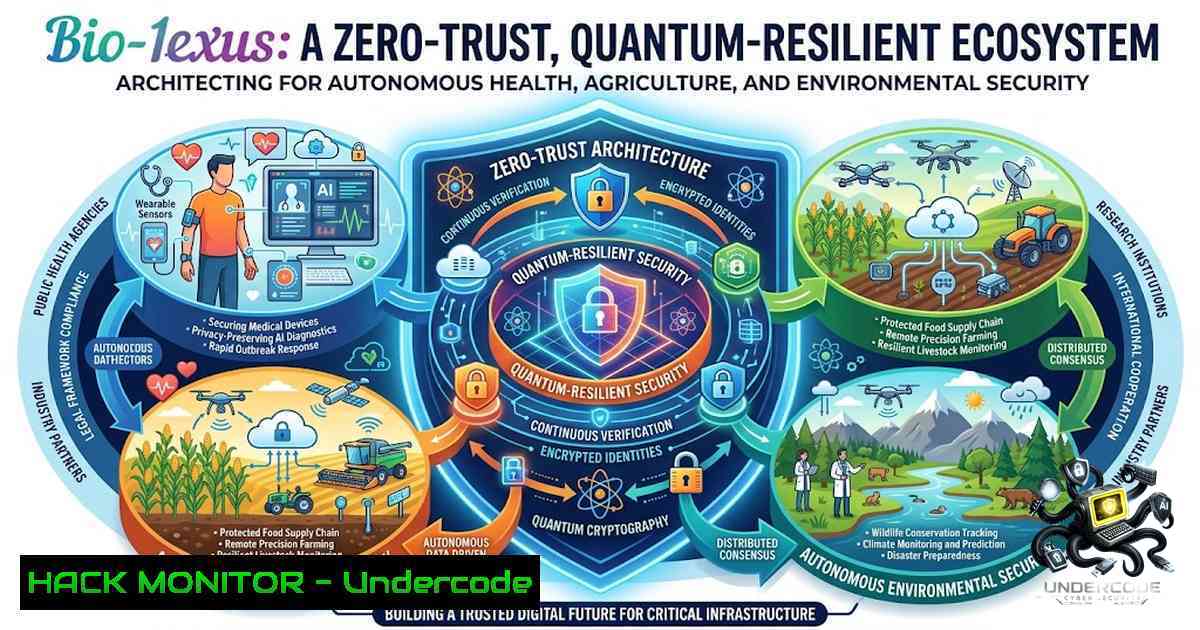
The convergence of Edge-AI, precision medicine, and smart agriculture is no longer a futuristic vision but an architectural necessity. Project Bio-1exus presents a unified Deep Tech framework that integrates non-invasive respiratory defense, dynamic molecular pharmacy, and autonomous agricultural IoT into a single, self-healing biosphere【9†L1-L3】. This article dissects the technical blueprint of this ecosystem, focusing on the zero-trust cybersecurity protocols, systems administration policies, and the critical IT infrastructure required to deploy and manage life-critical IoT networks where network breaches are fatal【9†L14-L15】.
Learning Objectives:
- Understand the core components of the Bio-1exus Ecosystem, including the Hemo-Respiratory Shield, Edge-Agri Node, and Omni-Command Interface.
- Master the implementation of Zero-Trust Bio-Cryptographic Security for authenticating biometric signatures and securing sensitive agricultural and health data.
- Acquire practical skills in configuring Edge-AI nodes, deploying autonomous IoT sensor networks, and managing field IT operations using hardened, portable command centers.
You Should Know:
- Deploying the Edge-Agri Node: Autonomous IoT for Smart Agriculture
The Edge-Agri Node is a self-sustaining sensor network that optimizes water conservation, predicts crop diseases, and generates a live Agricultural Digital Twin【9†L10-L11】. This system requires robust field IT operations to manage life-critical IoT systems in extreme outdoor environments【9†L12-L13】.
To configure a basic Edge-Agri Node on a Linux-based single-board computer (e.g., Raspberry Pi or NVIDIA Jetson), you will need to set up the sensor interface and data transmission.
Step‑by‑step guide:
1. Update the system and install necessary packages:
sudo apt update && sudo apt upgrade -y
sudo apt install python3-pip git mosquitto mosquitto-clients -y
2. Clone the Edge-Agri Node repository (hypothetical):
git clone https://github.com/bio-1exus/edge-agri-1ode.git
cd edge-agri-1ode
3. Install Python dependencies for sensor data processing:
pip3 install -r requirements.txt
4. Configure the MQTT broker for local IoT communication:
sudo systemctl enable mosquitto
sudo systemctl start mosquitto
5. Run the sensor data acquisition script:
python3 sensor_node.py --config configs/agricultural_site_01.yaml
This setup enables the collection of soil moisture, temperature, and humidity data, which is then transmitted to the central Digital Twin for analysis.
2. Implementing Zero-Trust Bio-Cryptographic Security
Zero-Trust Bio-Cryptographic Security governs every node in the Bio-1exus ecosystem, ensuring absolute immunity to cyber threats and unauthorized access【9†L14-L15】. This involves authenticating a patient’s live biometric signature or securing a nation’s agricultural harvest data【9†L14】.
A key component is the implementation of mutual TLS (mTLS) for device-to-cloud communication, combined with biometric authentication using hardware security modules (HSMs).
Step‑by‑step guide for setting up mTLS on an Edge-AI node:
1. Generate a Certificate Authority (CA) key and certificate:
openssl genrsa -out ca.key 4096
openssl req -1ew -x509 -days 365 -key ca.key -out ca.crt
2. Generate a private key and Certificate Signing Request (CSR) for the Edge node:
openssl genrsa -out edge_node.key 2048
openssl req -1ew -key edge_node.key -out edge_node.csr
3. Sign the Edge node’s certificate with the CA:
openssl x509 -req -days 365 -in edge_node.csr -CA ca.crt -CAkey ca.key -set_serial 01 -out edge_node.crt
4. Configure the MQTT broker to require mTLS:
Edit the Mosquitto configuration file (`/etc/mosquitto/mosquitto.conf`) and add:
listener 8883
cafile /etc/mosquitto/ca_certificates/ca.crt
certfile /etc/mosquitto/certs/server.crt
keyfile /etc/mosquitto/certs/server.key
require_certificate true
use_identity_as_username true
5. Restart the MQTT broker:
sudo systemctl restart mosquitto
This configuration ensures that only authenticated and authorized devices with valid certificates can publish or subscribe to the MQTT topics, forming the backbone of a zero-trust network.
- Hardening the Omni-Command Interface for Field IT Operations
The Omni-Command Interface is a hyper-portable, Tandem-OLED command center with extreme battery endurance and anti-reflective displays【9†L12-L13】. IT support teams, field doctors, and agricultural engineers use this to analyze live Digital Twins flawlessly under the glaring sun【9†L13】.
Securing this interface involves implementing full-disk encryption, enabling a host-based firewall, and configuring a VPN for secure remote access to the Bio-1exus backend.
Step‑by‑step guide for hardening a Windows-based Omni-Command Interface:
1. Enable BitLocker Drive Encryption:
- Open Control Panel > System and Security > BitLocker Drive Encryption.
- Select “Turn on BitLocker” for the system drive and follow the prompts to save the recovery key.
2. Configure Windows Defender Firewall:
- Open Windows Security > Firewall & network protection.
- Click on “Advanced settings” and create inbound rules to block all unnecessary ports (e.g., block SMB ports 445, 139 except for specific IPs).
- Create outbound rules to restrict traffic to only the Bio-1exus VPN and trusted update servers.
- Set up a WireGuard VPN for secure remote access:
– Install WireGuard on the Omni-Command Interface and the Bio-1exus cloud server.
– Generate the client and server keys:
 On the client (Omni-Command Interface)
wg genkey | tee privatekey | wg pubkey > publickey
– Configure the `wg0.conf` file on the client with the server’s public key, allowed IPs, and endpoint.
– Start the WireGuard tunnel:
wg-quick up wg0
4. Enable Windows Defender Application Guard:
- Go to Windows Security > App & browser control > Isolated browsing.
- Turn on Application Guard to open untrusted sites in a Hyper-V container, isolating any potential threats from the host system.
4. API Security for the Dynamic Micro-Pharmacy
The dynamic micro-pharmacy synthesizes and deploys precise prophylactic interventions in real-time, with zero cloud latency【9†L8-L9】. This requires a secure API gateway to handle requests from the Edge-AI.
To secure the API, implement OAuth 2.0 with JWT (JSON Web Tokens) and enforce rate limiting.
Step‑by‑step guide for securing a REST API using Python (Flask) and JWT:
1. Install the required Python packages:
pip3 install flask flask-jwt-extended rate-limiter
2. Create a simple Flask API with JWT authentication:
from flask import Flask, jsonify, request
from flask_jwt_extended import create_access_token, jwt_required, JWTManager
from flask_limiter import Limiter
from flask_limiter.util import get_remote_address

app = Flask(<strong>name</strong>)
app.config["JWT_SECRET_KEY"] = "your-secret-key"  Change this!
jwt = JWTManager(app)
limiter = Limiter(app, key_func=get_remote_address, default_limits=["200 per day", "50 per hour"])

@app.route("/login", methods=["POST"])
def login():
 In production, validate credentials against a secure database
username = request.json.get("username", None)
password = request.json.get("password", None)
if username != "bio_nexus" or password != "secure_password":
return jsonify({"msg": "Bad username or password"}), 401

access_token = create_access_token(identity=username)
return jsonify(access_token=access_token)

@app.route("/synthesize", methods=["POST"])
@jwt_required()
@limiter.limit("10 per minute")  Rate limiting for the sensitive endpoint
def synthesize():
 Logic to synthesize prophylactic intervention
data = request.get_json()
 Process the request...
return jsonify({"msg": "Intervention synthesized successfully"}), 200

if <strong>name</strong> == "<strong>main</strong>":
app.run(host="0.0.0.0", port=5000, ssl_context=('cert.pem', 'key.pem'))  Enforce HTTPS
3. Run the API with HTTPS enabled:
Generate a self-signed certificate or use Let’s Encrypt, and run the Flask app with the `ssl_context` parameter.
5. Cloud Hardening for the Agricultural Digital Twin
The Agricultural Digital Twin is a live, cloud-based replica of the physical agricultural assets【9†L11】. Hardening this cloud environment is critical to prevent data breaches and ensure the integrity of the food supply chain.
Step‑by‑step guide for hardening a cloud instance (AWS EC2 as an example):
1. Restrict Security Group Rules:
- In the AWS Management Console, navigate to the EC2 Security Group.
- Remove all rules that allow traffic from `0.0.0.0/0` except for necessary services (e.g., HTTPS).
- Only allow SSH access from specific IP addresses used by the Omni-Command Interface.
2. Enable AWS Config and AWS Security Hub:
- Activate AWS Config to continuously monitor and record resource configurations.
- Enable AWS Security Hub to aggregate security findings and check against best practices (e.g., CIS benchmarks).
3. Implement IAM Least Privilege:
- Create IAM roles with the principle of least privilege for all services and users.
- Use IAM policies to restrict actions to only what is necessary.
- Enable MFA for all IAM users.
4. Encrypt Data at Rest and in Transit:
- Enable EBS encryption for all volumes.
- Use S3 server-side encryption for all agricultural data stored in buckets.
- Enforce TLS 1.2 or higher for all data in transit.
What Undercode Say:
- Key Takeaway 1: The Bio-1exus Ecosystem is a prime example of how Deep Tech can unify seemingly disparate fields—health, agriculture, and environmental science—through a common architectural framework of Edge-AI and Zero-Trust security.
- Key Takeaway 2: The practical implementation of this vision relies heavily on robust systems administration, from configuring MQTT brokers with mTLS to hardening cloud environments and securing APIs with JWT and rate limiting.
The technical depth of Project Bio-1exus is impressive, but its success hinges on the execution of these security and IT protocols. The integration of a zero-trust model is not just a buzzword; it is a fundamental requirement when dealing with life-critical systems. The field IT operations aspect, particularly the need for a hyper-portable and ruggedized command center, highlights the real-world challenges of deploying such technology in diverse and often harsh environments. The emphasis on zero cloud latency for the dynamic micro-pharmacy underscores the critical importance of Edge-AI in reducing dependence on centralized cloud infrastructure, thereby enhancing both speed and resilience.
Prediction:
- +1 The Bio-1exus framework will catalyze a new wave of interdisciplinary innovation, leading to the development of more resilient and autonomous systems for global health and food security.
- +1 The demand for cybersecurity professionals with expertise in IoT, Edge-AI, and Zero-Trust architectures will surge as industries adopt similar integrated ecosystems.
- -1 The complexity and cost of implementing such a comprehensive system may create a digital divide, where only well-funded organizations can afford this level of protection and efficiency, potentially exacerbating existing inequalities.
- -1 The reliance on AI for critical decisions in health and agriculture introduces new vectors for adversarial attacks, requiring continuous monitoring and updating of the AI models to prevent exploitation.
▶️ Related Video (82% Match):
🎯Let’s Practice For Free:
🎓 Live Courses & Certifications:
Join Undercode Academy for Verified Certifications
🚀 Request a Custom Project:
Secure, high-velocity infrastructure and disruptive technological engineering. Contact our engineering team for high-tier development and proprietary systems:
[email protected]
💎 Smart Architecture | 🛡️ Secure by Design | ⭐ Trusted by Thousands
IT/Security Reporter URL:
Reported By: Mostafa Adel – Hackers Feeds
Extra Hub: Undercode MoN
Basic Verification: Pass ✅


