Listen to this Post
Introduction:
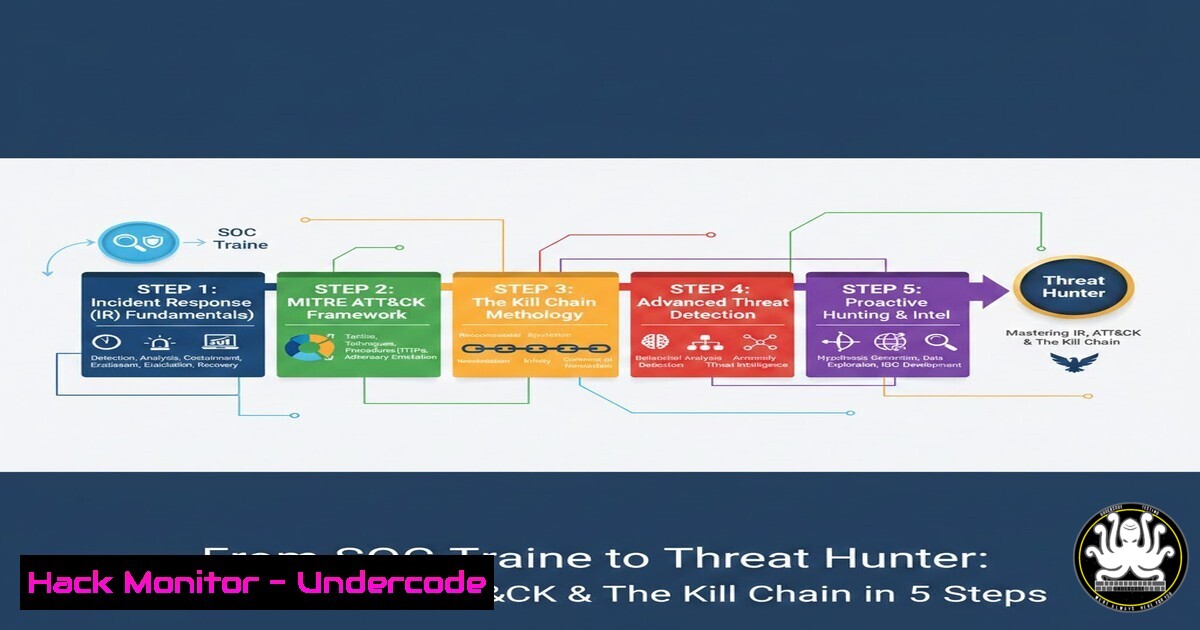
In the relentless arms race of cybersecurity, a structured defense is no longer a luxury but a necessity. Modern Security Operations Center (SOC) analysts must move beyond alert monitoring to become proficient threat hunters, leveraging proven frameworks to dismantle attacks. Mastering the synergy between Incident Response (IR), the MITRE ATT&CK® framework, and the Cyber Kill Chain provides the blueprint for transforming reactive security postures into proactive, intelligence-driven defense operations.
Learning Objectives:
- Understand and apply the six phases of the NIST Incident Response Lifecycle to a simulated breach.
- Conduct effective log analysis across Windows and Linux systems using native command-line tools.
- Map adversary behavior to the MITRE ATT&CK® framework and identify breakpoints within the Cyber Kill Chain.
- Utilize open-source threat emulation tools to test defenses and validate detection capabilities.
- Navigate key hands-on training platforms to build and reinforce practical Blue Team skills.
You Should Know:
1. The Incident Response Lifecycle: Your Battle Plan
The NIST IR lifecycle (Preparation, Detection & Analysis, Containment, Eradication, Recovery, Post-Incident Activity) is the backbone of organized defense. A study by IBM underscores its value, finding that organizations with a formal IR team and tested plan save an average of $1.5 million per data breach compared to those without.
Step‑by‑step guide explaining what this does and how to use it.
Preparation: Develop and document IR procedures, contact lists, and communication plans. Technically, this includes deploying and configuring Security Information and Event Management (SIEM) systems and Endpoint Detection and Response (EDR) tools across your estate.
Detection & Analysis: This phase is triggered by an alert or anomaly. For example, a surge in outgoing network traffic from a workstation. Analysts must quickly gather context from logs and tools.
Containment: Execute short-term containment (e.g., isolating a host from the network) and long-term containment (e.g., applying a system-wide firewall rule to block malicious IPs).
Linux: `sudo iptables -A INPUT -s nftables.
Windows: `New-NetFirewallRule -DisplayName “Block Attacker” -Direction Outbound -RemoteAddress
Eradication: Identify and remove the root cause. This could involve deleting malicious files, disabling compromised user accounts, or patching exploited vulnerabilities.
Recovery: Carefully restore affected systems to operation from clean backups, while monitoring for signs of re-infection.
Lessons Learned: The critical final phase. Document what happened, what was done, and how to improve. This report feeds back into the Preparation phase, creating a virtuous cycle of improvement.
- Log Analysis & Investigative Tools: Finding the Signal in the Noise
Logs are the digital forensics breadcrumb trail. Effective analysts must be fluent in querying and parsing these logs to reconstruct events.
Step‑by‑step guide explaining what this does and how to use it.
Windows Event Logs: Use PowerShell’s `Get-WinEvent` for powerful filtering.
Example: Search for failed login attempts (Event ID 4625) from a specific IP address in the last 24 hours:
Get-WinEvent -FilterHashtable @{LogName='Security'; ID=4625; StartTime=(Get-Date).AddHours(-24)} | Where-Object {$_.Properties[bash].Value -eq '<IP_ADDRESS>'}
Linux System Logs: Key logs reside in /var/log/. Use `journalctl` for systemd-based systems and `grep` for powerful pattern matching.
Example: View kernel messages and filter for hardware errors:
journalctl -k --since "2 hours ago" | grep -i "error|fail"
Example: Search for SSH authentication failures in auth.log:
grep "Failed password" /var/log/auth.log
Network Traffic: Use `tcpdump` for packet capture and analysis.
Example: Capture HTTP traffic to/from a specific host:
sudo tcpdump -i eth0 'host 192.168.1.100 and port 80' -w capture.pcap
- The MITRE ATT&CK® Framework: Speaking the Adversary’s Language
MITRE ATT&CK is a globally accessible knowledge base of adversary tactics and techniques based on real-world observations. It provides a common taxonomy for defenders to describe attacker behavior.
Step‑by‑step guide explaining what this does and how to use it.
1. Navigate to the MITRE ATT&CK® Website. Explore the Matrices (Enterprise, Mobile, ICS).
2. Map an Alert to a Technique. A suspicious PowerShell script executing encoded commands maps directly to T1059.001: Command and Scripting Interpreter: PowerShell and the Execution tactic.
3. Use for Detection Engineering. Search for a technique, like T1082: System Information Discovery. The page provides procedure examples, mitigation strategies, and detection recommendations you can implement in your SIEM (e.g., alerts for excessive use of `systeminfo` or uname -a).
4. Leverage ATT&CK Navigator. Use the online Navigator to visualize techniques relevant to your environment or a specific threat group.
- The Cyber Kill Chain: Visualizing the Attack Timeline
Lockheed Martin’s Cyber Kill Chain model breaks an attack into seven sequential stages: Reconnaissance, Weaponization, Delivery, Exploitation, Installation, Command & Control (C2), and Actions on Objectives. Mapping to this chain helps identify the stage of an attack and the most effective countermeasures.
Step‑by‑step guide explaining what this does and how to use it.
Consider a phishing-based ransomware attack:
Reconnaissance: Attacker researches employees on LinkedIn (breakpoint: user security awareness training).
Weaponization: Creates a malicious PDF with an embedded macro.
Delivery: Sends phishing email (breakpoint: email filtering, Sender Policy Framework – SPF/DKIM/DMARC).
Exploitation: User opens PDF, enables macros.
Installation: Macro drops ransomware payload (breakpoint: EDR blocking execution).
Command & Control (C2): Payload calls home (breakpoint: network IDS/IPS blocking known C2 domains/IPs).
Actions on Objectives: Ransomware encrypts files. The goal is to break the chain as early as possible.
5. Hands-On Threat Emulation with Atomic Red Team
Testing your defenses is crucial. Atomic Red Team, by Red Canary, provides simple, cross-platform tests mapped to MITRE ATT&CK techniques.
Step‑by‑step guide explaining what this does and how to use it.
1. Clone the Repository: `git clone https://github.com/redcanaryco/atomic-red-team.git`
2. Review an Atomic Test. Navigate to `atomics/T1059.001/` for PowerShell tests.
3. Execute a Test (In a Safe Lab Environment!). Run the test using the provided runner:
.\Invoke-AtomicTest T1059.001 -TestNumbers 1
This executes a simple PowerShell command. Monitor your SIEM/EDR console to see if you detected the command execution as per ATT&CK technique T1059.001.
4. Verify & Harden. If the test was not detected, use the mitigation guidance on the corresponding MITRE ATT&CK page to improve your defenses.
- Building Your Lab: From Theory to Muscle Memory
Consistent practice is key. Utilize the resources mentioned in the original post:
TryHackMe: Offers guided, browser-accessible paths for IR and defense.
Blue Team Labs Online: Provides scenario-based challenges focusing on log analysis and investigation.
Home Lab: Set up a virtual network using VirtualBox/VMware. Install a SIEM like Security Onion or Wazuh, a Windows domain controller, and a Linux client. Generate your own “malicious” traffic with tools like Atomic Red Team to practice detection and analysis in a controlled environment.
What Undercode Say:
- Frameworks are Force Multipliers: IR provides the process, ATT&CK provides the vocabulary, and the Kill Chain provides the timeline. Using them in concert transforms disjointed alerts into a coherent attack narrative, enabling precise and effective defensive actions.
- The Tool is Secondary to the Analyst: While EDR and SIEM are critical, their value is unlocked by an analyst who can proficiently use native OS commands (
grep,Get-WinEvent,journalctl) for deep-dive investigations and validation.
Analysis:
The post highlights the foundational shift from passive monitoring to active defense literacy. The true skill showcased is not just the recognition of individual frameworks, but the understanding of their interdependence. An IR plan is executed blindly without ATT&CK to contextualize techniques. The Kill Chain’s value diminishes if you cannot use log analysis to pinpoint the current stage of the breach. This integrated approach, practiced relentlessly in hands-on labs, is what separates a ticket-closer from a true threat hunter who can anticipate, disrupt, and neutralize adversaries before critical assets are compromised.
Prediction:
The future of Blue Team operations lies in the tight integration of these human-driven frameworks with AI and automation. We will see SIEM and EDR platforms increasingly using ATT&CK as a native language for automated alert enrichment and correlation, while AI assistants will suggest containment actions based on the Kill Chain stage and previously documented IR playbooks. However, the analyst’s conceptual understanding of these models will remain paramount, as they will be required to train, oversee, and validate the automated systems, making the skills outlined here more valuable, not less, in the AI-augmented SOC of tomorrow.
▶️ Related Video (76% Match):
🎯Let’s Practice For Free:
IT/Security Reporter URL:
Reported By: Serah Mulwa – Hackers Feeds
Extra Hub: Undercode MoN
Basic Verification: Pass ✅


