Listen to this Post
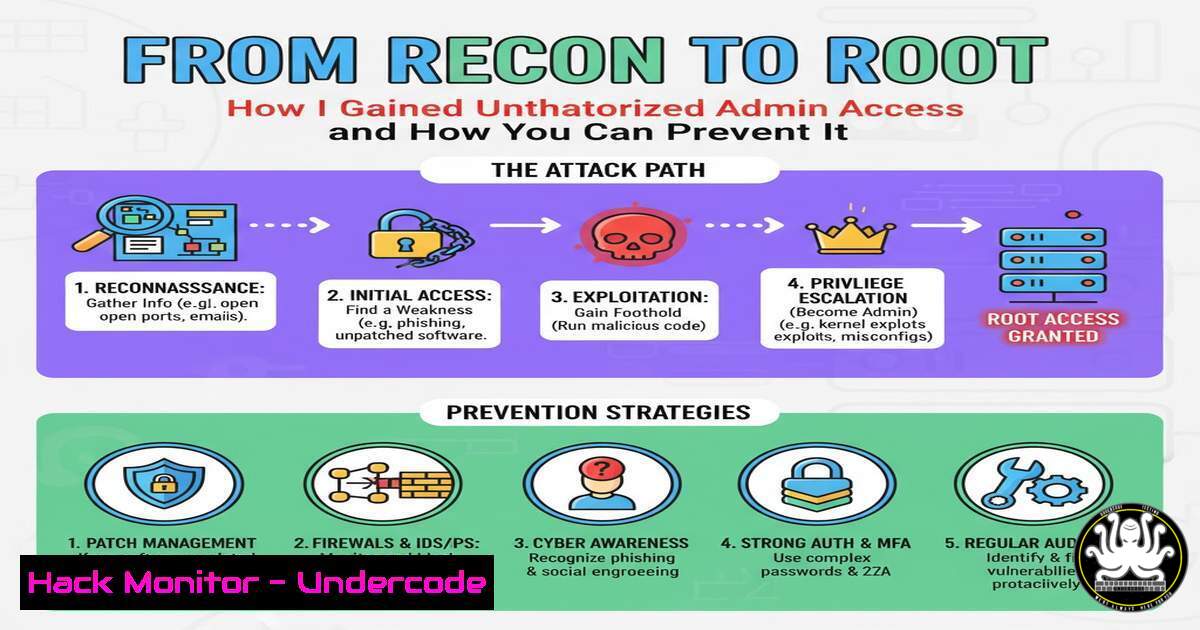
Introduction:
In the world of bug bounty hunting, the most critical vulnerabilities are often discovered not through complex exploits, but through meticulous reconnaissance and fundamental security oversights. This article deconstructs a real-world finding of an unauthorized admin panel access vulnerability, demonstrating the practical steps every security professional and developer must understand to both discover and defend against such common yet devastating flaws.
Learning Objectives:
- Master advanced reconnaissance techniques to discover hidden administrative interfaces.
- Understand and identify common authentication and access control misconfigurations.
- Implement hardening measures to secure administrative pathways and sensitive endpoints.
You Should Know:
1. The Power of Comprehensive Reconnaissance
The initial phase of any successful security assessment involves casting a wide net to enumerate every possible attack surface. Simply scanning for common paths like “/admin” is insufficient. Modern reconnaissance leverages automated tools combined with intelligent data analysis to discover obscure subdomains, forgotten development endpoints, and exposed cloud storage.
Step-by-step guide:
- Subdomain Enumeration: Use tools like `subfinder` and `amass` to discover all subdomains associated with your target.
subfinder -d target.com -o subdomains.txt
amass enum -passive -d target.com -o amass_subs.txt
sort -u subdomains.txt amass_subs.txt > all_subs.txt
- Content Discovery: Employ a robust tool like `ffuf` to brute-force directories and files on discovered hosts and subdomains.
ffuf -w /usr/share/wordlists/SecLists/Discovery/Web-Content/common.txt -u https://target.com/FUZZ -mc 200,301,302,403
- Analyzing JavaScript Files: Modern web applications often leak API endpoints and internal paths within client-side JavaScript. Use a tool like `LinkFinder` to extract these:
python3 LinkFinder.py -i https://target.com/main.js -o output.html
The goal is to build a complete map of the application’s infrastructure, leaving no endpoint untested.
2. Identifying and Testing Administrative Interfaces
Once potential admin panels are discovered (e.g., /administrator, /panel, /backend), the next step is to probe their authentication mechanisms. The initial check is for default credentials, but the more subtle flaw is often weak access control.
Step-by-step guide:
- Default Credentials: Test a list of common default username and password pairs for applications like WordPress Admin, Joomla, or custom panels.
- Bypass Testing: Attempt to access the panel directly without any authentication. If redirected to a login page, observe the HTTP response codes and URL changes.
- Parameter Manipulation: For pages that check user roles via parameters (e.g.,
?isAdmin=true), use Burp Suite to intercept the request and modify these values. Test for insecure direct object references (IDOR) by changing user IDs in API calls made by the application.
3. Exploiting Access Control Vulnerabilities
The core of this finding often lies in Broken Access Control. The server may authenticate a user but fail to re-authorize their permissions when accessing sensitive functions.
Step-by-step guide:
- Horizontal Privilege Escalation: Log in as a low-privilege user (User A). Access a function like
GET /api/v1/users/123/profile. Intercept this request in Burp Suite and change the user ID to that of another user (User B). If you can view User B’s data, horizontal access control is broken. - Vertical Privilege Escalation: While authenticated as a low-privilege user, find a request that grants access to an admin function, such as
POST /api/admin/createUser. Replay this request. If it executes successfully, vertical access control is broken, allowing you to perform administrative actions.
4. Hardening Authentication and Session Management
Strong authentication is meaningless if sessions are poorly managed. Implement robust mechanisms to prevent session hijacking and fixation.
Step-by-step guide:
- Session Timeout: Enforce an absolute session timeout on the server-side. For example, in a Node.js/Express application:
app.use(session({ secret: 'your-secret', resave: false, saveUninitialized: false, cookie: { maxAge: 15 60 1000 } // 15 minutes })); - Secure Cookie Attributes: Ensure session cookies are set with the
HttpOnly,Secure, and `SameSite` attributes to prevent theft via XSS and CSRF attacks. - Role-Based Re-Authorization: For every sensitive request, the backend must re-validate that the authenticated user has the necessary permissions for that specific action.
- Implementing Web Application Firewall (WAF) and Rate Limiting
A WAF can help block automated scanning and common exploit patterns, while rate limiting protects authentication endpoints from brute-force attacks.
Step-by-step guide:
- Cloud WAF Configuration: If using AWS, you can create a WAF rule to block requests to known admin paths from untrusted IP ranges.
- Rate Limiting with Nginx: Implement rate limiting on login endpoints.
http {
limit_req_zone $binary_remote_addr zone=login:10m rate=5r/m;</li>
</ul>

server {
location /login {
limit_req zone=login burst=10 nodelay;
proxy_pass http://myapp;
}
}
}
This configuration allows only 5 requests per minute per IP address to the `/login` location, with a burst of 10 requests.
6. Proactive Monitoring and Logging for Admin Panels
You cannot protect what you cannot see. Comprehensive logging of all access attempts to administrative interfaces is crucial for early detection of attacks.
Step-by-step guide:
- Centralized Logging: Use a SIEM (Security Information and Event Management) solution to aggregate logs. Create alerts for any successful or failed login attempts to admin panels.
- Windows Command for Log Query: On a Windows server, you can use PowerShell to query for specific events, such as failed logins (Event ID 4625).
Get-EventLog -LogName Security -InstanceId 4625 -After (Get-Date).AddHours(-24) | Where-Object {$_.ReplacementStrings[bash] -eq 'AdminPanel'} - Linux Log Monitoring: On Linux, fail2ban can monitor authentication logs and ban IPs that show malicious signs. A custom filter can be written for your admin panel.
What Undercode Say:
- Consistency Over Complexity: The most critical vulnerabilities are often simple misconfigurations found through persistent, methodical reconnaissance, not advanced zero-day exploits.
- The Shared Responsibility of Security: Defending admin panels is a multi-layered effort requiring developers to write secure code, sysadmins to harden infrastructure, and SOC analysts to monitor for breaches. A failure in any one layer can lead to a total compromise.
This case study underscores a persistent truth in cybersecurity: the attack surface is constantly expanding. While the initial recon may have found an “obscure” panel, the root cause was a logical flaw in authorization logic. As applications grow more complex, integrating microservices and serverless functions, the potential for such access control bugs multiplies. Defenders must adopt a “never trust, always verify” (Zero Trust) mindset, implementing authorization checks at every service boundary. The tools and techniques used by researchers will continue to evolve, leveraging AI to automate the discovery of subtle logical flaws, making proactive defense and continuous security testing not just best practice, but a necessity for survival.
Prediction:
The automation of reconnaissance and vulnerability discovery through AI will rapidly shrink the time between an application’s update and the discovery of its new attack surfaces. Techniques like the one demonstrated, which currently rely on human persistence, will be executed at machine speed and scale. This will force a paradigm shift in defensive security, moving from periodic penetration testing to continuous, automated security validation integrated directly into the CI/CD pipeline. Organizations that fail to embed security into their development lifecycle will find their newly deployed features almost instantly targeted and exploited.
🎯Let’s Practice For Free:
IT/Security Reporter URL:
Reported By: Deepak Saini – Hackers Feeds
Extra Hub: Undercode MoN
Basic Verification: Pass ✅🔐JOIN OUR CYBER WORLD [ CVE News • HackMonitor • UndercodeNews ]
📢 Follow UndercodeTesting & Stay Tuned:


