Listen to this Post
Introduction:
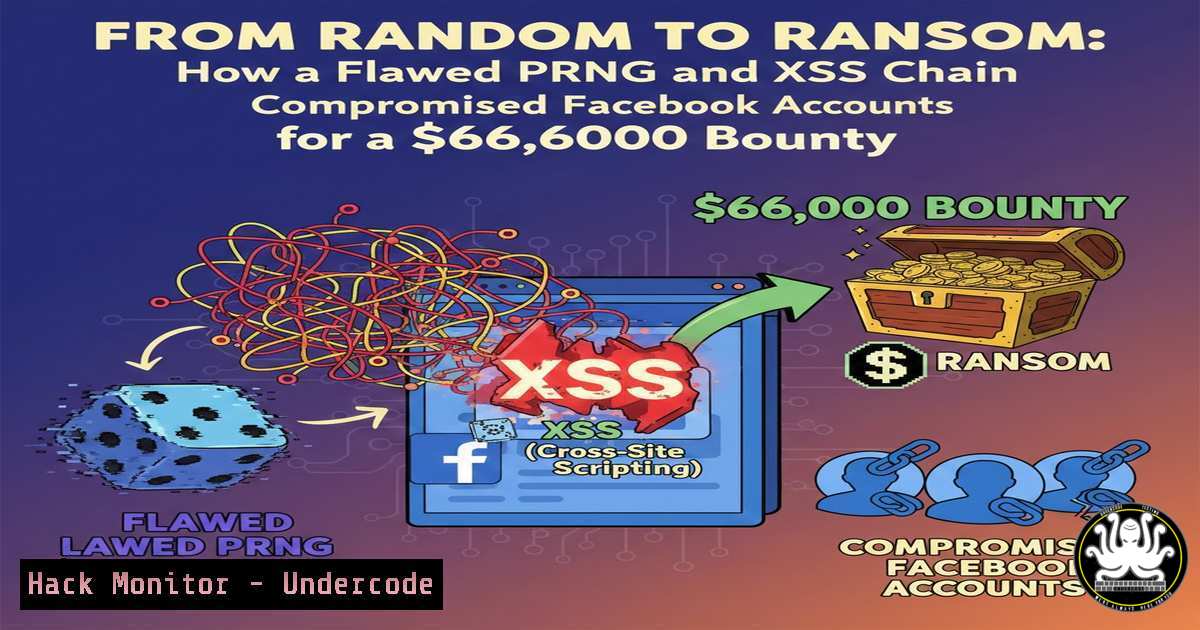
A sophisticated security research breakthrough exposed a critical account takeover vulnerability within the Facebook mobile application ecosystem. The flaw was not a single bug but a cascade of failures: a cryptographically insecure random number generator (PRNG) for session secrets, combined with a DOM-based Cross-Site Scripting (XSS) vulnerability in the Facebook JavaScript SDK. This chain allowed an attacker to hijack user sessions by predicting security tokens and injecting malicious scripts, ultimately leading to a $66,000 bug bounty award from Meta.
Learning Objectives:
- Understand the critical security risk of using non-cryptographic PRNGs (
Math.random()) for generating security tokens and secrets. - Analyze how postMessage communication and iframe handling can introduce XSS and side-channel attacks in third-party SDKs.
- Learn the methodology of chaining multiple lower-severity issues (PRNG prediction, XSS, framing bypasses) to achieve high-impact exploitation.
You Should Know:
- The Weak Link: Cryptographically Insecure Random Number Generation
The core vulnerability stemmed from the Facebook JavaScript SDK using `Math.random()` to generate critical callback identifiers. These identifiers acted as shared secrets to validate messages between the host page and Facebook’s plugin iframes.
Step-by-step guide explaining what this does and how to use it:
`Math.random()` in JavaScript is a pseudo-random number generator (PRNG) designed for speed, not security. Its internal state is deterministic and can be reverse-engineered if an attacker can observe a sequence of outputs. In this case, the SDK’s `guid()` function generated the secret like this:
function guid() {
return 'f' + (Math.random()  (1 << 30)).toString(16).replace('.', '');
}
How to Exploit/Mitigate:
Exploitation Observation: The researcher found that the same PRNG state was used to generate `window.name` properties for plugin iframes. By forcing iframe re-creation and reading these names via a carefully controlled browsing context, the attacker could collect sequential outputs of Math.random().
State Reconstruction: Using these outputs, tools like the Z3 theorem prover can reconstruct the PRNG’s internal state (V8’s `xorshift128+` algorithm) and predict all future and past “random” values, including the secret callback ID.
Secure Alternative: Always use the Cryptographically Secure Pseudorandom Number Generator (CSPRNG) provided by the Web Crypto API for security-sensitive operations.
// Secure method to generate a random string
function secureGuid() {
const array = new Uint8Array(16);
window.crypto.getRandomValues(array);
return Array.from(array, byte => byte.toString(16).padStart(2, '0')).join('');
}
- The Injection Point: DOM XSS in the Facebook JS SDK
The second flaw was a DOM-based Cross-Site Scripting (XSS) vulnerability within the SDK’s message handler for the Customer Chat plugin. An attacker-controlled `iconSVG` parameter from a postMessage was directly injected into the DOM without sanitization.
Step-by-step guide explaining what this does and how to use it:
The SDK had an event handler that took data from incoming messages and passed it to a rendering function:
this.subscribe("xd.mpn.setupIconIframe", function(b) {
a.$CustomerChat20(b);
});
Inside `$CustomerChat20`, the `iconSVG` field was unsafely injected:
f != null && (d("sdk.DOM").html(i, f), ...)
How to Exploit/Mitigate:
Crafting the Payload: An attacker would craft a malicious postMessage containing an `iconSVG` payload with JavaScript, e.g., <svg onload="fetch('/steal-cookie?data='+document.cookie)">.
Triggering the Handler: The challenge was getting the SDK to accept this malicious message. It required passing two checks: the message must originate from `www.facebook.com` and contain the correct, predicted callback ID (covered in Step 1).
Secure Coding Practice: Never inject unsanitized user or external input into the DOM. Use safe methods like `textContent` or rigorously sanitize HTML input using libraries like DOMPurify. For SDKs, implement strict input validation schemas for all message parameters.
3. Bypassing Frame Protections: The Legacy Header Trap
To leak the iframe `window.name` (PRNG output), the attacker needed to embed a Facebook page in a nested iframe under their control. This was thwarted by modern frame-busting headers like Content-Security-Policy: frame-ancestors.
Step-by-step guide explaining what this does and how to use it:
The researcher discovered a critical misconfiguration in Facebook’s mobile webview environment. When a page was requested with specific compatibility parameters (&cquick=1), it would set a legacy `X-Frame-Options: ALLOW-FROM` header instead of the modern, enforceable `frame-ancestors` CSP directive.
The Vulnerability: The `ALLOW-FROM` directive is not supported by any major modern browser. When a browser encounters this unsupported header, it effectively ignores it, resulting in no frame protection at all.
Exploitation Command/Check: You can test a URL’s frame-busting headers using curl:
curl -I "https://www.facebook.com/somepage?cquick=1&cquick_token=TOKEN&ctarget=https://www.facebook.com"
Look for the presence of `X-Frame-Options: ALLOW-FROM` and the absence of a strong `frame-ancestors` CSP header.
Mitigation: Never rely on X-Frame-Options: ALLOW-FROM. Exclusively use the `Content-Security-Policy` header with the `frame-ancestors` directive. For example:
`Content-Security-Policy: frame-ancestors ‘self’;`
- The Chained Attack: From Prediction to Account Takeover
The full exploit chain wove these vulnerabilities together into a devastating attack.
Step-by-step guide explaining what this does and how to use it:
1. Lure Victim: The victim visits an attacker-controlled page within the Facebook mobile app’s in-app browser (WebView).
2. Setup & Leak: The attacker’s page embeds a target Facebook page (e.g., a business plugin demo page) in an iframe. It then uses JavaScript to navigate a sub-iframe, read its leaked `window.name` (a `Math.random()` output), and force a plugin re-initialization to get the next output.
3. PRNG State Solve: After collecting enough samples, the attacker uses a modified Z3 solver script (referencing PwnFunction’s research) to reconstruct the V8 PRNG state and calculate the active, secret callback ID.
4. Forge the Message: The attacker crafts a malicious postMessage with the predicted callback ID and a script-stealing payload in the `iconSVG` field. The message is sent from a controlled `www.facebook.com` plugin endpoint.
5. Execute & Compromise: The vulnerable SDK validates the origin and correct callback ID, accepts the message, and unsafely injects the iconSVG, executing the attacker’s JavaScript in the context of the Facebook page, leading to session theft and account takeover.
5. Lessons for Developers and Bug Bounty Hunters
This case study is a masterclass in modern vulnerability research, highlighting key areas for defensive and offensive focus.
Step-by-step guide explaining what this does and how to use it:
For Defensive Developers:
Audit Third-Party SDKs: Treat embedded SDKs as part of your attack surface. Review their security posture and how they handle cross-origin communication.
Harden postMessage Handlers: Implement strict allowlists for origins, validate all message data against a strict schema, and use robust message type verification.
window.addEventListener('message', (event) => {
// 1. Verify origin
if (event.origin !== 'https://trusted.example.com') return;
// 2. Verify expected structure
if (typeof event.data !== 'object' || event.data.type !== 'expectedType') return;
// 3. Sanitize any data before DOM interaction
const safeContent = DOMPurify.sanitize(event.data.content);
// ... then process
});
For Bug Bounty Hunters:
Think in Chains: Look for seams between systems (web/mobile, main app/SDK). A medium-severity XSS in a third-party context can become critical when chained with a logic flaw or state prediction bug in the main application.
Investigate Legacy Features: Features like Facebook’s `cquick` compatibility parameter are prime targets for misconfigurations and header conflicts that can weaken security postures.
What Undercode Say:
- The Architecture of a Modern Software Supply Chain Attack: This vulnerability wasn’t in Facebook’s core login system, but in a software development kit (SDK) offered to millions of websites. It reveals how third-party code integrated for functionality (like a chat plugin) can become a Trojan horse, compromising the security of the host application. This blurs the line between first-party and third-party risk.
- The High Stakes of “Non-Critical” Bugs: Individually, an XSS in an SDK or the use of `Math.random()` for a nonce might be rated as medium severity. This research demonstrates their catastrophic potential when combined. It underscores the necessity for security engineers and bounty programs to deeply evaluate the exploitability context and the potential for vulnerability chaining, rather than assessing flaws in isolation.
Prediction:
This sophisticated exploit will have a ripple effect across the application security landscape. In the short term, we will see a surge in security audits targeting other major third-party SDKs (social media widgets, chat plugins, analytics scripts) for similar patterns of insecure PRNG usage and unsafe postMessage handling. Major platforms will likely mandate stricter security requirements for listed SDKs. In the longer term, this research accelerates the deprecation of legacy web features like `X-Frame-Options: ALLOW-FROM` and pushes browser vendors towards even stricter default isolation policies for embedded content. Furthermore, it sets a new benchmark for bug bounty valuations, where complex, multi-step exploit chains against core user security will command increasingly premium rewards, incentivizing deeper, more architectural security research.
▶️ Related Video (72% Match):
🎯Let’s Practice For Free:
IT/Security Reporter URL:
Reported By: Ysammouda Account – Hackers Feeds
Extra Hub: Undercode MoN
Basic Verification: Pass ✅


