Listen to this Post
Introduction:
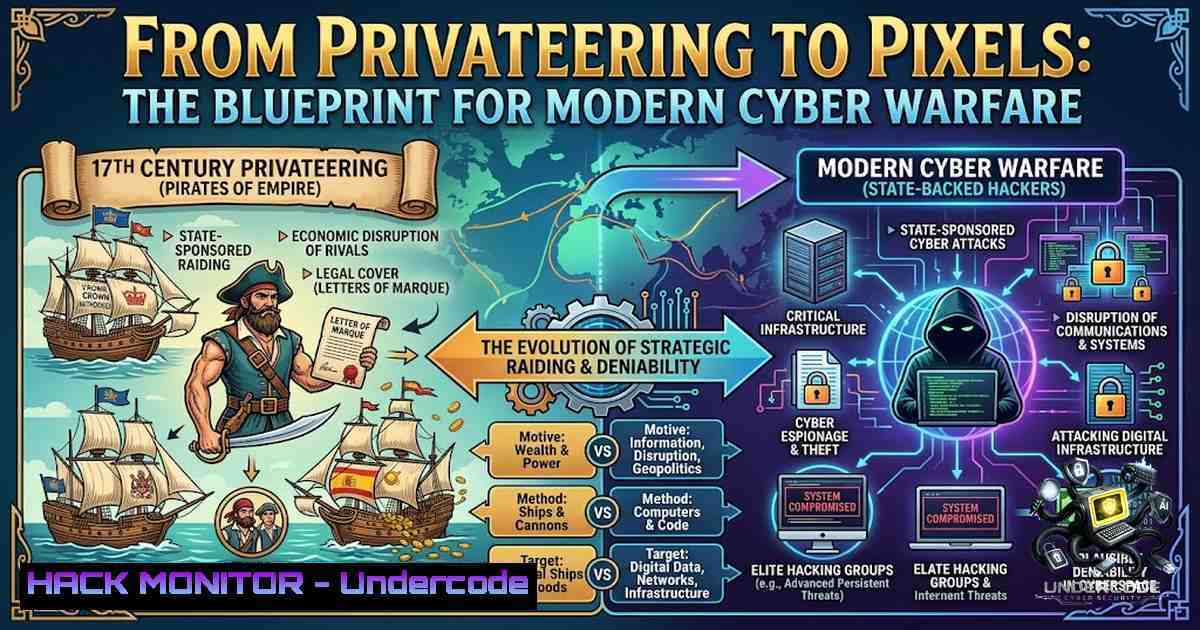
The story of Robert Rich, the second Earl of Warwick, is a tale of contradictions—a Puritan patron who bankrolled Pilgrims’ passage to freedom while simultaneously investing in the slave trade and plundering Spanish silver fleets. His privateering empire, built on letters of marque and the exploitation of human capital, seeded the economic foundations of the New World. But as the House of Commons Business and Trade Committee recently warned, Britain is now “hugely exposed to the risks of economic warfare,” with “cyber” mentioned over 100 times in their latest report on economic security. The same predatory instincts that drove Rich’s fleet across the Atlantic now manifest in ransomware gangs, state-sponsored hackers, and the weaponization of digital infrastructure. To understand modern cyber threats, one must first understand the historical playbook of privateering—and how to defend against it.
Learning Objectives:
- Understand the historical analogy between 17th-century privateering and modern cyber warfare, including the role of semi-state actors and letters of marque.
- Identify the top ten economic security threats facing the UK and US, as outlined by the Business and Trade Committee, with a focus on critical national infrastructure (CNI) attacks.
- Master practical Linux and Windows command-line techniques for threat detection, log analysis, and system hardening.
- Implement API security best practices and cloud hardening configurations to mitigate common attack vectors.
- Develop a foundational understanding of vulnerability exploitation and mitigation strategies, including patch management and zero-trust architectures.
- The Privateering-Cyber Analogy: When Letters of Marque Go Digital
In the Age of Sail, nations issued letters of marque to private citizens, authorizing them to capture enemy vessels and their cargo during times of war. These privateers were essentially state-sponsored pirates—deniable assets who enriched themselves while advancing national interests. Robert Rich, with his fleet of privateering vessels, was one of the most successful of these operators, plundering Spanish silver and reinvesting the proceeds into colonial enterprises.
Today, the same dynamic plays out in cyberspace. Nation-states increasingly outsource cyber operations to semi-state actors: ransomware gangs, hacktivist collectives, and private security firms that operate in a grey zone between legality and warfare. The Business and Trade Committee’s report underscores this shift, warning that the UK’s economic security regime is “not fit for the future” and risks becoming the “weak point in the West’s emerging system of economic security”. Just as Rich’s privateers operated with implicit government approval, modern cyber privateers often enjoy tacit state backing, complicating attribution and accountability.
Step‑by‑step guide: Understanding the Analogy
- Identify the actors: Map modern cyber threats to historical privateering roles—nation-states as sponsoring monarchies, ransomware groups as privateers, and critical infrastructure as the treasure fleets.
- Analyze the motivation: Like Rich’s pursuit of silver, modern attackers seek financial gain, intellectual property, or strategic disruption.
- Examine the deniability: Just as privateers could be disavowed, state-sponsored hackers use proxies and false flags to obscure attribution.
- Study the decline: Historical privateering declined due to international treaties and the rise of formal navies. Similarly, cybersecurity requires global cooperation and robust defensive frameworks.
-
The Modern Threat Landscape: What the Business & Trade Committee Found
The House of Commons Business and Trade Committee’s report, Toward a New Doctrine for Economic Security, identifies ten primary threats to the UK’s economic resilience. Cybersecurity is foundational to every one of them, with particular emphasis on:
- Attacks on Critical National Infrastructure (CNI) : Power grids, water supplies, and transportation networks are increasingly vulnerable to ransomware and sabotage.
- Supply Chain Compromise: Third-party vendors and software dependencies introduce cascading risks.
- Data Sovereignty Erosion: With 88% of UK listed firms relying on US email providers, and 100% of companies with revenues above £200m doing so, the UK’s digital infrastructure is heavily dependent on foreign control.
- AI-Enabled Threats: Generative AI lowers the barrier for phishing, deepfakes, and automated vulnerability scanning.
Step‑by‑step guide: Assessing Your Organization’s Exposure
- Conduct a threat modeling exercise using the STRIDE framework (Spoofing, Tampering, Repudiation, Information Disclosure, Denial of Service, Elevation of Privilege).
- Map your critical assets—identify which systems, if compromised, would cause catastrophic business or national security impact.
- Review your supply chain—audit third-party vendors, open-source dependencies, and cloud service providers for security posture.
- Implement continuous monitoring using SIEM (Security Information and Event Management) tools like Splunk, ELK Stack, or Microsoft Sentinel.
Linux Command: Checking for Unusual Network Connections
 List all active network connections with associated processes
sudo netstat -tunap | grep ESTABLISHED

Monitor real-time connection attempts
sudo tcpdump -i eth0 -1 -c 100

Check for listening ports and the services bound to them
sudo ss -tulpn
Windows Command (PowerShell): Auditing Open Ports and Connections
 Display active TCP connections
Get-1etTCPConnection | Where-Object {$_.State -eq "Established"}

List all listening ports
Get-1etTCPConnection | Where-Object {$_.State -eq "Listen"}

Check for scheduled tasks that might indicate persistence
Get-ScheduledTask | Where-Object {$_.State -1e "Disabled"}
3. API Security Hardening: The New Treasure Fleet
Just as Rich’s privateers targeted Spanish silver fleets, modern attackers target APIs—the connective tissue of modern applications. APIs expose endpoints that, if misconfigured, can leak sensitive data, enable unauthorized access, or facilitate denial-of-service attacks. The OWASP API Security Top 10 includes broken object-level authorization, broken authentication, and excessive data exposure as critical vulnerabilities.
Step‑by‑step guide: Securing Your APIs
- Implement authentication and authorization using OAuth 2.0 or OpenID Connect. Never rely on API keys alone.
- Enforce rate limiting to prevent brute-force and DoS attacks. Use tools like NGINX, Kong, or Cloudflare.
- Validate input rigorously—use schema validation, whitelist allowed characters, and sanitize all inputs.
- Encrypt data in transit using TLS 1.3. Disable deprecated protocols like SSLv3 and TLS 1.0.
- Log and monitor API traffic—set up alerts for anomalous patterns, such as sudden spikes in error rates or requests from unusual geolocations.
Linux Command: Testing API Endpoints with cURL
 Test a GET endpoint with authentication header
curl -X GET "https://api.example.com/v1/users" -H "Authorization: Bearer YOUR_TOKEN"

Test a POST endpoint with JSON payload
curl -X POST "https://api.example.com/v1/login" -H "Content-Type: application/json" -d '{"username":"admin","password":"test"}'

Check for rate limiting by sending multiple requests
for i in {1..100}; do curl -s -o /dev/null -w "%{http_code}\n" "https://api.example.com/v1/resource"; done
Windows Command (PowerShell): API Testing
 Invoke a REST API GET request
Invoke-RestMethod -Uri "https://api.example.com/v1/users" -Headers @{Authorization="Bearer YOUR_TOKEN"}

Test a POST request with body
$body = @{username="admin"; password="test"} | ConvertTo-Json
Invoke-RestMethod -Uri "https://api.example.com/v1/login" -Method Post -Body $body -ContentType "application/json"
4. Cloud Security Hardening: Fortifying the Digital Plantations
Rich’s wealth was built on plantations—colonial enterprises that required constant protection from rival powers and internal rebellion. Today, cloud environments are the new plantations: vast, distributed, and lucrative targets. Misconfigured S3 buckets, overly permissive IAM roles, and unpatched virtual machines are the equivalent of unguarded stockades.
Step‑by‑step guide: Hardening Cloud Infrastructure
- Apply the principle of least privilege—grant users and services only the permissions they absolutely need. Use AWS IAM, Azure RBAC, or GCP IAM to enforce fine-grained access.
- Enable multi-factor authentication (MFA) for all administrative accounts.
- Encrypt data at rest using cloud-provider KMS (Key Management Service) and customer-managed keys where possible.
- Configure VPCs and security groups to restrict inbound and outbound traffic. Default-deny all rules, then explicitly allow required traffic.
- Enable comprehensive logging—CloudTrail, Azure Monitor, or GCP Operations Suite—and ship logs to a centralized SIEM.
- Automate patch management—use tools like AWS Systems Manager, Azure Update Management, or GCP OS Patch Management to ensure VMs are consistently updated.
Linux Command: Auditing Cloud Instance Security
 Check for open ports on an EC2 instance (using nmap)
nmap -sV -p- -T4 <instance-ip>

Verify SSH configuration
sudo cat /etc/ssh/sshd_config | grep -E "PermitRootLogin|PasswordAuthentication|Port"

List all users with sudo privileges
sudo cat /etc/sudoers | grep -v "^" | grep -v "^$"
Windows Command (PowerShell): Cloud VM Hardening
 Check Windows Firewall rules
Get-1etFirewallRule | Where-Object {$_.Enabled -eq "True"}

List all local users and their group memberships
Get-LocalUser | ForEach-Object { $<em>.Name; Get-LocalGroupMember -Group "Administrators" | Where-Object {$</em>.Name -like "$($_.Name)"} }

Enable BitLocker encryption (if applicable)
Manage-bde -on C: -RecoveryPassword -SkipHardwareTest
- Vulnerability Exploitation and Mitigation: From Zero-Days to Patch Tuesdays
The Earl of Warwick’s privateers exploited the vulnerabilities of Spanish treasure fleets—predictable routes, undermanned escorts, and outdated defensive tactics. Modern attackers do the same, scanning for unpatched vulnerabilities, default credentials, and misconfigurations. The Business and Trade Committee report emphasizes that cyber attacks on CNI are among the most severe threats, requiring proactive defense-in-depth strategies.
Step‑by‑step guide: Vulnerability Management Lifecycle
- Discover: Use automated scanners like Nessus, OpenVAS, or Qualys to identify vulnerabilities across your environment.
- Prioritize: Apply the CVSS (Common Vulnerability Scoring System) to rank vulnerabilities by severity. Focus on critical and high-severity issues first.
- Remediate: Apply patches, configuration changes, or compensating controls. For zero-days, implement virtual patching via WAF or IDS/IPS rules.
- Verify: Re-scan to confirm remediation and conduct penetration testing to validate defenses.
- Monitor: Continuously monitor for new vulnerabilities and emerging threat intelligence feeds (e.g., CISA, NCSC, MITRE ATT&CK).
Linux Command: Vulnerability Scanning with OpenVAS
 Install OpenVAS (on Debian/Ubuntu)
sudo apt update && sudo apt install openvas -y
sudo gvm-setup
sudo gvm-start

Scan a target IP
omp -u admin -w password -h <target-ip> --xml "<create_task>...</create_task>"
Windows Command (PowerShell): Using Windows Update for Patching
 Check for available updates
Get-WindowsUpdate

Install all available updates
Install-WindowsUpdate -AcceptAll

View installed updates history
Get-HotFix | Sort-Object InstalledOn -Descending
Mitigation Strategies:
- Zero-Trust Architecture: Assume breach and verify every access request. Implement micro-segmentation and continuous authentication.
- Network Segmentation: Isolate critical systems from general-purpose networks. Use VLANs, firewalls, and software-defined perimeters.
- Incident Response Plan: Develop and regularly test a playbook for detecting, containing, and recovering from cyber incidents.
- Security Awareness Training: Educate employees on phishing, social engineering, and secure password practices.
6. Training and Certification: Building the Digital Navy
Just as the Royal Navy eventually replaced privateers with professional, disciplined forces, modern organizations must invest in trained cybersecurity professionals. The UK offers several pathways, including Cyber Security Technical Professional (Level 6) integrated degrees and Cyber Security Technician (Level 3) apprenticeships. These programs provide hands-on experience in threat detection, incident response, and security architecture.
Recommended Certifications:
- CompTIA Security+: Foundational knowledge for entry-level roles.
- Certified Ethical Hacker (CEH) : Practical skills in penetration testing and vulnerability assessment.
- Certified Information Systems Security Professional (CISSP) : Advanced certification for experienced practitioners.
- GIAC Certifications: Specialized tracks in incident response, forensics, and security management.
- Cloud Security Certifications: AWS Certified Security – Specialty, Azure Security Engineer Associate, or Google Professional Cloud Security Engineer.
Step‑by‑step guide: Building a Security Training Program
- Assess current skill levels—conduct a gap analysis to identify strengths and weaknesses.
- Define role-based learning paths—tailor training to specific job functions (e.g., SOC analyst, cloud engineer, developer).
- Leverage hands-on platforms—use TryHackMe, Hack The Box, or Cyber Range for practical exercises.
- Encourage continuous learning—allocate budget for conferences, webinars, and subscriptions to threat intelligence feeds.
- Measure effectiveness—track certification attainment, incident response times, and phishing simulation results.
What Undercode Say:
- Historical echoes matter: The privateering model of the 17th century provides a powerful lens for understanding modern cyber warfare. Just as Rich’s privateers operated in a legal grey zone, today’s state-sponsored hackers exploit ambiguous international norms.
- Economic security is national security: The Business and Trade Committee’s report makes it clear that cyber resilience is not optional—it is foundational to the UK’s economic future. Organizations that fail to invest in cybersecurity risk becoming the weak link in the Western alliance.
- Defense requires constant adaptation: Rich’s privateers eventually declined because nations built professional navies and signed treaties. Similarly, cybersecurity demands continuous improvement, international cooperation, and a shift from reactive to proactive defense.
Analysis: The parallels between 17th-century privateering and 21st-century cyber threats are striking. Both involve semi-state actors, deniable operations, and the pursuit of economic gain through asymmetric means. The Business and Trade Committee’s warning that the UK is “hugely exposed to the risks of economic warfare” underscores the urgency of adopting a new doctrine for economic security. Organizations must move beyond perimeter-based defenses and embrace zero-trust architectures, continuous monitoring, and robust incident response capabilities. The historical lesson is clear: those who fail to adapt to new forms of warfare—whether on the high seas or in cyberspace—risk being plundered.
Prediction:
- +1 The growing recognition of cyber threats as economic warfare will drive increased investment in cybersecurity training, with the UK’s apprenticeship programs and integrated degrees producing a new generation of skilled professionals.
- +1 International cooperation on cyber norms and treaties will intensify, mirroring the historical decline of privateering through multilateral agreements.
- -1 The reliance of UK firms on US-controlled digital infrastructure poses a significant sovereignty risk, which could be exploited in geopolitical conflicts.
- -1 AI-enabled cyber attacks will lower the barrier to entry for malicious actors, leading to a surge in automated, large-scale attacks on critical infrastructure.
- +1 The adoption of zero-trust architectures and sovereign cloud solutions will accelerate, reducing the attack surface and improving resilience.
- -1 Without urgent reform, the UK risks becoming the “weak point in the West’s emerging system of economic security,” as warned by the Business and Trade Committee.
- +1 Historical awareness of privateering’s decline offers a roadmap for curbing state-sponsored cyber operations through legal frameworks and economic incentives.
- -1 Ransomware gangs will continue to evolve, adopting more sophisticated tactics such as double extortion and supply chain compromise, demanding a coordinated international response.
▶️ Related Video (72% Match):
🎯Let’s Practice For Free:
🎓 Live Courses & Certifications:
Join Undercode Academy for Verified Certifications
🚀 Request a Custom Project:
Secure, high-velocity infrastructure and disruptive technological engineering. Contact our engineering team for high-tier development and proprietary systems:
[email protected]
💎 Smart Architecture | 🛡️ Secure by Design | ⭐ Trusted by Thousands
IT/Security Reporter URL:
Reported By: Rt Hon – Hackers Feeds
Extra Hub: Undercode MoN
Basic Verification: Pass ✅


