Listen to this Post
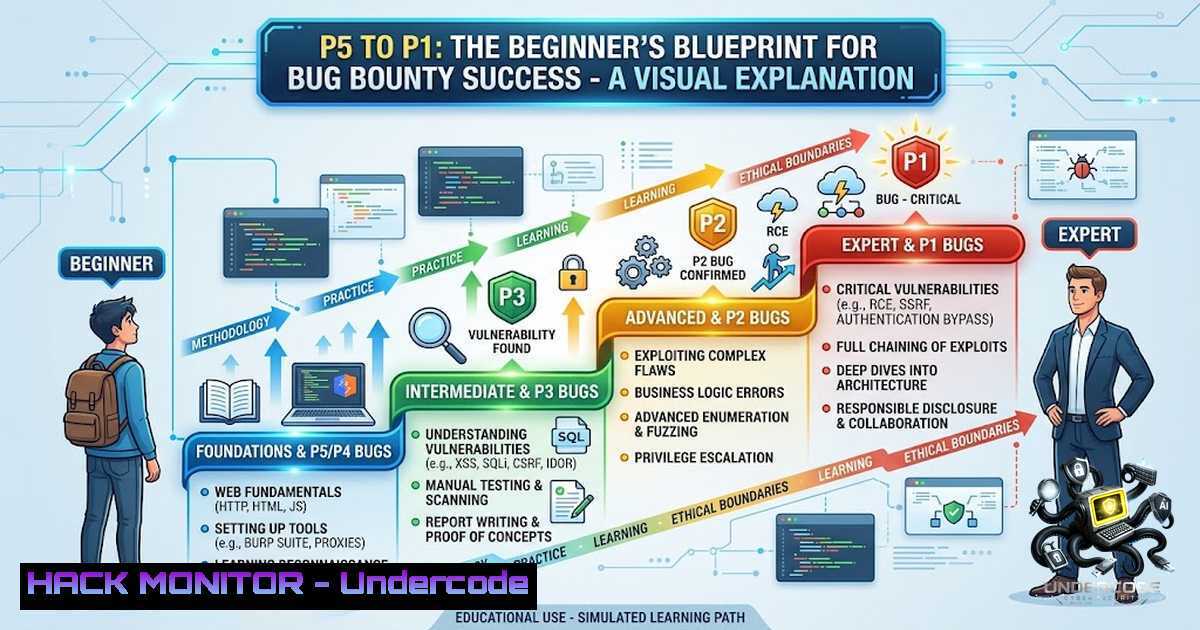
Introduction:
The journey from zero to your first accepted bug bounty report is a rite of passage in the cybersecurity community. While an Informational (P5) finding may seem trivial to seasoned researchers, it represents a validated foothold—a proof that your methodology, tooling, and reconnaissance efforts align with real-world vulnerability identification. This milestone is not merely about severity scores; it is about establishing a disciplined approach to web application security testing, understanding the OWASP Top 10 attack vectors, and mastering the art of chaining seemingly low-impact issues into critical exploits.
Learning Objectives:
- Understand the end-to-end lifecycle of a bug bounty report, from reconnaissance to responsible disclosure.
- Master essential reconnaissance and fingerprinting techniques using open-source intelligence (OSINT) and active scanning tools.
- Identify and exploit common web vulnerabilities including IDOR, XSS, SQLi, and misconfigurations across Linux and Windows environments.
- Develop a structured methodology for API security testing and cloud hardening assessments.
- Learn to write professional, reproducible proof-of-concept (PoC) reports that accelerate triage and validation.
You Should Know:
- Reconnaissance and Attack Surface Mapping – The Foundation of Every Hunt
Before firing a single payload, the cornerstone of effective bug hunting is exhaustive reconnaissance. This phase determines the quality of your findings—rushing here often leads to missing low-hanging fruit or, worse, triggering WAF alerts prematurely. Begin with passive OSINT to enumerate subdomains, exposed buckets, and technology stacks. Tools like Amass, Subfinder, and `Shodan` are indispensable. For active enumeration, combine directory brute-forcing with parameter discovery.
Step‑by‑step guide – Passive and Active Reconnaissance:
- Passive Enumeration: Use `subfinder -d target.com -o subs.txt` to gather subdomains from open sources. Feed these into `httpx -l subs.txt -o alive.txt` to filter live hosts.
- Active Directory Brute‑forcing: On Linux, `gobuster dir -u https://target.com -w /usr/share/wordlists/dirbuster/directory-list-2.3-medium.txt -x php,html,js` reveals hidden endpoints. For Windows, PowerShell alternatives like `Invoke-WebRequest` can be scripted to loop through wordlists.
- Parameter Discovery: Use `ffuf -u https://target.com/FUZZ -w params.txt` to uncover hidden parameters that may be vulnerable to injection. Combine with
Burp Suite‘s Param Miner extension for automated parameter guessing. - Cloud Bucket Enumeration: Use `aws s3 ls s3://target-bucket/ –1o-sign-request` to test for publicly readable S3 buckets. On Azure, `az storage blob list –account-1ame targetaccount –container-1ame public` achieves similar results.
- Web Vulnerability Deep Dive – OWASP Top 10 in Practice
The OWASP Top 10 remains the definitive roadmap for web application security. For beginners, focusing on Injection (A03), Broken Access Control (A01), and Cross-Site Scripting (A07) yields the highest probability of finding validated bugs. The key is to move beyond automated scanners and understand the business logic behind each endpoint.
Step‑by‑step guide – Testing for IDOR and SQL Injection:
- IDOR (Insecure Direct Object References): Intercept authenticated requests and modify parameters like `user_id=123` to
user_id=124. If the application returns another user’s data without re-authenticating, you’ve found an IDOR. On Linux, use `curl -X GET “https://api.target.com/user/124” -H “Cookie: session=xyz”` to automate this check. - SQL Injection (Error‑Based): Append a single quote (
') to a parameter and observe error messages. For time‑based blind SQLi, use `sleep(5)` payloads. Example:https://target.com/product?id=1' AND SLEEP(5)--. Use `sqlmap -u “https://target.com/product?id=1” –batch –dbs` for automated exploitation, but always manually verify to avoid false positives. - XSS (Cross‑Site Scripting): Inject `` into input fields and URL parameters. For blind XSS, use `XSS Hunter` or `Burp Collaborator` to catch callbacks. On Windows, you can use `powershell -command “Invoke-WebRequest -Uri ‘https://target.com?q=‘”` to test from the command line.
- API Security Testing – The New Attack Frontier
Modern web applications are API‑driven, making API endpoints a prime target. Unlike traditional web forms, APIs often expose extensive functionality through REST, GraphQL, or SOAP. Common issues include broken object level authorization (BOLA), excessive data exposure, and mass assignment vulnerabilities.
Step‑by‑step guide – API Recon and Exploitation:
- GraphQL Introspection: Query `https://target.com/graphql` with `{“query”:”{__schema{types{name}}}”}` to dump the entire schema. If introspection is enabled, you can map all available queries and mutations.
- BOLA Testing: Similar to IDOR, but for API endpoints. Change `{“user_id”:”123″}` to `{“user_id”:”124″}` in POST requests. Use `Postman` or `Insomnia` to craft and replay requests with different authorization tokens.
- Rate Limiting Bypass: Many APIs implement rate limiting per IP. Use `X-Forwarded-For` headers to spoof IP addresses:
curl -H "X-Forwarded-For: 192.168.1.100" -X GET "https://api.target.com/endpoint". On Linux, tools like `httpx` and `masscan` can be combined to test for rate limit misconfigurations. - JWT Weaknesses: Decode JWTs using `jwt.io` or the command line:
echo "eyJhbGciOiJIUzI1NiIsInR5cCI6IkpXVCJ9.eyJzdWIiOiIxMjM0NTY3ODkwIiwibmFtZSI6IkpvaG4gRG9lIiwiaWF0IjoxNTE2MjM5MDIyfQ.SflKxwRJSMeKKF2QT4fwpMeJf36POk6yJV_adQssw5c" | jq -R 'split(".") | .[bash] | @base64d | fromjson'. Test for `none` algorithm or weak secrets using `crackjwt` wordlists.
- Cloud Hardening and Misconfiguration – From Open Buckets to Privilege Escalation
Cloud environments introduce unique attack vectors. Misconfigured S3 buckets, publicly accessible databases, and overly permissive IAM roles are routinely found in bug bounty programs. Hardening these requires a combination of configuration reviews and active testing.
Step‑by‑step guide – Cloud Security Assessment:
- S3 Bucket Permissions: Use `aws s3api get-bucket-acl –bucket target-bucket` to list permissions. If `AllUsers` or `AuthenticatedUsers` have `READ` access, the bucket is exposed. Remediate by setting `private` ACLs:
aws s3api put-bucket-acl --bucket target-bucket --acl private. - Azure Blob Public Access: Check container ACLs with
az storage container show --1ame container-1ame --account-1ame account-1ame. If `publicAccess` is `container` orblob, data is publicly readable. Use `az storage container set-permission –1ame container-1ame –public-access off` to harden. - IAM Role Testing: On AWS, attempt to assume roles using
aws sts assume-role --role-arn arn:aws:iam::account:role/role-1ame --role-session-1ame test. If misconfigured trust policies allow external principals, this can lead to privilege escalation. - Kubernetes Misconfigurations: Check for exposed Kubelet APIs on port 10250. Use `curl -k https://node-ip:10250/pods` to list running pods. If unauthenticated, an attacker can execute commands inside containers.
- Reporting and Proof‑of‑Concept – The Art of Effective Disclosure
A finding is only as good as its report. Triage teams are overloaded; a clear, reproducible PoC accelerates validation and increases your bounty. Structure your report with a summary, technical details, step‑by‑step reproduction, impact analysis, and remediation recommendations.
Step‑by‑step guide – Crafting a Professional Report:
- Summary: One sentence describing the vulnerability and its impact (e.g., “IDOR in user profile endpoint allows viewing any user’s PII”).
- Technical Details: Include exact HTTP requests and responses. Use `curl` commands or Burp request/response pairs. Example:
GET /api/user/124 HTTP/1.1 Host: target.com Cookie: session=xyz. - Reproduction Steps: Write numbered steps that anyone can follow: (1) Log in as user A, (2) Navigate to profile, (3) Change user ID parameter to 124, (4) Observe user B’s data.
- Impact: Quantify the risk—what data is exposed? Can this lead to account takeover? Is PII or financial data involved?
- Remediation: Suggest fixes, e.g., “Implement server‑side access controls to validate the authenticated user’s ownership of the requested resource.”
6. Tooling and Automation – Building Your Arsenal
Efficiency in bug bounty comes from automation. While manual testing is irreplaceable, scripting repetitive tasks saves hours. Develop a toolkit that includes both open‑source and custom scripts.
Step‑by‑step guide – Automation Scripts:
- Linux Bash Script for Subdomain Takeover:
!/bin/bash for sub in $(cat subs.txt); do dig CNAME $sub | grep "herokuapp\|github\|amazonaws" && echo "$sub is vulnerable"; done. - Windows PowerShell for Header Checks: `$headers = Invoke-WebRequest -Uri “https://target.com” -Method Head; $headers.Headers[“Server”]; $headers.Headers[“X-Powered-By”]` to fingerprint technologies.
- Python Script for Parameter Fuzzing: Use `requests` library to loop through a wordlist and log status codes and response sizes to identify anomalies.
- Burp Suite Extensions: Install `Autorize` for privilege escalation testing, `Turbo Intruder` for high‑speed fuzzing, and `Active Scan++` for advanced vulnerability detection.
- Continuous Learning and Mindset – From P5 to P1
The transition from informational to critical findings is not purely technical—it requires a shift in mindset. Beginners often focus on scanner outputs; experts think in terms of business logic and data flows. Study past reports, participate in CTFs, and engage with the community. Every rejected report is a learning opportunity.
Step‑by‑step guide – Skill Development:
- Practice on Labs: Use platforms like HackTheBox, TryHackMe, and PentesterLab to practice specific vulnerabilities in isolated environments.
- Read Public Reports: Platforms like HackerOne and Bugcrowd publish disclosed reports. Analyze the methodology behind critical findings.
- Join Communities: Engage in Discord servers, Reddit (r/bugbounty), and Twitter/X to discuss techniques and get feedback on your reports.
- Contribute to Open Source: Find security issues in popular open‑source projects to build your resume and give back to the community.
What Undercode Say:
- Key Takeaway 1: The first accepted report, regardless of severity, validates your methodology and proves that you can think like an attacker. It is a tangible milestone that separates theoretical knowledge from practical application.
- Key Takeaway 2: Consistency and documentation are more important than finding a critical bug on day one. The process of reconnaissance, testing, and reporting builds the muscle memory required for advanced exploitation.
- Analysis: The journey from P5 to P1 is not linear. It involves understanding that low‑severity issues often chain together to form critical attack paths. For instance, an information disclosure (P5) revealing internal IP addresses, combined with a misconfigured firewall (P4), could lead to network pivot and data exfiltration. The beginner who celebrates their first P5 is already on the path to thinking in terms of attack chaining. Moreover, the bug bounty ecosystem rewards thoroughness—detailed reports with clear PoCs are valued even for low‑severity findings because they save triage time. The psychological boost from a validated report cannot be overstated; it reinforces the hunter’s mindset and encourages deeper exploration. Finally, the community’s support, as seen in the original post’s engagement, highlights that mentorship and shared learning are integral to the field. No researcher succeeds in isolation.
Prediction:
- +1 The democratization of bug bounty platforms will continue to lower the barrier to entry, leading to a surge in beginner researchers who will discover novel vulnerabilities in emerging technologies like AI/ML APIs and serverless architectures.
- +1 The quality of beginner reports will improve as tooling becomes more sophisticated, with AI‑assisted fuzzing and automated PoC generation reducing the friction between discovery and disclosure.
- -1 The increasing volume of low‑severity reports may overwhelm triage teams, potentially leading to longer response times and burnout among junior researchers who struggle to get their findings acknowledged.
- -1 As attack surfaces expand into IoT and 5G, beginners without embedded systems knowledge may find traditional web bug bounty less rewarding, forcing a skillset pivot that could discourage newcomers.
- +1 However, the rise of specialized programs (e.g., API‑only, cloud‑only) will create niche opportunities for researchers who invest in deep domain expertise, turning that first P5 into a springboard for a lucrative career.
- +1 The community’s emphasis on continuous learning will foster a new generation of security leaders who prioritize ethical disclosure and collaborative defense, ultimately strengthening the entire ecosystem.
▶️ Related Video (68% Match):
🎯Let’s Practice For Free:
🎓 Live Courses & Certifications:
Join Undercode Academy for Verified Certifications
🚀 Request a Custom Project:
Secure, high-velocity infrastructure and disruptive technological engineering. Contact our engineering team for high-tier development and proprietary systems:
[email protected]
💎 Smart Architecture | 🛡️ Secure by Design | ⭐ Trusted by Thousands
IT/Security Reporter URL:
Reported By: Shahzaib Khan – Hackers Feeds
Extra Hub: Undercode MoN
Basic Verification: Pass ✅


