Listen to this Post
Introduction:
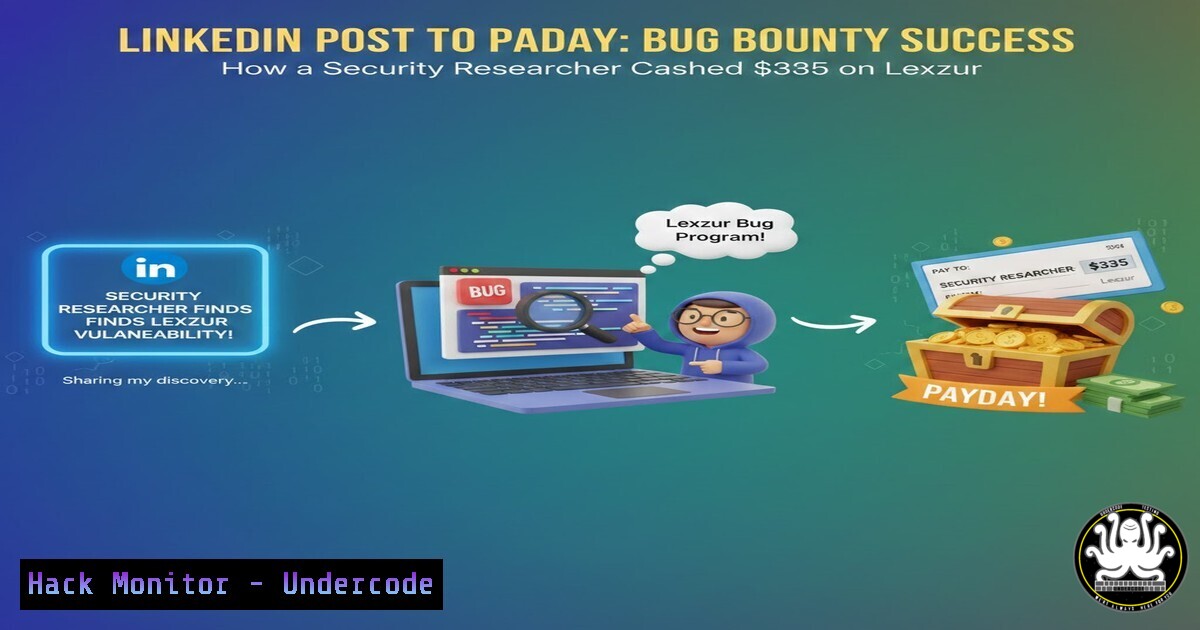
In the world of cybersecurity, the “bug bounty” has evolved from a niche hobby into a legitimate income stream for ethical hackers. A recent LinkedIn post by Aditya Singh highlights a practical case of responsible disclosure, detailing how they secured multiple bounties totaling $335 from Lexzur. While the financial reward is modest, the technical journey behind identifying those vulnerabilities is a masterclass in web application security testing. This article breaks down the potential methodologies, commands, and tools a researcher might use to find similar bugs, turning curiosity into cash.
Learning Objectives:
- Understand the lifecycle of responsible disclosure and bug bounty hunting.
- Learn how to enumerate web applications for common vulnerabilities (IDOR, XSS, Misconfigurations).
- Execute practical reconnaissance and exploitation commands using Linux and specialized security tools.
You Should Know:
- The Art of Reconnaissance: Finding the Attack Surface
Before a single payload is sent, a bug hunter must understand the target. Lexzur, being a document management and ERP platform, likely has complex user roles, file upload functions, and API endpoints. The first step is passive and active reconnaissance to map the digital terrain.
What this does: We need to discover hidden directories, subdomains, and parameters that aren’t linked on the main site.
Step‑by‑step guide:
- Subdomain Enumeration: Often, bugs live on staging or admin subdomains (
admin.lexzur.com,api.lexzur.com).Using Sublist3r (Linux) sublist3r -d lexzur.com -o lexzur_subdomains.txt Using Assetfinder assetfinder --subs-only lexzur.com >> assets.txt
- Directory Busting: Finding hidden directories can reveal admin panels or old versions of the app.
Using Gobuster (Linux)
gobuster dir -u https://target.lexzur.com -w /usr/share/wordlists/dirbuster/directory-list-2.3-medium.txt -x php,html,txt -o directories.txt
- Parameter Fuzzing: Many bounties come from vulnerabilities in URL parameters (e.g.,
?id=123,?file=doc.pdf).Using ffuf to find hidden parameters ffuf -u https://target.lexzur.com/page?FUZZ=test -w /usr/share/seclists/Discovery/Web-Content/burp-parameter-names.txt -fc 400,404
2. Exploiting Insecure Direct Object References (IDOR)
Based on the bounty amounts received (multiple $50 and $30 rewards), IDORs are a strong candidate. An IDOR occurs when an application exposes a direct reference to an internal object (like a database key or filename) without proper access control.
What this does: It allows a user to access or modify another user’s data by changing a parameter value.
Step‑by‑step guide (Manual Testing):
- Intercept Traffic: Open Burp Suite or OWASP ZAP. Navigate to a sensitive function, such as viewing an invoice.
- Analyze the Request: Look for identifiers in the URL or POST body.
– Example URL: https://app.lexzur.com/downloadInvoice?invoice_id=7890`7891
3. Manipulate the Value: Change the `invoice_id` to a sequential number (e.g.,,7892`).
4. Check the Response: If the server returns the invoice belonging to another user without asking for re-authentication, you have found an IDOR.
5. Automation with cURL (Linux/Windows WSL):
 Attempt to access a different resource
curl -X GET "https://app.lexzur.com/downloadInvoice?invoice_id=7891" -H "Cookie: session=YOUR_SESSION_COOKIE" -v
3. Cross-Site Scripting (XSS) in Web Forms
XSS vulnerabilities are perennial favorites for bug bounty hunters due to their prevalence. The $30-$50 bounties often point to Reflected or DOM-based XSS.
What this does: Injects malicious scripts into web pages viewed by other users.
Step‑by‑step guide (Payload Delivery):
- Identify Injection Points: Search bars, comment sections, or URL parameters.
- Basic Payload Test: Start with a simple, harmless alert to prove execution.
<script>alert('XSS')</script>
If filtered, try encoded variants:
%3Cscript%3Ealert('XSS')%3C/script%3E
3. Context-Specific Attack: If the input is reflected inside a JavaScript variable, break out of the context.
";alert('XSS');//
4. Using a Browser’s Console (Windows/Linux): Open Developer Tools (F12) to inspect how the input is being rendered. If your payload appears in the HTML source but isn’t executing, the site might have a WAF (Web Application Firewall). You must then obfuscate the payload.
4. Exploiting API Misconfigurations (The $75 Find)
The largest bounty in the post was $75. Higher bounties usually correlate with impact, such as Privilege Escalation or API security flaws. Modern platforms like Lexzur rely heavily on RESTful APIs.
What this does: Tests for Broken Object Level Authorization (BOLA) in APIs, which is the API version of IDOR.
Step‑by‑step guide (API Testing):
- Capture an API Call: Open the Network tab in Chrome DevTools (F12) while performing an action.
- Check for Mass Assignment: Look for POST/PUT requests containing JSON. Try adding extra parameters.
– Original Request:
{"name": "test", "role": "user"}
– Modified Request (Privilege Escalation):
{"name": "test", "role": "admin", "isAdmin": true}
3. HTTP Method Tampering: If a GET request shows your profile (/api/user/me), try changing the method to PUT or PATCH to see if you can modify your own attributes in unintended ways.
 Using cURL to test method tampering
curl -X PATCH https://api.lexzur.com/v1/user/me -H "Content-Type: application/json" -d '{"email":"[email protected]"}' -H "Authorization: Bearer [bash]"
5. Leveraging Search Engines for OSINT (Google Dorking)
Sometimes, vulnerabilities aren’t found by scanning, but by searching. Configuration files, exposed logs, or staging servers indexed by Google are low-hanging fruit.
What this does: Uses advanced search operators to find sensitive information accidentally left public.
Step‑by‑step guide (Windows/Linux Browser):
Open Google and use the `site:` operator combined with specific file types or error messages related to Lexzur.
– Find Excel/CSV files: `site:lexzur.com filetype:xls OR filetype:csv`
– Find exposed config files: `site:lexzur.com inurl:.env`
– Find error messages: `site:lexzur.com “Fatal error” OR “Warning: mysql_connect()”`
– Find login portals: `site:lexzur.com inurl:login OR inurl:admin`
6. Mitigation: Hardening Against These Attacks (DevSecOps View)
To understand the bug, one must understand the fix. If you were a Lexzur developer, how would you stop these $335 payouts?
Step‑by‑step guide (Configuration & Code):
- IDOR Mitigation: Implement complex, unpredictable UUIDs instead of sequential integers for object references. Enforce ownership checks on the backend for every request.
- XSS Mitigation (Windows/Linux Server Config): Implement a strong Content Security Policy (CSP) header.
In Apache .htaccess or httpd.conf
Header set Content-Security-Policy "default-src 'self'; script-src 'self' https://trusted.cdn.com;"
- API Security: Validate the JSON schema strictly. Do not automatically bind incoming JSON to internal objects (avoid mass assignment).
- WAF Rules: Deploy a Web Application Firewall like ModSecurity to block common attack patterns (SQLi, XSS) before they reach the application logic.
What Undercode Say:
- Volume over Value: Aditya’s post proves that bug hunting isn’t always about the “one big score.” A steady stream of $30 and $50 bounties from responsible disclosures is a sustainable and respectable way to contribute to cybersecurity, building a reputation that leads to higher-paying private programs.
- The Methodology Matters: The success highlighted in the post is a direct result of systematic testing. Whether it was IDOR, XSS, or API flaws, the researcher likely followed a structured approach—starting with reconnaissance, moving to automated scanning, and finishing with manual verification to eliminate false positives.
This post serves as a microcosm of the modern bug bounty ecosystem. It demonstrates that platforms like Lexzur are actively listening to researchers, and that persistence pays off. For aspiring hunters, the lesson is clear: master the basics of web application logic, learn to use tools like Burp Suite and ffuf proficiently, and always adhere to the rules of engagement. The $335 is not just a reward; it’s a validation of technical skill and ethical responsibility, turning a LinkedIn update into a badge of honor.
Prediction:
As more companies adopt DevOps and rapid deployment cycles, the attack surface will continue to expand, particularly in API integrations. We predict a rise in “bounty automation,” where researchers will leverage AI-assisted fuzzing to find logic flaws faster. Consequently, we will see companies shifting their focus from reactive patching to “bounty-driven development,” where security testing is integrated into the CI/CD pipeline before code is even merged, making the $75 bounties of today harder to find but more impactful when discovered.
▶️ Related Video (76% Match):
🎯Let’s Practice For Free:
IT/Security Reporter URL:
Reported By: Https: – Hackers Feeds
Extra Hub: Undercode MoN
Basic Verification: Pass ✅


