Listen to this Post
Introduction:
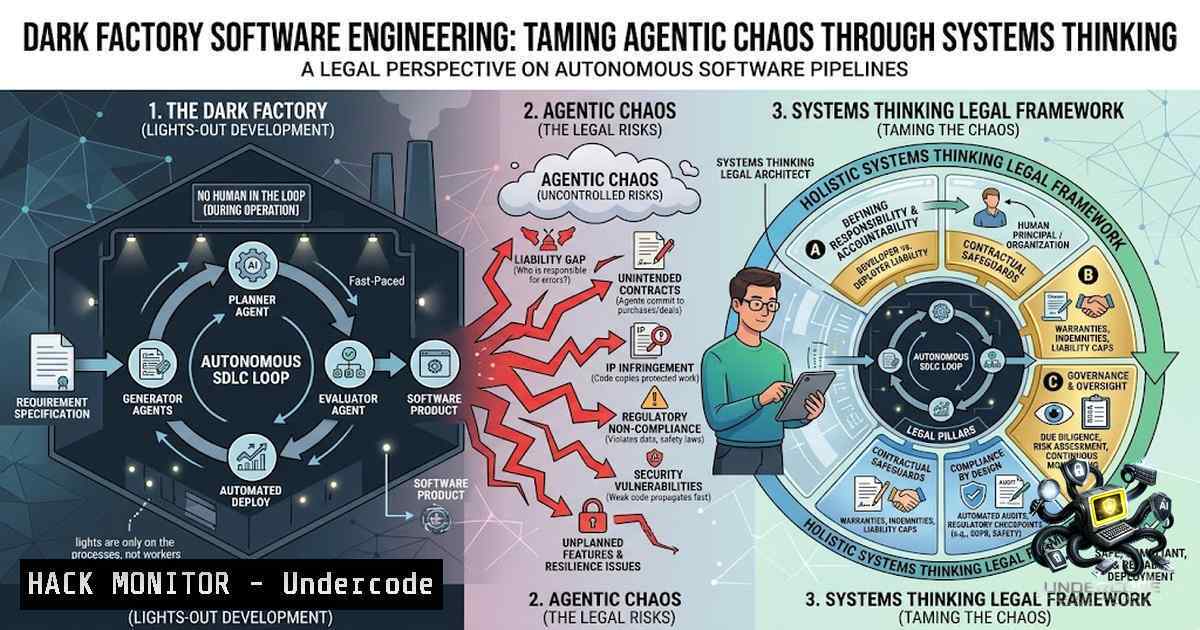
The concept of a “dark factory” — borrowed from Japanese manufacturing facilities like Fanuc’s robotics plant in Oshino, where robots build robots with the lights off — is rapidly migrating into software engineering. With the emergence of frontier AI models such as GPT-5.6 Sol and Claude Fable 5, engineers are now experimenting with building production-grade software without directly looking at the code, relying instead on autonomous AI agents. However, this paradigm introduces significant systems engineering challenges: AI agents tend to create monolithic files, refuse to refactor, and lose coherence as project complexity grows. This article explores the architectural patterns, guardrails, and operational disciplines necessary to transform agentic chaos into a controlled, lights-out software factory.
Learning Objectives:
- Understand the dark factory paradigm and its application to AI-driven software development
- Master code quality gates, architectural enforcement, and workflow patterns that tame agentic behavior
- Implement practical guardrails using linters, formatters, and CI/CD pipelines
- Design “outer loop” control systems that maintain human oversight without per-line code review
- Apply adversarial review models and specification-driven quality assurance
You Should Know:
- Code Style Constraints: Engineering Predictability into Agent Output
AI agents, left to their own devices, exhibit problematic coding behaviors: they create excessively long files, avoid refactoring in favor of appending code, and produce inconsistent patterns. The solution lies in establishing hard stylistic constraints that agents must follow.
Step‑by‑step guide:
- Enforce unit-testable, functional code: Instruct agents to write mostly functional code that separates side effects from pure logic, making it inherently testable.
- Adopt red/green Test-Driven Development (TDD): Require agents to write failing tests before implementation, then make them pass — this ensures test coverage is not an afterthought.
- Parameterize tests: Use cross-product test parametrization to exhaustively cover edge cases while keeping test suites tight.
- Eliminate defensive programming: In early-stage projects (version 0.0.x), forbid backward-compatibility hacks. Agents should not document “what used to happen”.
- Mandate refactoring: Before adding new code, agents must survey existing code and consider refactoring as the primary approach. Pull requests should show a healthy mix of deleted and added lines of code (LOC).
- Extract constants and configuration: All constants, copy, formulas, and config should reside in dedicated files for easy human auditing.
- Use Simplified Technical English (STE): All text — UI labels, docstrings, PR descriptions — must use complete sentences without metaphors, em-dashes, or personifications.
Linux/Windows Commands:
 Enforce Python code style with ruff
ruff check --select E,W,F,I,C90 --ignore E501 .

Run black formatter
black --line-length 88 .

Check for dead code with vulture
vulture . --min-confidence 70 --exclude "tests,.venv"

Measure cyclomatic complexity (Linux/macOS)
pip install radon
radon cc . -a -s
2. Enforced & Precommit Checks: Programmatic Quality Gates
Quality cannot be left to agent discretion. Programmatic gates that reject non-compliant code before it reaches review are essential.
Step‑by‑step guide:
- Set hard limits: Cap files at 400 lines, functions at 100 lines, and folders at 8 files. These thresholds force decomposition and prevent monoliths.
- Run formatters and linters automatically: Integrate tools like
ruff,eslint, and `prettier` into the pre-commit hook. - Detect dead code programmatically: Use tools like `vulture` (Python) to identify and remove unused code.
- Enforce code coverage: Maintain >95% test coverage and gate merges on coverage drops.
- Limit cognitive complexity: Set cognitive complexity threshold at 15 and nesting depth at 4. Use `ruff C901` with `flake8-cognitive-complexity` (Python) or `sonarjs/cognitive-complexity` (JavaScript).
- Centralize checks in a Makefile: Never run these checks as one-offs; codify them in `Makefile` targets that run consistently.
- Keep CI under 5 minutes: Parallelize tests or use selective testing to achieve speed without sacrificing coverage.
Example `Makefile` target:
.PHONY: lint test check-quality

lint:
ruff check .
black --check .

check-quality:
ruff check --select C901 .
vulture . --min-confidence 70

test:
pytest --cov=. --cov-fail-under=95

precommit: lint check-quality test
Windows PowerShell equivalent:
 Using ruff and pytest in PowerShell
ruff check .
pytest --cov=. --cov-fail-under=95 --cov-report=term
3. Workflow Patterns: Stacked PRs and Structured Communication
As projects scale, multiple agents working in parallel create coordination nightmares. Stacked pull requests and structured PR descriptions provide the necessary coordination layer.
Step‑by‑step guide:
- Stack PRs for large features: Break large features into a stack of dependent, smaller PRs. Each PR should be reviewable independently.
- Limit PR size: Keep PRs under 1,000 lines of code (excluding tests). This forces agents to ship incrementally.
- Require comprehensive PR descriptions: Every PR must describe:
- Before/after — what changed and why
- Approach — how the solution was implemented
- Alternatives considered — including approaches from other projects or literature
- All assumptions — business logic, constants, semantic definitions, decision points
- Communicate for human reviewers: This software exists within a larger organization; reviewers need visibility into decisions to provide effective direction and support
Git command for stacked PRs:
 Create a branch stack
git checkout -b feature/base
git commit -m "Base refactor"
git checkout -b feature/extension
git commit -m "Feature implementation"
git checkout -b feature/integration
git commit -m "Integration layer"

Push all branches
git push origin feature/base feature/extension feature/integration
- The Outer Loop: Control Systems Theory for Agentic Development
The “outer loop” is the systems engineering layer that governs how agents operate. Drawing from control systems theory, this involves designing feedback mechanisms that keep the system within acceptable bounds.
Step‑by‑step guide:
- Define the harness as the design: The harness — the configuration, rules, and constraints — is not an afterthought; it is the architecture. Engineers write the roadmap, define architecture layers, design conventions, and author issue specs. Agents operate within these constraints.
- Implement adversarial review: Use separate reviewer agents with isolated permissions — they can read and critique but cannot edit files. This prevents collusion and ensures objective quality assessment.
- Use specification-driven quality gates: Human-authored scenario specs define “done.” The functional reviewer generates ephemeral integration tests from specs, not just rubber-stamping the diff.
- Enforce architecture-as-code: Machine-readable layer definitions validated by `godark vet` ensure architectural compliance.
- Maintain structured agent dialogue: Implementers post reasoning as PR comments; reviewers challenge it. The PR thread becomes an auditable record of adversarial design review.
- Enable full run observability: Use a local web dashboard showing review chain timelines, quality flags, tool traces, and agent dialogue history for every issue.
Example `godark` CLI usage (macOS/Linux):
 Install Dark Factory via Homebrew
brew install peter-stratton/dark-factory/godark

Initialize a new project with harness
godark new my-project --harness=strict

Validate architecture constraints
godark vet

Run the autonomous pipeline on an issue
godark run ISSUE-123
5. Infrastructure as Code and Automated Deployments
A true dark factory extends beyond code generation into infrastructure provisioning and deployment automation.
Step‑by‑step guide:
- Version-control everything: Application code, infrastructure definitions, policies, and configuration must all live in version control.
- Encode architecture decisions into templates: Use Infrastructure as Code (IaC) tools like Terraform, Pulumi, or Helm to codify environment definitions.
- Automate progressive deployments: Implement canary releases, blue-green deployments, or feature flags to reduce deployment risk.
- Collect compliance evidence automatically: Evidence should be a byproduct of delivery, not assembled manually after the fact.
- Implement automated rollbacks: When health checks fail, rollback should happen without human intervention.
Terraform example for automated infrastructure:
 main.tf
resource "aws_instance" "app" {
ami = data.aws_ami.amazon_linux.id
instance_type = var.instance_type

user_data = <<-EOF
!/bin/bash
 Automated deployment script
docker pull ${var.image_tag}
docker run -d -p 80:80 ${var.image_tag}
EOF

tags = {
Environment = var.environment
ManagedBy = "dark-factory"
}
}
6. Security Hardening in the Dark Factory
Automation introduces new security vectors. The dark factory must embed security at every layer.
Step‑by‑step guide:
- Run agents in sandboxed containers: Agents execute inside ephemeral Docker containers with no access to the host filesystem or network beyond what’s explicitly allowed.
- Scan dependencies automatically: Integrate SCA (Software Composition Analysis) tools like
trivy,snyk, or `owasp dependency-check` into the pipeline. - Enforce secret scanning: Use tools like `trufflehog` or `git-secrets` to prevent credential leaks.
- Automate SAST/DAST: Run static and dynamic application security tests as part of the CI pipeline.
- Gate on vulnerability thresholds: Fail builds if critical or high-severity vulnerabilities are detected.
Security scanning commands:
 Scan container images with Trivy
trivy image myapp:latest --severity CRITICAL,HIGH --exit-code 1

Scan for secrets in the repository
trufflehog git file://. --only-verified

OWASP Dependency Check (Java/JavaScript/Python)
dependency-check --scan . --format HTML --out report.html
Windows (using Docker Desktop):
 Run Trivy in Docker on Windows
docker run --rm -v ${PWD}:/src aquasec/trivy image myapp:latest --severity CRITICAL,HIGH
7. Observability and Human Trust
Trust is the currency of dark factory engineering. Without visibility, engineers become nauseous and uneasy about what’s happening under the hood.
Step‑by‑step guide:
- Implement screenshot-based validation: Unit tests can be gamed, but screenshot demos rarely lie. Require agents to produce visual evidence of UI changes.
- Use structured logging: All agent actions, decisions, and reasoning should be logged in a structured format (JSON) for easy querying.
- Build a local dashboard: Aggregate review chain timelines, quality flags, tool traces, and agent dialogue history.
- Create human-readable summaries: Generate daily or per-sprint summaries of what agents accomplished, what they struggled with, and what risks were identified.
Example structured logging setup:
import structlog

logger = structlog.get_logger()

def agent_action(action_type, details, agent_id):
logger.info(
"agent_action",
action_type=action_type,
agent_id=agent_id,
timestamp=datetime.utcnow().isoformat(),
details
)
What Undercode Say:
- Key Takeaway 1: The dark factory is not about removing humans — it’s about elevating them. Humans define the “outer loop” (architecture, constraints, specs), while agents execute within those boundaries. The goal is to eliminate toil, not judgment.
-
Key Takeaway 2: Success requires relentless automation of quality gates. AI agents will naturally drift toward entropy (long files, no refactoring, inconsistent patterns). Programmatic enforcement of code style, complexity limits, and test coverage is the only scalable way to maintain coherence.
-
Key Takeaway 3: Adversarial review with isolated reviewer agents is a game-changer. By separating the implementer from the reviewer and giving reviewers read-only permissions, you create a system of checks and balances that mirrors human code review but operates at machine speed.
-
Key Takeaway 4: The dark factory is already here. Projects like `godark` (Go CLI for autonomous AI agents) and Momentiq’s multi-vendor adversarial critic (Cursor, Codex, Gemini, Grok) are production-ready implementations. The question is no longer if but how we build the guardrails.
-
Key Takeaway 5: Observability is non-1egotiable. When engineers lose visibility into the codebase, trust erodes and the project becomes unsustainable. Screenshot demos, structured logs, and local dashboards are essential tools for maintaining human confidence in autonomous systems.
Prediction:
-
+1 The dark factory model will become the default for greenfield projects within 18–24 months, driven by the rapid improvement of agentic coding models like GPT-5.6 Sol and Claude Fable 5.
-
+1 Open-source frameworks like Dark Factory (
godark) and OctopusGarden will mature into enterprise-grade platforms, complete with standardized harness types and pre-built adversarial reviewer configurations. -
-1 Organizations that adopt dark factories without investing in the “outer loop” (architecture, constraints, observability) will face catastrophic technical debt, with AI-generated codebases becoming unmaintainable within 6–8 weeks.
-
+1 The role of the software engineer will shift dramatically toward “harness engineering” — designing the constraints, policies, and feedback loops that govern agent behavior — rather than writing code line-by-line.
-
-1 Security and compliance teams will initially struggle to audit AI-generated codebases, leading to governance bottlenecks that slow adoption until new tooling (automated evidence collection, SBOM generation, policy-as-code) catches up.
-
+1 The convergence of dark factory principles with platform engineering and Infrastructure as Code will create a fully automated software delivery lifecycle — from spec to production — with humans intervening only at the strategic level.
▶️ Related Video (88% Match):
https://www.youtube.com/watch?v=0PgB3EQ74OM
🎯Let’s Practice For Free:
🎓 Live Courses & Certifications:
Join Undercode Academy for Verified Certifications
🚀 Request a Custom Project:
Secure, high-velocity infrastructure and disruptive technological engineering. Contact our engineering team for high-tier development and proprietary systems:
[email protected]
💎 Smart Architecture | 🛡️ Secure by Design | ⭐ Trusted by Thousands
IT/Security Reporter URL:
Reported By: https://lnkd.in/p/eKzqNX_Z – Hackers Feeds
Extra Hub: Undercode MoN
Basic Verification: Pass ✅


