
Listen to this Post
Introduction:
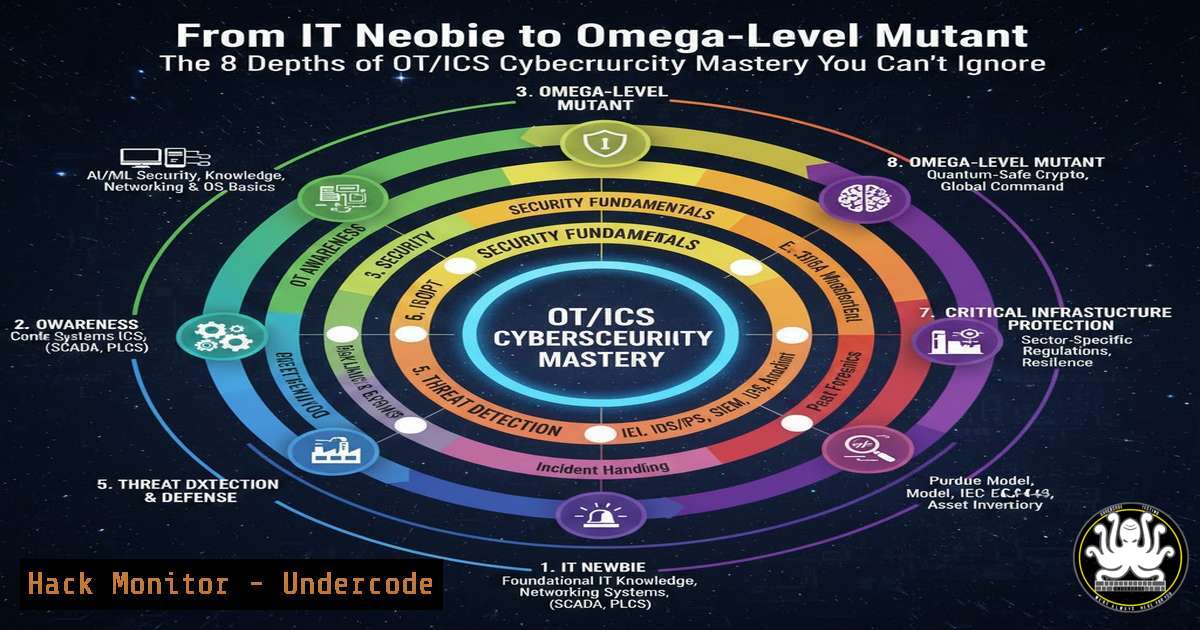
Operational Technology (OT) and Industrial Control Systems (ICS) security is often mistakenly oversimplified as an extension of IT cybersecurity. The reality is a complex, multi-layered discipline demanding a hybrid skillset of engineering prowess and cyber expertise to protect critical infrastructure like power grids and water treatment plants. This guide maps the journey from surface-level awareness to transcendent mastery, providing the technical roadmap and tools required to secure the industrial world.
Learning Objectives:
- Differentiate the core architectural and philosophical principles between IT and OT cybersecurity.
- Implement practical, network-level security controls like segmentation and ACLs in an OT environment.
- Develop advanced monitoring and threat-hunting capabilities using OT-specific protocols and threat intelligence.
You Should Know:
1. Surface Level: Mapping the OT Landscape
The foundational step is understanding the lexicon and core components. OT encompasses the hardware and software that detect or cause physical change. ICS is a major subset of OT, and SCADA (Supervisory Control and Data Acquisition) is a specific type of ICS for large-scale, geographically dispersed operations. Key assets include Engineering Workstations (EWS), Human-Machine Interfaces (HMI), Programmable Logic Controllers (PLC), and Data Historians.
Step-by-step guide:
Asset Identification: Begin by passive network mapping. On a Linux system connected to a test or isolated OT network, use `tcpdump` to listen for broadcast traffic: sudo tcpdump -i eth0 -nn not arp -w ot_capture.pcap. Analyze the `.pcap` file in Wireshark, filtering for common OT protocols (e.g., modbus, dnp3, ethernet/ip).
Software Inventory: On a Windows-based Engineering Workstation, use PowerShell to list installed software: Get-WmiObject -Class Win32_Product | Select-Object Name, Version. Document all engineering and HMI software (e.g., Siemens TIA Portal, Rockwell FactoryTalk).
- Intermediate Depth: Bridging the IT/OT Divide & Foundational Hardening
At this depth, you operationalize the differences. While IT prioritizes Confidentiality, OT prioritizes Availability and Safety. Patching cycles are measured in years, not days. Security begins with hardening these long-lived assets.
Step-by-step guide:
Host Hardening (Windows EWS): Disable unnecessary services and ports.
Open PowerShell as Administrator.
Disable the Windows Defender Service (if replaced by an OT-approved AV): `Stop-Service -Name WinDefend -Force` and Set-Service -Name WinDefend -StartupType Disabled.
Harden the firewall with strict rules: New-NetFirewallRule -DisplayName "Allow Modbus TCP" -Direction Inbound -Protocol TCP -LocalPort 502 -Action Allow.
Network Segmentation Concept: Design a “conduit” model. Using a managed industrial switch, create VLANs to segment zones (e.g., Level 3 – Site Operations, Level 2 – Area Control, Level 0 – Process). Configure Access Control Lists (ACLs) on the switch to only permit specific traffic between zones.
- Advanced Depth: Securing Remote Access & Network Monitoring
Unsecured remote access is a top OT attack vector. Monitoring must detect both IT-based attacks and process anomalies.
Step-by-step guide:
Implement a Jump Server: Deploy a hardened Linux host as a mandatory jump point for all remote access.
Install and configure OpenSSH server: sudo apt install openssh-server.
Enforce key-based authentication and disable password login in /etc/ssh/sshd_config: PasswordAuthentication no, PubkeyAuthentication yes.
Use tools like `tshark` (terminal-based Wireshark) to log all session activity: sudo tshark -i eth0 -Y "modbus" -V -w /var/log/ot_access.pcap.
Deploy a Passive OT Monitor: Use a tool like Zeek (Bro) with OT protocol analyzers. After installing Zeek, add the ICS-named policy (git clone https://github.com/zeek/zeek-ics`) and run it on a monitoring port:cd /opt/zeek/bin && ./zeek -C -i eth1 /path/to/zeek-ics/local.zeek`. This will generate logs of all protocol transactions for baseline analysis.
- Deep Architecture Layer: Designing with ISA/IEC 62443 & Unidirectional Gateways
This level involves architecting resilient systems per the ISA/IEC 62443 standard, focusing on zones and conduits. Unidirectional gateways (data diodes) are critical for protecting Level 0/1 systems.
Step-by-step guide:
Zone Conduit ACL Configuration (Cisco-style): On a layer 3 switch/router between zones, implement granular ACLs.
access-list 110 permit tcp host 10.1.2.10 host 10.0.1.5 eq 502
access-list 110 deny ip any 10.0.1.0 0.0.0.255
interface GigabitEthernet0/1
ip access-group 110 in
This only allows the specific HMI (10.1.2.10) to talk to the PLC (10.0.1.5) on Modbus TCP port 502, blocking all other traffic to the PLC subnet.
Data Diode Simulation (Test Lab): Using Linux iptables, you can simulate a read-only data diode forwarding data from a “source” NIC (eth0) to a “destination” NIC (eth1) but blocking all return traffic:
`sudo iptables -A FORWARD -i eth0 -o eth1 -j ACCEPT`
`sudo iptables -A FORWARD -i eth1 -o eth0 -j DROP`
5. Pro Layer: OT Threat Hunting & Protocol Analysis
Professionals proactively hunt for threats using deep protocol understanding and threat intelligence like MITRE ATT&CK for ICS.
Step-by-step guide:
Crafting YARA Rules for OT Malware: Create a YARA rule to detect known ICS malware like Industroyer.
rule Industroyer_SSL_DLL {
meta:
description = "Detects Industroyer's SSL DLL"
author = "OT Analyst"
strings:
$s1 = "ssl_encrypt" wide
$s2 = "ssl_decrypt" wide
$opcode = { 8B 45 ?? 89 85 ?? ?? ?? ?? 8B 45 ?? 89 85 }
condition:
uint16(0) == 0x5A4D and all of them
}
Scan a system with: `yara -r industroyer_rule.yar /path/to/scan`.
Anomalous Modbus Traffic Detection: Use Python with `scapy` to detect abnormal function codes (e.g., `05` – Write Single Coil, which is a control command) from an unauthorized IP.
from scapy.all import
def modbus_monitor(pkt):
if pkt.haslayer(TCP) and pkt.dport == 502:
if pkt[bash].payload:
func_code = pkt[bash].payload.load[bash]  Modbus function code offset
if func_code == 0x05 and pkt[bash].src != "10.1.2.10":
print(f"[bash] Write command from unauthorized IP: {pkt[bash].src}")
sniff(filter="tcp port 502", prn=modbus_monitor, store=0)
- Abyss Depths: Integrating AI for Anomaly Detection & Firmware Analysis
The expert layer involves leveraging AI for behavioral analytics and dissecting device firmware.
Step-by-step guide:
Python-based PLC Logic Anomaly Detector: Use a simple ML model (like Isolation Forest) to detect unusual PLC cycle times or register values.
import pandas as pd
from sklearn.ensemble import IsolationForest
 df contains historical PLC register values
model = IsolationForest(contamination=0.01)
model.fit(df[['register_a', 'cycle_time']])
df['anomaly'] = model.predict(df[['register_a', 'cycle_time']])
print(df[df['anomaly'] == -1])  Output the anomalies
Basic Firmware Extraction & Analysis: For a device with a serial port, use `minicom` or `screen` to interrupt boot and access the U-Boot loader: screen /dev/ttyUSB0 115200. Use loader commands (dump memory, tftp) to export firmware. Analyze extracted binaries with `binwalk -Me firmware.bin` and `strings -n 10 .bin` to find hardcoded credentials or vulnerabilities.
What Undercode Say:
The Journey is Non-Linear: True OT security proficiency requires parallel learning in both cyber tactics and the physical industrial processes they control. You cannot secure what you do not understand.
Tools Are Secondary, Mindset is Primary: While commands and tools are essential, the core differentiator is adopting a safety-first, availability-centric mindset that fundamentally contradicts the “patch fast, patch often” IT dogma.
The post correctly frames OT security as a deep, specialized field, but understates the prerequisite industrial engineering knowledge. The “Transcendence” level isn’t just about technical skill; it’s about developing an intuition for the physical consequences of cyber actions. The provided technical steps bridge the gap from theory to practice, but each command must be validated in a non-production environment first. The future of OT security lies in the convergence of IT threat intelligence with physical process modeling, creating digital twins for safe attack simulation.
Prediction:
The convergence of IT and OT will accelerate, driven by Industry 4.0 and AI integration, making OT networks more exposed to IT-borne threats. Future major attacks will increasingly leverage AI to learn normal process behavior and execute subtle, highly destructive manipulations that evade traditional signature-based detection. The demand for the “Omega-level Mutant” – professionals who can perform firmware reverse-engineering on a PLC, understand the thermodynamics of the system it controls, and deploy AI-driven behavioral guards – will explode. The industry will move towards standardized, embedded security chips (like TPMs for OT) and mandatory resilience testing through automated purple teaming in simulated environments.
▶️ Related Video (76% Match):
🎯Let’s Practice For Free:
IT/Security Reporter URL:
Reported By: Mikeholcomb There – Hackers Feeds
Extra Hub: Undercode MoN
Basic Verification: Pass ✅


