Listen to this Post
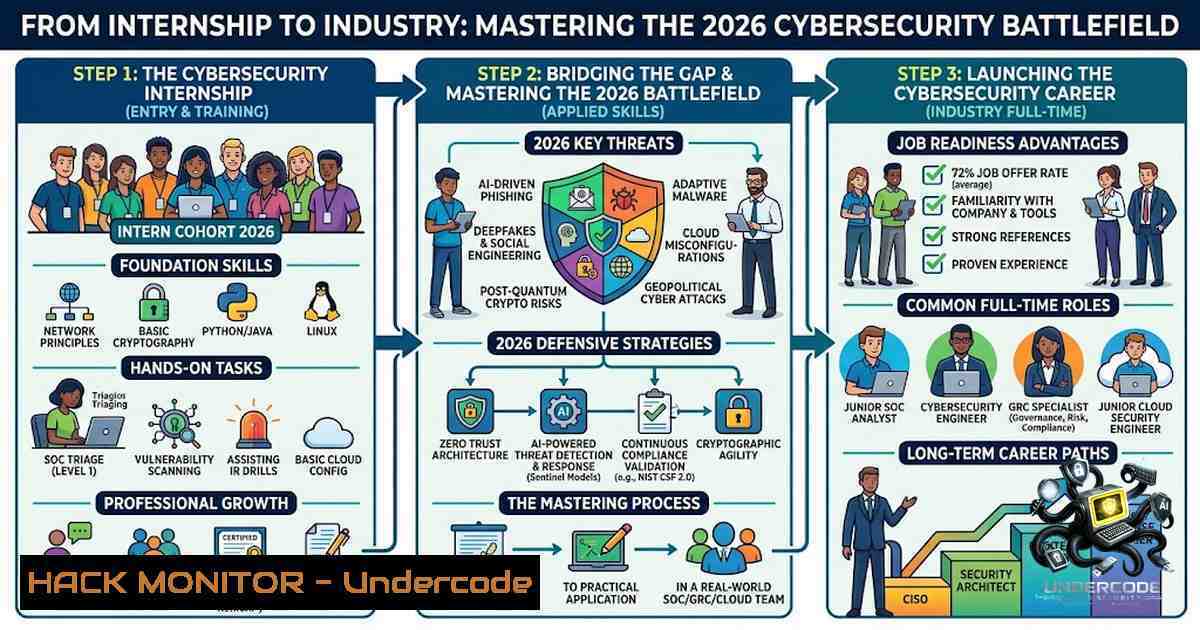
Introduction:
The cybersecurity landscape of 2026 is defined by an unprecedented asymmetry: AI-enabled adversaries increased their activity by 89% year over year, using automation for reconnaissance, credential theft, and evasion, while time-to-exploit for critical outbreaks has shrunk from nearly five days to just 24 to 48 hours. Against this backdrop, structured internship programs like the 45-Day Cyber Shakti Internship serve as critical pipelines for developing the multidisciplinary expertise required to defend modern digital ecosystems—spanning AI security, penetration testing, digital forensics, OSINT, and cyber law.
Learning Objectives:
- Understand the convergence of AI-driven threats and AI-powered defense mechanisms in modern security operations
- Master the technical workflows and toolchains for penetration testing, malware analysis, and digital forensics across network, mobile, and cloud environments
- Develop investigative capabilities encompassing OSINT, cryptocurrency tracing, and dark web intelligence for real-world threat hunting
You Should Know:
- The AI Security Paradox: 77% Adoption, Lagging Trust
AI is now embedded throughout the cybersecurity stack, with 77% of security stacks incorporating AI capabilities. Yet adoption is growing much faster than trust or understanding. According to the State of AI Cybersecurity 2026 report, 67% of organizations use supervised machine learning, 67% use agentic AI, and 58% use natural language processing (NLP) in their security tooling.
The threat reality is stark: AI-enabled offensive tools contributed to a 389% year-over-year increase in ransomware victims. Attackers logged more than 640 billion reconnaissance events in the second half of 2025 alone, using automation and AI to find vulnerabilities faster. Traditional signature-based detection now catches only about 80% of attacks in AI-driven threat environments, while AI-1ative security tools can raise protection to 97–99%.
For SOC teams, this means adapting to an asymmetrical fight where attackers use legitimate system tools (LOLBins—living-off-the-land binaries) to hide malicious activity. Network Detection and Response (NDR) solutions leveraging behavioral analytics, heuristics, and ML models have become essential for detecting anomalies that traditional tools overlook.
Practical Commands for AI-Assisted Security Workflows:
Kali Linux 2026.2 AI-Assisted Command Generation:
 Install shell-gpt for AI-assisted command generation
pip install shell-gpt

Generate security commands using natural language
sgpt "find all open ports on 192.168.1.0/24 using nmap"
sgpt "generate a reverse shell payload for Linux using Python"
FortiNDR Cloud CLI Integration (Conceptual):
 Query NDR for AI-based threat detection
curl -X GET "https://fortindr.cloud/api/v1/threats/ai-detected" \
-H "Authorization: Bearer $API_KEY" \
-H "Content-Type: application/json"
2. Penetration Testing in 2026: Beyond Vulnerability Scanning
Penetration testing in 2026 follows a structured methodology that separates it from ad hoc vulnerability scanning. Regular, methodical pen testing delivers a 155% ROI, with the average cost of a data breach in 2025 reaching $4.5 million.
Step-by-Step Penetration Testing Workflow (PTES-Aligned):
Phase 1: Planning and Scoping — Define target systems, testing boundaries, and rules of engagement in writing.
Phase 2: Reconnaissance — Passive reconnaissance uses public sources: WHOIS records, DNS lookups, and Shodan queries. Active reconnaissance involves direct interaction.
Phase 3: Scanning and Enumeration — Identify live hosts, open ports, and running services.
Phase 4: Vulnerability Assessment — Automated scanning combined with manual validation.
Phase 5: Exploitation — Validate vulnerabilities and demonstrate impact.
Phase 6: Post-Exploitation — Assess lateral movement, privilege escalation, and data exfiltration paths.
Phase 7: Reporting — Document findings with remediation guidance.
Essential 2026 Pen Testing Commands:
Network Discovery with Nmap:
 Comprehensive port scan with service detection
nmap -sC -sV -O -A -T4 192.168.1.0/24

Stealth SYN scan with version detection
nmap -sS -sV -p- --min-rate 1000 192.168.1.100

UDP scan for common services
nmap -sU -p 53,67,68,69,123,135,137,138,139,161,162,445,514,520,631,1434,1900,4500,49152 192.168.1.100
Web Application Testing with Burp Suite & sqlmap:
 Automated SQL injection detection
sqlmap -u "http://target.com/page?id=1" --batch --level=3 --risk=2

Dump database with specific parameters
sqlmap -u "http://target.com/page?id=1" --dbs --tables --dump --threads=10

Burp Suite CLI for headless scanning (via burp-rest-api)
curl -X POST "http://localhost:8090/burp/scanner/scans" \
-H "Content-Type: application/json" \
-d '{"urls":["https://target.com"],"scan_configurations":[{"name":"Active Scan"}]}'
Kali Linux 2026.2 New Tools: The release includes legba for password spraying and authentication testing, shell-gpt for AI-assisted command generation, Tailscale for secure remote connectivity, and tookie-osint for social media reconnaissance. These tools reflect how modern assessments combine identity testing, cloud infrastructure, web applications, and social engineering.
3. Malware Analysis: LLMs and Memory Forensics
Modern malware increasingly employs polymorphism and code obfuscation, making traditional signature-based detection less effective. Behavioral analysis using API call sequences helps understand malware behavior, but extracting useful patterns remains challenging.
MALLM Framework (Malware Analysis with Large Language Models):
The MALLM framework models API call sequences as a behavioral language and utilizes LLMs to identify semantic behavioral patterns. The first stage uses embeddings from pre-trained LLMs to identify benign vs. malicious programs. The second stage classifies malware families by fine-tuning using Low-Rank Adaptation (LoRA), changing less than 0.37% of model parameters. The framework achieves 97.85% detection accuracy.
Fileless Malware Detection with Volatility and Rekall:
Fileless, memory-resident malware bypasses disk-based detection methods. A comprehensive detection framework using Volatility and Rekall forensic tools analyzes volatile memory with multi-layered heuristic rules to interpret execution paths, malicious processes, and covert code injections. Deep learning models (CNN, LSTM, RNN, GNN) and machine learning techniques (SVM, DT, RF) improve classification of polymorphic, metamorphic, and evolving fileless malware.
Memory Forensics Commands:
 Install Volatility 3
pip install volatility3

Identify OS profile from memory dump
vol -f memory.dmp windows.info

List running processes
vol -f memory.dmp windows.pslist

Dump suspicious process memory
vol -f memory.dmp windows.dumpfiles --pid 1234

Scan for malware indicators with YARA
vol -f memory.dmp windows.malfind

Extract network connections
vol -f memory.dmp windows.netscan

Analyze with Rekall (alternative framework)
rekall -f memory.dmp pslist
rekall -f memory.dmp malfind
4. Network Forensics: Packet Analysis at Scale
Network forensics in 2026 requires analyzing massive packet captures to identify malicious activity, often hidden within encrypted traffic or using legitimate system tools.
Network Forensics Commands with tshark and Scapy:
Basic PCAP Analysis with tshark:
 Protocol hierarchy statistics
tshark -r capture.pcap -q -z io,phs

Extract all HTTP requests with host and URI
tshark -r capture.pcap -Y "http.request" -T fields -e http.host -e http.request.uri -e http.user_agent

Export HTTP objects
tshark --export-objects http,/tmp/http_obj capture.pcap

Identify DNS queries (unique)
tshark -r capture.pcap -Y "dns" -T fields -e dns.qry.name | sort -u

Detect suspicious traffic on non-standard ports
tshark -r capture.pcap -Y "tcp.port not in {80,443,53,22,21} and tcp.flags.syn==1" -T fields -e ip.src -e ip.dst -e tcp.dstport

Follow a specific TCP stream
tshark -r capture.pcap -z follow,tcp,ascii,0
Python Scapy for Custom Analysis:
from scapy.all import

Read PCAP
packets = rdpcap('capture.pcap')

Filter and analyze HTTP requests
for pkt in packets:
if pkt.haslayer(TCP) and pkt.haslayer(Raw):
payload = pkt[bash].load.decode(errors='ignore')
if 'HTTP' in payload:
print(payload[:500])

Check for suspicious payloads
for pkt in packets:
if pkt.haslayer(TCP):
payload = bytes(pkt[bash].payload)
if b'flag' in payload.lower() or b'secret' in payload.lower():
print(f"Found suspicious content: {payload[:100]}")
New Tools: Packrat CLI provides human-readable packet analysis, while ja4monitor offers live monitoring with JA4 fingerprinting.
5. Mobile Forensics: The New Frontline
Mobile devices are involved in over 95% of criminal cases. With zero-trust operating systems, fully encrypted devices, and massive data volumes, the challenge is no longer just getting the data—it is making sense of it.
The 5-Stage Mobile Forensic Workflow:
Stage 1: Seizure and Isolation — Place the device in a Faraday Bag or enable Airplane Mode with Wi-Fi/Bluetooth disabled to prevent remote wipe commands.
Stage 2: Identification — Accurately identify the make, model, chipset, and OS version to select the appropriate extraction profile.
Stage 3: Acquisition — Four levels of extraction: Logical (file system), File System (full filesystem), Physical (bit-for-bit copy), and RAM capture. MSAB’s XRY Pro 11.5 now captures RAM before initiating brute-forcing on all physical extractions, ensuring the snapshot reflects the device’s state before forced authentication begins.
Stage 4: Analysis — Parse extracted data, reconstruct timelines, and correlate artifacts.
Stage 5: Reporting — Generate forensically sound reports for legal proceedings.
Mobile Forensic Tools and Techniques:
- XRY Pro 11.5: Faster extraction on latest Android devices with improved RAM extraction and BruteStorm Surge
- XAMN 8.8: Intelligent video thumbnails at scene changes for faster evidence review
- Cellebrite Inseyets: Industry-leading mobile forensics software with expanded lawful access
- Detego 2026 R2: Introduces YARA-based scanning for rapid malware and IOC identification
6. Cryptocurrency & Dark Web Investigation
The 2026 dark web landscape features increasingly sophisticated cryptocurrency laundering operations. In a recent high-profile case, Gujarat’s Cyber Centre of Excellence uncovered a Rs 226-crore cryptocurrency network allegedly linked to drug trafficking, money laundering, and terror financing. The accused extensively used privacy-focused cryptocurrency Monero to hide fund movements, with transactions worth nearly USD 20 million identified.
Cryptocurrency Tracing Commands and Tools:
Blockchain Analysis with Python:
 Basic Bitcoin transaction analysis
import requests

def get_transaction_details(txid):
url = f"https://blockchain.info/rawtx/{txid}"
response = requests.get(url)
return response.json()

Analyze transaction flow
tx = get_transaction_details("txid_here")
for inp in tx['inputs']:
print(f"Input from: {inp['prev_out']['addr']}")
for out in tx['out']:
print(f"Output to: {out['addr']} - Amount: {out['value']/1e8} BTC")
OSINT for Dark Web Investigations:
 SpiderFoot for automated OSINT
spiderfoot -l 127.0.0.1:5001 -s target_domain.com

Recon-1g for dark web reconnaissance
recon-1g
marketplace install all
workspace create darkweb_investigation
use recon/domains-hosts/bing_domain_web
set source darkweb_site.onion
run
Monero Tracing (Advanced): Norwegian police recently developed methods to trace Monero transactions on the dark web, leading to arrests across 7 countries. Pakistan’s FIA has established a dedicated dark web investigation unit using blockchain forensics and OSINT.
7. OSINT Investigation: The Intelligence Backbone
Open-source intelligence serves three core functions: attack surface management, threat intelligence gathering, and incident response enrichment.
Five-Step OSINT Investigation Workflow:
- Define Objectives — Identify what intelligence is needed and why
-
Collect Data — Gather from publicly available sources (social media, DNS, WHOIS, breach databases, Shodan)
-
Process and Normalize — Structure raw data for analysis
-
Analyze and Correlate — Connect disparate data points into actionable intelligence
-
Report and Act — Deliver findings and recommend actions
Essential OSINT Commands and Tools (2026):
Domain and IP Intelligence:
 Shodan CLI for device discovery
shodan search "port:22 country:US"

WHOIS lookup
whois target.com

DNS enumeration with Amass
amass enum -d target.com
OpenOSINT Toolkit (18 modular tools):
 Install OpenOSINT
pip install openosint

Email and username investigation
openosint email [email protected]
openosint username targetuser

Breach database lookup
openosint breach [email protected]

Subdomain enumeration
openosint subdomain target.com
Argus OSINT Framework (Local-first, zero API keys):
Argus runs entirely on your local machine with 13 modules and AI chaining via Ollama—describe your target in plain English, and Argus decides which tools to run.
What Undercode Say:
- Cybersecurity is a multidisciplinary battlefield — The 45-Day Cyber Shakti Internship demonstrates that modern security professionals must master an interconnected ecosystem spanning AI security, penetration testing, malware analysis, network/mobile/digital forensics, cryptocurrency tracing, dark web intelligence, OSINT, SOC operations, and cyber law. No single domain operates in isolation.
-
AI is both the weapon and the shield — The 89% year-over-year increase in AI-enabled adversary activity demands that defenders adopt AI-powered tools not as optional enhancements but as essential components of their security stack. Yet the 77% adoption rate with lagging trust highlights a critical skills gap: organizations are deploying AI without fully understanding its capabilities and limitations.
-
The threat landscape is accelerating faster than defenses — With time-to-exploit shrinking from five days to 24–48 hours and ransomware victims surging 389% year-over-year, reactive security is no longer viable. Proactive threat hunting, continuous monitoring, and AI-assisted detection have become survival requirements.
-
Digital forensics is the new frontline — Mobile devices in over 95% of criminal cases, coupled with the rise of fileless malware and privacy-focused cryptocurrencies like Monero, means investigators must stay ahead of OS updates, encryption, and obfuscation techniques. Tools like MALLM achieving 97.85% detection accuracy represent the future of forensic analysis.
-
Practical skills matter more than certifications — The internship experience underscores that real-world cybersecurity demands hands-on proficiency with tools (Kali Linux 2026.2, Volatility, tshark, XRY Pro), command-line fluency, and the ability to connect technical findings to legal and investigative frameworks. Theory without practice is insufficient in an environment where attackers are operationalizing AI at scale.
Prediction:
+1 AI-1ative security operations will become the industry standard by 2027, with agentic AI handling 90% of investigation activity autonomously, fundamentally reshaping SOC roles from reactive monitoring to strategic threat hunting.
+1 The integration of LLMs into malware analysis (MALLM achieving 97.85% accuracy) will accelerate incident response timelines, enabling organizations to contain breaches within hours rather than days.
-1 The 389% surge in ransomware victims will continue as AI-enabled offensive tools lower the barrier to entry for cybercriminals, potentially exceeding 500% year-over-year growth by 2027 unless defensive AI adoption accelerates.
-1 Privacy-focused cryptocurrencies like Monero will become the default payment mechanism for dark web transactions, complicating law enforcement investigations and requiring new blockchain forensic capabilities that currently lag behind criminal innovation.
+1 The emergence of OSINT frameworks like Argus with local AI chaining will democratize intelligence gathering, enabling smaller security teams to conduct sophisticated investigations without expensive commercial tools.
-1 The gap between AI adoption (77%) and AI understanding will create a “trust deficit” that adversaries will exploit through AI-powered social engineering and prompt injection attacks, potentially causing a wave of AI-assisted data breaches in the second half of 2026.
+1 Mobile forensics advancements—particularly RAM capture before brute-forcing and AI-assisted ISP/Chip-Off extraction—will significantly improve evidence recovery from encrypted and damaged devices, strengthening criminal investigations and incident response.
-1 The proliferation of fileless, memory-resident malware will render traditional endpoint protection obsolete for an estimated 40% of enterprises by 2027, forcing rapid migration to memory-aware detection frameworks.
+1 Structured internship programs like Cyber Shakti will become the primary talent pipeline for the cybersecurity industry, as universities struggle to keep curricula aligned with the rapidly evolving threat landscape of 2026.
-1 Critical infrastructure remains vulnerable: with CVE-2026-59310 (CVSS 9.8) already under active exploitation across 47 countries and no workaround available, 2026 will see at least one major critical infrastructure breach exploiting unpatched vulnerabilities in widely deployed platforms.
▶️ Related Video (90% Match):
🎯Let’s Practice For Free:
🎓 Live Courses & Certifications:
Join Undercode Academy for Verified Certifications
🚀 Request a Custom Project:
Secure, high-velocity infrastructure and disruptive technological engineering. Contact our engineering team for high-tier development and proprietary systems:
[email protected]
💎 Smart Architecture | 🛡️ Secure by Design | ⭐ Trusted by Thousands
IT/Security Reporter URL:
Reported By: https://lnkd.in/p/eXFPCU4q – Hackers Feeds
Extra Hub: Undercode MoN
Basic Verification: Pass ✅


