Listen to this Post
Introduction:
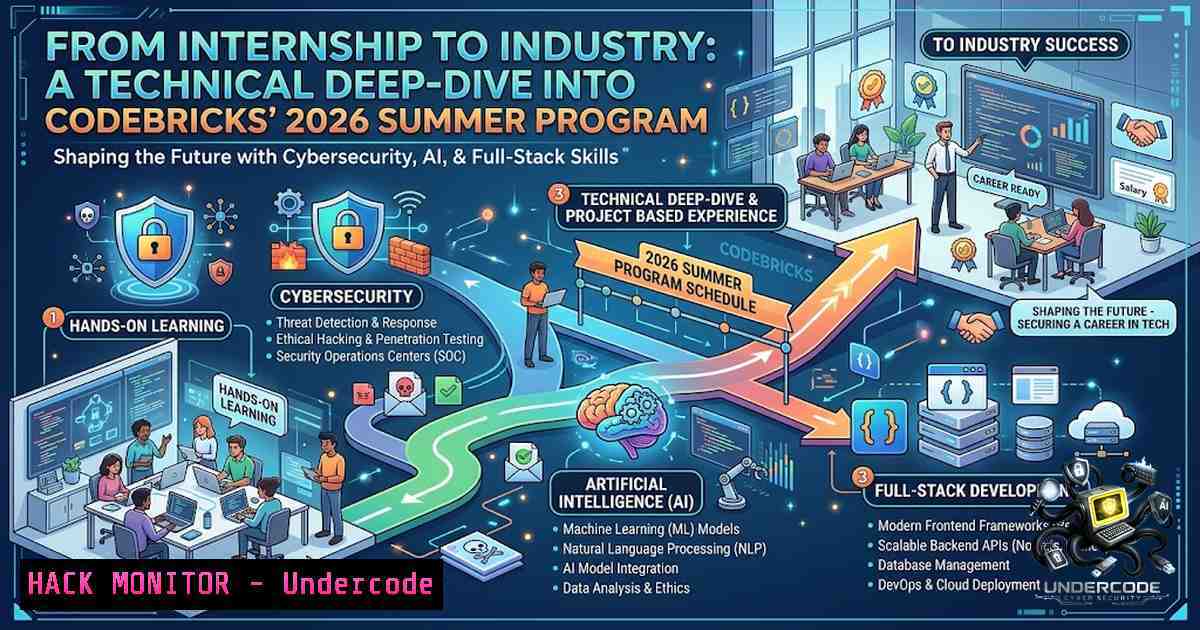
The modern internship has evolved far beyond coffee-fetching; it is now a critical pipeline for technical talent acquisition and skill validation. CodeBricks’ 2026 Summer Internship Program offers a structured, domain-specific entry point into this landscape, covering everything from Python and Full-Stack Development to AI/ML and Cybersecurity. However, to truly maximize such an opportunity, candidates must understand the underlying technical rigor, toolchains, and security implications that define these fields in 2026.
Learning Objectives:
- Objective 1: Master the foundational toolchains for Full-Stack Development, including Next.js 16, React 19, and TypeScript, while understanding secure deployment practices.
- Objective 2: Develop and deploy a real-world Machine Learning pipeline, encompassing data preprocessing, model training (Neural Networks), and API-based deployment.
- Objective 3: Execute a structured cybersecurity assessment, including vulnerability scanning (Nmap, Nikto), exploitation techniques (SQLi, XSS), and system hardening (Lynis, AppArmor).
You Should Know:
1. Full-Stack Development: From Localhost to Production
A modern full-stack internship is no longer just about HTML and CSS; it demands proficiency with the JavaScript ecosystem and cloud-1ative deployment. The CodeBricks program emphasizes practical, project-based learning. A typical capstone project might involve building a Kanban-style project management tool using Next.js 16 with the App Router, React 19, and TypeScript.
Step‑by‑step guide: Setting Up a Modern Full-Stack Environment
- Environment Setup: Ensure you have Node.js 20+ LTS and `pnpm` installed (
npm install -g pnpm). - Project Initialization: Clone the repository and navigate to the project directory. Install dependencies using
pnpm install. - Development Server: Start the local development server with
pnpm dev. The application will typically be available at `http://localhost:3000`.
4. Database Integration: Configure a PostgreSQL database with Drizzle ORM for data persistence.
5. Authentication: Implement secure user authentication using a provider like Clerk.
6. Production Build: Generate a production-optimized build using `pnpm buildand test it locally withpnpm start`. - Deployment: Deploy the final application to a platform like Vercel, ensuring environment variables are correctly configured.
2. Cybersecurity: Vulnerability Assessment and System Hardening
For those selecting the Cybersecurity domain, the internship provides hands-on experience with industry-standard tools. The workflow typically progresses from reconnaissance to exploitation and finally to remediation. A key part of this is understanding how to secure both the application and the underlying operating system.
Step‑by‑step guide: Conducting a Security Audit with Open-Source Tools
1. Reconnaissance: Begin with network scanning using Nmap to identify open ports and running services. For faster results, use RustScan (rustscan -a <target_ip> -- -A -sC).
2. Web Application Scanning: Use Nikto for web server vulnerability scanning (nikto -h http://<target_url>).
3. Deep Dive with ZAP: Perform an automated scan of the web application using OWASP ZAP to identify issues like SQL Injection and XSS.
4. System Hardening Audit: Run Lynis to audit the system’s security posture (sudo lynis audit system). Review the hardening score and recommendations.
5. Remediation: Apply key fixes such as:
- SSH Hardening: Edit `/etc/ssh/sshd_config` to change the default port, set
MaxAuthTries 3, and disable X11 forwarding. - Kernel Hardening: Apply sysctl hardening configurations.
- Malware Scanning: Install and run `rkhunter` to check for rootkits.
- Container Security: If using Docker, scan images for vulnerabilities using Trivy (
trivy image <image_name>). -
AI & Machine Learning: From Data to Deployment
The AI/ML track focuses on building real-world applications, from simple regression models to complex neural networks. The internship structure often progresses from basic tasks (data visualization) to intermediate (model evaluation) and expert levels (hyperparameter tuning and deployment).
Step‑by‑step guide: Building and Deploying an ML Model
- Data Preprocessing: Load your dataset using Pandas. Handle missing values (
df.fillna()), scale features usingStandardScaler, and encode categorical variables. - Model Development: Start with a simple model like Linear Regression (
from sklearn.linear_model import LinearRegression). Train the model on your training set. - Evaluation: Evaluate model performance using metrics like Mean Squared Error (MSE) or R-squared. Generate a classification report for classification tasks.
- Advanced Modeling: For more complex tasks, build a feedforward neural network using TensorFlow/Keras or PyTorch.
- Hyperparameter Tuning: Use Grid Search or Random Search (
from sklearn.model_selection import GridSearchCV) to find the optimal parameters for your model. - Model Persistence: Save the trained model using
joblib.dump(model, 'model.pkl'). - Deployment: Create a Flask or FastAPI backend that loads the saved model and provides a REST API endpoint for inference.
4. Python Programming: Building Practical Tools
Python remains a cornerstone of the internship, used across various domains. In cybersecurity, it’s used to build custom tools like port scanners and vulnerability scanners.
Step‑by‑step guide: Building a Simple Port Scanner in Python
1. Setup: Create a new Python file (e.g., scanner.py) and install the required libraries (pip install socket python-1map).
2. Implementation: Use Python’s `socket` library to attempt connections to a range of ports on a target IP.
3. Multi-threading: Implement threading to speed up the scanning process.
4. Service Detection: Use `socket.getservbyport(port)` to identify the service running on an open port.
5. GUI Integration: For a more professional touch, build a GUI using Tkinter.
6. Reporting: Generate a PDF report of the scan results using ReportLab.
5. Data Analytics: Turning Data into Insights
The Data Analytics domain focuses on wrangling, visualizing, and interpreting data to drive business decisions. Interns typically work with real-world datasets to build dashboards and predictive models.
Step‑by‑step guide: Performing Exploratory Data Analysis (EDA)
- Data Acquisition: Load a dataset (e.g., Sales, HR Attrition, or E-commerce data) into a Pandas DataFrame.
- Data Cleaning: Handle missing values, remove duplicates, and correct data types.
- Visualization: Use Matplotlib and Seaborn to create visualizations like scatter plots, histograms, and correlation matrices to identify patterns and outliers.
- Statistical Analysis: Perform statistical modeling, such as time series analysis or classification, to extract actionable insights.
- Dashboard Creation: Build an interactive dashboard using a tool like Streamlit or Power BI to present your findings.
What Undercode Say:
- The “Project Portfolio” is the New Resume: In 2026, employers value demonstrable skills over theoretical knowledge. The CodeBricks program’s emphasis on real-world project exposure and building a project portfolio is not just a buzzword; it’s a strategic career move. The ability to showcase a working application or a security audit report on GitHub or LinkedIn significantly enhances employability.
- Security is a Shared Responsibility: The inclusion of a dedicated Cybersecurity domain reflects the industry’s urgent need for security-conscious developers. However, even those in Full-Stack or AI/ML tracks must adopt a “security-first” mindset. Understanding concepts like input validation, secure coding, and vulnerability scanning (as detailed in the cybersecurity guide) is no longer optional; it is a baseline requirement for any technical role.
Prediction:
- +1 The convergence of AI and Cybersecurity will create a new breed of “AI Security Engineer” roles. Interns who gain experience in both domains, such as using AI to detect anomalies or securing AI models themselves, will be highly sought after.
- +1 Remote-first internship programs like CodeBricks’ will become the industry standard, democratizing access to high-quality technical training and allowing companies to tap into a global talent pool.
- -1 The rapid adoption of AI tools in development (e.g., code generation) will increase the attack surface. Interns must be trained not just to write code, but to critically analyze AI-generated code for security vulnerabilities and logical flaws.
- +1 The emphasis on practical, task-based learning over passive instruction will accelerate the transition from student to professional, making internships the primary driver of technical skill acquisition in the tech industry.
▶️ Related Video (64% Match):
🎯Let’s Practice For Free:
🎓 Live Courses & Certifications:
Join Undercode Academy for Verified Certifications
🚀 Request a Custom Project:
Secure, high-velocity infrastructure and disruptive technological engineering. Contact our engineering team for high-tier development and proprietary systems:
[email protected]
💎 Smart Architecture | 🛡️ Secure by Design | ⭐ Trusted by Thousands
IT/Security Reporter URL:
Reported By: Hr Codebricks – Hackers Feeds
Extra Hub: Undercode MoN
Basic Verification: Pass ✅


