
Listen to this Post
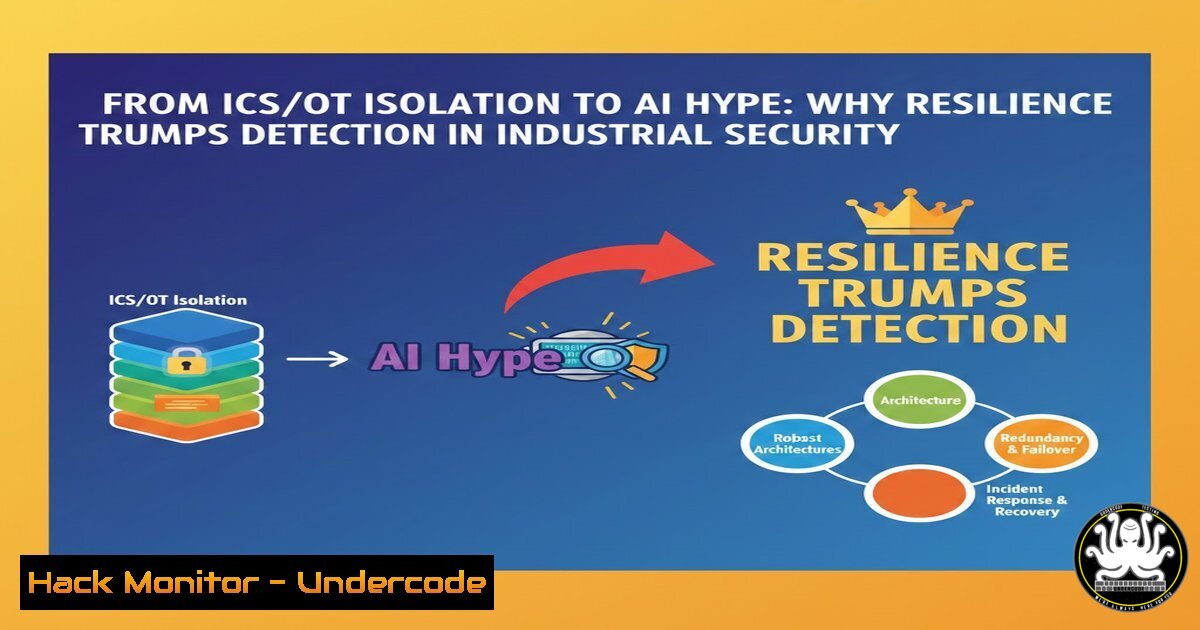
Introduction:
For over a decade, Operational Technology (OT) and Industrial Control Systems (ICS) were considered the “air-gapped” bastions of cybersecurity—simple, deterministic, and safe due to their isolation. However, the modern convergence of IT and OT, coupled with the rise of AI-driven dashboards and analytics, has introduced complexity without necessarily solving core vulnerabilities. Drawing from a 15-year journey in the field, this article explores the paradigm shift from a “detection-only” mindset back to foundational architectural resilience, examining how platforms like Labshock are redefining how we simulate, observe, and secure industrial environments.
Learning Objectives:
- Understand the historical evolution of OT security from air-gapped isolation to modern networked complexity.
- Differentiate between detection-based security and architecture-based resilience in industrial environments.
- Identify practical methods for simulating OT systems to observe behavioral anomalies.
- Learn basic command-line techniques for mapping OT network behavior.
- Analyze the limitations of AI in OT security when divorced from architectural understanding.
You Should Know:
- The Golden Age of OT: Isolation as a Security Feature
In the early days of OT, security was not a product feature; it was a byproduct of design. Systems were purpose-built, running on proprietary protocols like Modbus, DNP3, or Profibus, and were physically disconnected from corporate networks and the internet. This “security through obscurity” and physical isolation meant that while vulnerabilities existed, the attack surface was microscopic.
To understand this legacy environment, an engineer might use basic network scanning to map the deterministic nature of these networks. While modern OT requires extreme caution (as active scanning can disrupt processes), understanding the baseline is key.
Linux Command (Passive Reconnaissance):
 Using tcpdump to passively listen for OT protocols on a specific interface
sudo tcpdump -i eth0 -n port 502 or port 20000
 Port 502 is typically Modbus, Port 20000 is commonly used for DNP3
 This shows the traffic without injecting packets, revealing what devices are communicating.
- The Integration Era: When IT “Best Practices” Invaded the Factory Floor
As business demands for data analytics grew, OT environments adopted IT solutions like antivirus, standard backups, and IP-based networking. This introduced the concept of the “Purdue Model”分层, attempting to segment the plant floor from the enterprise. While segmentation remains a gold standard, the introduction of standard operating systems (like Windows XP for HMI machines) brought patch management nightmares and traditional malware risks.
Windows Command (Checking for Legacy OT Connections):
On a legacy HMI or Engineering Workstation, one might check for persistent connections to domain controllers or update servers, which could indicate a violation of the Purdue Model.
:: View active network connections to see if the OT box is talking to IT ranges
netstat -an | find "ESTABLISHED"
:: Check the routing table to see if there's a default gateway pointing to the corporate network
route print
- The SIEM and Dashboard Deluge: Visualizing Blind Spots
By 2018, the industry recognized that “blind spots” were rampant. The response was the development of OT-specific SIEM (Security Information and Event Management) platforms. These platforms aggregated logs from PLCs, RTUs, and HMIs to provide a centralized view. However, this aggregation often created noise. The focus shifted from “what is happening” to “how many alerts can we generate?”
To simulate log collection relevant to OT (without a live SIEM), one can use scripting to generate system health logs, mimicking how a PLC might report its status.
Bash Script Snippet (Simulating PLC Health Logs):
!/bin/bash
 Simulate log entries for an OT device
echo "$(date) - PLC-04 - CPU Load: 15% - Memory: 42% - Network Status: Online" >> /var/log/ot_simulation.log
echo "$(date) - PLC-04 - Modbus Register 40001 Value: 78.5" >> /var/log/ot_simulation.log
tail -f /var/log/ot_simulation.log
4. The IDS Wave: Detecting the Anomalies
Network-based Intrusion Detection Systems (IDS) like Snort and Zeek (formerly Bro) were adapted for OT. Signatures were written for specific protocol exploits (e.g., a malicious Modbus write command). This was a significant step forward, but it remained reactive. It could tell you an attack was happening, but it couldn’t stop the physical consequence of a compromised valve opening.
Linux Command (Running Zeek for OT Protocol Analysis):
Zeek can be configured to parse OT traffic. Assuming a PCAP file of OT traffic is available for analysis (never run on a live production network without proper authorization):
 Install Zeek (if not present)
sudo apt-get install zeek -y

Analyze a pcap file to extract Modbus commands
zeek -r capture_ot_traffic.pcap modbus

View the extracted modbus.log to see function codes and register accesses
cat modbus.log
- The Architecture Awakening: Building Resilience, Not Just Stacking Tools
The core realization from the original post is that “Detection alone doesn’t solve OT security; Architecture does.” This means moving away from solely relying on AI to find needles in haystacks, and instead building a haystack that is inherently fireproof. This involves:
– Whitlisting: Allowing only known applications and scripts to run on HMIs.
– Network Micro-segmentation: Using firewalls to ensure that even if a device is compromised, it cannot talk to critical PLCs.
– Physical Redundancy: Ensuring that a cyber event cannot trigger a cascading physical failure.
Linux Command (Implementing Basic ACL with IPTables on an OT Gateway):
Simulating a simple ACL to ensure only a specific Engineering Workstation can talk to a PLC.
 Allow traffic from Engineering Workstation (192.168.1.100) to PLC (192.168.1.50) on port 502
sudo iptables -A FORWARD -s 192.168.1.100 -d 192.168.1.50 -p tcp --dport 502 -j ACCEPT

Drop everything else to that PLC
sudo iptables -A FORWARD -d 192.168.1.50 -p tcp --dport 502 -j DROP
6. Simulation: The Labshock Approach to Safe Testing
You cannot test security controls on a live blast furnace. The future of OT security lies in digital twins and simulation. Platforms like Labshock allow security teams to simulate the OT architecture, inject attack scenarios, and observe system behavior without impacting production. This mirrors the “cyber range” concept but focuses specifically on the architectural resilience of a specific plant.
Generalized Simulation Concept (Using Python to emulate a simple PLC response):
 Simple PLC simulator responding to Modbus-like requests
import socket

server = socket.socket(socket.AF_INET, socket.SOCK_STREAM)
server.bind(('0.0.0.0', 5020))  Using 5020 to avoid privileged port
server.listen(1)
print("PLC Simulator listening on port 5020...")

while True:
client_socket, addr = server.accept()
print(f"Connection from {addr}")
request = client_socket.recv(1024)
 In a real scenario, parse Modbus frame here
print(f"Received: {request.hex()}")
 Send a dummy response (e.g., read coil response)
response = b'\x00\x01\x02\x01\x01'
client_socket.send(response)
client_socket.close()
What Undercode Say:
- Architecture is the new Antivirus: In OT, you cannot patch your way to security. The emphasis must shift to designing networks that are resilient by default, where a single compromised device cannot lead to a catastrophic failure.
- Clarity over Complexity: The industry’s obsession with AI-driven dashboards has created a false sense of security. The real value lies in understanding the deterministic “normal” behavior of industrial processes. If you don’t know what “normal” looks like, detecting “abnormal” is just guesswork.
- Simulation is Essential: The ability to safely test attacks and failures in a simulated environment (like Labshock) is no longer a luxury but a necessity. It bridges the gap between theoretical security policies and physical reality, allowing engineers to fail safely to build stronger systems.
Prediction:
Over the next five years, the OT security market will undergo a correction. The current trend of layering generic IT security tools with AI “bolt-ons” will prove insufficient against sophisticated threats like kinetic cyber attacks. We will see a resurgence of “Purdue Model purism,” where air-gapping and deterministic networking make a comeback, enhanced not by more software, but by hardware-enforced segmentation and digital twin technology for predictive resilience. The winners will be platforms that help engineers understand their architecture, not just those that visualize their alerts.
▶️ Related Video (82% Match):
🎯Let’s Practice For Free:
IT/Security Reporter URL:
Reported By: Zakharb Labshock – Hackers Feeds
Extra Hub: Undercode MoN
Basic Verification: Pass ✅


