Listen to this Post
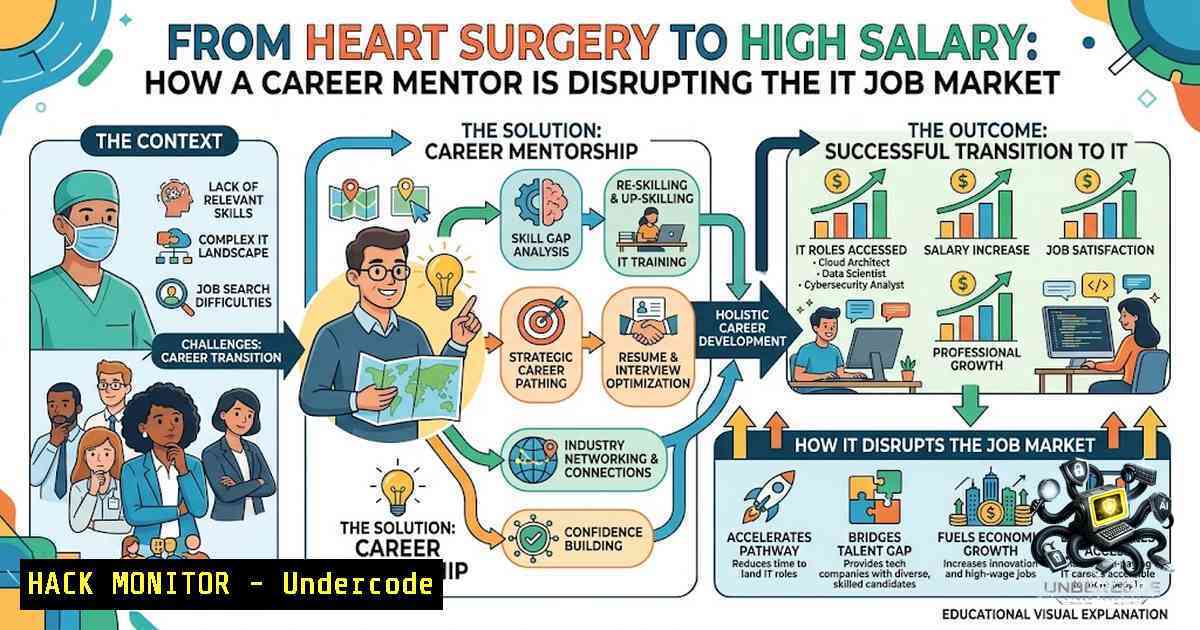
Introduction:
In a compelling narrative that bridges profound personal adversity with professional triumph, Michal Mironi, a veteran career mentor with over six years of experience and 800 successful contracts, reveals the cornerstone of her coaching philosophy. Mironi’s journey, marked by childhood heart surgeries and a lifelong battle against fear and insecurity, has been the crucible for her unique approach to career development in the high-stakes fields of IT, cybersecurity, and AI. By transforming her perceived weaknesses into a formidable strength, Mironi has developed a methodology that promises not just job placement, but significant career acceleration, boasting a 20-80% salary upgrade and a 50% reduction in job search time for her clients.
Learning Objectives:
- Understand how to leverage personal adversity and emotional intelligence to build a resilient professional persona in the competitive tech industry.
- Identify strategies for short-circuiting the traditional job search process, potentially cutting the timeline by half.
- Analyze the mentorship techniques that lead to significant salary increases of 20-80% in technology roles.
You Should Know:
1. The “Trauma-to-Tech” CV Optimization Protocol
This is not your standard resume rewrite. Mironi’s methodology suggests that the most powerful CVs are those that demonstrate “anti-fragility”—the ability to grow stronger from chaos and stress. In the cybersecurity and IT sectors, where resilience and adaptability are paramount, a candidate’s ability to articulate their personal growth narrative is as valuable as their technical certifications.
Step‑by‑step guide explaining what this does and how to use it:
– Step 1: Conduct a “Flaw Audit.” Instead of listing technical skills (Python, AWS, Kali Linux), list personal challenges you have overcome that required those skills. For example, “Overcame budget constraints to build a secure multi-cloud environment” is more powerful than “Experienced with AWS.”
– Step 2: Frame the Narrative. Structure your CV with a “Technical Resilience” section. For each job, focus on a failure or a crisis you managed. This aligns with Mironi’s philosophy that “whoever has felt small can recognize a person who has lost faith in themselves.”
– Step 3: Quantify the Impact. Mironi’s focus is on “20-80% upgrades.” Translate your resilience into dollars or efficiency. E.g., “Identified a critical CVE in a production system, preventing a potential data breach and saving $X.”
– Step 4: Technical Implementation. If you’re transitioning to a new tech stack, include a “Trial-by-Fire” section where you list new technologies you learned to solve a specific problem, showing adaptability.
– Step 5: Review with a Mentor. The final step is to have someone read it back to you with a focus on “emotional resonance.” If it’s dry, it needs rewriting.
2. Reverse-Engineering the Job Description for Salary Arbitration
Mironi’s claim of “20-80% salary upgrade” requires a technical approach to negotiation. It involves moving from a candidate who “wants the job” to one who “fills a specific, quantifiable gap.”
Step‑by‑step guide explaining what this does and how to use it:
– Step 1: Threat Modeling. Treat the job description like a security assessment. Identify the company’s pain points. Are they migrating to the cloud? Dealing with ransomware threats? Struggling with compliance?
– Step 2: The Proof of Concept. During the interview, present a small, free “audit” or proof of concept. For a cybersecurity role, you could say, “I noticed from your public DNS records that you might be vulnerable to subdomain takeover (CVE-2024-XXXX). I’d like to show you how to mitigate this.”
– Step 3: Creating Leverage. By demonstrating your value before salary discussions, you shift the balance of power. The company is no longer just hiring a worker; they are hiring a problem-solver.
– Step 4: The “Stop-Loss” Strategy. Determine the absolute minimum you will accept. This should be a 20% increase. If they can’t meet it, you are prepared to walk away, a move derived from Mironi’s counsel of “shortening the job search.”
– Step 5: Negotiation Script. Use a technical script: “Based on the market rate for an AWS Security Architect with my specific mitigation skills in this region, I am looking for a range of X to Y. However, I am confident I can deliver Z to your organization, which justifies a 30% increase.”
3. The Technical Interview “Command Injection” Protocol
Just as an SQL injection exploits poor input validation, you must “inject” value into the interview process. This protocol ensures you move from being a job seeker to being a trusted advisor.
Step‑by‑step guide explaining what this does and how to use it:
– Step 1: Pre-Interview Recon. Use OSINT tools (like Maltego or Shodan) to gather information about the company’s infrastructure (ethically and legally). This demonstrates initiative.
– Step 2: Scenario-Based Responses. When asked, “How would you handle a breach?”, don’t just list the steps. Use the STAR method (Situation, Task, Action, Result) and then add a “Lessons Learned” or “Hardening” section.
– Step 3: Show, Don’t Tell. If interviewing for a DevSecOps role, say: “I would set up a CI/CD pipeline using Jenkins, integrate it with SonarQube for SAST, and run a script to provision the environment using Terraform. Here is a sample YAML snippet I use for implementing security gatekeeping…”
security-checks:
stage: test
script:
- docker run --rm -v $PWD:/src aquasec/trivy image --exit-code 1 --severity CRITICAL my-app:latest
- npm install -g snyk
- snyk test --severity-threshold=high
- Step 4: The “Flip the Script.” Ask the interviewer, “What is the biggest security or technical challenge your team is facing right now? Based on what I see, I believe my experience with Python automation could help.”
4. Technical Hardening: The “Post-Hack” Recovery Plan
Mironi’s message of “building oneself from the ruins” has a direct parallel in incident response and disaster recovery. When a system is compromised (the career lost), how do you rebuild it better?
Step‑by‑step guide explaining what this does and how to use it:
– For Linux (Server Hardening): After a breach, if you are reinstalling a server, automate the hardening process.
!/bin/bash
 Hardening script
apt-get update && apt-get upgrade -y
apt-get install ufw fail2ban -y
ufw default deny incoming
ufw default allow outgoing
ufw allow ssh
ufw enable
systemctl enable fail2ban
sed -i 's/PasswordAuthentication yes/PasswordAuthentication no/g' /etc/ssh/sshd_config
systemctl restart sshd
- For Windows (Active Directory Recovery): If a career path has been derailed (like AD being compromised), you run a security audit.
PowerShell script to check for insecure protocols
Get-SmbServerConfiguration | Select EnableSMB1Protocol
Set-SmbServerConfiguration -EnableSMB1Protocol $false -Force
- Build a “Battle-Tested” Portfolio. Create a GitHub repository of your “solutions,” showing how you fixed things or protected them. This is your digital portfolio showing you don’t just know the theory; you’ve lived the battle.
5. The “Empathy-Driven” Mentoring Approach in IT Leadership
The post reveals that Mironi’s strength is empathy born from experience. In IT leadership, this translates to better team management and retention, which are highly sought-after skills for senior DevOps or IT managers.
Step‑by‑step guide explaining what this does and how to use it:
– Step 1: Identify the “Fear.” Is a junior developer afraid of breaking the production pipeline? Reassure them by implementing a “Blue/Green Deployment” strategy so they can deploy without fear.
– Step 2: Code Reviews as Mentorship. Don’t just critique the code; understand the context. If the code is messy, show them one piece to refactor at a time. This builds their confidence.
– Step 3: Retain the Talent. Mironi’s approach suggests that by showing you care (like she did with her heart condition), you build loyalty. This reduces turnover costs (which can be up to 150% of the employee’s salary).
– Step 4: Security Culture. By not judging a developer’s mistakes (the “fallibility” Mironi speaks of), you foster a security culture where they are more likely to admit their mistakes, allowing for rapid mitigation.
What Undercode Say:
Key Takeaway 1: The CEO’s vulnerability is a sign of strength. In the tech world, where agility and resilience are tested daily, admitting past failures is a badge of honor.
Key Takeaway 2: Career mentoring isn’t just about resumes; it’s about emotional intelligence. The tools you use (like Firewalls or CI/CD pipelines) are secondary to how you collaborate.
Key Takeaway 3: The 20-80% salary upgrade isn’t a myth. It’s a result of moving from a tactical implementer to a strategic advisor who can solve pain points.
Key Takeaway 4: Mentorship can reduce the job search time by 50% because a good mentor focuses on the “why” not just the “how,” teaching the candidate to sell their value.
Key Takeaway 5: The cybersecurity and IT fields are becoming saturated with technical talent, but there is a shortage of “anti-fragile” professionals who can communicate risk and manage teams effectively.
The analysis of the article reveals that Michal Mironi’s success lies in her ability to humanize the technical recruitment process. The IT industry, often viewed as a meritocracy of hard skills, is actually driven by soft skills and resilience. By sharing her story of heart surgery and insecurity, she is not selling a guide; she is selling a mindset shift. She is telling IT professionals that their struggles—whether with a complex bug, a failed project, or a broken CI/CD pipeline—are the raw materials for a superior career. Her clients don’t just get better paying jobs; they get a sense of purpose. The “salary upgrade” is just a metric of their newfound belief in themselves. In essence, she turns the “bug” (adversity) into a “feature” of their professional identity, which explains the rapid job placement and financial success she claims.
Prediction:
+N The rise of mentors like Michal Mironi signals a market shift where soft skills and personal storytelling will become as crucial as technical expertise in IT hiring, leading to more diverse and resilient teams.
+N This approach will force tech companies to innovate their HR processes, moving away from keyword-based filtering to value-based interviewing, increasing the quality of hires.
-1 The proliferation of “career coaching” in the absence of technical pedigree could lead to a new type of “snake oil” salesmen, where a lack of actual technical knowledge in the mentor could be detrimental to candidates.
▶️ Related Video (76% Match):
🎯Let’s Practice For Free:
🎓 Live Courses & Certifications:
Join Undercode Academy for Verified Certifications
🚀 Request a Custom Project:
Secure, high-velocity infrastructure and disruptive technological engineering. Contact our engineering team for high-tier development and proprietary systems:
[email protected]
💎 Smart Architecture | 🛡️ Secure by Design | ⭐ Trusted by Thousands
IT/Security Reporter URL:
Reported By: Michal Mironi – Hackers Feeds
Extra Hub: Undercode MoN
Basic Verification: Pass ✅


