Listen to this Post
Introduction:
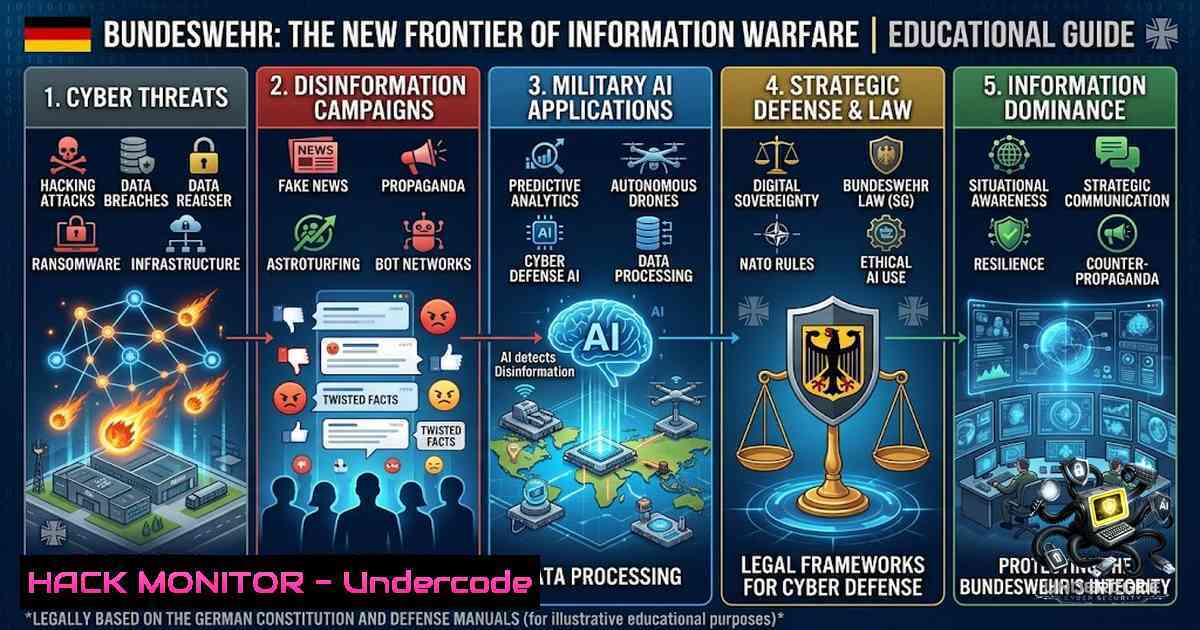
The modern battlefield extends far beyond physical terrains—it rages across social media feeds, comment sections, and digital information ecosystems. Recent disinformation salvos targeting the German Bundeswehr’s disaster relief efforts in Venezuela and the 2021 Ahr Valley floods expose a sophisticated cyber warfare tactic: weaponizing historical narratives to erode public trust in military institutions【1†L4-L7】. As state and non-state actors deploy coordinated fake news campaigns, understanding the intersection of cybersecurity, military AI, and information operations becomes critical for defense professionals, IT security architects, and policymakers alike.
Learning Objectives:
- Objective 1: Analyze the mechanics of disinformation campaigns targeting military institutions and identify indicators of coordinated inauthentic behavior (CIB) across social platforms.
- Objective 2: Master technical countermeasures—including OSINT verification workflows, API-based threat intelligence feeds, and cloud-hardened incident response protocols—to detect and mitigate narrative-based cyber attacks.
- Objective 3: Evaluate the role of AI-driven sentiment analysis and large language models (LLMs) in automating disinformation detection, while understanding the ethical and operational limitations of these tools in military contexts.
- Anatomy of a Disinformation Salvo: From Social Comments to Cyber Warfare
The coordinated attack against the Bundeswehr follows a recognizable pattern: inflammatory comments beneath legitimate posts accuse the military of failing during the 2021 Ahr Valley floods, despite documented evidence of 2,330 soldiers, 300+ vehicles, 12 boats, 10 helicopters, and seven satellite communication systems deployed over 48 days to rescue approximately 150 lives in Ahrweiler and Dernau alone【1†L7-L13】. This tactic—rewriting historical fact to manufacture outrage—serves a dual purpose: degrading domestic trust in national defense institutions while amplifying geopolitical narratives favorable to adversarial states.
From a cybersecurity perspective, these campaigns leverage astroturfing (fake grassroots movements), sock puppet accounts, and coordinated hashtag hijacking (Bundeswehr, Venezuela, Ahrtal). Detection requires monitoring sentiment velocity—the rate at which negative sentiment spikes across previously neutral threads. Security operations centers (SOCs) can implement social graph analysis using Python’s NetworkX library to map account relationships and identify botnets:
import networkx as nx
import pandas as pd
 Load engagement data (mentions, replies, retweets)
df = pd.read_csv('engagement_log.csv')
G = nx.from_pandas_edgelist(df, 'source_account', 'target_account')
 Calculate betweenness centrality to find super-spreaders
centrality = nx.betweenness_centrality(G)
suspicious = [acc for acc, val in centrality.items() if val > 0.8]
print(f"Potential bot accounts: {suspicious}")
Step-by-step OSINT verification workflow for military narrative attacks:
- Collect raw data: Use Twitter API v2 or Reddit’s Pushshift API to pull all comments containing target keywords (Bundeswehr + Ahrtal) within a 72-hour window.
- Account age filtering: Flag accounts created within 90 days of the campaign—legitimate users rarely join platforms solely to comment on niche military topics.
- Content similarity clustering: Apply TF-IDF vectorization and cosine similarity to group near-identical comments (hallmark of copy-paste bot operations).
- Cross-reference with known CIB indicators: Compare against MITRE ATT&CK’s T1568 (Dynamic Resolution) and T1071 (Application Layer Protocol) for command-and-control patterns.
-
Military AI and Predictive Analytics for Crisis Response
The Bundeswehr’s disaster response data—7 satellite communication systems, 3 water treatment plants, and 3,060 tons of material transported—represents a goldmine for training AI models in logistics optimization and resource allocation under extreme conditions【1†L11-L13】. Machine learning algorithms can predict equipment failure rates, optimize convoy routing, and even simulate “what-if” scenarios for simultaneous domestic and international deployments.
For IT professionals, implementing predictive maintenance on military-grade hardware involves:
- Sensor data ingestion: Using MQTT brokers to collect telemetry from vehicles, generators, and communication arrays.
- Anomaly detection: Deploying Isolation Forest or LSTM autoencoders in Python (scikit-learn, TensorFlow) to flag deviations from normal operating parameters.
- Dashboard visualization: Building real-time Grafana panels that integrate with Prometheus metrics from edge devices.
Linux command snippet for monitoring system logs across distributed military nodes:
 Aggregate logs from multiple forward operating bases (FOBs)
journalctl --since "2026-06-27 00:00:00" --until "2026-06-28 23:59:59" \
| grep -E "ERROR|WARNING|CRITICAL" \
| awk '{print $1, $2, $5, $NF}' \
| sort | uniq -c | sort -1r > /var/log/critical_events.log
 Push to centralized SIEM (e.g., Splunk, Elastic)
curl -X POST "https://siem.bundeswehr.intra/ingest" -H "Content-Type: application/json" -d @/var/log/critical_events.log
Windows PowerShell equivalent for incident responders:
Get-WinEvent -LogName System, Application -MaxEvents 1000 | Where-Object { $_.LevelDisplayName -match "Error|Critical" } |
Group-Object ProviderName |
Sort-Object Count -Descending |
Export-Csv -Path "C:\IncidentResponse\critical_events.csv" -1oTypeInformation
3. API Security and Threat Intelligence Integration
Disinformation campaigns often correlate with cyber espionage—adversaries probe military social media accounts for credentials, exploit OAuth misconfigurations, or deploy credential-stuffing attacks against personnel. Securing APIs that expose Bundeswehr operational data (even sanitized versions) requires:
- Zero-trust architecture: Implement mutual TLS (mTLS) with client certificates for all internal microservices.
- Rate limiting: Use Redis-based token buckets to prevent brute-force enumeration of user endpoints.
- API gateway hardening: Configure Kong or NGINX with WAF rules blocking SQLi, XSS, and path traversal attempts.
Example NGINX rate-limiting configuration for a military API:
location /api/v1/intel {
limit_req zone=api_limit burst=20 nodelay;
limit_req_status 429;
proxy_pass https://backend-intel.svc.cluster.local;
proxy_set_header X-Forwarded-For $proxy_add_x_forwarded_for;
}
For threat intelligence sharing, integrate STIX/TAXII feeds from NATO’s Cyber Defence Centre. Automate indicator-of-compromise (IOC) ingestion using Python’s `stix2` library:
from stix2 import TAXIICollectionSource, Filter
import requests
 Fetch latest IOCs from shared intelligence pool
collection = TAXIICollectionSource("https://taxii.nato.int/collection/")
filters = Filter("type", "=", "indicator")
for indicator in collection.query(filters):
print(f"Indicator: {indicator.pattern} - Valid until: {indicator.valid_until}")
4. Cloud Hardening for Military-Grade Data Residency
The Bundeswehr’s disaster response coordination likely involves hybrid cloud environments (e.g., BWI’s Azure Stack or AWS GovCloud). Hardening these deployments against state-level adversaries demands:
- Encryption at rest and in transit: AES-256-GCM for S3 buckets, TLS 1.3 with perfect forward secrecy for all API calls.
- Identity federation: Integrate with Bundeswehr’s PKI using SAML 2.0 or OIDC with strict audience restrictions.
- Immutable backups: Enable S3 Object Lock or Azure Blob immutability to prevent ransomware-induced deletion of critical logistics data.
Terraform snippet for deploying a hardened S3 bucket:
resource "aws_s3_bucket" "bundeswehr_logs" {
bucket = "bw-disaster-logs-${var.environment}"
acl = "private"

versioning {
enabled = true
}

lifecycle_rule {
enabled = true
noncurrent_version_expiration {
days = 90
}
}
}

resource "aws_s3_bucket_public_access_block" "block_public" {
bucket = aws_s3_bucket.bundeswehr_logs.id
block_public_acls = true
block_public_policy = true
ignore_public_acls = true
restrict_public_buckets = true
}
5. Vulnerability Exploitation and Mitigation in Information Operations
Adversaries exploit cognitive vulnerabilities—confirmation bias, authority bias, and negativity bias—rather than code flaws. Mitigation requires adversarial training for military public affairs officers and automated fact-checking pipelines.
Deploying an AI-powered fact-checking bot using HuggingFace’s transformer models:
from transformers import pipeline
 Load pre-trained NLI model for contradiction detection
nli = pipeline("text-classification", model="facebook/bart-large-mnli")
claim = "Bundeswehr did nothing during Ahr Valley floods"
evidence = "2,330 soldiers deployed, 150 lives rescued, 48-day operation"
result = nli(f"{claim} </s></s> {evidence}")
print(f"Entailment score: {result[bash]['score']:.2f}")  High score = claim supported by evidence
For red teaming, simulate disinformation campaigns in controlled sandboxes using GPT-4 or Claude to generate synthetic adversarial content, then train detection models on these datasets.
6. Training Courses and Certification Pathways
Professionals seeking to specialize in military-grade cybersecurity and information warfare should consider:
- SANS SEC530: Defensible Security Architecture – Covers zero-trust implementation for government networks.
- EC-Council’s Certified Threat Intelligence Analyst (CTIA) – Focuses on STIX/TAXII and OSINT methodologies.
- NATO’s Cyber Defence Training Programme – Offers hands-on exercises in red/blue team operations.
- AI for Defense (Carnegie Mellon University) – Addresses LLM security, adversarial ML, and autonomous systems.
Recommended homelab setup for practice:
- SIEM: Elastic Stack (ELK) with custom dashboards for social media ingestion.
- Threat Intelligence: MISP instance with automated feed from AlienVault OTX.
- Cloud: AWS Free Tier or Azure for Students with GuardDuty and Defender enabled.
What Undercode Say:
- Key Takeaway 1: Disinformation is not merely a “communications problem”—it is a cyber weapon that exploits human cognition as the attack surface. Defending against it requires the same rigor as patching zero-day vulnerabilities, including continuous monitoring, threat hunting, and incident response playbooks tailored to narrative-based attacks.
- Key Takeaway 2: The Bundeswehr’s documented disaster response capabilities (2,330 soldiers, 300+ vehicles, satellite comms, water purification) provide empirical data that can be leveraged for AI-driven logistics optimization and predictive maintenance, but this same data must be protected as critical national infrastructure against espionage and manipulation.
- Analysis: The intersection of military operations and information warfare demands a new breed of cybersecurity professional—one fluent in OSINT, cloud security, API hardening, and adversarial ML. As state actors refine their disinformation tactics, NATO and allied nations must invest in joint cyber defence exercises that simulate hybrid attacks combining kinetic threats with digital deception. The Ahr Valley narrative assault is a warning shot; the next campaign may target troop morale, recruitment, or even operational security during actual deployments. Proactive defence means treating every social media comment as a potential IOC and every historical fact as a data point requiring cryptographic verification.
Prediction:
- +1 The integration of AI-driven sentiment analysis into military SOCs will accelerate, with NATO standardizing a Common Disinformation Detection Framework (CDDF) by 2028, enabling real-time cross-border threat intelligence sharing.
- +1 Open-source intelligence (OSINT) tools will become mandatory training for all public affairs officers, reducing response time to narrative attacks from days to minutes through automated claim-verification pipelines.
- -1 Adversarial states will escalate to deepfake-enhanced disinformation, synthesizing fake audio/video of military leaders to manufacture credibility for false narratives, demanding investment in digital forensics and content provenance standards (e.g., C2PA).
- -1 Without sustained funding for cyber defence training and cloud hardening, smaller NATO members remain vulnerable to API-based infiltration and credential theft, potentially exposing troop movements or logistics routes during future crises.
▶️ Related Video (78% Match):
https://www.youtube.com/watch?v=0HYeoNR11RE
🎯Let’s Practice For Free:
🎓 Live Courses & Certifications:
Join Undercode Academy for Verified Certifications
🚀 Request a Custom Project:
Secure, high-velocity infrastructure and disruptive technological engineering. Contact our engineering team for high-tier development and proprietary systems:
[email protected]
💎 Smart Architecture | 🛡️ Secure by Design | ⭐ Trusted by Thousands
IT/Security Reporter URL:
Reported By: Andyartmann Social – Hackers Feeds
Extra Hub: Undercode MoN
Basic Verification: Pass ✅


