Listen to this Post
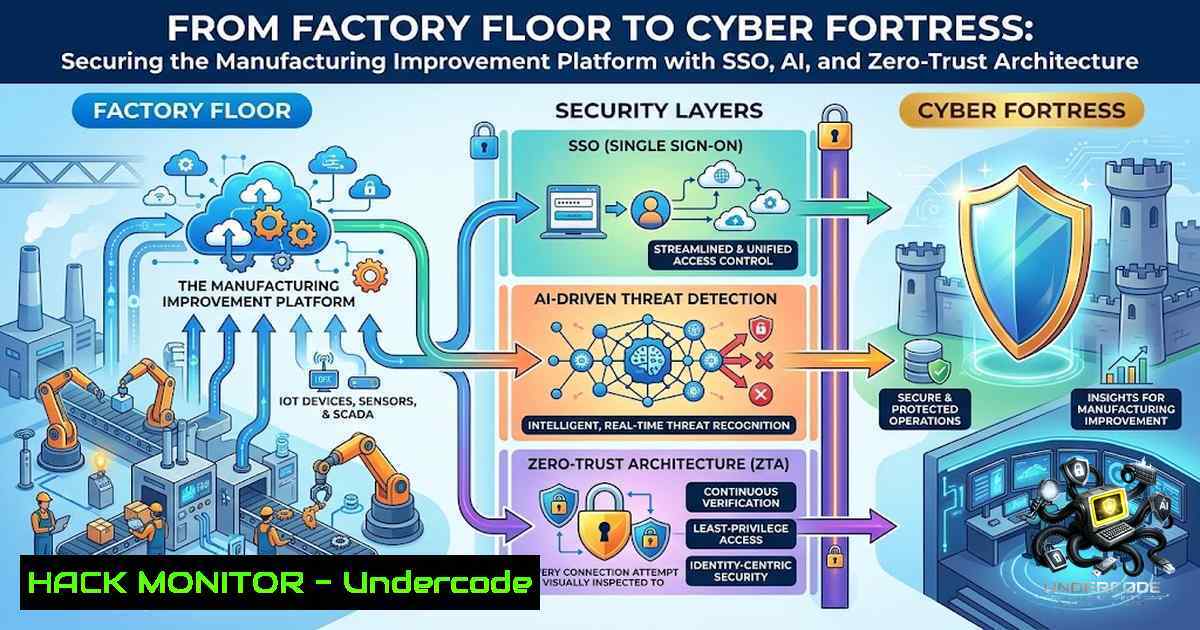
Introduction:
The convergence of operational technology (OT) and information technology (IT) has transformed manufacturing floors into data-rich environments, but this digital evolution introduces a complex attack surface that threat actors are eager to exploit. As manufacturing improvement platforms evolve to incorporate real-time analytics, artificial intelligence, and cloud-based architectures, the imperative to harden these systems against cyber threats becomes as critical as the production metrics they track—because a breach in the platform that monitors OEE and downtime can just as easily become the entry point for ransomware that halts an entire production line.
Learning Objectives:
- Understand how to implement and harden Single Sign-On (SSO) for manufacturing platforms using SAML 2.0, OAuth 2.0, and OpenID Connect (OIDC) to reduce identity-related attack vectors
- Master the configuration of role-based access control (RBAC) and zero-trust principles within industrial software environments
- Learn to secure API endpoints, cloud infrastructure, and data pipelines that power AI-driven manufacturing analytics
- Acquire hands-on commands and scripts for Linux/Windows system hardening, log monitoring, and vulnerability mitigation in OT-connected environments
You Should Know:
- Hardening Single Sign-On (SSO) and Identity Management in Manufacturing Platforms
The post highlights a major upgrade to a web-based client with Single Sign-On capabilities, explicitly citing “lägre IT-administration och bättre cybersäkerhet” (lower IT administration and better cybersecurity). SSO is not merely a convenience feature—it is a foundational security control that reduces password fatigue, eliminates credential reuse, and centralizes authentication policies. However, misconfigured SSO implementations can become single points of failure.
Step‑by‑step guide to implementing and hardening SSO for your manufacturing platform:
- Choose your identity provider (IdP) — Popular enterprise options include Azure AD (Entra ID), Okta, Google Workspace, and JumpCloud. Ensure your IdP supports SAML 2.0 or OIDC.
-
Configure SAML 2.0 federation — On your IdP dashboard, create a new enterprise application. Set the Assertion Consumer Service (ACS) URL to your platform’s SSO endpoint (e.g., `https://yourplatform.goodsolutions.se/sso/saml2`). Define the Entity ID as a unique identifier for your service provider.
-
Map attributes correctly — Ensure the IdP sends the following SAML attributes: `NameID` (user principal name),
email,givenName,surname, and `groups` (for role mapping). Incorrect attribute mapping leads to authentication failures or privilege escalation. -
Enable Just-In-Time (JIT) provisioning — This automatically creates user accounts in the platform upon first successful SSO login, reducing administrative overhead while maintaining security.
-
Implement conditional access policies — Restrict access based on trusted IP ranges, device compliance, and risk signals. For example, block access from non-corporate networks or require multi-factor authentication (MFA) for all users.
-
Monitor SSO logs — Regularly audit authentication logs for anomalies such as failed login bursts, logins from unusual geographies, or after-hours access patterns.
Linux Command for SSO Log Monitoring:
 Monitor authentication logs for failed SSO attempts (SAML assertions)
sudo tail -f /var/log/auth.log | grep -i "saml|sso|authentication failure"

On systems using systemd journal
sudo journalctl -u your-sso-service -f | grep -i "error|failed|denied"
Windows Command for Event Log Analysis:
 Query Security Event Log for failed logons (Event ID 4625) with SSO context
Get-WinEvent -LogName Security | Where-Object { $_.Id -eq 4625 } | Select-Object TimeCreated, Message | Format-List

Monitor for successful SSO logins (Event ID 4624) with elevated privileges
Get-WinEvent -LogName Security | Where-Object { $<em>.Id -eq 4624 -and $</em>.Message -match "SAML" } | Select-Object TimeCreated, Message
2. Securing AI-Driven Data Pipelines and Real-Time Analytics
The post emphasizes using “AI, realtidsdata och kunskapen hos människorna i fabriken” (AI, real-time data, and the knowledge of people in the factory) to simplify understanding of what needs to be done. While AI unlocks predictive maintenance and anomaly detection, it also introduces new attack vectors: data poisoning, model inversion, and adversarial inputs.
Step‑by‑step guide to securing AI and data pipelines in manufacturing environments:
- Encrypt data at rest and in transit — Use TLS 1.3 for all data-in-transit between machines, edge devices, and the cloud platform. For data at rest, implement AES-256 encryption for databases and object storage.
-
Implement data lineage and integrity checks — Use cryptographic hashing (SHA-256) to verify that telemetry data from factory machinery has not been tampered with before it enters the AI pipeline.
-
Sanitize training data — Before feeding production data into AI models, strip sensitive information (PII, proprietary process parameters) and validate input schemas to prevent injection attacks.
-
Deploy model monitoring — Continuously monitor AI model drift and performance degradation. Sudden changes in prediction accuracy may indicate data poisoning or adversarial interference.
-
Restrict API access to AI endpoints — Use API keys with short lifetimes, OAuth 2.0 client credentials, and rate limiting to prevent brute-force or denial-of-service attacks against inference endpoints.
Python Code Snippet for Secure API Call with Token Authentication:
import requests
import hashlib
import hmac
import time

Secure API call with HMAC-SHA256 signature
def secure_api_call(api_url, api_key, secret_key, payload):
timestamp = str(int(time.time()))
signature = hmac.new(
secret_key.encode('utf-8'),
f"{api_key}{timestamp}{payload}".encode('utf-8'),
hashlib.sha256
).hexdigest()

headers = {
'X-API-Key': api_key,
'X-Timestamp': timestamp,
'X-Signature': signature,
'Content-Type': 'application/json'
}

response = requests.post(api_url, json=payload, headers=headers, timeout=10)
return response.json()
- OEE Tracking, Downtime Analysis, and OT Security Hardening
The platform serves approximately 15,000 users across 300 factories, tracking Overall Equipment Effectiveness (OEE), downtime, disturbances, and cycle times. OEE is calculated as Availability × Performance × Quality. Each of these metrics relies on data collected from programmable logic controllers (PLCs), human-machine interfaces (HMIs), and IoT sensors—devices that were traditionally air-gapped but are now increasingly connected to corporate networks and the cloud.
Step‑by‑step guide to securing OT data collection and OEE tracking:
- Segment OT and IT networks — Use VLANs and firewalls to isolate the factory network from the corporate IT network. Implement industrial demilitarized zones (IDMZ) for all data flows between OT and IT.
-
Harden PLC and HMI devices — Change default credentials, disable unused services (Telnet, FTP, SNMP v1/v2), and enable secure logging. Regularly patch firmware according to vendor advisories.
-
Use secure protocols for data collection — Replace insecure protocols like Modbus/TCP (no encryption) with Modbus/TCP Secure (Modbus/TLS) or OPC UA with security enabled.
-
Implement application whitelisting — On Windows-based HMIs and SCADA servers, use AppLocker or Windows Defender Application Control to prevent execution of unauthorized binaries.
-
Deploy endpoint detection and response (EDR) — On all Windows-based OT workstations, deploy EDR solutions with behavioral monitoring to detect ransomware or lateral movement attempts.
Windows PowerShell Script for Auditing OT Device Credentials:
 Audit local user accounts on OT workstations (ensure no default passwords)
Get-LocalUser | Where-Object { $_.Enabled -eq $true } | Select-Object Name, PasswordRequired, PasswordLastSet, LastLogon

Check for insecure services running on OT devices
Get-Service | Where-Object { $<em>.Status -eq 'Running' -and ($</em>.Name -match "telnet|ftp|snmp|rpc") }
Linux Command for Network Segmentation Verification:
 Verify firewall rules isolating OT network (e.g., 192.168.10.0/24) from IT
sudo iptables -L -1 -v | grep -E "192.168.10|FORWARD"

Check for listening ports on OT devices that should be disabled
sudo netstat -tulpn | grep -E ":(21|23|161|445|3389)"  FTP, Telnet, SNMP, SMB, RDP
4. Cloud Infrastructure Hardening for SaaS Manufacturing Platforms
Good Solutions delivers its platform as a SaaS solution, with real-time data collection from factory machinery and cloud-based analytics. Cloud environments are prime targets for credential theft, misconfiguration exploits, and insider threats.
Step‑by‑step guide to hardening cloud infrastructure for manufacturing SaaS:
- Enable cloud-1ative security posture management (CSPM) — Use tools like AWS Security Hub, Azure Security Center, or GCP Security Command Center to continuously monitor for misconfigurations.
-
Implement least-privilege IAM policies — Never use root accounts for daily operations. Create service accounts with minimal required permissions and rotate access keys every 90 days.
-
Enable VPC flow logs and network monitoring — Capture all traffic logs to detect unusual outbound connections, data exfiltration attempts, or communication with known malicious IP addresses.
-
Deploy Web Application Firewall (WAF) — Protect the web-based client from common OWASP Top 10 attacks including SQL injection, cross-site scripting (XSS), and CSRF.
-
Regularly scan for vulnerabilities — Use container scanning (Trivy, Clair) for Docker images and static application security testing (SAST) for code repositories.
AWS CLI Command for IAM Policy Audit:
 List all IAM users and their attached policies
aws iam list-users --query 'Users[].UserName' --output table
aws iam list-attached-user-policies --user-1ame <username>

Check for unused access keys (older than 90 days)
aws iam list-access-keys --user-1ame <username> --query 'AccessKeyMetadata[?CreateDate<=<code>2026-05-06</code>]'
Azure CLI Command for Security Center Recommendations:
 Get security recommendations for your subscription
az security assessment list --query "[?status.code=='Unhealthy']" --output table

Enable just-in-time (JIT) VM access
az security jit-policy create --location <region> --resource-group <rg> --1ame <policy-1ame> --vm-1ames <vm-1ames>
5. API Security and Integration Platform Hardening
The post mentions an “Öppen integrationsplattform” (open integration platform). Open APIs enable seamless connectivity with ERP systems, MES, and CMMS, but they also expand the attack surface. Insecure APIs are now the leading vector for data breaches.
Step‑by‑step guide to securing manufacturing platform APIs:
- Authenticate all API requests — Use OAuth 2.0 with the client credentials grant for machine-to-machine communication. Never use API keys alone without additional signing.
-
Validate all inputs rigorously — Implement JSON schema validation, whitelist acceptable input patterns, and reject unexpected fields to prevent injection attacks.
-
Implement rate limiting and throttling — Protect against brute-force attacks and DoS by limiting requests per API key per time window (e.g., 1,000 requests per minute).
-
Log all API access — Maintain detailed audit logs including timestamp, API key/client ID, endpoint accessed, HTTP method, response status, and payload size.
-
Use API gateways — Deploy an API gateway (Kong, AWS API Gateway, Azure API Management) as a single entry point for all API traffic, enabling centralized authentication, logging, and threat detection.
Python Flask Example for API Rate Limiting and Input Validation:
from flask import Flask, request, jsonify
from flask_limiter import Limiter
from flask_limiter.util import get_remote_address
import jsonschema

app = Flask(<strong>name</strong>)
limiter = Limiter(app=app, key_func=get_remote_address, default_limits=["1000 per minute"])

Define expected JSON schema for OEE data ingestion
oee_schema = {
"type": "object",
"properties": {
"machine_id": {"type": "string", "pattern": "^[A-Z0-9-]+$"},
"availability": {"type": "number", "minimum": 0, "maximum": 1},
"performance": {"type": "number", "minimum": 0, "maximum": 1},
"quality": {"type": "number", "minimum": 0, "maximum": 1},
"timestamp": {"type": "string", "format": "date-time"}
},
"required": ["machine_id", "availability", "performance", "quality", "timestamp"],
"additionalProperties": False
}

@app.route('/api/oee', methods=['POST'])
@limiter.limit("100 per minute")
def post_oee():
data = request.get_json()
try:
jsonschema.validate(instance=data, schema=oee_schema)
except jsonschema.ValidationError as e:
return jsonify({"error": "Invalid input", "detail": str(e)}), 400
 Process OEE data securely...
return jsonify({"status": "accepted"}), 202
6. Vulnerability Exploitation and Mitigation in OT-Connected Environments
The convergence of IT and OT means vulnerabilities in one domain can cascade into the other. Common attack vectors include unpatched Windows-based HMIs, default credentials on PLCs, and insecure remote access solutions.
Step‑by‑step guide to vulnerability assessment and mitigation:
- Conduct regular vulnerability scans — Use tools like Nessus, OpenVAS, or Qualys to scan both IT and OT network segments. For OT, use passive scanning to avoid disrupting production.
-
Prioritize patching based on CVSS scores — Focus on critical (CVSS ≥ 9.0) and high-severity vulnerabilities that are remotely exploitable and have known exploits in the wild.
-
Implement a virtual patch — For legacy OT systems that cannot be patched immediately, use intrusion prevention systems (IPS) or web application firewalls to block known exploit patterns.
-
Test patches in a staging environment — Before deploying patches to production OT systems, validate them in a representative test environment to ensure they do not break critical manufacturing processes.
-
Develop an incident response plan for OT — Include specific procedures for isolating compromised OT devices, reverting to manual operations, and preserving forensic evidence without disrupting production.
Linux Command for Vulnerability Scanning with OpenVAS:
 Install OpenVAS and update vulnerability database
sudo apt-get install openvas
sudo gvm-setup
sudo gvm-start

Run a basic scan on an OT subnet (replace 192.168.10.0/24 with your OT network)
gvm-cli --gmp-username admin --gmp-password <password> socket --socket-path /var/run/gvmd.sock --xml "<create_task><name>OT Scan</name><target><hosts>192.168.10.0/24</hosts></target></create_task>"
7. ISO 27001 Compliance and Information Security Management
Good Solutions is ISO 27001 certified, confirming that its systems and processes meet international information security standards. This certification provides a framework for continuous improvement of the Information Security Management System (ISMS).
Step‑by‑step guide to aligning with ISO 27001 controls:
- Define the scope — Clearly document which systems, processes, and data are covered by the ISMS.
-
Conduct a risk assessment — Identify assets, threats, vulnerabilities, and impacts. Use a risk matrix to prioritize treatment options.
-
Implement controls from Annex A — Key controls include access control (A.9), cryptography (A.10), operations security (A.12), and incident management (A.16).
-
Maintain evidence of compliance — Document all policies, procedures, training records, and audit logs. Conduct internal audits at regular intervals.
-
Engage an external certification body — Undergo a Stage 1 (documentation review) and Stage 2 (implementation review) audit to achieve or renew certification.
Linux Command for Log Retention and Integrity (ISO 27001 A.12.4):
 Configure log rotation to retain logs for at least 90 days
sudo cat > /etc/logrotate.d/security-logs << EOF
/var/log/auth.log /var/log/syslog /var/log/secure {
daily
rotate 90
compress
delaycompress
missingok
notifempty
create 640 root adm
postrotate
/usr/sbin/service rsyslog restart > /dev/null 2>&1 || true
endscript
}
EOF

Generate cryptographic hash of logs for integrity verification
sha256sum /var/log/auth.log > /var/log/auth.log.sha256
What Undercode Say:
- Security is not a feature—it is a prerequisite for digital manufacturing transformation. The integration of SSO, AI, and cloud-1ative architectures in manufacturing platforms demands a security-first mindset from the ground up.
-
The human element remains the weakest link. Even the most sophisticated technical controls can be bypassed through social engineering, credential theft, or insider threats. Continuous security awareness training for all 15,000 users is non-1egotiable.
-
OT security requires a different playbook than IT security. Availability and safety take precedence over confidentiality and integrity in manufacturing environments. Patching, vulnerability scanning, and incident response must be carefully orchestrated to avoid production disruption.
-
Compliance frameworks like ISO 27001 provide structure but not immunity. Certification demonstrates a commitment to best practices, but it does not guarantee security. Continuous monitoring, threat hunting, and adaptive controls are essential.
-
The convergence of IT and OT is irreversible. As manufacturing platforms become more connected and intelligent, security professionals must bridge the gap between these two historically siloed domains. Collaboration between IT security teams, OT engineers, and factory operators is the only path forward.
Prediction:
-
+1 The adoption of SSO and zero-trust architectures in manufacturing will accelerate, driven by both security imperatives and operational efficiency gains. Organizations that embrace these models will experience fewer identity-related breaches and lower administrative overhead.
-
-1 The rise of AI-powered manufacturing analytics will attract sophisticated adversaries who target data pipelines and ML models. Data poisoning attacks and adversarial ML will become tangible threats within the next 18–24 months.
-
+1 ISO 27001 certification will become a baseline requirement for manufacturing software vendors, as large enterprises demand third-party validation of security postures before procurement.
-
-1 Legacy OT devices with hard-coded credentials and unpatched firmware will remain the Achilles’ heel of manufacturing cybersecurity. Until these devices are replaced or properly segmented, they will continue to be exploited in ransomware campaigns.
-
+1 The integration of security into the software development lifecycle (DevSecOps) for manufacturing platforms will mature, with automated SAST, DAST, and container scanning becoming standard practices.
-
-1 The shortage of cybersecurity professionals with OT expertise will persist, creating a talent gap that adversaries will exploit. Organizations must invest in cross-training IT security staff in OT protocols and vice versa.
-
+1 Regulatory frameworks will increasingly mandate cybersecurity standards for critical manufacturing sectors, driving investment in compliance automation and continuous monitoring solutions.
▶️ Related Video (74% Match):
https://www.youtube.com/watch?v=0HTg24UC_gQ
🎯Let’s Practice For Free:
🎓 Live Courses & Certifications:
Join Undercode Academy for Verified Certifications
🚀 Request a Custom Project:
Secure, high-velocity infrastructure and disruptive technological engineering. Contact our engineering team for high-tier development and proprietary systems:
[email protected]
💎 Smart Architecture | 🛡️ Secure by Design | ⭐ Trusted by Thousands
IT/Security Reporter URL:
Reported By: Mikael Persson – Hackers Feeds
Extra Hub: Undercode MoN
Basic Verification: Pass ✅


