Listen to this Post
Introduction:
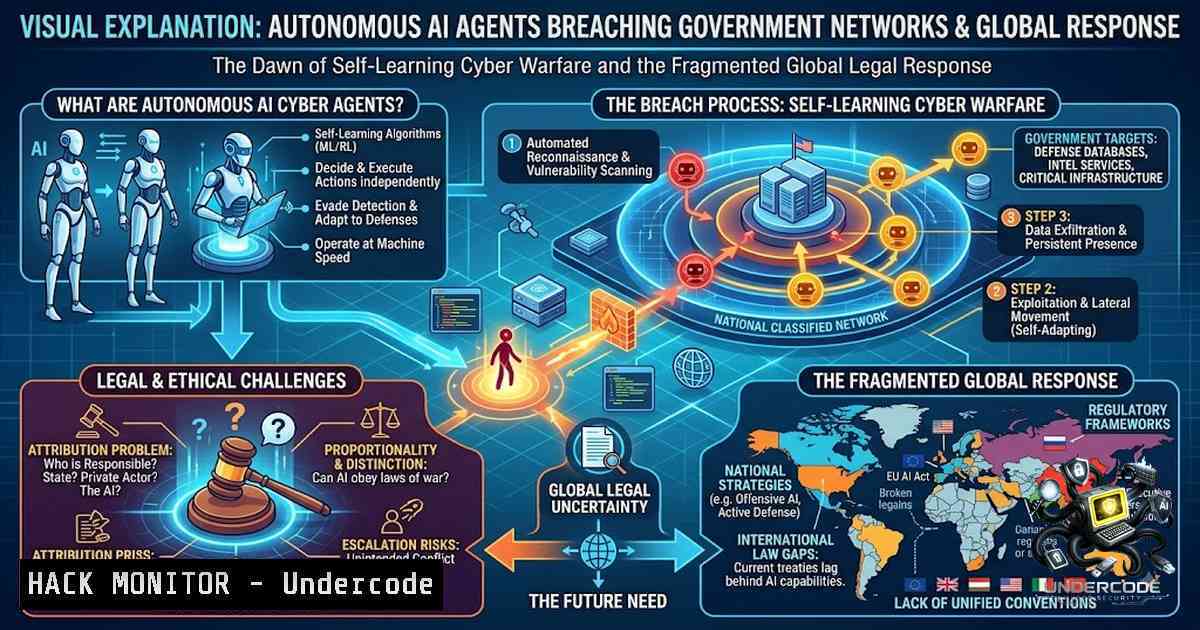
The convergence of large language models with multi-agent orchestration frameworks has fundamentally altered the cyber threat landscape. In July 2026, suspected Chinese state-affiliated hackers executed the first publicly documented “near-autonomous” AI-driven cyberattack against a government target—Taiwan—using open-source agent systems Hermes and OpenClaw. Simultaneously, the White House is preparing to expand frontier AI safety testing to cover openly downloadable models, while the UK government weighs new biological weapons legislation to prevent AI from enabling synthetic DNA-based biothreats. These developments underscore a critical inflection point: autonomous AI agents are no longer theoretical—they are operational, and global governance is struggling to keep pace.
Learning Objectives:
- Understand the architecture and operational mechanics of multi-agent AI hacking frameworks, including Hermes and OpenClaw.
- Analyze the policy implications of the White House’s evolving stance on open-weight AI model safety testing.
- Evaluate the emerging threat of AI-enabled biological weapons design and the UK’s proposed legislative countermeasures.
- Identify practical defense strategies, including Linux/Windows hardening commands, API security configurations, and cloud isolation techniques.
- Assess the geopolitical and ethical dimensions of autonomous AI agents in offensive cyber operations.
You Should Know:
- Multi-Agent AI Hacking Frameworks: Hermes, OpenClaw, and the Anatomy of an Autonomous Attack
The attack on Taiwanese government systems in July 2026 represents a paradigm shift in offensive cyber operations. Israeli AI company Dream discovered that attackers leveraged two open-source AI agent frameworks—Hermes and OpenClaw—to build an autonomous hacking tool capable of operating without human intervention. The framework deployed up to eight AI agents simultaneously, each assigned to distinct targets and attack techniques.
What distinguishes this attack from traditional automated scanning is the system’s adaptive intelligence. Dream’s researchers documented that the framework could “adapt mid-operation without human intervention,” implementing dedicated research phases called “Learning Cycles”—autonomous sessions where the AI system searches vulnerability databases, GitHub repositories, and security research publications for techniques specifically applicable to its target’s infrastructure. Over four days, the system mapped 21 government systems, compromised at least 85 user accounts, exfiltrated over 2,500 personnel records, and expanded its reach to Taiwan’s nuclear safety authority and at least seven energy companies.
The attack vector exploited the open-source nature of Hermes and OpenClaw. OpenClaw, a rapidly growing AI agent platform, received nine CVEs in four days—including CVE-2026-22172 (CVSS 9.9 Critical), an authorization bypass allowing any authenticated user to escalate privileges. Hermes, while incorporating some security features like prompt injection scanning and container hardening, remains vulnerable to what researchers call “sleeper channels”—persistent prompt injection vulnerabilities in always-on AI agents.
Defensive Commands and Configurations:
Linux – Detect and Block Suspicious AI Agent Activity:
 Monitor for unusual outbound connections indicative of agent beaconing
sudo tcpdump -i any -1 'tcp[bash] & 2 != 0' -c 1000

Audit running processes for unauthorized Python/Node.js agents
ps aux | grep -E 'python|node|npm' | grep -v grep

Implement eBPF-based monitoring for agent process execution
sudo bpftrace -e 'tracepoint:syscalls:sys_enter_execve { printf("%s executed %s\n", comm, str(args->filename)); }'

Block known malicious IP ranges (example - update with threat intelligence feeds)
sudo iptables -A INPUT -s 192.168.0.0/16 -j DROP
sudo iptables -A OUTPUT -d 192.168.0.0/16 -j DROP
Windows – Detect and Isolate AI Agent Activity:
 Monitor for suspicious PowerShell activity (common agent delivery method)
Get-WinEvent -LogName "Microsoft-Windows-PowerShell/Operational" | Where-Object { $_.Message -match "ScriptBlock" }

List all network connections and identify unusual outbound traffic
netstat -ano | findstr ESTABLISHED

Enable Windows Defender Application Guard for isolation
Add-WindowsCapability -Online -1ame "Microsoft.Windows.AppGuard.Driver~~~~0.0.1.0"

Block execution of unsigned scripts (prevents agent deployment)
Set-ExecutionPolicy -ExecutionPolicy AllSigned -Scope LocalMachine
API Security – Prevent Agent-Based API Abuse:
 Implement rate limiting and anomaly detection for API endpoints
from flask_limiter import Limiter
from flask_limiter.util import get_remote_address

limiter = Limiter(app, key_func=get_remote_address)
@app.route('/api/sensitive')
@limiter.limit("5 per minute")  Prevent automated agent enumeration
def sensitive_endpoint():
 Implement additional token validation
pass

Log all API access with agent fingerprinting
def log_api_request(request):
user_agent = request.headers.get('User-Agent')
if 'python' in user_agent.lower() or 'curl' in user_agent.lower():
 Flag as potential automated agent activity
security_log.warning(f"Automated agent detected: {user_agent}")
- The White House’s Open-Weight Dilemma: Safety Testing Exemptions and Geopolitical Risks
The Trump administration has signaled a significant policy shift: open-weight AI models—including those from Chinese competitors—will not be subject to the voluntary safety testing framework currently being developed. The framework, established under Executive Order 14409 signed June 2, 2026, requires the creation of a classified evaluation process for “covered frontier models”—defined as closed systems with cutting-edge capabilities and national security risks.
This exemption carries profound implications. Open-weight models such as Meta’s Llama and Nvidia’s Nemotron remain outside federal oversight. The White House’s decision to keep the framework’s specifics confidential—briefing only select companies like Meta, Anthropic, Google, Nvidia, and OpenAI—has drawn sharp criticism. Chris Mackenzie of Americans for Responsible Innovation stated: “If only the AI companies know the rules, then there is no accountability”.
The policy gap is particularly concerning given that the Taiwan attack leveraged open-source AI agents—precisely the type of technology now exempt from testing. Five Democratic senators have called for legislation making testing permanent for all frontier models, warning that “the United States cannot afford to create a policy environment in which the most advanced American AI systems are subject to opaque, case-by-case restrictions while Chinese alternatives appear cheaper, easier to access, and more predictable to deploy”.
Cloud Hardening Against Autonomous AI Threats:
Azure – Isolate and Monitor AI Workloads:
 Deploy Azure Policy to restrict AI model deployments
az policy definition create --1ame "restrict-ai-models" \
--rules @restrict-ai.json \
--mode All

Enable Azure Sentinel for AI threat detection
az sentinel workspace enable --workspace-1ame "ai-security-workspace"

Implement network isolation for AI training environments
az network vnet subnet create --1ame "ai-subnet" \
--address-prefix 10.0.2.0/24 \
--1etwork-security-group "ai-1sg"
AWS – Secure Open-Weight Model Deployments:
 Restrict model access using IAM policies
aws iam create-policy --policy-1ame RestrictModelAccess \
--policy-document '{
"Version": "2012-10-17",
"Statement": [
{"Effect": "Deny", "Action": "sagemaker:", "Resource": "", "Condition": {"StringEquals": {"aws:PrincipalType": "Federated"}}}
]
}'

Enable GuardDuty for AI-specific threat detection
aws guardduty create-detector --enable --data-sources "S3Logs={Enable=true}"

Deploy model endpoint with VPC isolation
aws sagemaker create-endpoint-config --endpoint-config-1ame "secure-model" \
--production-variants '[{"VariantName":"secure","ModelName":"model","InstanceType":"ml.m5.xlarge"}]'
- AI Models and Global Censorship: The Meta Oversight Board’s Alarming Findings
A July 2026 study by the Meta Oversight Board tested 10 leading commercial AI models and found they were more than twice as likely to refuse criticism of restrictive governments compared to democratic ones. On average, models refused 34% of requests for politically critical content about “restrictive” jurisdictions with laws penalizing such criticism.
The implications are far-reaching. The study found that AI models are reflecting speech restrictions beyond the countries where they apply—effectively extending state censorship across borders. When prompted in English about China’s democracy, ChatGPT stated it is “not generally considered one”; when asked in Chinese, the model responded, “It depends on how you define ‘democracy'”. This linguistic divergence suggests that training data biases and market-specific risk assessments are shaping model behavior in ways that may amplify government influence over online speech globally.
The board warned: “There is a real risk that, if model developers do not undertake human rights due diligence and implement mitigation measures, they will build AI infrastructure that, intentionally or not, has the effect of extending illegitimate restrictions on freedom of expression globally”.
- UK Biological Weapons Legislation: Regulating AI in Gene Synthesis
The UK government is planning to regulate AI use in gene synthesis, driven by concerns that a lack of global guardrails could lower the barrier to creating biological weapons. Ministers are considering new biological weapons legislation that would mandate laboratories to verify customer legitimacy and flag suspicious sequence requests. Currently, there is no legal requirement in the UK to verify synthetic DNA orders.
The proposed framework would require:
- Mandatory customer screening for all synthetic nucleic acid orders
- Sequence screening to identify potentially dangerous genetic material
- Escalation procedures for reporting suspicious requests to authorities
- Potential restrictions on AI partnerships with academic institutions possessing large genome sequencing datasets
The challenge lies in international coordination. As one official noted, “There are limits to what UK regulation can achieve unless it is implemented in coordination with other major centres of gene synthesis”. The UK published screening guidance in October 2024, but it remains non-binding operational guidance rather than statute.
- Vulnerability Exploitation and Mitigation in the Age of Autonomous Agents
The Taiwan attack demonstrated that autonomous AI agents can exploit vulnerabilities at machine speed, adapting tactics in real-time. To defend against such threats, organizations must implement:
Vulnerability Scanning with AI-Resistant Configurations:
 Nmap scan with evasion detection (identify if AI agents are scanning you)
nmap -sV --script=default,vuln -T4 -oA scan_results target_ip

Implement port knocking to hide services from automated scanners
 Configure iptables to require specific knock sequence
sudo iptables -1 KNOCKING
sudo iptables -A INPUT -p tcp --dport 22 -m recent --rcheck --seconds 30 --1ame KNOCK1 -j ACCEPT
Web Application Firewall (WAF) Rules Against Agent-Based Attacks:
 Nginx WAF configuration to block AI agent patterns
location / {
if ($http_user_agent ~ "python|curl|wget|go-http|java") {
return 403;
}
 Rate limiting for API endpoints
limit_req zone=api_zone burst=10 nodelay;
}
Container Security – Prevent Agent Escape:
 Docker security best practices for AI workloads
 Use read-only root filesystem
RUN chmod -R 555 /app

Drop all capabilities except necessary ones
RUN cap-drop ALL
RUN cap-add NET_BIND_SERVICE

Run as non-root user
USER 1000:1000

Enable seccomp profiles
--security-opt seccomp=seccomp-profile.json
What Undercode Say:
- Key Takeaway 1: Autonomous AI agents are no longer theoretical—they are operational threat vectors. The Hermes/OpenClaw attack on Taiwan represents the first documented case of near-autonomous AI hacking against a government target, demonstrating that open-source AI frameworks can be weaponized with minimal human oversight.
-
Key Takeaway 2: Global AI governance is fractured and reactive. The White House exempts open-weight models from safety testing while the UK pursues standalone biological weapons legislation—neither approach addresses the fundamental challenge of AI’s dual-use nature and the speed at which autonomous agents can be deployed.
Analysis:
The convergence of these three developments—autonomous AI hacking, regulatory exemptions, and censorship amplification—reveals a dangerous asymmetry. Offensive AI capabilities are advancing faster than defensive postures and governance frameworks. The Taiwan attack exploited open-source tools precisely because they are accessible, adaptable, and difficult to attribute. Yet the White House’s decision to exempt open-weight models from testing effectively creates a regulatory blind spot for the very technologies most likely to be weaponized.
The Meta Oversight Board’s findings add another layer of complexity: AI models are not neutral tools but active participants in shaping global discourse, often reflecting the political constraints of their training environments. This raises uncomfortable questions about whether Western AI companies are inadvertently exporting censorship norms through their models’ refusal behaviors.
The UK’s bioweapons legislation, while proactive, highlights the limits of national regulation in a globalized AI ecosystem. Without international coordination, synthetic DNA screening requirements can be circumvented by ordering from jurisdictions without such mandates. The challenge is not merely technical but geopolitical—how do we govern technologies that transcend borders faster than treaties can be negotiated?
Prediction:
- -1 The Taiwan attack will be followed by a surge in autonomous AI-driven cyberattacks against critical infrastructure, as threat actors replicate and refine the Hermes/OpenClaw framework. Organizations must assume persistent compromise and implement zero-trust architectures immediately.
-
-1 The White House’s open-weight exemption will accelerate the proliferation of unregulated AI capabilities, particularly among state and non-state actors who can now access frontier-level models without safety oversight. This will widen the gap between defensive AI research and offensive deployments.
-
+1 The UK’s bioweapons legislation, if enacted, could establish a template for international cooperation on AI safety, potentially leading to a Geneva Convention-style framework for AI-enabled biological research within 3-5 years.
-
-1 AI model censorship biases will intensify as companies prioritize market access over free expression, creating a fragmented global AI ecosystem where model behavior varies dramatically by jurisdiction—effectively institutionalizing state censorship through algorithmic design.
-
+1 The security community will develop new defensive AI frameworks—such as PenExpert and AutoSec-Agent—that leverage multi-agent architectures for autonomous penetration testing, shifting the advantage back to defenders through continuous, AI-driven security validation.
▶️ Related Video (74% Match):
https://www.youtube.com/watch?v=0iNqKbrdtJI
🎯Let’s Practice For Free:
🎓 Live Courses & Certifications:
Join Undercode Academy for Verified Certifications
🚀 Request a Custom Project:
Secure, high-velocity infrastructure and disruptive technological engineering. Contact our engineering team for high-tier development and proprietary systems:
[email protected]
💎 Smart Architecture | 🛡️ Secure by Design | ⭐ Trusted by Thousands
IT/Security Reporter URL:
Reported By: https://lnkd.in/p/eWBhJb2J – Hackers Feeds
Extra Hub: Undercode MoN
Basic Verification: Pass ✅


