Listen to this Post
Introduction:
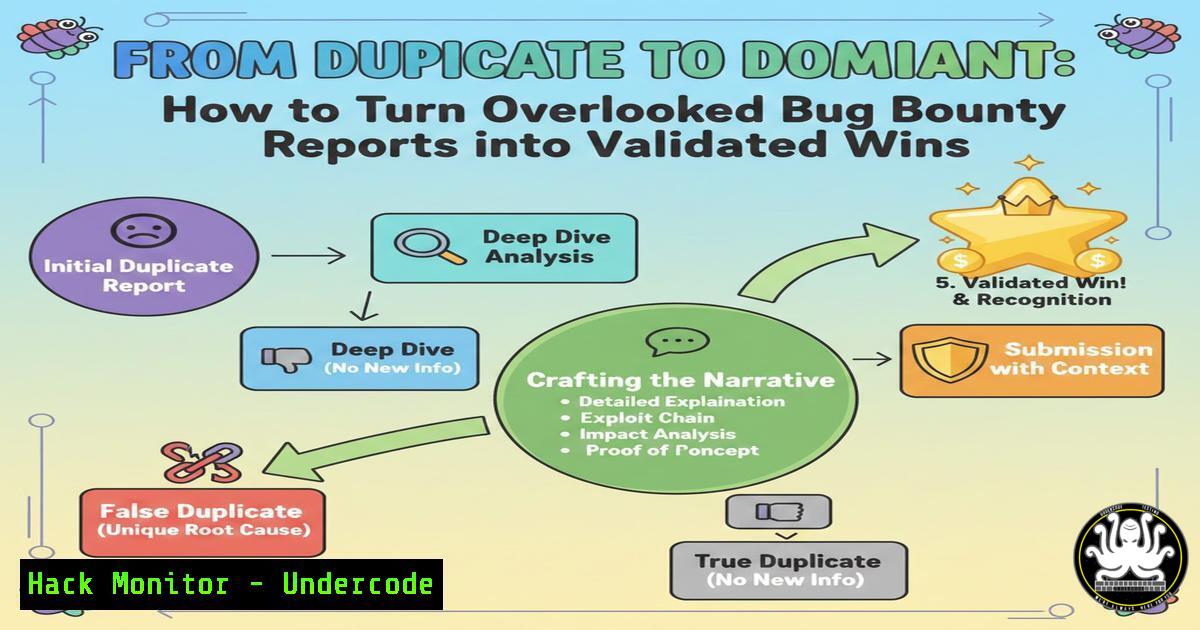
In the competitive arena of bug bounty hunting, discovering a vulnerability only to find it flagged as a duplicate is a common yet frustrating experience. However, as highlighted by security researchers like Youssef Ezzat, a “duplicate” status does not equate to a dead end. This article delves into advanced strategies for transforming seemingly redundant findings into accepted submissions, emphasizing meticulous documentation, exploitation depth, and methodological rigor that can distinguish your report from the initial submission.
Learning Objectives:
- Understand how to analyze and escalate a “duplicate” bug bounty report to an accepted state.
- Learn advanced evidence-gathering techniques, including custom proof-of-concept (PoC) development and environment verification.
- Master the procedural and communication tactics for effectively engaging with security triage teams.
You Should Know:
1. The Anatomy of a Winning Duplicate Report
A duplicate report is often closed because it describes the same root vulnerability as a prior submission. Your goal is to demonstrate a unique angle, greater impact, or a more reliable exploitation path. The first step is a forensic comparison: request details of the original report (if the program allows) or hypothesize the bug class based on the affected component.
Step‑by‑step guide explaining what this does and how to use it.
Step 1: Reconstitute the Target. Use tools like `amass` and `subfinder` to map the asset thoroughly, identifying subdomains or endpoints the initial hunter may have missed.
subfinder -d target.com -o subdomains.txt
amass enum -active -d target.com -o amass_output.txt
Step 2: Analyze the Vulnerability Class. If it’s an SQL Injection marked duplicate, probe for other parameters, HTTP methods (GET, POST, PUT), or API endpoints vulnerable to the same flaw. A tool like `ffuf` can help.
ffuf -w wordlist.txt -u https://target.com/api/FUZZ -X POST -d 'param1=FUZZ¶m2=test' -fr "error"
Step 3: Document the Differentiation. Clearly articulate in your report replay why your finding is distinct—perhaps you found a different affected parameter, a more severe impact (data exfiltration vs. boolean-based detection), or a bypass for a proposed fix.
2. Crafting an Irrefutable Proof-of-Concept
A common reason for duplicate dismissal is an incomplete or theoretical PoC. Your PoC must be executable, safe, and demonstrative of tangible impact.
Step‑by‑step guide explaining what this does and how to use it.
Step 1: Environment Isolation. Use a Docker container to simulate a test environment, ensuring your exploit works reliably without network variability.
docker run --rm -it alpine sh -c "apk add curl && curl -X POST https://target.com/vuln-endpoint --data 'inject=payload'"
Step 2: Escalate the Impact. Move from detection to exploitation. For a Server-Side Request Forgery (SSRF) duplicate, show access to internal metadata services.
POST /fetch_url HTTP/1.1
Host: target.com
Content-Type: application/json

{"url": "http://169.254.169.254/latest/meta-data/iam/security-credentials/"}
Step 3: Visual Evidence. Supplement your PoC code with screenshots, videos, and intercepted HTTP/S requests from tools like Burp Suite. Annotate clearly to show the successful exploitation chain.
3. Leveraging Version History and Source Code Analysis
Many duplicates arise from vulnerabilities in open-source components. Demonstrating the exact commit or library version can prove your instance is unique or shows a broader attack surface.
Step‑by‑step guide explaining what this does and how to use it.
Step 1: Identify Components. Use `wappalyzer` or `builtwith` from the CLI or browser extension to fingerprint technologies.
Step 2: Source Code Recon. If the project is open-source, clone the repository and use `git log` and `git diff` to find unpatched instances.
git clone https://github.com/target/repo.git
cd repo
git log -p --grep="security" --since="2023-01-01"
Step 3: Correlate Findings. Link the vulnerable code path you discovered in the live application to the specific, unpatched version in the repository, proving the issue persists beyond the initially reported instance.
4. The Art of Professional Triage Communication
Communicating with program triagers respectfully and technically is crucial. Your goal is to be a collaborative ally, not an adversarial claimant.
Step‑by‑step guide explaining what this does and how to use it.
Step 1: Structured Follow-up. In your report comment, use a clear format:
1. Thank the triager for their review.
- State you believe this is a distinct case.
- Bullet-point the technical differentiators (different endpoint, higher privilege, new bypass technique).
4. Attach your enhanced PoC.
Step 2: Reference Internal Data. If you have evidence of different user IDs, session cookies, or affected data sets, present them in a table format within the report.
Step 3: Know When to Escalate. If communication stalls, politely inquire about the program’s appeal process. Maintain all technical details in the report portal; avoid direct messages for security and accountability.
5. Post-Acclusion: Building a Hunter’s Knowledge Base
Every duplicate, whether accepted or not, is a learning opportunity. Systematize this knowledge to prevent future duplicates and sharpen your skills.
Step‑by‑step guide explaining what this does and how to use it.
Step 1: Create a Hunting Log. Use a secured note-taking app (e.g., Obsidian with encryption) to record: target, bug class, date, duplicate ID, and your analysis.
Step 2: Conduct a Retrospective. For each duplicate, ask: Could my recon have been broader? Was my PoC the best it could be? What unique angle did I miss?
Step 3: Automate Differentiation Checks. Write simple scripts to check if your discovered endpoints or parameters differ from common wordlists.
import requests
my_findings = ["/api/v2/user/export", "/admin/backup"]
common_list = ["/api/v1/user/export", "/admin/log"]
unique = list(set(my_findings) - set(common_list))
print(f"Unique endpoints: {unique}")
What Undercode Say:
- Depth Trumps Discovery. The initial finder gets the reward, but the researcher who provides the deeper exploitation path, demonstrates wider impact, and documents it professionally often wins the trust of the program and paves the way for future, non-duplicate acceptances. This shifts the hunter’s mindset from being a mere vulnerability scanner to a security analyst.
- The “Duplicate” is a Starting Line, Not the Finish. Treat every duplicate notification as a challenge to refine your methodology. The most successful hunters systematize their process—from automated recon and differential analysis to professional communication—turning a perceived setback into a skill-building exercise that inevitably leads to more valid, unique findings.
Prediction:
The bug bounty ecosystem will increasingly leverage AI to perform initial triage and duplicate detection. This will raise the bar for hunters, making shallow reports even less likely to be accepted. However, it will also create opportunities for researchers who master the skills outlined above—deep technical analysis, sophisticated PoC development, and clear documentation. The future will favor the strategic hunter who can collaborate with AI-driven triage by providing the contextual nuance and exploitation proof that algorithms cannot deduce alone, solidifying their role as an essential component of the security posture.
▶️ Related Video (80% Match):
🎯Let’s Practice For Free:
IT/Security Reporter URL:
Reported By: Youssef Ezzat2025 – Hackers Feeds
Extra Hub: Undercode MoN
Basic Verification: Pass ✅


